On this page · 8 sections
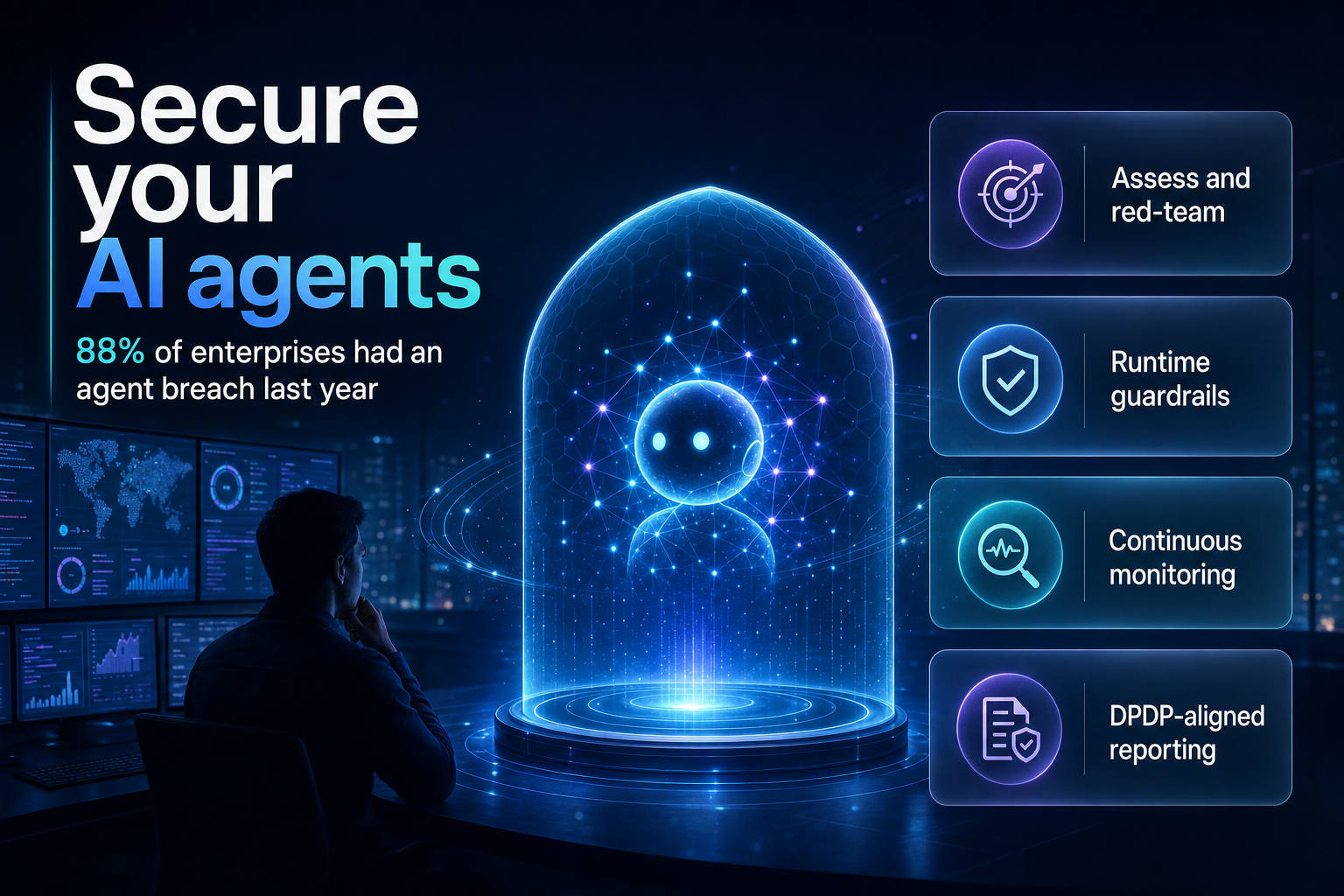
Summary. Enterprises are shipping AI agents faster than they are securing them, and the numbers show the cost of that gap. In 2026, 88% of organizations reported at least one AI agent-related breach in the prior year, with data leakage and input manipulation the most common. A Cloud Security Alliance survey found 82% of enterprises have unknown AI agents in their environments, and while 72% of organizations are deploying or scaling agents, only 21% have a mature governance model. The market is responding: agentic AI security is projected to grow from $1.65 billion in 2026 to $13.52 billion by 2032, a 42% annual rate. In India the average data breach already costs a record ₹220 million. eCorpIT's AI agent security and guardrails service exists to close the gap between deploying agents and running them safely, with discovery, red teaming, guardrails, runtime monitoring, and compliance reporting. This article explains the risk, what a real engagement looks like, and how to start.
We build production AI agents ourselves, so the security work is grounded in how agents actually fail, not a checklist bought off a shelf.
The gap between deploying agents and securing them
Agents are different from ordinary software because they act. They call tools, move data, and often execute code, which opens attack surfaces that traditional application security was never designed to cover, such as prompt injection and excessive agency. The result is a widening gap between adoption and control, and the survey data is stark.
| Signal | 2026 figure | What it means |
|---|---|---|
| Deploying or scaling agents | 72% of organizations | Adoption is mainstream |
| Had an AI agent breach in the past year | 88.4% | Incidents are near-universal |
| Have unknown agents in their environment | 82% | Shadow agents are everywhere |
| Have a mature governance model | 21% | Control lags far behind adoption |
| Have a named person accountable for agents | 7.2% | Ownership is largely missing |
Those figures come from NeuralTrust's 2026 survey of 160 CISOs, a Cloud Security Alliance study on unknown agents, and a VentureBeat security survey on the enforcement gap. The through-line is that scaling AI safely is harder than deploying it, and most teams have not caught up.
The threat is not theoretical. This year an AI agent chained a single framework flaw into a full ransomware campaign, which we covered in our analysis of the JADEPUFFER attack, and exposed AI tools like Langflow have been exploited repeatedly. Automated attackers make even small, low-value agents worth targeting.
What eCorpIT's AI agent security service covers
Our service is built around how agents behave in production. It is not a one-off scan; it is a structured engagement that leaves you with hardened agents, working guardrails, and evidence you can show an auditor or regulator.
| Phase | What we do | Outcome |
|---|---|---|
| Discovery | Inventory every agent, including shadow deployments | You know what you actually run |
| Assessment and red teaming | Probe for prompt injection, data leakage, excessive agency | A ranked list of real weaknesses |
| Guardrails | Add least-privilege scoping, input and output filtering, human approval | Unsafe actions blocked in real time |
| Runtime monitoring | Log and watch agent actions for drift | Fast detection when behavior changes |
| Compliance and reporting | Map controls to DPDP and OWASP guidance | Audit-ready evidence |
This mirrors the accepted structure of AI security work in 2026: identify where AI is used, assess the boundary, test likely attacks, enforce controls, monitor behavior, and preserve evidence. Red teaming combines automated tooling with expert testers who craft scenarios from real adversary tactics, and it runs before and after deployment because every model update or prompt change can reopen a hole. The guardrail and governance layers connect directly to the controls in our AI agent security and prompt-injection guide and enterprise AI agent governance guide.
A market that reflects real, urgent demand
If this reads like a niche concern, the spending says otherwise. The agentic AI security market is forecast to grow from $1.65 billion in 2026 to $13.52 billion by 2032 at a 42% compound annual rate, and the narrower AI red teaming services market is projected to rise from $1.75 billion in 2025 to $2.26 billion in 2026. That growth is driven by adversarial attacks, model manipulation, and expanding compliance requirements in regulated sectors. Buyers are converging on the same needs: prompt security, guardrails, red teaming, and continuous monitoring, with human-in-the-loop review becoming standard.
Engagements are not one-size-fits-all, so we offer a few shapes depending on where you are.
| Engagement | What is included | Best for |
|---|---|---|
| One-time security assessment | Discovery plus red teaming and a fix plan | Teams with agents already live |
| Guardrail implementation | Building and wiring runtime controls | Teams that know their gaps |
| Managed monitoring | Ongoing runtime watch and re-testing | Agents that change often |
| Compliance readiness | DPDP and CERT-In aligned design and evidence | Regulated or India-based firms |
| Incident-response support | Containment and reporting help | Teams responding to an event |
Honest scope: what we build, and what we do not claim
We are specific about what this service is. We design and harden agent systems and align deployments with DPDP, CERT-In, and OWASP guidance. We do not claim to make you "compliant" with a stamp, because compliance is an ongoing posture, not a certificate we can grant. We use verified controls and real testing rather than promises. eCorpIT is a Gurugram-based technology organization, founded in 2021, assessed at CMMI Level 5, and an MSME, with senior-led, multi-disciplinary teams. We partner with providers including AWS, Microsoft, Google, and Kaspersky. Because our engineers ship production AI agents, the security recommendations are ones we apply to our own work.
India-specific considerations
For Indian enterprises, AI agent security and data-protection duties are now one conversation. An agent incident that exposes personal data triggers the DPDP obligation to report to the Data Protection Board within 72 hours, alongside the CERT-In duty to report cyber incidents within 6 hours. With the average Indian breach at ₹220 million and the DPDP framework moving toward full enforcement around 13 May 2027, the cost of an unmanaged agent is rising and the runway to prepare is finite. We design deployments so that logging, access control, and data handling make an incident containable and reportable, and we help teams in Gurugram, Delhi NCR, and across India build the muscle before they need it.
FAQ
How eCorpIT can help
If you are deploying AI agents and are not sure they are safe, eCorpIT can help. Our senior-led teams run discovery and red teaming to find your real weaknesses, implement least-privilege guardrails and runtime monitoring, and design your deployment aligned with DPDP, CERT-In, and OWASP guidance. We work from one-time assessments through fully managed monitoring, sized to your estate. Talk to our team to scope an AI agent security review.
References
_Last updated: 12 July 2026._