On this page · 15 sections
- Pattern 1: Strangler fig replacement
- Pattern 2: Branch by abstraction
- Pattern 3: Anti-corruption layer
- Pattern 4: Golden paths on an internal developer platform
- Pattern 5: DORA-metric guardrails
- Putting the playbook together
- A worked example: strangling a checkout monolith
- Common failure modes
- Where AI fits in modernization
- Sequencing a year of modernization
- India-specific considerations
- Where to start
- FAQ
- How eCorpIT can help
- References
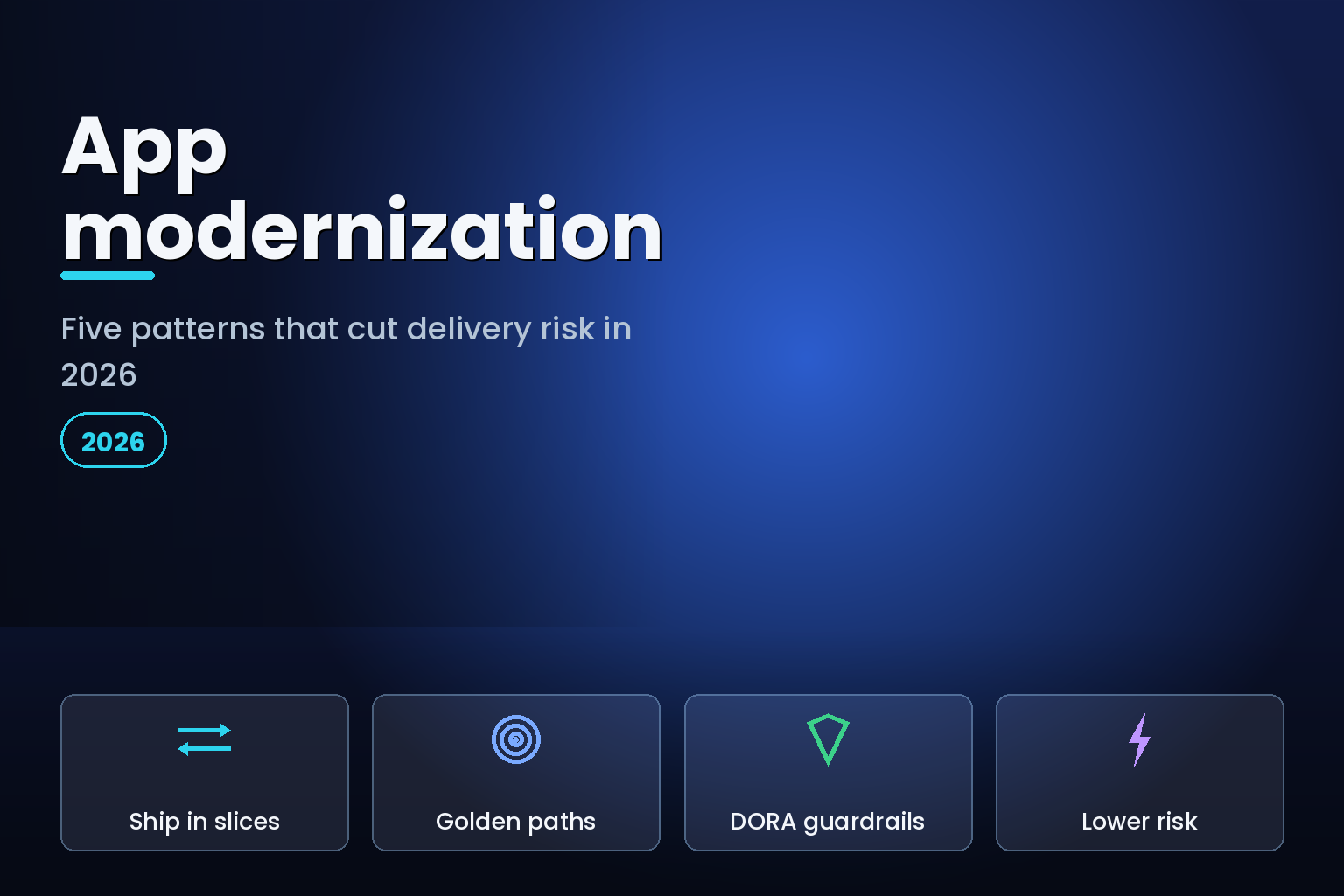
Summary. Most modernization projects fail on delivery risk, not technology. The platform engineering market that underpins safer delivery is worth USD 10.44 billion in 2026 and growing near 25% a year, and Gartner expects 80% of large software organisations to run platform engineering teams by 2026, up from 45% in 2022. Yet fewer than 30% will see measurable productivity gains, because a platform team is not the same as a platform that works. The five patterns below cut delivery risk directly: strangler fig replacement, branch by abstraction, an anti-corruption layer, golden paths on an internal developer platform, and DORA-metric guardrails. Teams on mature internal platforms report 30% to 50% shorter lead times for new services. Here is the playbook.
Delivery risk is the chance that a change breaks production, slips its date, or stalls a release. Modernization concentrates that risk, because you are changing a running system that the business depends on. The patterns here share one idea: shrink the size of each change and make every step reversible, then let a platform make the safe path the default. None of them is new, but together they are the difference between a modernization that ships value monthly and one that disappears into a multi-year rewrite. For the AI-architecture side of modern stacks, see our guide to generative AI enterprise strategy.
| Pattern | What it does | Delivery risk it cuts |
|---|---|---|
| Strangler fig | Replace a legacy system in slices behind a façade | Big-bang failure, long time-to-value |
| Branch by abstraction | Change behind an abstraction, switch when ready | Long-lived branches, risky merges |
| Anti-corruption layer | Isolate new code from the legacy model | Coupling and data drift during coexistence |
| Golden paths | Paved, supported defaults on a platform | Variance, unsafe one-off setups |
| DORA guardrails | Measure flow and stability, gate on signals | Blind releases, slow recovery |
Pattern 1: Strangler fig replacement
The strangler fig is the backbone of low-risk modernization. You put a façade in front of the legacy system, then replace functionality one slice at a time, routing each request to either the old system or a new service until the old one is gone. The existing application keeps working throughout, as both Microsoft's Azure Architecture Center and AWS Prescriptive Guidance describe.
The reason to prefer it is risk, not elegance. As software architect Martin Fowler, who named the pattern, put it: "The most important reason to consider a strangler fig application over a cut-over rewrite is reduced risk. A strangler fig can give value steadily and the frequent releases allow you to monitor its progress more carefully." The numbers back the instinct. A big-bang rewrite can run two to four years before its first release, while a strangler fig delivers value with the first migrated service, even though fully replacing a large monolith still takes two to five years.
| Aspect | Big-bang rewrite | Strangler fig |
|---|---|---|
| Time to first value | 2 to 4 years | The first migrated slice |
| Total timeline | One long cutover | 2 to 5 years, value throughout |
| Rollback | All or nothing | Per slice |
| Risk per change | High, concentrated | Low, isolated |
| Business disruption | Large at cutover | Minimal, continuous |
Pattern 2: Branch by abstraction
Strangler fig handles the system boundary; branch by abstraction handles change inside a codebase. You introduce an abstraction over the part you want to change, build the new implementation behind it while the old one still serves traffic, and switch over when the new path is ready, often behind a feature flag. The point is to keep changes integrated in the main line rather than in a long-lived branch that becomes a risky merge later.
Paired with progressive delivery, where you release to a small percentage of traffic first and watch the signals, this pattern separates deploy from release. Code can ship to production turned off, then be enabled gradually. That separation is one of the strongest levers on delivery risk, because a bad change is caught at 1% of traffic, not at 100%.
Pattern 3: Anti-corruption layer
The hardest part of any strangler migration is the coexistence phase, when old and new run together and must agree on data. The primary technical challenge is maintaining data consistency between the systems, so the pattern that protects you is the anti-corruption layer: a translation boundary that keeps the legacy data model from leaking into your new services. New code talks to a clean interface, and the layer maps between it and the legacy model.
Without this boundary, the legacy schema's quirks spread into the new system, and you finish the migration with a fresh codebase that has inherited the old one's constraints. With it, each new service stays decoupled, which keeps changes isolated and diagnosable, exactly the property that lowers risk during a long coexistence.
Pattern 4: Golden paths on an internal developer platform
Patterns one to three are architecture. Pattern four is how you make them repeatable at scale. An internal developer platform provides golden paths, the paved, supported defaults for building, testing, and shipping a service, so teams do not reinvent pipelines, infrastructure, and guardrails for every modernization slice. This is where platform engineering earns its place: it turns good patterns into the path of least resistance.
The market reflects the shift, with the platform engineering and internal developer platform space worth USD 10.44 billion in 2026 per Mordor Intelligence, and Gartner forecasting that 80% of large software organisations will have platform teams by 2026. The warning is in the same data: fewer than 30% will see measurable productivity gains. A platform only cuts risk if it is run as a product, with golden paths people actually adopt, not a mandatory tool nobody likes.
Pattern 5: DORA-metric guardrails
The fifth pattern is measurement, because you cannot manage delivery risk you cannot see. The DORA metrics, deployment frequency, lead time for changes, change failure rate, and time to restore service, give you a read on both speed and stability, and DORA's 2025 research found that platform quality is one of the capabilities that most amplifies the positive effect of AI on performance, as platform engineering maturity research reports. Teams on mature internal platforms report 30% to 50% reductions in lead time for new services.
Use the metrics as guardrails, not a scoreboard. Gate a risky release on a healthy change-failure rate, watch lead time to catch a process that is silently slowing, and treat a rising time-to-restore as a signal to invest in recovery. Modern platforms increasingly build in two more guardrails at the same point: FinOps cost visibility before deploy rather than after the invoice, and security as a built-in platform capability rather than a late review, with platform engineering trend analysis noting that 73% of platform teams now ship AI assistants alongside these.
Putting the playbook together
The five patterns are layers of one approach. Strangler fig and the anti-corruption layer shrink and isolate change at the system boundary. Branch by abstraction and progressive delivery shrink and isolate change inside the code. Golden paths make the safe versions of all of that the default, and DORA guardrails tell you whether it is working. Adopt them in that order if you are starting cold: get one slice of a legacy system behind a façade, prove the pattern, then invest in the platform that makes the second and tenth slices routine.
The trap to avoid is buying the platform first. The data is blunt that most organisations will have a platform team but not the productivity gains, because they built a platform before they had the patterns it was supposed to pave. Patterns first, then the platform that scales them.
A worked example: strangling a checkout monolith
Make the pattern concrete with a common case: a legacy checkout monolith that handles cart, pricing, payment, and order history in one deployable. A big-bang rewrite would try to replace all four at once and risk the revenue path on a single cutover. The strangler approach starts by putting a façade, often an API gateway or reverse proxy, in front of the monolith so every request flows through a point you control. Nothing changes for users yet, but you now have the switch.
You then pick the lowest-risk, highest-learning slice, usually order history, because it is read-heavy and off the payment path. You build a new order-history service, route only that traffic to it through the façade, and keep an anti-corruption layer translating between the new service and the monolith's data. Once it is stable, you take the next slice. Pricing and payment come last, because they carry the most risk, and by then the team has proven the pattern on safer ground. The monolith shrinks slice by slice until it can be retired. At no point is the whole checkout flow at risk, and at every point you are shipping.
Common failure modes
Even with the right patterns, modernization fails in predictable ways, and naming them helps you avoid them. The first is the façade that becomes permanent: teams add the proxy, migrate two easy slices, then stop, leaving a half-strangled system more complex than either the old or the new design. Set a finish line and track the percentage of traffic still hitting the legacy path. The second is the anti-corruption layer that leaks: under deadline pressure, teams let the legacy model bleed into the new services, and the new code inherits the old constraints. Treat the boundary as non-negotiable. The third is the data-consistency gap during coexistence, where old and new disagree about state; this is the hardest part technically, so design the synchronisation and the source of truth before you split the slice, not after.
The fourth failure mode is organisational: building the platform before the patterns. A platform team that has not actually run a strangler migration tends to pave the wrong paths, which is part of why fewer than 30% of organisations with platform teams report real productivity gains. Earn the patterns on a real migration first, then encode what worked into golden paths.
Where AI fits in modernization
AI now sits inside the platform, not beside it. Platform teams increasingly ship AI assistants as part of the developer experience, with trend analysis reporting that 73% of platform teams now do so, and DORA's 2025 research found that AI's benefit depends far more on the quality of the surrounding system than on any single tool. The implication for modernization is specific: an AI assistant can accelerate the repetitive parts of a strangler migration, such as generating anti-corruption mappings, drafting tests for a migrated slice, or summarising a legacy module's behaviour, but only if the platform around it is sound. Bolting an assistant onto a chaotic delivery system mostly speeds up the chaos.
The safe way to add AI is to treat it as another capability on the golden path: available, governed, and measured by the same DORA signals you use for everything else. Used that way, it shortens the slow steps of modernization without adding a new source of delivery risk.
Sequencing a year of modernization
A realistic first year has a shape. The first quarter is one façade and one shipped slice, to prove the pattern and build trust. The second quarter adds branch by abstraction and progressive delivery so in-code change gets safer, and hardens the anti-corruption layer as more slices land. The third quarter is where a platform investment pays off, encoding the now-proven patterns into golden paths so other teams can follow without re-deriving them. The fourth quarter is measurement and tuning: wire DORA metrics into release decisions, add FinOps and security guardrails at provisioning, and report lead-time and change-failure trends to leadership. The point is steady, compounding progress, not a heroic cutover.
India-specific considerations
For Indian engineering leaders, modernization risk often meets cost and compliance pressure at once. A big-bang rewrite that runs two to four years before its first release is a hard budget to defend in rupees, which is why the incremental patterns matter commercially as well as technically. The platform layer also helps with the Digital Personal Data Protection Act 2023 (DPDP): golden paths can bake in data-handling defaults, so every new service inherits compliant logging, retention, and access controls instead of each team improvising.
The cost guardrail is the other India point. FinOps visibility at provisioning time keeps cloud spend predictable as you modernise, which matters when budgets convert from dollar-priced cloud services into rupee P&Ls. We design platform and modernization programmes that keep delivery risk low and align with DPDP requirements across AWS, Microsoft, and Google. For the strategy frame, see our guide to generative AI enterprise strategy.
Where to start
Pick one painful, well-bounded slice of a legacy system and put it behind a façade this quarter, because nothing builds confidence like a shipped strangler slice. Add a feature flag so deploy and release are separate. Stand up an anti-corruption layer before the coexistence phase bites. Only then invest in golden paths, and instrument everything with DORA metrics so you can prove the risk came down. Modernization is not a single project; it is a habit of small, reversible, measured changes, and the platform is what makes that habit cheap to keep.
FAQ
How eCorpIT can help
eCorpIT (eCorp Information Technologies Private Limited) is a Gurugram-based, CMMI Level 5 technology organisation whose senior engineering teams run modernization and platform programmes. We help teams plan strangler-fig migrations, build anti-corruption layers, stand up internal developer platforms with golden paths, instrument DORA metrics, and design applications aligned with DPDP requirements across AWS, Microsoft, and Google. Read more about us, or contact our team to plan a low-risk modernization.
References
- Martin Fowler, Strangler Fig Application, martinfowler.com.
- Microsoft Learn, Strangler Fig Pattern, Azure Architecture Center, 2026.
- AWS Prescriptive Guidance, Strangler fig pattern, 2026.
- Thoughtworks, Embracing the Strangler Fig pattern for legacy modernization, 2026.
- Growin, Platform Engineering in 2026: 5 Shifts Driving the Rise of Internal Developer Platforms, 2026.
- LeanOps, Platform Engineering Trends 2026: 11 Key Shifts, 2026.
- Platform Engineering, Platform engineering maturity in 2026: What the data tells us, 2026.
- Mordor Intelligence, Platform Engineering and Internal Developer Platform (IDP) Market, 2026.
- DEV Community, Platform Engineering in 2026: The Numbers Behind the Boom, 2026.
- Curotec, Modernizing a Legacy Application Using the Strangler Fig Pattern, 2026.
- Dignitas Digital, Application Modernization with Strangler Fig Pattern, 2026.
_Last updated: June 22, 2026._