On this page · 9 sections
Summary. Custom web applications in India, meaning internal tools, dashboards, booking systems and customer portals, run ₹5,00,000 to ₹30,00,000 in 2026, roughly $6,000 to $36,000. Simpler work starts lower: a business web app with CRM integration lands at ₹1,00,000 to ₹2,00,000, and a standard multi-tenant SaaS platform with subscription billing and user roles at ₹3,00,000 to ₹8,00,000. Indian teams charge about $15 to $35 per hour against $100 to $200 in the US, a 60% to 75% saving when the partner is chosen well. The first-year total runs 25% to 30% above the initial quote once hosting at ₹2,000 to ₹25,000 a month and annual maintenance at 15% to 20% of build cost are counted. The average enterprise now runs an estimated 699 unintegrated applications. Cost is the easy question. Whether to build at all is the one worth answering first.
When building is the right answer
Most custom builds should not happen. The three signals that justify one are specific and testable, which is what makes them useful.
| Signal | Buy SaaS if... | Build custom if... |
|---|---|---|
| Data model | Your entities fit the vendor's schema | There is a structural mismatch you keep working around |
| Workflow | Your process resembles everyone else's | The workflow is itself the product, and it differentiates you |
| Vendor headroom | You use a fraction of what you bought | You have customised a SaaS vendor to its ceiling |
| Integration count | The tool talks to two or three systems | The tool sits at the centre of many, in a way no vendor anticipated |
| Data ownership | Vendor terms match your obligations | Residency or retention rules the vendor cannot meet |
If none of those describe you, buy the SaaS. A custom build to replace a tool that fits is expensive theatre.
If one of the first three describes you, the cost objection is weaker in 2026 than it was three years ago. The rates moved and the tooling improved. A workflow that is genuinely differentiated, running on a data model that will not fit a vendor's schema, is a build.
There is a trap on the other side too. For a genuine web application or product, templates become expensive through technical debt. Their rigid structure costs more over time than the licence saved up front. The template is cheap in month one and costs you in year two.
What it costs
| Application type | Indicative cost | Note |
|---|---|---|
| Simple MVP web app | From ₹50,000 | The floor, not a business system |
| Business web app with CRM integration | ₹1,00,000–₹2,00,000 | One integration, standard flows |
| SaaS or marketplace | ₹3,00,000–₹6,00,000 | Multi-tenant basics |
| SaaS platform with billing and roles | ₹3,00,000–₹8,00,000 | Subscription billing, user roles, core feature set |
| Custom internal tool, dashboard or portal | ₹5,00,000–₹30,00,000, about $6,000–$36,000 | The band most business systems land in |
| Overall web application range | ₹75,000–₹10,00,000 by complexity and stack | Wide because it spans very different products |
| SaaS MVP | ₹15,00,000–₹40,00,000 | A product, not an internal tool |
Indian engineering rates run about $15 to $35 per hour against $100 to $200 per hour in the US, which is where the 60% to 75% saving comes from. The saving is real and it is conditional on picking a partner with delivery discipline, because a cheap rate on a rebuilt project is not a saving.
The costs the quote leaves out
This is where budgets break, and none of it is exotic.
| Item | Typical cost | Timing |
|---|---|---|
| Hosting | ₹2,000–₹25,000 per month | Ongoing from launch |
| Annual maintenance | 15%–20% of build cost per year | Every year, forever |
| Payment gateway fees | Per transaction | Scales with success |
| SMS and WhatsApp API | Per message | Scales with users |
| Domain renewal and SSL | Small but recurring | Annual |
| First-year total | Budget 25%–30% above the initial quote | Plan for it at approval, not at renewal |
The 15% to 20% annual maintenance line is the one that should shape the decision rather than merely the budget. A ₹20,00,000 build carries ₹3,00,000 to ₹4,00,000 a year of maintenance before anyone asks for a new feature. Over five years that is another build. If you would not fund that, do not start.
Budget 25% to 30% above the quote for the first year. Every team that skips this discovers it in month nine.
The AI-readiness argument that changed the calculation
The reason to replace spreadsheets in 2026 is different from the reason in 2023, and it is the most interesting shift in this space.
Legacy files are dark data. A spreadsheet on a shared drive is invisible to the autonomous agents businesses now use for procurement, support and logistics. You cannot point an agent at a process that lives in a workbook somebody emails around. The data has to be in a system with an API before any agent can touch it.
The supporting numbers are unflattering. Per the 2026 Spreadsheet Software Market Report, 68% of businesses lose productivity to manual data reconciliation, finance teams spend 15 hours weekly fixing spreadsheet discrepancies, and 78% of compliance officers prioritise role-based access control and encryption over cost. Fifteen hours a week is most of a full-time role, spent on reconciliation that exists because the data lives in the wrong place.
And the integration surface is worse than most teams believe: an estimated 699 unintegrated applications in the average enterprise in 2026. That is the real problem a custom internal tool solves. Not a prettier interface. A place where the process actually lives.
The tool is not the point. The API is.
Rebuild is rarely the right R
When the system already exists, you have seven options, and teams reach for the most expensive one too readily.
| Option | What it means | When it fits |
|---|---|---|
| Rehost | Move infrastructure, no code changes | Time pressure; the code is fine, the hosting is not |
| Replatform | Move with targeted improvements | Modest wins available cheaply |
| Refactor | Restructure code without changing behaviour | The logic is right, the structure is not |
| Rearchitect | Redesign the architecture, often to a modular monolith in 2026 rather than microservices | Scale or team-structure problems the current shape cannot hold |
| Rebuild | Start over, preserving business logic | The logic is worth keeping; nothing else is |
| Repurchase | Replace with SaaS | Your process is not differentiated after all |
| Retire | Decommission | Nobody has used it in a year and nobody will say so |
Two things worth noting. Rearchitecting in 2026 often means a modular monolith rather than microservices, which is a correction on the last decade's default. And retire is a real option that gets skipped because it is nobody's project. Our guides on monolith to microservices modernisation and platform engineering modernisation patterns go deeper on the middle rows.
How we build web applications
eCorpIT is a CMMI Level 5 certified, MSME-registered technology organisation founded in 2021 and based in Gurugram, and a partner of AWS, Microsoft, Google, Shopify and Kaspersky. Our web work runs through senior-led, multi-disciplinary teams.
The process, honestly described.
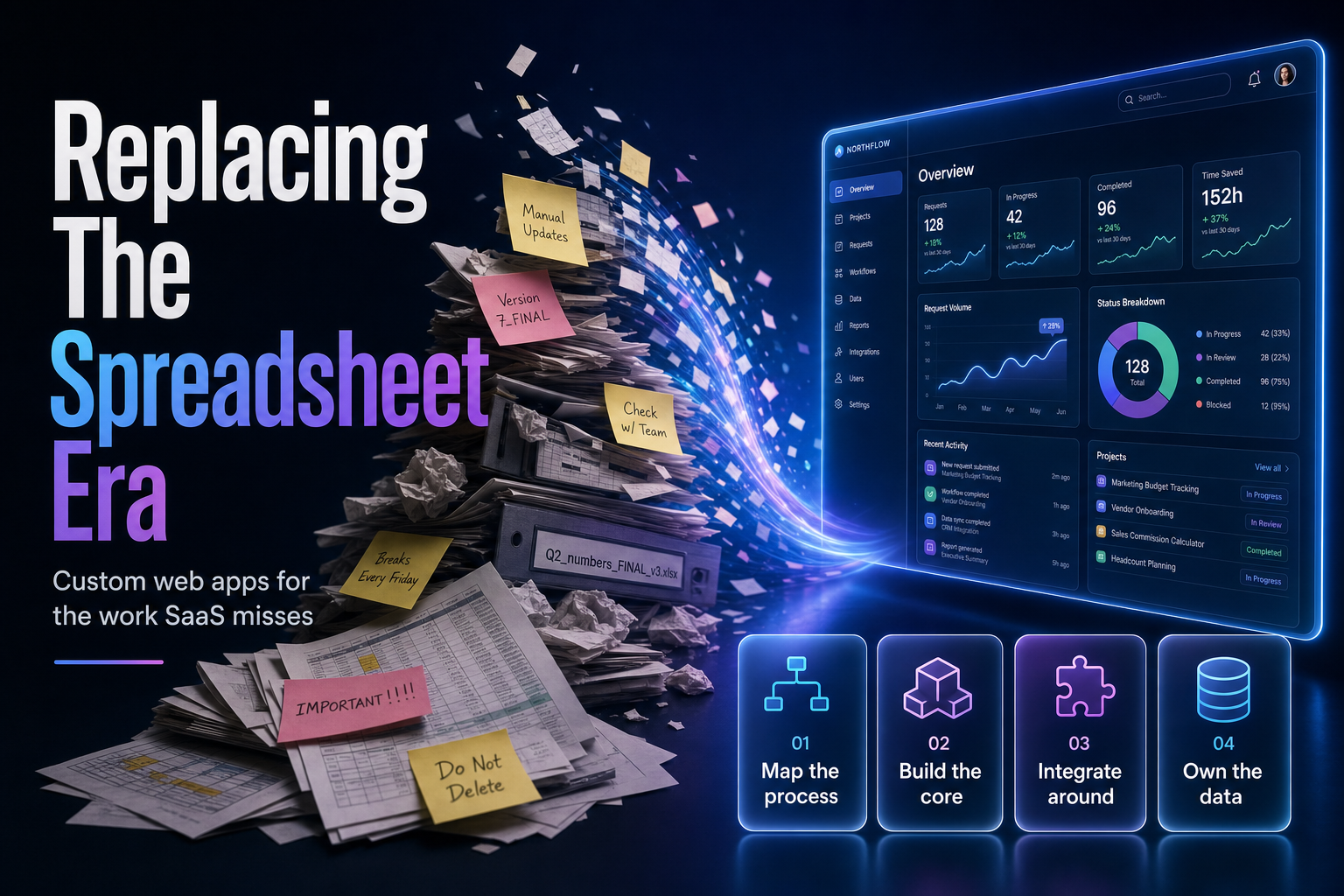
Map the process before the screens. We start by finding where the work actually happens, which is usually a spreadsheet nobody mentioned in the brief. That spreadsheet is the specification.
Test the build-versus-buy signals openly. If your data model fits a vendor's schema and your workflow is not differentiating, we will say so. A custom build that should have been a SaaS licence is a bad outcome for both of us, and it shows up in year two.
Build the core, integrate around it. With an estimated 699 unintegrated applications in a typical enterprise, the integration surface is the project. The core system is often the easy part.
Design for the API from day one. If the point is getting a process out of dark data and into something an agent or a report can reach, the interface is the deliverable and the screens are a client of it.
Then plan the maintenance honestly, at 15% to 20% of build cost a year, and say so before you approve rather than after.
Who this suits: teams whose process genuinely does not fit an off-the-shelf tool, or who have customised a SaaS vendor to its ceiling and are paying for the privilege. Who it does not: anyone whose real problem is that they have 275 SaaS applications and 57% of the licences unused, which is a consolidation problem rather than a build one, and we cover that in our look at AI-native work platforms.
If your systems need moving rather than rebuilding, our cloud migration and modernisation service is the closer fit.
FAQ
How eCorpIT can help
eCorpIT is a CMMI Level 5 certified, MSME-registered technology organisation in Gurugram, founded in 2021, and a partner of AWS, Microsoft, Google, Shopify and Kaspersky. Our senior-led teams start by finding the spreadsheet where your process really lives, test the build-versus-buy signals with you before quoting a build, and design for the API so the work stops being dark data. We price maintenance at 15% to 20% a year openly rather than discovering it later. To scope an internal tool, portal or modernisation, contact us.
References
- Custom SaaS Development: Build vs Buy Analysis (2026) — Design Revision
- How Much Does SaaS Development Cost in India in 2026? — Mavani Solution
- Legacy System Integration for Enterprise AI Automation — GS Consulting
- Legacy System Modernization Guide for Enterprises 2026 — Sparkout Tech
_Last updated: July 15, 2026._