On this page · 11 sections
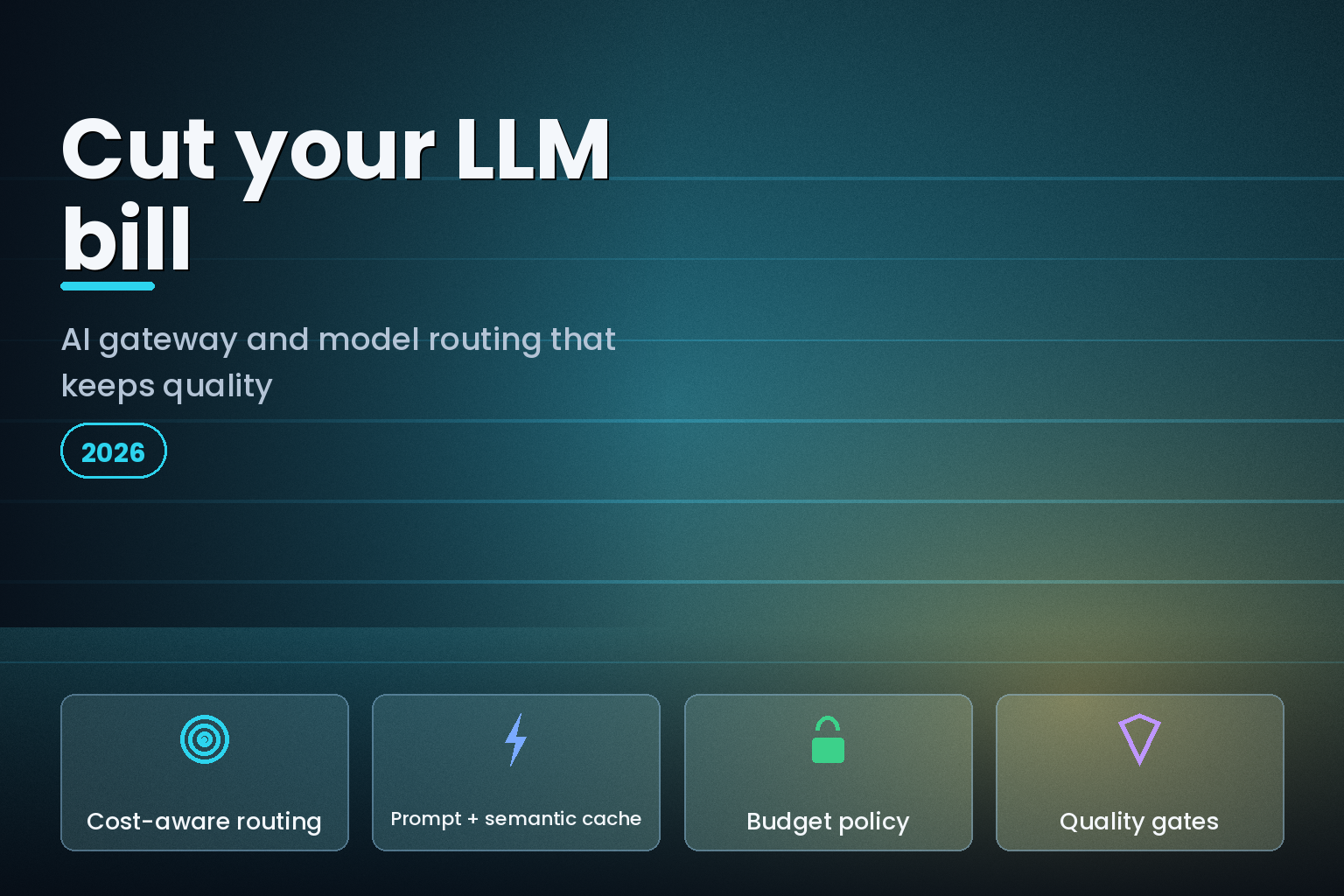
Summary. The fastest way to cut an AI bill in 2026 is to stop sending every request to a frontier model. Prices now span more than 140 times from the cheapest tier to the most expensive: Amazon Nova Micro costs $0.035 per million input tokens, while Claude Opus 5 is reported at $5 per million input and $25 per million output. Most workloads run a mix of easy and hard requests, yet route all of them to one costly model. The FinOps Foundation's 2026 State of FinOps report, from 1,192 practitioners stewarding more than $83 billion in cloud spend, found 98% now manage AI spending, up from 31% two years ago, and named AI cost management the number one skill teams are adding. An Opslyft study of 84 Amazon Bedrock deployments cut cost per answer from $0.41 to $0.07, an 83% drop, once routing, caching, and right-sizing were in place. The control point that makes this practical is an AI gateway. eCorpIT designs, deploys, and runs that gateway, with cost-aware model routing and caching that typically cuts LLM spend 40 to 70% while holding quality. This article explains how, and where the savings come from.
Why LLM bills spiral
AI spend behaves differently from classic cloud spend, and it grows faster. Almost nothing that drives the bill lives in finance; it lives in the codebase. A prompt template that sends 8,000 tokens of context on every call, a default set to the most expensive model, a retry loop with no cap, a chatbot with no caching: each is an engineering decision, and each shows up as money.
The scale is real. The FinOps Foundation reports that AI spend management jumped from 31% of practitioners in 2024 to 63% in 2025 to 98% in 2026. J.R. Storment, executive director of the FinOps Foundation, said "FinOps has definitively expanded to a broad array of technology value management, and the FinOps Foundation has followed to reflect the full scope of what practitioners are doing in the industry today." Cost per token is the wrong unit to manage. The real metric is cost per resolved task, because a cheap model that fails and triggers a retry on an expensive one costs more than routing correctly the first time.
The good news is that the same reports show large, repeatable savings. Mature FinOps programs cut cloud spend 20 to 25% in the first year, and AI-specific optimization goes further because the price spread between models is so wide. That spread is the opportunity.
The price spread is the opportunity
Frontier and budget models differ in price by more than two orders of magnitude. The table below shows public per-million-token rates as of July 2026. Reading it, the question stops being "which model is best" and becomes "which model is enough for this request."
| Model (July 2026) | Input per 1M | Output per 1M | Typical use |
|---|---|---|---|
| Amazon Nova Micro | $0.035 | $0.14 | High-volume classification, extraction |
| GPT-5.6 Luna (OpenAI) | $0.20 | $1.20 | Routing, summaries, simple chat |
| Claude Haiku 4.5 (Anthropic) | $1.00 | $5.00 | Fast general tasks, tool calls |
| Grok 4.5 (xAI) | $2.00 | $6.00 (cached input $0.50) | Agentic tool use, coding |
| Claude Opus 5 (Anthropic) | $5.00 | $25.00 | Hardest reasoning and code |
The input spread from Amazon Nova Micro to Claude Opus 5 is roughly 140 times. Send a routine classification to Opus 5 and you pay frontier rates for a task a budget model handles at the same quality. Send a hard multi-step reasoning task to Nova Micro and it fails, then a retry on a frontier model costs you twice. Neither is right. The answer is to match each request to the cheapest model that clears the quality bar, which is what routing does. Our budget LLM tier cost comparison breaks the tiers down further.
The unit that matters: cost per resolved task
Cost per token is easy to measure and misleading to manage. What a business pays for is a resolved task, and the same task can cost wildly different amounts depending on where it is routed. A worked example makes the gap concrete. Take a support workflow of 100,000 requests a month, each averaging about 2,000 input tokens and 500 output tokens, priced at the July 2026 public rates in the table above.
Send every request to Claude Opus 5, and the input costs 200 million tokens at $5 per million, or $1,000, plus 50 million output tokens at $25 per million, or $1,250: about $2,250 a month. Now route the same traffic, sending the 80% that are routine to Claude Haiku 4.5 and escalating only the hardest 20% to Opus 5. The Haiku share costs about $360 (160 million input tokens at $1, plus 40 million output at $5), and the Opus share costs about $450 (40 million input at $5, plus 10 million output at $25), for roughly $810 a month. Same 100,000 tasks, a 64% lower bill, and if the router is tuned so the escalated 20% are genuinely the hard ones, quality on the tasks that need it is unchanged.
Caching compounds the saving. In the same workflow a long system prompt and product context repeat on every call, so prompt caching the shared prefix removes most of the input cost on cached requests, and semantic caching serves near-duplicate questions with no model call at all. Stacked on the routed $810, a moderate 30 to 40% cache-hit rate takes the bill lower again. This is why the reported combined range for routing plus caching is 40 to 70% rather than a single number: the result depends on how repetitive your traffic is and how aggressively you cache. The figures move with your traffic mix and quality bar, which is why an assessment measures your real distribution instead of assuming one. But the shape holds: when the price spread between tiers is more than 140 times, the routing decision, not the model choice, sets most of the bill.
The four levers that cut the bill
Four techniques do most of the work. They stack, and a real program uses all four.
| Lever | How it works | Reported saving |
|---|---|---|
| Model routing | Send each request to the cheapest model that meets a quality threshold; escalate only hard ones | 75-85% on routed traffic at about 95% of frontier quality |
| Prompt caching | Reuse a cached prefix (system prompt, context) at a steep discount | Up to about 90% off cached input tokens |
| Semantic caching | Serve a stored answer when a new query is semantically close to a past one | 30-50% at moderate cache-hit rates |
| Batching | Send non-urgent work to batch endpoints | About 50% on eligible traffic |
Model routing is the biggest lever. A confidence-gated router sends everything to a cheap default first and escalates to a frontier model only when the task is hard or the cheap model is unsure. Reported results put this at 75 to 85% cost reduction on routed traffic while keeping around 95% of frontier quality, per practitioner write-ups collected by AI gateway vendors.
Caching is the second lever, and it has two forms. Prompt caching reuses a fixed prefix such as a long system prompt or retrieved context; Grok 4.5's cached-input rate of $0.50 against its $2.00 standard input rate is a 75% discount on the cached portion, and some providers go up to about 90% off. Semantic caching serves a stored answer when a new question is close enough to an earlier one, and typically cuts 30 to 50% at moderate hit rates. Batching non-urgent jobs adds roughly 50% on eligible traffic. Combined, routing and caching are widely reported to cut LLM costs 40 to 70%, and the Opslyft Bedrock study reached an 83% cut in cost per answer.
The AI gateway is the control point
You cannot run routing, caching, and budget policy well if each application talks to each model provider directly. An AI gateway sits between your applications and the model providers and centralizes the control: it routes requests, enforces budget and rate policy, caches responses, and fails over to a backup model, all without changing application code. Applications call the gateway with one interface; the gateway decides which model actually runs.
Mature gateways include LiteLLM, Cloudflare AI Gateway, Kong AI Gateway, and Bifrost, and they differ in latency overhead, caching support, and how routing policies are expressed. Our AI gateway comparison of LiteLLM, Cloudflare, Kong, and Bifrost covers the trade-offs, and the LLM hybrid-routing spend-decision framework sets out how to choose routing rules. The gateway is where a FinOps policy stops being a slide and becomes enforced behaviour: a per-team token budget, a default cheap model, an allow-list of models the app may escalate to, and a cache in front of all of it.
Protect quality while you cut cost
Cutting cost is easy if you accept worse output. The engineering problem is cutting cost while holding quality, and that needs a quality gate, not a hope. Before a routing change ships, run an evaluation harness on your real tasks and compare the cheaper route against the frontier baseline on accuracy, not vibes. Route by task class: classification and extraction to a budget model, general chat to a mid tier, hard reasoning and code to a frontier model, with confidence-based escalation for the uncertain cases. Log every routed request so you can measure realized savings and quality drift over time, and re-check when a provider ships a model update, because a cheaper model that quietly regresses will cost you in failed tasks. This is the same discipline that protects agent reliability, and it is why routing and evaluation belong in the same program rather than separate projects.
How eCorpIT builds and runs this
eCorpIT is a Gurugram-based technology company, founded in 2021, with CMMI Level 5, MSME, and ISO 27001:2022 certifications and partnerships with AWS, Microsoft, and Google. Our senior-led engineering teams design and operate AI gateways and model-routing systems as a managed capability, not a one-time script.
In an assessment we usually find the same handful of leaks: one default model handling every request regardless of difficulty, system prompts that resend thousands of tokens of context on every call with no caching, retry loops with no ceiling, and no per-team budget or alerting, so overspend surfaces in the monthly invoice rather than the day it happens. None of these need a model change to fix. They need a control point and a policy, which is exactly what a gateway provides.
The engagement follows a clear shape. We start with an assessment: instrument current LLM spend by application, model, and request type, and find where money is going. We then deploy an AI gateway suited to your stack, whether self-hosted LiteLLM or a managed option, and put your applications behind one interface. Next we design routing and caching policy: a cheap default, confidence-based escalation, prompt and semantic caching, per-team budgets, and model allow-lists, each validated against an evaluation harness so quality holds. Finally we run it, tracking realized savings and quality, and re-tuning when models and prices change. For teams that also need to move off an expensive default model, this pairs with our LLM migration and cost-optimization service and the broader cloud FinOps playbook for Indian teams.
We design these systems aligned with India's Digital Personal Data Protection Act 2023 requirements, including keeping prompt and routing logs inside your controlled environment and supporting on-premises or in-region routing where data residency matters. We do not quote a fixed rate card here because the right engagement depends on your traffic and stack; the assessment produces a scoped plan and an expected saving before any build begins.
India-specific considerations
For Indian startups and enterprises, the LLM bill is often a dollar-denominated cost against rupee revenue, so a 40 to 70% cut has an outsized effect on the runway. Routing high-volume, low-complexity traffic, the classification, extraction, and summarization that dominate most Indian SaaS and D2C workloads, to a budget tier such as GPT-5.6 Luna at $0.20 per million input tokens or Amazon Nova Micro at $0.035, while reserving Grok 4.5 or Claude Opus 5 for the genuinely hard requests, is where most of the saving sits.
Data residency and DPDP shape the design. Prompts and completions frequently contain personal data, so routing logic, caching, and logs must be handled under the Digital Personal Data Protection Act 2023: keep trajectory and prompt logs inside your controlled environment, apply retention limits, and prefer in-region or on-premises routing for sensitive workloads. An AI gateway helps here too, because it is the single place to enforce which providers may see which data.
FAQ
How eCorpIT can help
eCorpIT designs, deploys, and runs AI gateways with cost-aware model routing and caching so your LLM bill falls without your product getting worse. Our senior-led teams assess where spend is going, put your applications behind a gateway, set routing and caching policy validated against a quality harness, and manage it as prices and models change. If your AI costs are climbing faster than usage and you want a plan grounded in your own traffic, talk to our team for a spend assessment and a scoped optimization plan.
References
_Last updated: August 1, 2026._