On this page · 13 sections
- Why discounting stopped working
- Bet 1: first-party data platforms
- Bet 2: AI personalization and dynamic pricing
- Bet 3: WhatsApp commerce and retention
- Bet 4: AI customer support
- Bet 5: predictive retention and subscription 3.0
- Bet 6: post-purchase experience technology
- Bet 7: AI search and answer-engine visibility
- The economics behind the bets
- India-specific considerations
- FAQ
- How eCorpIT can help
- References
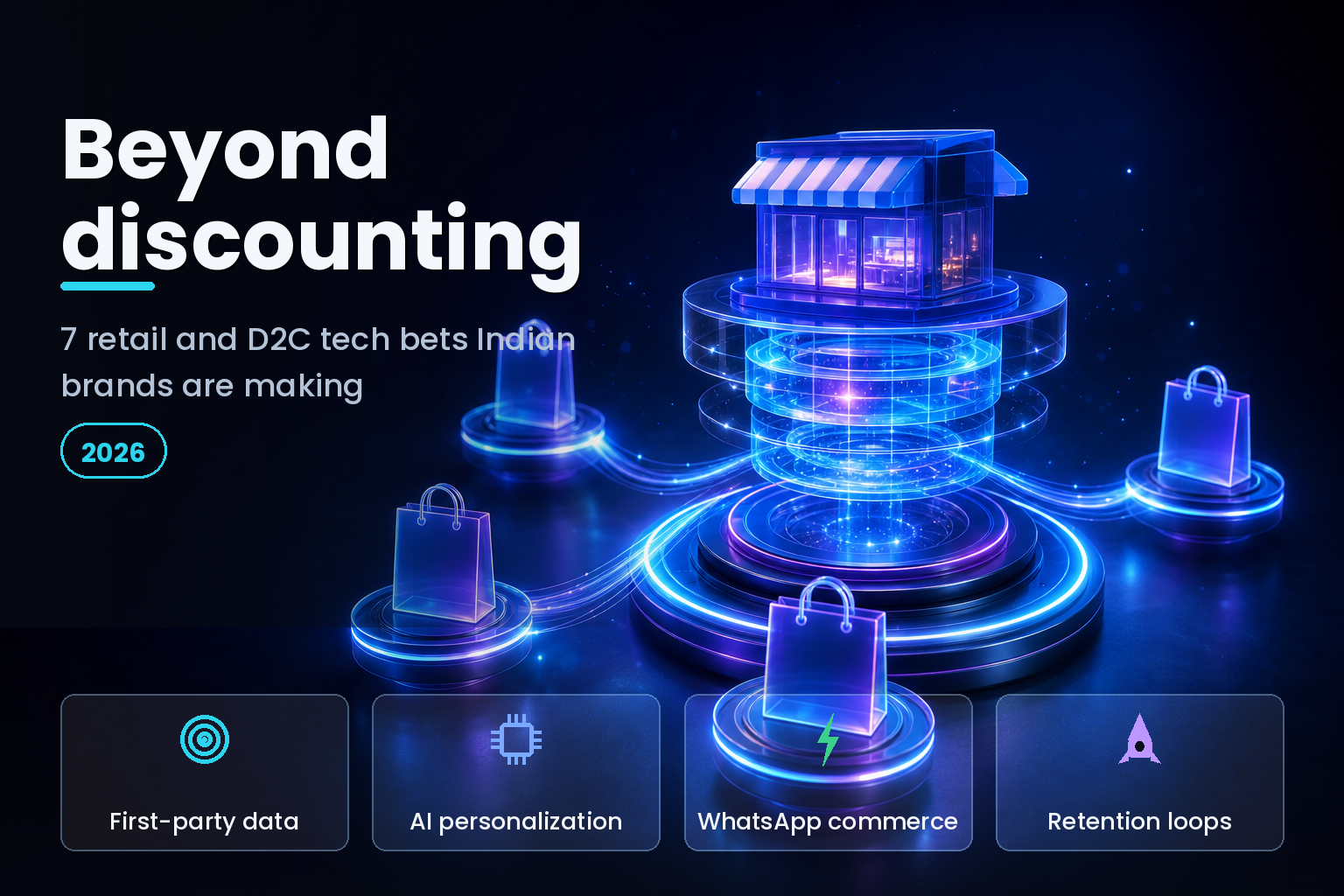
Summary. India's direct-to-consumer market is large and still growing fast: it is valued at about $108.76 billion in 2026, projected to reach $322 billion by 2031 at a 24.3% compound rate, and the sector crossed $60 billion in GMV in 2025. But the discounting playbook has stopped working, because acquisition keeps getting dearer, with Meta ad cost per acquisition rising 32% from about ₹380 in 2025 to ₹502 in 2026. The economics now favour retention: a brand typically turns profitable at its 2.3rd order, repeat customers generate 44% of revenue while being only 21% of buyers, and a 5% lift in retention can raise profit by 25 to 95%. So the smartest Indian brands are placing technology bets that build loyalty and margin instead of buying volume. Here are seven of them, and why each one earns its place in 2026.
The common thread is a shift from renting customers through ads to owning the relationship through data and experience. Every bet below moves spend from the top of the funnel, where costs only rise, to the parts of the business that compound: repeat purchase, lifetime value, and first-party data.
Why discounting stopped working
The maths turned against discounts. Meta acquisition costs rose about 32% year on year, and acquiring a new customer can cost up to 25 times more than retaining an existing one, per the State of Indian D2C 2026 analysis. Meanwhile repeat customers, just 21% of a typical store's base, generate 44% of revenue and 46% of orders and spend 67% more than new buyers, per the retention playbook data. A discount trains customers to wait for the next one; retention technology compounds. That is the logic behind all seven bets.
Bet 1: first-party data platforms
The foundational bet is owning customer data. As third-party targeting weakens and acquisition costs climb, brands that own first-party data can feed it back into every channel, which the brands pulling ahead in 2026 do rather than out-spending rivals on ads, per analysis of the first-party data stack. Indian brands are increasingly building customer data platforms, often without heavyweight enterprise suites, anchored by unified order and warehouse management. The payoff is a rapid feedback loop, with some brands moving from a social trend to warehouse shelves in under 21 days. Data ownership is the platform every other bet runs on.
Bet 2: AI personalization and dynamic pricing
The second bet uses AI to protect margin while still feeling personal. AI lets a brand adjust pricing and promotions by customer segment and real-time inventory, keeping a competitive edge without blanket discounts, per the hyper-personalization analysis. Instead of a flat "10% off," a brand can target a high-frequency, low-value customer with loyalty points or a referral bonus rather than another price cut. Personalization done on first-party data is what turns a generic store into one that feels made for the shopper, and it is a direct lever on both conversion and margin.
Bet 3: WhatsApp commerce and retention
In India, the retention channel that matters most is WhatsApp. It is the country's most powerful D2C retention channel, with more than 500 million active users and open rates above 90%, far ahead of email or SMS. Brands are betting on WhatsApp for order updates, re-engagement, cart recovery, and even catalogue and checkout flows, because a message that is actually read is worth more than one that sits unopened. For an Indian brand, a WhatsApp-first retention stack reaches customers where they already are, which is why it has become a default bet rather than an experiment.
Bet 4: AI customer support
Support is both a cost centre and a retention moment, and AI is reshaping both. Brands adopting AI chatbots can cut customer support costs by 40 to 60%, per the State of Indian D2C 2026 data, while giving instant answers that keep a frustrated buyer from churning. The bet is not to replace humans entirely but to automate the repetitive queries, order status, returns, sizing, so human agents handle the cases that build loyalty. Done well, it lowers cost and raises satisfaction at the same time, which is rare.
Bet 5: predictive retention and subscription 3.0
The fifth bet is to anticipate the customer rather than react. Brands are moving to what the industry calls Subscription 3.0, using predictive AI to automate reorders before a customer runs low and to flag churn risk early, per the 2026 loyalty analysis. A model that predicts when a consumable will run out, and nudges a reorder at the right moment, converts a one-off buyer into a recurring one without a discount. Given that a brand turns profitable around its 2.3rd order, technology that reliably drives the second and third purchase is among the highest-use bets available.
Bet 6: post-purchase experience technology
The moment after checkout is underused, and it is a retention goldmine. Brands that invest in branded order-tracking pages, proactive delay alerts, and a considered unboxing experience raise customer lifetime value, per the retention playbook. In India, where a large share of orders are still cash-on-delivery and delivery anxiety is real, a branded tracking page that keeps the customer informed reduces support tickets and builds trust. The bet is to treat the delivery window as a branded experience rather than a courier's problem.
Bet 7: AI search and answer-engine visibility
The final bet is on discovery beyond paid ads. The brands growing profitably in 2026 combine paid acquisition with organic search, AI search visibility, and content commerce, rather than leaning on ad spend alone. As shoppers increasingly ask AI assistants for recommendations, being visible in AI answers becomes a discovery channel in its own right. This is where generative-engine and answer-engine optimisation matter, and our guides on AEO versus GEO versus SEO and the ultimate guide to SEO in 2026 go deeper. A brand that earns organic and AI-driven discovery lowers its blended acquisition cost, which is the whole point.
| # | Tech bet | What it replaces | Primary payoff |
|---|---|---|---|
| 1 | First-party data platform | Rented third-party audiences | Owned data, feedback loops |
| 2 | AI personalization and pricing | Blanket discounts | Margin and relevance |
| 3 | WhatsApp commerce | Low-open-rate email and SMS | Read messages, retention |
| 4 | AI customer support | Costly manual support | 40 to 60% lower support cost |
| 5 | Predictive retention | Reactive win-back | Reliable second and third orders |
| 6 | Post-purchase experience | Generic courier tracking | Higher lifetime value |
| 7 | AI search visibility | Ad-only discovery | Lower blended acquisition cost |
The economics behind the bets
Each bet is a response to the same shift in unit economics. When acquisition rises and retention drives profit, spend has to move from the funnel's top to its middle and bottom.
| Metric | Figure (2026) | What it implies |
|---|---|---|
| India D2C market size | About $108.76 billion | Large, still growing at 24.3% |
| Meta CAC change | ₹380 to ₹502, up 32% | Acquisition keeps getting dearer |
| Repeat customer share | 21% of buyers, 44% of revenue | Retention is where the money is |
| Retention use | 5% lift, 25 to 95% more profit | The highest-return move available |
| AI support saving | 40 to 60% lower cost | Cost and retention improve together |
India-specific considerations
Two India factors sharpen these bets. First, geography: tier 2 and tier 3 cities contributed 66% of new orders in FY26, so the tech has to work for customers who prefer WhatsApp over email, sometimes pay cash on delivery, and value clear delivery communication, which is exactly why bets 3 and 6 rank so highly here. Second, data protection: the Digital Personal Data Protection Act, 2023 (DPDP) governs the first-party data these bets depend on, so a CDP or personalization engine must be built with clear consent and sound handling from the start, not retrofitted. A brand that treats DPDP compliance as part of its data platform turns a legal requirement into customer trust. For related reading, see our retail and D2C notes on the blog.
FAQ
How eCorpIT can help
eCorpIT is a Gurugram-based technology organisation with senior-led engineering teams that build commerce technology for D2C and retail brands. We can design your first-party data platform, wire AI personalization and predictive retention into your store, build WhatsApp commerce and post-purchase flows, and improve your AI-search visibility, all with DPDP compliance built in. If you want a technology roadmap that grows profit through retention rather than discounts, contact us. You can also browse the eCorpIT blog or read about our team.
References
_Last updated: July 5, 2026._