On this page · 11 sections
- What Microsoft and Mistral announced on July 21, 2026
- Why control is the real axis for regulated buyers
- The three deployment modes, in plain terms
- Open-weight, API-only, or self-hosted: the model-choice call
- What it costs, and where the real cost sits
- India-specific considerations: DPDP, data residency, and BFSI
- A decision framework: which mode for which workload
- What the announcement does not solve
- FAQ
- How eCorpIT can help
- References
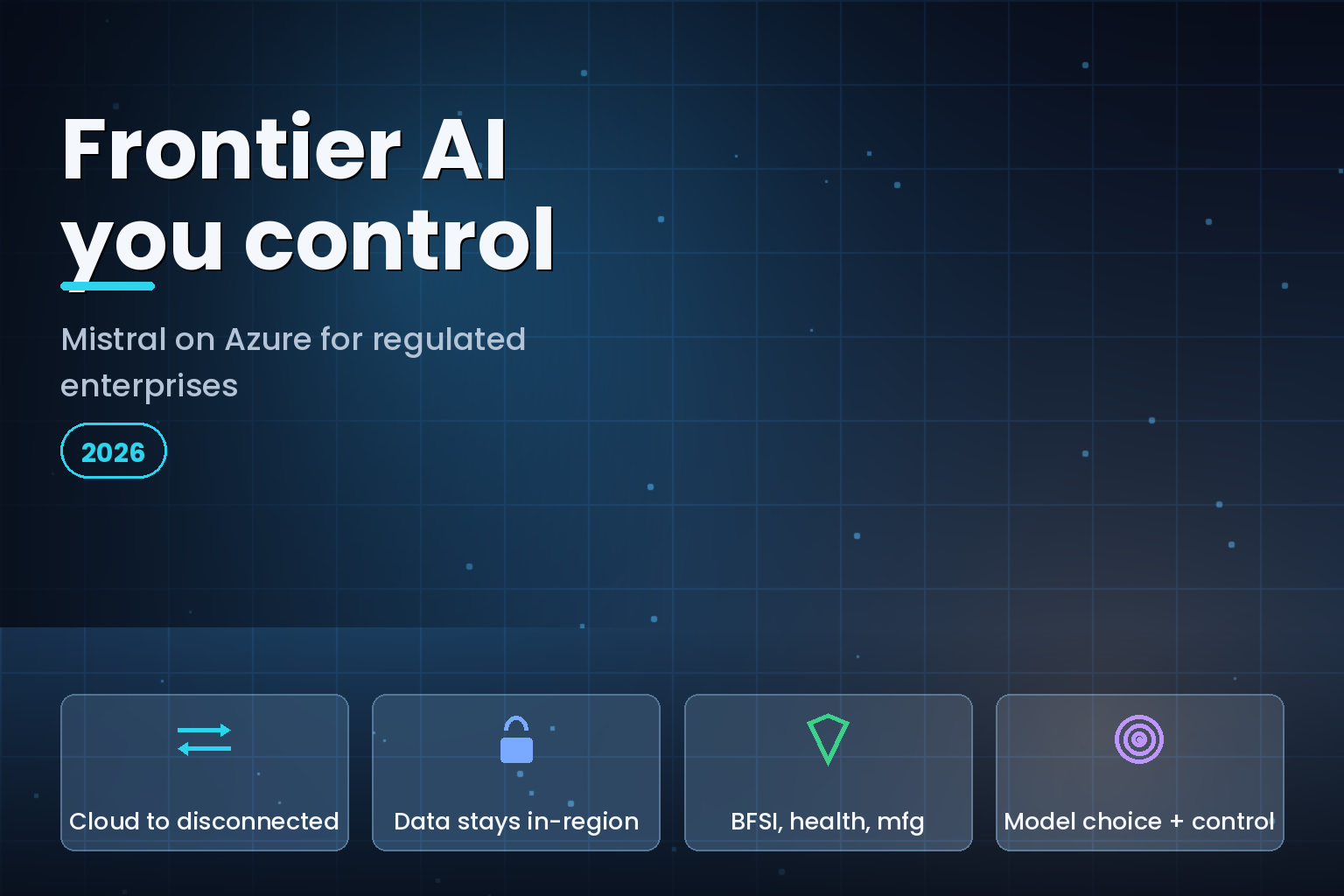
Summary. On July 21, 2026, Microsoft and Mistral expanded their partnership and put Mistral Medium 3.5, an open-weight dense 128B model with a 256K-token context window, plus the OCR 4 document model, into Microsoft Foundry, with Medium 3.5 also in Copilot Studio. The headline for regulated buyers is not the model. It is that Azure and Azure Local now run the same Mistral models across three modes: cloud, cloud-connected, and fully disconnected. Medium 3.5 lists at about $1.50 per million input tokens and $7.50 per million output tokens as of July 2026 on the managed API. For a bank, hospital, or factory in India, the choice interacts directly with the Digital Personal Data Protection (DPDP) Rules 2025, which carry penalties up to Rs 250 crore and phase in Consent Manager registration from November 13, 2026. This guide sets out what the announcement changes, the three deployment modes side by side, and how to pick one per workload.
If you have spent 2026 watching AI budgets balloon and pilots stall before production, the interesting part of this deal is the word Microsoft chose to repeat: control. Brad Smith, Vice Chair and President at Microsoft, framed it as giving customers "a trusted foundation for AI they can operate on their own terms." That is a direct answer to the question regulated CTOs actually ask, which is not "is this model smart enough" but "where does my data go, who can see it, and what happens when the network drops."
This article is written for that reader: a CTO or platform lead in financial services, healthcare, or manufacturing who has to satisfy an auditor, not just a demo. We will keep the two macro-decisions separate. First, the deployment mode (cloud versus cloud-connected versus disconnected). Second, the model-sourcing call (a managed open-weight model like Mistral, an API-only frontier model, or a fully self-hosted open-weight stack you run yourself).
What Microsoft and Mistral announced on July 21, 2026
The announcement had three parts. Microsoft agreed a new multibillion-dollar arrangement to expand AI infrastructure in Europe, drawing on Mistral's expanded Europe-based GPU capacity built on thousands of NVIDIA Vera Rubin GPUs. At the platform layer, Mistral Medium 3.5 and OCR 4 became available in Microsoft Foundry, and Medium 3.5 arrived in Copilot Studio. At the deployment layer, Azure and Azure Local were positioned to run those models across cloud, cloud-connected, and fully disconnected environments.
Two design facts matter more than the marketing. Medium 3.5 is an open-weight model placed inside a managed Azure environment. Open weights are what make a disconnected deployment possible at all: you cannot air-gap a model whose weights live only behind someone else's API. And Foundry Local extends the same Foundry development experience to Azure Local, so a team can build against one set of models, tools, and APIs and then run the result in the cloud or on their own hardware without redesigning the application.
Arthur Mensch, Co-Founder and Chief Executive Officer of Mistral, described the mission as putting "frontier AI in the hands of every organization while keeping them in control of their technology," delivered "everywhere our customers operate." Mistral is headquartered in France and independent, with a presence in the United States, the United Kingdom, and Singapore, which is part of why the deal is pitched at European and other regulated markets where data sovereignty is a procurement requirement rather than a preference.
Microsoft positioned all of this as an extension of its Sovereign Cloud approach and the European Digital Commitments it made in 2025. The commercial motion is a joint go-to-market: funded proofs of concept, Azure credits, and workshops to move customers from pilot to production.
Why control is the real axis for regulated buyers
For a consumer app, the model-selection question is mostly about quality and price per token. For a regulated enterprise, three other constraints usually dominate, and they are the reason a slightly weaker model in the right place beats a slightly stronger model in the wrong place.
The first is data residency. A hospital processing patient records or a bank scoring loan applications often cannot send that data to a model endpoint in another jurisdiction. The second is operational continuity. Critical infrastructure and factory-floor systems have to keep working when connectivity fails, so a cloud-only inference call is a single point of failure. The third is auditability. When a regulator asks who could access a dataset and where inference ran, "it went to a public API" is a difficult answer to defend.
This is why the deployment mode is the decision that carries the compliance weight. The Microsoft and Mistral framing maps cleanly onto those three constraints: cloud for scale and the latest features, cloud-connected for local data with cloud operations when you want them, and fully disconnected for the workloads where residency, resilience, and control are non-negotiable. If you are still deciding which frontier model to standardise on across the business, our Gemini 3.5 Pro, GPT-5.6 and Claude Fable 5 model comparison covers the quality-and-price side of that call; this piece is about where the model runs.
The three deployment modes, in plain terms
Azure and Azure Local present one operating model across a spectrum of control. Here is what each mode means in practice, plus two adjacent options a regulated team will weigh alongside them.
| Deployment mode | Where it runs | Connectivity | Does data leave your boundary? | Best-fit workload |
|---|---|---|---|---|
| Azure cloud | Microsoft Azure region | Always online | Yes, into the chosen Azure region | High-scale apps, fastest access to new features |
| Cloud-connected (Azure Local) | Your datacentre or edge site | Connected to Azure when needed | Configurable per policy | Low-latency local data with cloud operations |
| Fully disconnected (Azure Local) | Your premises, air-gapped | None required | No | Classified, OT, and mission-critical systems |
| Foundry Local (build) | Developer machine or Azure Local | Optional | No | Building and testing with production parity |
| Mistral La Plateforme (managed API) | Mistral's managed cloud | Always online | Yes, to Mistral's service | Fast start with a European provider |
The mode that most changes the calculus for regulated teams is fully disconnected on Azure Local. It is the option that did not have a credible frontier-model answer for most of 2025. An air-gapped bank branch, a defence supplier, or a plant running operational technology can now apply an open-weight model to sensitive workflows without a live link to a public cloud, while keeping the same Foundry tools and APIs the cloud team uses. That consistency is the quiet win: teams avoid a fragmented architecture where the disconnected site runs a completely different, weaker stack.
Cloud-connected sits in the middle and is where a lot of real deployments will land. You keep data and inference on your own Azure Local hardware for latency and residency, but you stay connected to Azure for management, updates, and burst capacity when you choose to be. For manufacturing and industrial data, where latency, intellectual-property protection, and supply-chain resilience shape the design, this is often the pragmatic default.
Open-weight, API-only, or self-hosted: the model-choice call
Deployment mode is one axis. Model sourcing is the other, and it is where open weights change what is possible. An API-only frontier model can be excellent and cheap to start with, but you cannot run it disconnected, and your control over data ends at the provider's region boundary. A fully self-hosted open-weight stack gives you maximum control but hands you the entire operational burden: GPUs, serving, evaluations, and upgrades. The managed open-weight path that this partnership sells sits between those two.
| Option | Weights | Can run disconnected? | Ops burden | Control over data and model |
|---|---|---|---|---|
| Mistral Medium 3.5 on Azure or Azure Local | Open-weight, managed | Yes, via Azure Local | Medium | High |
| API-only frontier model on public cloud | Closed, API access | No | Low | Medium, bounded by region |
| Self-hosted open-weight on your own GPUs | Open-weight | Yes | High | Highest |
| Mistral OCR 4 on Foundry | Open-weight, managed | Yes | Medium | High, for document pipelines |
| Small open model at the edge | Open-weight | Yes | Medium to high | High |
The honest read is that no single row wins. A customer-facing chatbot with no sensitive data belongs on the API-only or cloud path, because low ops burden and fast feature access matter more than air-gapping. A claims-adjudication pipeline touching health data belongs on cloud-connected or disconnected Azure Local with an open-weight model. If your team already runs its own inference cluster and has the site-reliability depth for it, self-hosting an open-weight model may still be cheaper at scale; our guide to self-hosting open-weight LLMs in production and the open-weight self-host decision framework walk through when that math works.
OCR 4 deserves a separate note. Structured document processing is one of the highest-value, lowest-glamour workloads in regulated industries: loan files, discharge summaries, inspection reports. Having an open-weight OCR model that runs in the same Foundry environment, and can run disconnected, removes a common failure point where sensitive documents were being shipped to a third-party OCR service that never appeared in the AI risk assessment.
What it costs, and where the real cost sits
Managed API pricing is the visible number, and for Mistral Medium 3.5 it is roughly $1.50 per million input tokens and $7.50 per million output tokens as of July 2026, on a model with a 256K-token context window. La Plateforme also offers a rate-limited free tier of around one billion tokens per month for evaluation before pay-as-you-go begins. Those figures are useful for a cloud pilot. They are not the number that decides a disconnected deployment.
| Cost driver | Managed API (Medium 3.5) | Azure Local (cloud-connected or disconnected) | Self-hosted open-weight |
|---|---|---|---|
| Per-token price | ~$1.50 / $7.50 per M tokens (Jul 2026) | Bundled into licensing and your infrastructure | None; you own the hardware |
| Upfront infrastructure | None | Azure Local hardware | GPU capital expenditure |
| Ops and SRE effort | Low | Medium | High |
| Data-residency control | Bounded by region | Full, on your premises | Full |
| Time to first workload | Days | Weeks | Weeks to months |
The pattern holds across most enterprise AI programmes: the token bill is rarely the dominant cost. The dominant cost is the migration, the evaluation harness, and the operations. A disconnected Azure Local deployment trades a per-token line item for hardware and staffing, and it is worth it only when residency or resilience genuinely require it. Picking disconnected for a workload that could safely run in the cloud is how teams turn a modest monthly API bill into a large infrastructure project for no compliance benefit. If controlling model spend across a mixed estate is the pressing problem, the LLM hybrid routing and API spend decision framework is the companion to this piece.
India-specific considerations: DPDP, data residency, and BFSI
For Indian enterprises, the deployment-mode decision is now tied to a live regulatory clock. The DPDP Rules 2025 were notified by MeitY on November 13, 2025, and phase in over roughly 18 months. Consent Manager registration under the Rules begins on November 13, 2026, and the fuller operational obligations, including notice requirements and a 72-hour breach-notification timeline, follow from May 13, 2027. Non-compliance can draw penalties up to Rs 250 crore, which is large enough to make the "where does inference run" question a board-level one.
Data residency is where the Azure Local modes earn their place. A bank or hospital that must keep personal data within a defined boundary can run an open-weight model on cloud-connected or disconnected Azure Local and keep both the data and the inference inside that boundary, rather than sending it to a model endpoint in another region. That does not make an organisation automatically compliant, and no vendor announcement should be read as a compliance certificate. It removes one of the harder architectural obstacles to compliance. Teams starting this work should read the DPDP engineering playbook for Indian startups for the data-flow and consent plumbing, and can see the wider policy context in our overview of India's sovereign AI push and the IndiaAI mission.
There is a cost nuance specific to India. Azure Local hardware and the staff to run it are a real capital and operating commitment, and GPU capacity in India remains tighter and pricier than in the largest global regions. For many mid-market Indian firms, the sensible pattern is a hybrid: run the bulk of non-sensitive AI in an Indian Azure region, and reserve disconnected Azure Local for the specific workloads where residency or resilience is mandatory. That keeps the infrastructure bill proportional to the actual compliance requirement.
A decision framework: which mode for which workload
Start from the data, not the model. Classify each workload by the sensitivity of the data it touches and the consequence of an outage, then let that pick the mode.
If the data is public or low-sensitivity and an outage is a minor inconvenience, use the Azure cloud path or a managed API and move on. The control features are wasted effort here, and speed matters more.
If the data is regulated but you can tolerate cloud operations, use cloud-connected Azure Local. You keep data and inference local, satisfy most residency requirements, and still get Azure management and the option to burst. This is the right home for the majority of BFSI and healthcare workloads that are sensitive but not classified.
If the data is highly sensitive, the environment is air-gapped, or service continuity is mandatory regardless of connectivity, use fully disconnected Azure Local with an open-weight model such as Medium 3.5. Accept the higher operational cost as the price of the control the workload requires.
If you already operate a mature inference platform and have the reliability engineering to match, compare the managed Azure Local path against fully self-hosting an open-weight model on your own GPUs. The self-hosted route can win on unit cost at high volume, but only if you can staff it. The real question is usually the migration and operations, not the model.
What the announcement does not solve
A partnership press release is a starting line, not a finished system. Three cautions are worth stating plainly.
First, "open-weight and disconnectable" is not the same as "compliant." You still have to build the consent capture, data-flow controls, logging, and evaluation harness that an audit will ask for. The deployment mode removes an obstacle; it does not do the compliance work.
Second, disconnected deployments carry an ongoing burden that cloud hides: you own the patching, the model updates, and the physical security of the hardware. An air-gapped model that never gets updated can become its own risk over a couple of years.
Third, model quality still matters. An open-weight model you can run anywhere is only useful if it is good enough for the task. Validate Medium 3.5 or OCR 4 on your own data and your own evaluation set before committing an architecture to it, exactly as you would with any API-only model. Control is a reason to choose a model, not a substitute for testing it.
FAQ
How eCorpIT can help
eCorpIT is a Gurugram-based technology consultancy, founded in 2021 and certified for CMMI Level 5, ISO 27001:2022, and MSME, that helps regulated enterprises design AI deployments matched to their data-sensitivity and continuity requirements rather than to a vendor's default. We map each workload to the right mode across cloud, cloud-connected, and disconnected, build the evaluation and data-flow controls an audit will ask for, and design applications aligned with DPDP requirements. If you are weighing Mistral on Azure against an API-only model or a self-hosted stack, our private LLM deployment service and team can pressure-test the architecture with you. Start a conversation at /contact-us/.
References
- Microsoft and Mistral expand strategic partnership to give enterprises and regulated industries frontier AI they can control — Microsoft Source, July 21, 2026.
- Microsoft and Mistral expand AI partnership with sovereign cloud and Azure integration — BigDATAwire, July 21, 2026.
- Mistral Medium 3.5 API pricing and benchmarks — OpenRouter, accessed July 2026.
- Mistral Medium 3.5 pricing and specs — CloudPrice, accessed July 2026.
- Microsoft Sovereign Cloud — Microsoft, accessed July 2026.
- Azure Local — Microsoft Azure, accessed July 2026.
- Microsoft Foundry — Microsoft Azure, accessed July 2026.
- Microsoft Copilot Studio — Microsoft, accessed July 2026.
- Digital Personal Data Protection Rules, 2025 — overview and timeline, accessed July 2026.
- India's DPDP Rules 2025: a practical guide with implementation checklist — Scrut, accessed July 2026.
- Microsoft launches its own AI deployment company with a $2.5 billion commitment — TechCrunch, July 2, 2026.
- Mistral AI — company and model information, accessed July 2026.
_Last updated: July 31, 2026._