On this page · 9 sections
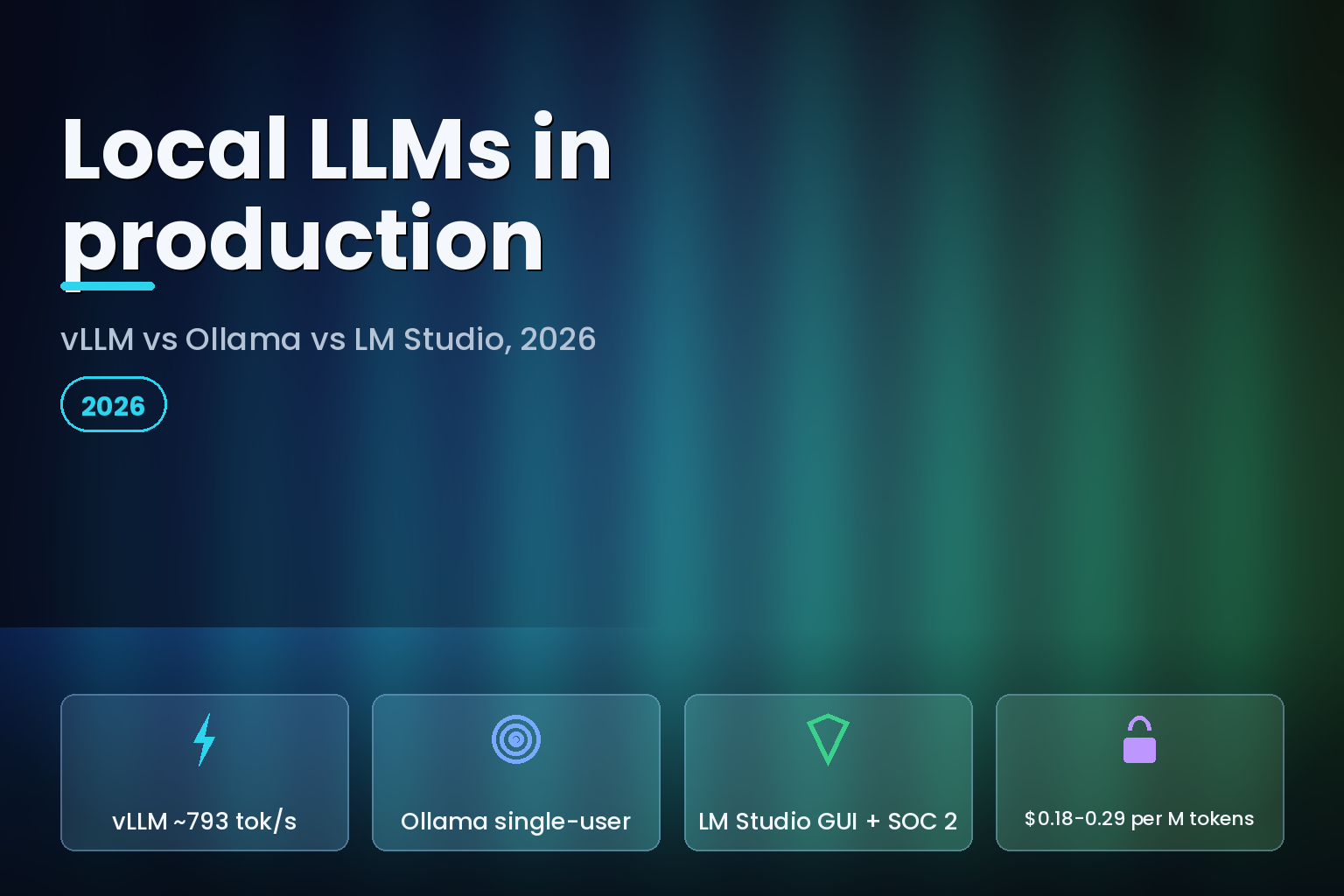
Summary. vLLM, Ollama and LM Studio are the three common ways to self-host an open-weight model, and they are built for different jobs. On identical hardware, Red Hat measured vLLM at roughly 793 tokens per second at peak against Ollama's 41, with P99 latency of 80 ms versus 673 ms, and about 2.3x higher throughput than Ollama at 8 concurrent users. Once you amortise the GPU, one 2026 benchmark puts local inference near $0.18 to $0.29 per million tokens, roughly 10x to 50x below hosted API rates. A used dual RTX 4090 box runs $2,200 to $2,600 and pushes a 4-bit 70B model near 100 tokens per second. LM Studio ships a free desktop app plus an Enterprise tier from $10 per user per month. The short version: pick vLLM for multi-user serving, Ollama for single-user and Apple Silicon, and LM Studio when a team wants a graphical interface with governance. Here is the throughput, the real cost, and a decision table.
This is not a "which is best" post, because the honest answer is that they do not compete for the same slot. The useful question is which one fits your concurrency, your hardware, and your operations team.
Why teams self-host at all
Three reasons push teams off hosted APIs and onto their own GPUs. Cost at scale is the loudest: an agent or product with steady, high token volume can pay 10x to 50x less per million tokens once the hardware is bought and busy, per a 2026 production self-host benchmark. Data control is the second: inference on your own hardware keeps prompts and user data off third-party endpoints, which matters for regulated data and, in India, for the data-minimisation expectations under the Digital Personal Data Protection Act 2023. Predictable capacity is the third: a reserved GPU does not rate-limit you during a traffic spike.
None of that is free. Self-hosting trades a per-token bill for capital, operations, and the risk of idle silicon. The engine you pick decides how much throughput you get from that hardware, which is where the numbers matter.
Throughput and latency: the Red Hat numbers
Red Hat's benchmarking team ran vLLM and Ollama on identical hardware across concurrency from 1 to 256 users, first in an August 2025 deep-dive and re-validated in 2026. The gap under load is large.
| Metric (identical hardware) | vLLM | Ollama |
|---|---|---|
| Peak throughput | ~793 tokens/s | 41 tokens/s |
| P99 latency at peak | 80 ms | 673 ms |
| Throughput at 8 concurrent users | ~2.3x Ollama | baseline |
| Time to first token under load | stays low | rises sharply |
| Very high concurrency (above 16) | inter-token latency creeps up | stays stable and low |
The headline is vLLM's continuous batching. It packs many requests into one running batch, so throughput climbs with concurrency instead of collapsing, which is why the Red Hat deep-dive calls it the engine for scalable serving. Note the honest caveat in the last row: above 16 concurrent users, vLLM's inter-token latency began to rise while Ollama's stayed low. Ollama is not trying to win the concurrency race. It is tuned for one user on a laptop or workstation, and it does that well.
So the throughput story is really about shape. If you serve many users at once, vLLM's numbers are decisive. If you serve one user, or you are prototyping, Ollama's simplicity costs you nothing you would have used.
The real cost model
Per-token pricing on self-hosted models is a function of hardware cost, utilisation, and power. Amortise a busy GPU and the number gets small. One 2026 benchmark put Ollama near $0.24 per million tokens as a pure-software baseline, with LM Studio around $0.29, a roughly 20% premium for its access control and interface. Both sit far under hosted API rates, which the same source pegs at 10x to 50x higher.
The catch is the word "busy". Those figures assume high utilisation. A GPU that sits idle half the day doubles your effective cost per token. Model the monthly total, not just the per-token rate. Here is a representative enterprise LM Studio deployment's monthly cost, from the same benchmark work.
| Monthly cost component | Amount | Share |
|---|---|---|
| Compute depreciation | $833 | 52% |
| Software licensing | $500 | 31% |
| Energy | $210 | 13% |
| Storage | $55 | 3% |
| Total | $1,598 | 100% |
Hardware dominates. That is why the GPU choice sets the budget. A used dual RTX 4090 box at $2,200 to $2,600 remains the value pick for a 4-bit 70B model at roughly 100 tokens per second, while a new dual RTX 5090 at about $4,000 buys 64 GB of VRAM and room for 8-bit quality, per 2026 hardware guides. The cost lesson is the same one we cover in self-hosting versus API inference cost and the economics of self-hosting a large model: self-hosting wins on steady, high volume and loses on bursty, low volume.
Operations and features, where they diverge
Throughput is one axis. How the engine fits your team is the other.
vLLM is the serving engine. It is an OpenAI-compatible server built for GPUs, with continuous batching, tensor parallelism, and a clean path onto Kubernetes for autoscaling. It expects a Linux and GPU operations culture. If you already run infrastructure, vLLM is the production answer, and it is the one we build on in our managed Kubernetes AI platform work.
Ollama is the single-user runtime. It is the fastest way to pull a model and run it locally, now MLX-backed for speed on Apple Silicon. It is excellent for development, prototyping, and on-device use, and it is not trying to be a multi-user server.
LM Studio is the governed desktop bridge. The desktop app is free, including for commercial use, with an OpenAI-compatible local API and permission keys for access control. In January 2026, version 0.4.0 added a headless server mode called llmster that deploys on a Linux server, cloud VM, or CI pipeline with a single command. The Enterprise tier, from $10 per user per month, adds LM Link for routing workloads across devices, SLA-backed support, and audit logging for SOC 2, per LM Studio's enterprise page. It suits a team that wants a GUI and governance without standing up vLLM.
Which engine to pick
| Scenario | Recommended engine | Why |
|---|---|---|
| Multi-user product or API serving | vLLM | Continuous batching; ~793 tokens/s at peak; scales on Kubernetes |
| Single developer or on-device app | Ollama | Simplest runtime; MLX-backed on Apple Silicon |
| Team wanting a GUI plus governance | LM Studio Enterprise | Access control, audit logging, LM Link, from $10/user/month |
| Prototyping before committing to hardware | Ollama | Zero setup cost; validate the model first |
| Regulated data, on-prem requirement | vLLM (self-managed) | Full control on your own GPUs and network |
The pattern most teams land on is to prototype on Ollama, then serve on vLLM once concurrency is real, and reach for LM Studio when non-engineers need controlled access to shared models. Picking one engine for all three jobs is the common mistake.
India-specific considerations
For Indian teams, imported GPUs carry duty and a weaker rupee, so the hardware line in that cost table lands harder. A dual RTX 4090 box that reads as $2,200 to $2,600 abroad is a larger rupee outlay once landed, which pushes the break-even point toward higher, steadier utilisation before self-hosting beats a hosted API. That maths is the same one we work through in our AI cloud-cost guide for Indian teams and why GPU spend is the top FinOps concern.
The counterweight is data residency. Running inference on Indian infrastructure keeps personal data in-country and off cross-border APIs, which is a cleaner position under the DPDP Act 2023 than routing every prompt overseas. For teams that need both control and managed operations, a self-hosted vLLM stack on cloud GPUs in an Indian region is often the balance, a path we detail in our private LLM deployment service and our note on choosing on-device versus cloud AI.
FAQ
How eCorpIT can help
eCorpIT is a Gurugram-based, senior-led engineering organisation (founded 2021, CMMI Level 5, MSME certified) that designs and operates self-hosted inference. We size the GPU against your real concurrency, deploy vLLM on Kubernetes for multi-user serving, and keep personal data in-country and aligned with DPDP requirements. If you are weighing a hosted API against your own GPUs, talk to our team about your workload. See our private LLM deployment service and managed Kubernetes AI platform.
References
- Ollama vs vLLM: a deep dive into performance benchmarking - Red Hat Developer
- Practical strategies for vLLM performance tuning - Red Hat Developer
- LM Studio Enterprise - LM Studio
- Local LLM workstation build 2026: dual RTX 4090 - PromptQuorum
- Run local LLMs in 2026: Ollama vs LM Studio vs vLLM - Digital Applied
- Minimum VRAM for local LLMs in 2026: GPU tiers tested - Kunal Ganglani
_Last updated: July 18, 2026._