On this page · 11 sections
- The compute build-out: subsidised GPUs at national scale
- Homegrown models are now credible
- The startup and capital signal
- The rules changed: DPDP is now a live clock
- How sovereign compute and DPDP push procurement the same way
- A practical procurement framework for 2026
- Where the shift bites first: a sector view
- India-specific considerations
- How eCorpIT can help
- FAQ
- References
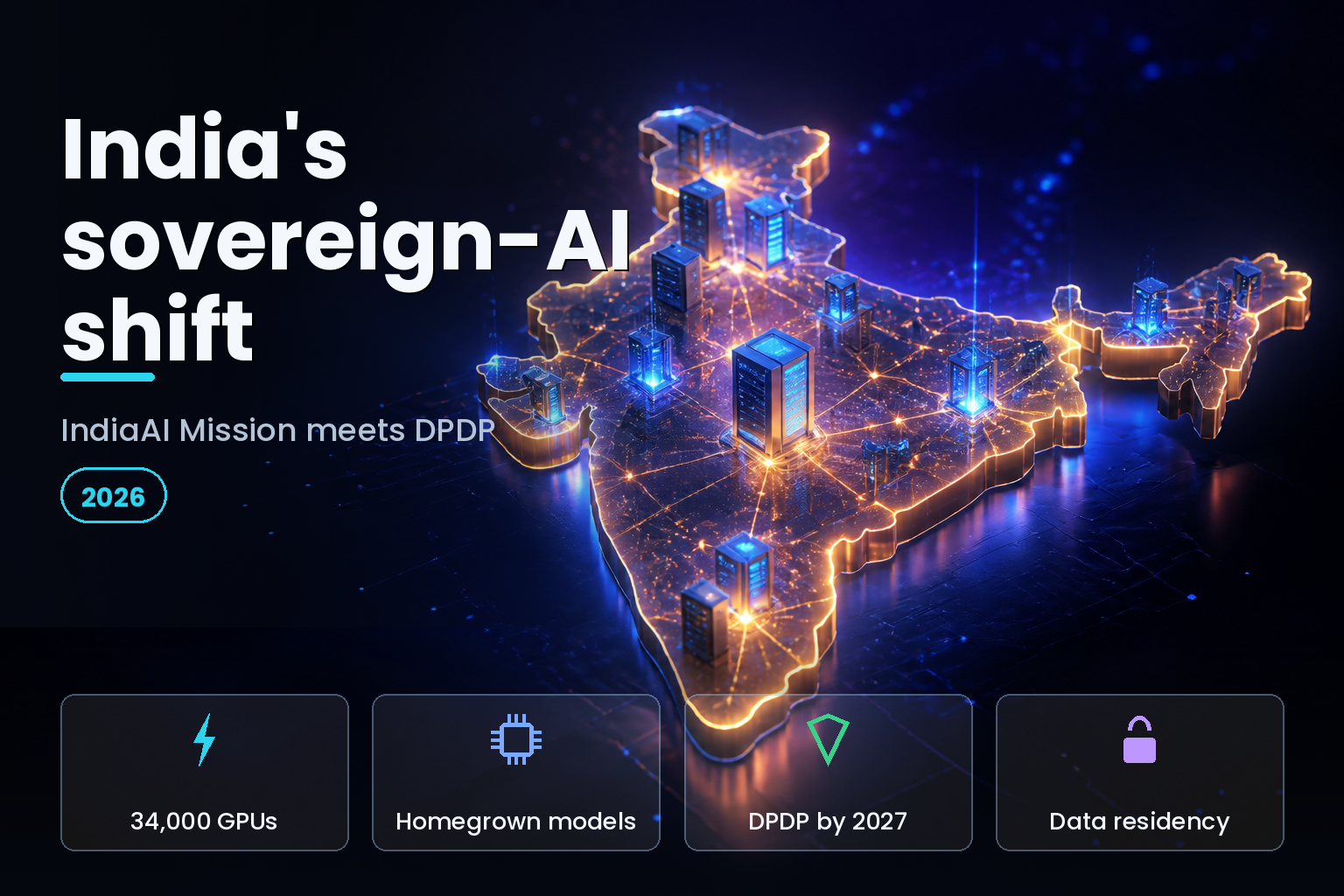
Summary. India is building a case for running enterprise AI on Indian soil, and the numbers are getting hard to ignore. The IndiaAI Mission, sanctioned at Rs 10,371.92 crore (about $1.25 billion) by the Cabinet in March 2024, had deployed roughly 34,000 GPUs by mid-2026 at heavily subsidised rates, and Union Minister Ashwini Vaishnaw has set a target of 100,000 public GPUs by December 2026. Homegrown models arrived too: Sarvam released Sarvam-30B and Sarvam-105B on 18 February 2026. On the rules side, the Digital Personal Data Protection Rules were notified on 14 November 2025, starting an 18-month compliance clock that ends on 13 May 2027. Together, subsidised compute, capable Indian models, and a data-localisation-friendly law are nudging enterprise AI procurement toward sovereign, India-built infrastructure. This guide explains what changed and how to plan.
For a CTO or founder in India, the question is no longer only which model is best. It is where your AI runs, whose infrastructure it sits on, and whether your data handling will survive a DPDP audit. This pillar walks through the compute build-out, the model landscape, the law, and a practical procurement framework.
The compute build-out: subsidised GPUs at national scale
The core of India's sovereign-AI push is cheap, accessible compute. The IndiaAI Mission spans seven pillars, compute, foundation models, datasets, application development, AI safety, startup support, and skills, but compute is the piece that changes procurement math first, as NVIDIA detailed.
By mid-2026, the mission had deployed roughly 34,000 GPUs across Indian data centers, accessible to registered startups, academic researchers, and government agencies at heavily subsidised rates, reported at around ₹65 per GPU-hour, a fraction of what comparable H100 time costs on a hyperscaler, per explainx.ai. That price gap is the point: it lets Indian teams train and serve models without hyperscaler bills.
The build-out is accelerating. At the AI Impact Summit, Vaishnaw announced adding 20,000 GPUs to reach 54,000 in the near term, on the way to 100,000 public GPUs by December 2026, as AI Spectrum India reported. Private capacity is scaling alongside: Yotta's "Shakti Cloud" runs on more than 20,000 NVIDIA Blackwell Ultra GPUs, and Larsen & Toubro is building gigawatt-scale AI-factory infrastructure with a 30-megawatt expansion in Chennai and a 40-megawatt facility in Mumbai.
| IndiaAI compute | Status (mid-2026) | Target |
|---|---|---|
| Public GPUs deployed | ~34,000 | 100,000 by December 2026 |
| Near-term addition | +20,000 announced | 54,000 in the near term |
| Subsidised access rate | ~₹65 per GPU-hour (reported) | Sustained subsidy for startups and researchers |
| Mission outlay | Rs 10,371.92 crore (~$1.25 billion) | Seven pillars, sanctioned March 2024 |
| Private sovereign cloud | Yotta Shakti Cloud, 20,000+ Blackwell Ultra GPUs | Gigawatt-scale L&T AI factories |
Sources: NVIDIA, explainx.ai, and AI Spectrum India. This connects directly to the wider GPU cost squeeze enterprises face globally.
Homegrown models are now credible
Subsidised compute would mean little without models worth running. That gap is closing. Sarvam released two open models on 18 February 2026: Sarvam-30B, a mixture-of-experts design, and Sarvam-105B, which activates roughly 9 billion parameters per token and carries a 128,000-token context window, per explainx.ai. BharatGen has built a 17-billion-parameter mixture-of-experts model using NVIDIA's NeMo framework.
The political read is confident. "In one year from now, most of our AI-related work, we should be able to do with our sovereign models," Ashwini Vaishnaw, Union Minister for Electronics and Information Technology, said in an interview at Davos, per Business Today. He also set an investment marker at the AI Impact Summit: "We are aiming to attract up to $200 billion in AI investments across compute, data and application layers over the next two years," as Storyboard18 recorded.
The honesty check matters too. Indian open models are improving fast but do not yet top global frontier leaderboards, and a genuine sovereignty question sits underneath the branding: infrastructure and models built with foreign chips and, in some cases, foreign access paths are not fully independent, as The Ken has argued. For most enterprise workloads, though, an Indian model on Indian infrastructure is already good enough and materially cheaper, which is what drives procurement.
The startup and capital signal
Sovereign infrastructure is pulling capital and company formation with it. India now hosts more than 170 AI startups that have collectively raised over $2.6 billion, per Inc42. The global platforms are leaning in: Google selected 20 Indian AI startups for its 2026 accelerator from roughly 2,500 applications, as Analytics India Magazine reported, and SAP Labs India launched a 2026 Startup Studio cohort focused on enterprise AI and deep tech.
For an enterprise buyer, that ecosystem depth means real choice among India-based vendors who understand local data rules, languages, and cost pressure. It also means the sovereign path is no longer a compromise on talent. Our generative AI enterprise strategy guide covers how to fold local vendors into a broader model portfolio.
The rules changed: DPDP is now a live clock
The second force reshaping procurement is regulation. The Digital Personal Data Protection Act, 2023 (DPDP) sat without operative rules for two years. That ended on 14 November 2025, when the Ministry of Electronics and Information Technology notified the DPDP Rules, 2025, starting a phased, 18-month compliance timeline, per India Briefing and EY.
The Act applies to virtually any organisation that processes the digital personal data of individuals in India, regardless of size or sector, from fintech apps and hospitals to manufacturing and SaaS firms. That breadth is why it touches AI procurement directly: if your model or vendor processes personal data, the deployment path is now a compliance decision, not only a cost one.
| DPDP milestone | Date | What it means for you |
|---|---|---|
| DPDP Act passed | 2023 | Primary law enacted, rules pending |
| DPDP Rules notified | 14 November 2025 | 18-month compliance clock starts |
| Data Protection Board established | November 2025 | Enforcement body stood up |
| Consent Manager Framework operational | ~13 November 2026 | Consent infrastructure goes live |
| Full compliance deadline | 13 May 2027 | All covered businesses must comply |
Sources: India Briefing and EY.
Readiness is uneven. Surveys summarised by ShieldByte Infosec show nearly 70% of organisations report limited familiarity with the Act, 71% struggle to interpret it, and only 38% have classified their personal data or identified third-party processors. For AI teams, that last figure is the warning: you cannot document how a model handles personal data if you have not classified the data first. Our guide to the DPDP consent manager framework breaks down the operational steps.
How sovereign compute and DPDP push procurement the same way
These two forces point in one direction. Subsidised Indian GPUs lower the cost of keeping workloads onshore, and DPDP raises the cost and risk of sending personal data offshore without airtight terms. The result is a procurement gravity toward Indian infrastructure and vendors for any workload that touches regulated data.
That does not mean abandoning global models. It means matching the workload to the right home.
| Procurement path | Best for | Trade-offs |
|---|---|---|
| IndiaAI subsidised compute | Startups, research, cost-sensitive training | Access limited to registered entities; capacity contended |
| Private sovereign cloud (Yotta, L&T) | Regulated workloads needing Indian residency | Newer platforms; verify SLAs and regions |
| Indian open models (Sarvam, BharatGen) | Cost-sensitive inference, Indic languages | Not yet frontier-topping on every benchmark |
| Global frontier models in-region | Hardest reasoning and agentic tasks | Confirm data residency and DPDP-compliant terms |
| Global models via consumer endpoints | Non-personal, low-risk experimentation | Weakest compliance posture; avoid for regulated data |
The pattern is clear: use sovereign compute and Indian models where cost and residency dominate, and reserve global frontier models for the hardest tasks, always under contracts that keep personal data within your DPDP consent basis.
A practical procurement framework for 2026
Turn the strategy into five decisions.
Classify data first. Before choosing any model or cloud, classify what personal data the workload touches and identify every third-party processor. This is a DPDP requirement and the input to every later choice.
Match residency to risk. Route workloads that process personal data of Indian users to Indian infrastructure, sovereign cloud, or in-region deployments with contractual residency, not consumer endpoints. Keep non-personal experimentation flexible.
Cost the compute honestly. Compare IndiaAI or sovereign-cloud GPU rates against hyperscaler pricing for your real usage, including the subsidised access where you qualify. The savings can be large, but capacity is contended, so plan lead times.
Keep the architecture portable. Even on sovereign infrastructure, avoid designs that lock you to a single model or provider, so you can move as capability and price shift. This mirrors the model-portability advice in our enterprise AI strategy work.
Write the contracts for the audit. Whoever supplies the model or cloud, the enterprise remains the data fiduciary under DPDP. Bake data access, residency, retention, and breach terms into every agreement now, well before the May 2027 deadline.
Where the shift bites first: a sector view
The pull toward sovereign infrastructure is not uniform. It is sharpest where personal or sensitive data meets heavy AI use, and lighter where workloads are non-personal or experimental.
| Sector | Why sovereign pull is strong | First move |
|---|---|---|
| Banking and fintech | Personal and financial data under DPDP plus sector rules | Classify data; route processing to in-region, compliant infrastructure |
| Healthcare | Sensitive health data; CDSCO and DPDP overlap | Build a DPDP-aligned data architecture before model selection |
| Public sector | Sovereignty mandate and IndiaAI access | Use IndiaAI compute and Indian models where eligible |
| Retail and D2C | Large consumer datasets; cost-sensitive inference | Indian open models for scale, frontier models for edge cases |
| SaaS and startups | Registered access to subsidised GPUs | Train on IndiaAI compute; keep architecture portable |
Banking, healthcare, and public-sector workloads feel the shift first because their data is both regulated and valuable, so the compliance cost of an offshore consumer endpoint is highest there. Retail and D2C follow, driven more by inference cost than by regulation, which makes Indian open models attractive for high-volume, lower-risk tasks. Startups sit in a favourable spot: they can register for subsidised IndiaAI compute and build sovereign from day one, provided they keep the architecture portable rather than welding it to a single provider. The common thread is sequencing, classify the data, then let the sensitivity of that data decide how far toward sovereign infrastructure each workload should move.
India-specific considerations
Two local realities deserve emphasis. First, the subsidy is conditional: IndiaAI's cheapest compute is aimed at registered startups, researchers, and government users, so a mid-market enterprise may still buy through private sovereign clouds rather than the public pool. Budget accordingly. Second, sovereignty is a spectrum, not a switch. Running on Indian data centers with foreign chips and foreign-owned software is more sovereign than a US consumer endpoint, but not absolute independence, a nuance worth stating plainly to boards rather than overselling. For regulated sectors such as healthcare, the data-architecture bar is higher still, as our clinical AI and DPDP guide sets out.
How eCorpIT can help
eCorpIT is a Gurugram-based, senior-led technology consultancy that helps Indian enterprises make these procurement calls with clear eyes. We classify your data against DPDP, compare IndiaAI and sovereign-cloud compute against hyperscaler pricing for your real workloads, evaluate Indian and global models on your tasks, and write contracts that keep you compliant and portable ahead of the May 2027 deadline. If you are planning where your AI should run in 2026, talk to our team.
FAQ
References
- Google picks 20 AI startups for India accelerator from 2,500 applications — Analytics India Magazine
_Last updated: 10 July 2026._