On this page · 10 sections
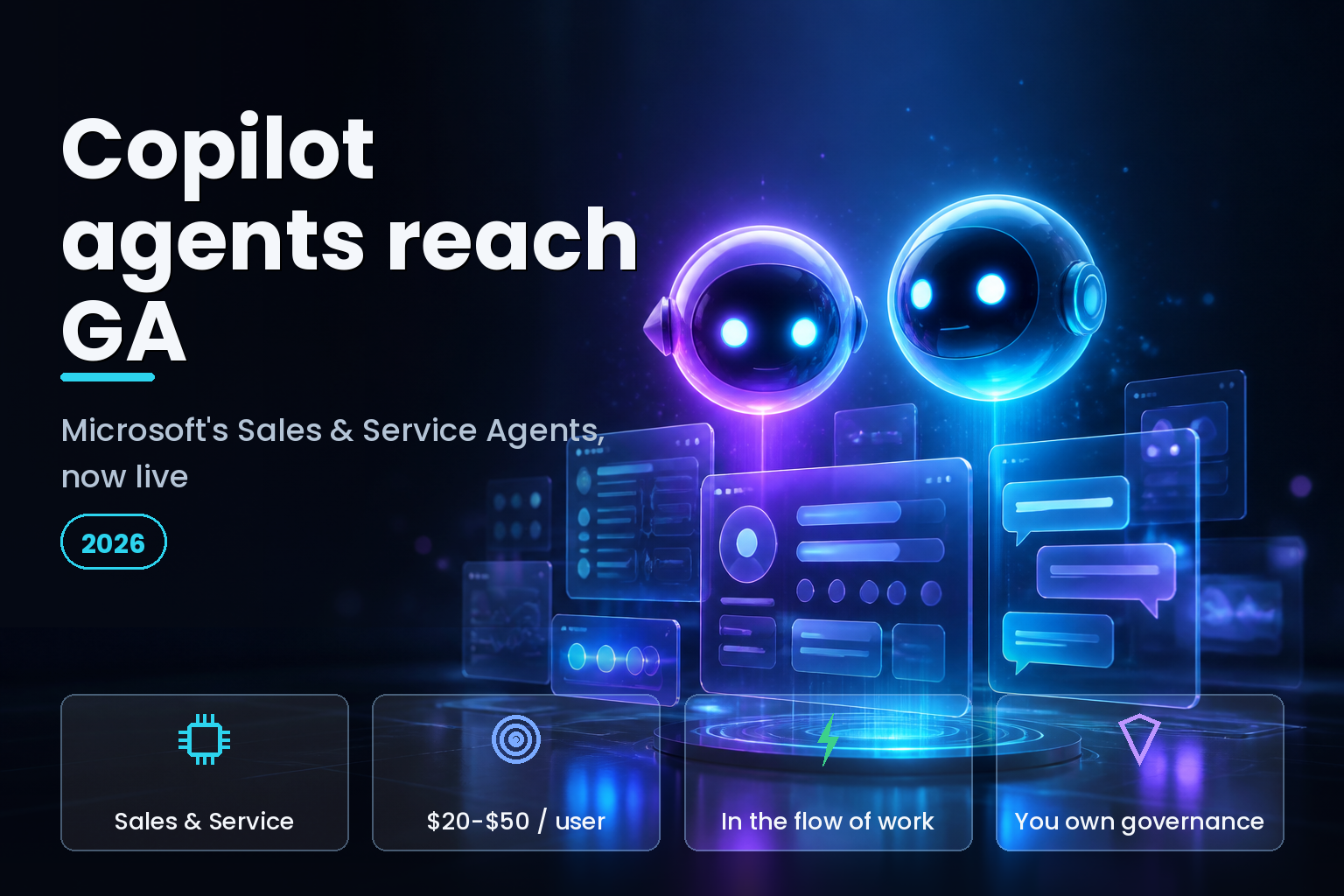
Summary. Microsoft has moved its packaged AI agents from preview into production. Service Agent reached general availability on 30 June 2026, per the Dynamics 365 blog, and Sales Agent is available alongside it, both running inside Dynamics 365 and Microsoft 365 Copilot. They are part of the 2026 Release Wave 1, published on 18 March 2026, which began rolling to general availability from 1 April 2026 and continues through September. Pricing is concrete: Copilot for Sales runs $50 per user per month standalone, or $20 per user per month as an add-on for existing Microsoft 365 Copilot subscribers. Deva Rajamohan, Corporate Vice President of Dynamics 365 Customer Experience at Microsoft, framed the pitch on 7 July 2026: "Agentic AI resets the equation. Rather than adding another tool to manage, it brings intelligence directly into the flow of work," in coverage of the Dynamics 365 customer-experience agent portfolio. For enterprises, the real question is what these agents do, what they cost, and when to build your own instead.
Packaged agents from a platform vendor change the build-versus-buy math for every sales and support team. This analysis covers what shipped, the licensing, and how to decide.
What actually reached general availability
Two role-based agents anchor the release. Service Agent, now generally available per the Microsoft Dynamics 365 blog, helps support teams resolve cases faster. At GA it includes case and customer context to summarise cases and interactions, knowledge and answer discovery to search and synthesise from trusted knowledge sources, and service actions to update cases, create notes, and draft customer communications.
Sales Agent is a role-based Copilot experience that brings AI insights, conversational intelligence, and seller workflows across Microsoft 365, embedding into Outlook, Teams, mobile, and Copilot chat. It gives sellers real-time account summaries, opportunity context, and post-meeting CRM capture in natural language, as CX Today reported. Both agents sit within a wider push: Microsoft made Agent 365, its agent management and governance layer, generally available on 1 May 2026, and it has added real-time voice agents across the Dynamics 365 customer-experience portfolio.
| Capability | Sales Agent | Service Agent |
|---|---|---|
| Primary user | Sellers and sales managers | Support and service teams |
| Core job | Account summaries, opportunity context, CRM capture | Case summaries, knowledge discovery, case actions |
| Where it runs | Outlook, Teams, mobile, Copilot chat | Microsoft 365 Copilot and Dynamics 365 |
| Autonomy | Assists and drafts inside the seller's flow | Resolves and updates cases with actions |
| GA status | Available in 2026 Release Wave 1 | Generally available 30 June 2026 |
Sources: Microsoft Dynamics 365 blog and CX Today. For the broader pattern, see our guide to AI agents in customer experience.
The pricing and licensing reality
Packaged does not mean simple to license. The headline number is clear, but access depends on which Microsoft licences you already hold.
| Item | Detail | Note |
|---|---|---|
| Copilot for Sales, standalone | $50 per user per month | Full seller experience without M365 Copilot |
| Copilot for Sales, add-on | $20 per user per month | For existing Microsoft 365 Copilot subscribers |
| Service Agent access | Dynamics 365 Customer Service licence | Enterprise or Premium edition for case data |
| Service Agent, full experience | Microsoft 365 Copilot licence | Unlocks case context and AI actions in one place |
| Governance | Microsoft Agent 365 | GA since 1 May 2026 for agent management |
Sources: Microsoft Dynamics 365 Sales pricing and Microsoft Security blog.
The practical lesson: if your organisation already runs Microsoft 365 Copilot, the $20 add-on path is the cheaper on-ramp, and Service Agent leans on your existing Dynamics 365 Customer Service licence. Teams without that base will pay more and should model the total, not the sticker line.
Why Microsoft is packaging agents now
The strategy is distribution. Microsoft already sits inside the daily tools of most enterprises, so embedding agents into Outlook, Teams, and Dynamics 365 puts AI where the work happens rather than in a separate app. Rajamohan's framing, that agentic AI brings intelligence into the flow of work rather than adding another tool, is the whole argument. It also fits the 2026 Release Wave 1 plan, which embeds autonomous agents across Sales, Finance, Service, and ERP, with general availability rolling from 1 April 2026 through September, per Cynoteck.
For teams already standardised on Microsoft, the appeal is real: less integration work, native governance through Agent 365, and data that stays inside the Microsoft tenant. Our note on enterprise AI agents in production covers why that last mile of integration usually decides success.
Build versus buy: how to decide
Packaged agents are a strong default for common workflows, but they are not always the right answer. The decision turns on fit, control, and cost.
| Factor | Microsoft packaged agents | Custom-built agents |
|---|---|---|
| Time to value | Fast; native to existing tools | Slower; needs design and build |
| Fit to your workflow | Good for standard sales and service flows | Tailored to your exact process |
| Model choice | Microsoft stack and models | Any model you select and route |
| Data and governance | Inside the Microsoft tenant and Agent 365 | Yours to design and own |
| Cost shape | Per-user licences | Build cost plus token and infrastructure |
| Lock-in | Tied to the Microsoft ecosystem | Portable if architected that way |
Buy when the workflow is standard, your stack is already Microsoft, and speed matters more than bespoke control. Build when the process is a competitive differentiator, you need model flexibility, or you must run outside the Microsoft ecosystem. Many enterprises will do both: packaged agents for common sales and service tasks, custom agents where the work is specific. Keeping the option to route across models, as we discuss in our comparison of GPT-5.6 and Claude Sonnet 5 for agents, matters most when you build.
Governance still sits with you
A packaged agent shortens setup, but it does not remove your responsibility. Service Agent can update cases and draft customer messages; Sales Agent captures CRM data and summarises accounts. Both act on real business data, so access scope, human review, logging, and rollback still need design. Microsoft's Agent 365 provides a management layer, but the policies are yours to set. Our guide to enterprise AI agent governance covers the control layers that matter once an agent can take actions.
A 60-day pilot plan
Packaged agents lower the setup cost, but a disciplined pilot still beats a broad switch-on. The goal is to prove value on a narrow slice before you license a whole team.
| Phase | Action | Success signal |
|---|---|---|
| Weeks 1-2 | Pick one workflow and one team; set access scope | Clear use case and a measurable baseline |
| Weeks 3-4 | Enable the agent for a small pilot group; add human review | Agent drafts or resolves without policy breaches |
| Weeks 5-6 | Measure against the baseline; tune knowledge sources | Time saved or cases resolved improves |
| Weeks 7-8 | Review governance, cost per seat, and errors | A go or no-go decision backed by data |
Start with Service Agent on a single high-volume case type, or Sales Agent for one seller segment, rather than the whole org. Keep a human in the loop on any action that touches a customer, and measure a real baseline first, so the pilot proves a number, not a feeling. If the agent clears the bar on time saved and error rate without governance surprises, expand; if not, the per-seat licence stays small while you rethink. This staged approach is the same one we recommend for any conversational AI in customer experience.
India-specific considerations
For Indian enterprises, two points shape adoption. The first is cost in local terms: at $50 per user per month, a 100-seat sales team is roughly $60,000 a year, near ₹50 lakh, so the per-seat maths deserves a hard ROI case before a broad rollout, especially where an existing Microsoft 365 Copilot base makes the $20 add-on far cheaper. The second is data governance under the Digital Personal Data Protection Act, 2023 (DPDP). Sales and Service Agents process customer personal data, so even with data kept in the Microsoft tenant, your organisation remains the data fiduciary and must set consent, retention, and access terms. Fold DPDP checks into the rollout rather than treating the vendor's controls as sufficient on their own. For the wider view, see our work on AI in customer service and cost.
How eCorpIT can help
eCorpIT is a Gurugram-based, senior-led technology consultancy that helps teams get real value from agentic AI. We assess whether Microsoft's packaged Sales and Service Agents fit your workflows, model the licensing against a custom-build alternative, and design the governance, access, and DPDP controls that keep agent actions safe on real customer data. If you are weighing Copilot agents against building your own, talk to our team.
FAQ
References
_Last updated: 10 July 2026._