On this page · 12 sections
- What Meta actually shipped on 5 August
- The two tiers, side by side
- What the discount is actually worth per month
- The rate limit is the second price, and it is the one that will bite
- What "we train on your prompts and completions" means for a repository
- A decision rule you can actually apply
- What Meta has not published
- India-specific considerations
- Running both tiers without creating a mess
- FAQ
- How eCorpIT can help
- References
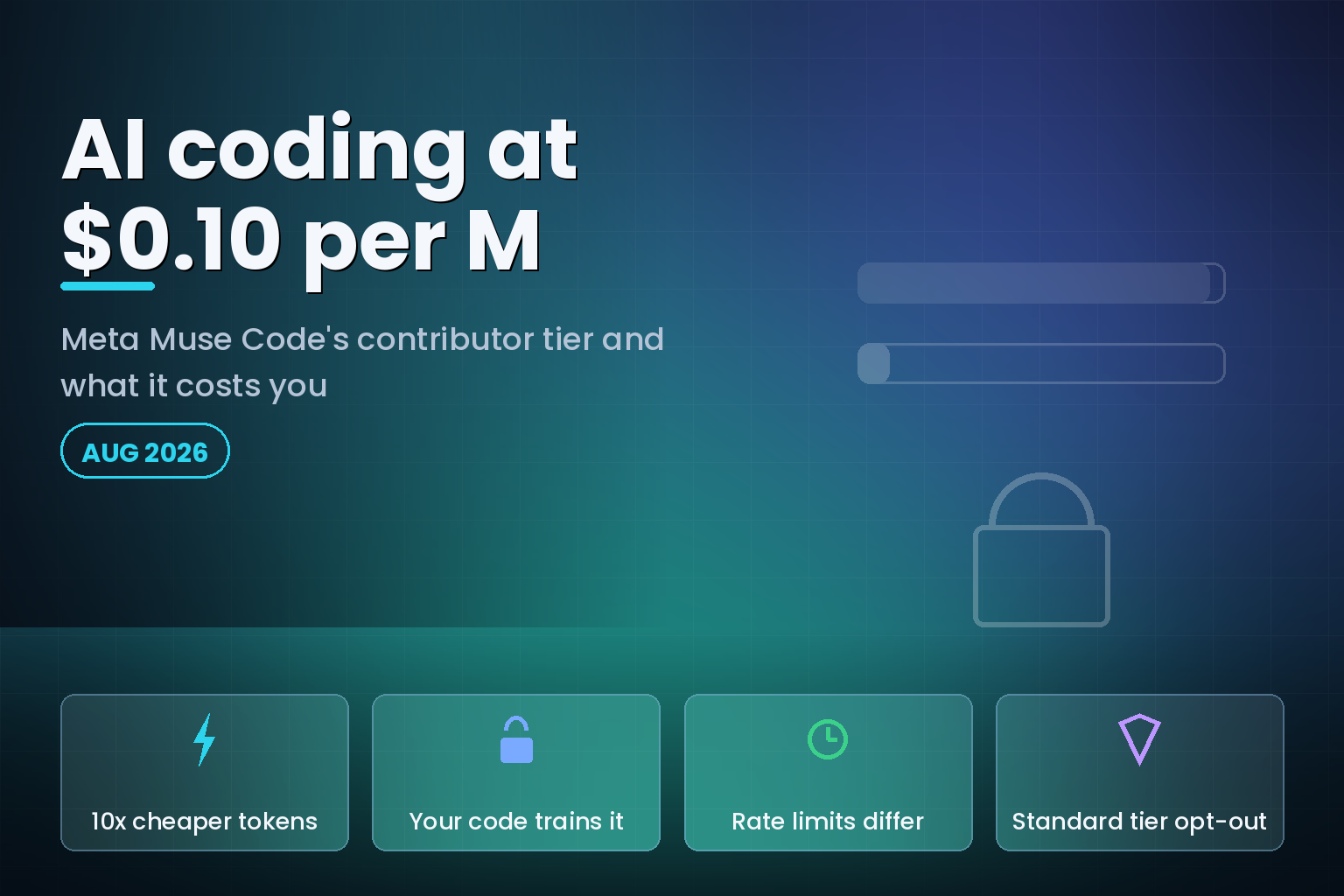
Summary. Meta released Muse Code in beta on 5 August 2026, a terminal coding agent powered by Muse Spark 1.2, and priced it two ways. The standard tier bills $1.25 per million input tokens and $4.25 per million output tokens, and Meta does not train on those prompts and completions. The contributor tier bills $0.10 and $0.20 for the same model, a 92% cut on input and 95% on output, in exchange for permission to train on your session data. Alexandr Wang, Meta's AI chief, called the cheap tier "more than 10-times cheaper" than any other. The discount is real. So is the second price nobody is quoting: the contributor tier is capped at 60 requests per minute against 3,000 on standard, and 2.1 million tokens per minute against 4 million. For a team burning 300 million input and 40 million output tokens a month, the two tiers cost $545 and $38 respectively. That $507 gap is the number your legal team is being asked to sell your source code for.
This is a procurement decision dressed up as a pricing page. Below is the arithmetic, the throughput ceiling that the price comparison hides, and a rule for deciding which repositories can go on which tier.
What Meta actually shipped on 5 August
Muse Code is a terminal agent for macOS and Linux with no desktop application, installed with one command from Meta's developer domain. It is Meta's answer to Anthropic's Claude Code and OpenAI's Codex, and its first serious entry into agentic coding.
Three design choices in Meta's launch post matter more than the marketing:
Persistent background agents. Muse Code runs a main agent loop alongside a set of async background agents that stay alive for the whole session rather than being spawned per task. Meta's stated reason is that persistent agents avoid re-gathering the same repository context on every step, which cuts latency and the amount of steering a developer has to do on long tasks.
A replay-exact event log. Every model call, tool run, approval and edit is appended to a local log. Meta describes the runtime as replay-exact and restart-safe: after a crash the agent resumes precisely where it stopped. For anyone who has lost a 40-minute agent run to a dropped connection, this is the most useful thing in the release.
Bundled skills. /plan converts a task into an approval-gated plan, /grill stress-tests that plan until it holds, and /goal drives toward a stated objective.
Mark Zuckerberg described the parallelism on X: "When a job is big enough, it fans out to separate sub-agents working in parallel in isolated worktrees. Your working copy is never touched. In testing we had it build six features for a game simultaneously with no collisions." TechCrunch and SiliconANGLE both carried the same wording on launch day.
The model underneath, Muse Spark 1.2, is a coding-focused update to Muse Spark 1.1. Meta co-trained it with the Muse Code harness itself, using rejection-sampled harness trajectories and tuning for goals, context compaction and subagents. Meta also ran a kernel-optimization case study in which the agent iterated on KDA and MLA kernels for NVIDIA Hopper GPUs across more than 1,000 tool calls and up to 24 hours of wall-clock time, benchmarked against a PyTorch reference at batch size 1, 64 heads, sequence length 8192 and latent dimension 512.
Muse Spark 1.2 is available in Muse Code, in the Meta Model API, and through OpenRouter.
The two tiers, side by side
Here is the full comparison, as reported by MacRumors on launch day.
| Attribute | Contributor tier | Standard tier | Ratio |
|---|---|---|---|
| Input, per 1M tokens | $0.10 | $1.25 | 12.5x cheaper |
| Output, per 1M tokens | $0.20 | $4.25 | 21.3x cheaper |
| Meta trains on your prompts and completions | Yes, required | No | — |
| Requests per minute | 60 | 3,000 | 50x fewer |
| Tokens per minute | 2,100,000 | 4,000,000 | 1.9x fewer |
| Model | Muse Spark 1.2 | Muse Spark 1.2 | Identical |
The model is the same on both tiers. You are not buying a weaker model cheaply; you are buying the same model under a different licence and a different throughput cap.
Wang put the commercial logic plainly to the Wall Street Journal: "We think that for a lot of workflows and a lot of use cases, this can be an incredibly good option, especially from a cost perspective." He was quoted by SiliconANGLE saying the contributor tier is "more than 10-times cheaper" than any other tier, and told CNBC that undercutting Claude and Codex on price is the differentiation strategy.
That framing is honest about what Meta wants. Meta narrowed its annual capital expenditure forecast on 29 July 2026 as its AI buildout grew, and coding is one of the few AI applications with proven enterprise willingness to pay. Cheap tokens buy training data; training data buys a better model; a better model sells more tokens.
What the discount is actually worth per month
Take a mid-sized product team running agentic coding seriously: roughly 300 million input tokens and 40 million output tokens a month across ten engineers. That is a plausible load once agents are reading whole repositories and running validation loops, and it is the scale at which token pricing stops being a rounding error.
| Model and tier | Input cost | Output cost | Monthly total |
|---|---|---|---|
| Muse Spark 1.2, contributor | $30 | $8 | $38 |
| Muse Spark 1.2, standard | $375 | $170 | $545 |
| Claude Haiku 4.5 | $300 | $200 | $500 |
| Claude Sonnet 5 (to 31 Aug 2026) | $600 | $400 | $1,000 |
| Claude Sonnet 5 (from 1 Sep 2026) | $900 | $600 | $1,500 |
| Claude Opus 5 | $1,500 | $1,000 | $2,500 |
| GPT-5.6 Sol | $1,500 | $1,200 | $2,700 |
Competitor rates are the published August 2026 list prices: Claude Opus 5 at $5/$25, Haiku 4.5 at $1/$5, and Sonnet 5 at $2/$10 through 31 August 2026 before it steps to $3/$15, per Anthropic's pricing documentation and the CloudZero and Finout breakdowns; GPT-5.6 Sol at $5/$30, which matches Opus 5 on input and costs more on output.
Three things fall out of that table.
First, the headline saving inside Muse Code is $507 a month at this volume. Real money, but not the kind of money that usually moves an enterprise procurement process. It becomes interesting at 10x the volume, or in a startup where $500 a month is a meaningful line item.
Second, Muse Code's standard tier is already the cheapest frontier-class coding option in the table, undercutting even Claude Haiku 4.5 and landing at roughly a third of Claude Sonnet 5's price after the September step-up. If Meta's motive is to win on price, standard tier alone does that. The contributor tier is not a pricing play. It is a data-acquisition play with a pricing wrapper.
Third, the Sonnet 5 introductory rate expires on 31 August 2026. Any cost comparison built this month against Sonnet 5 quietly gets 50% worse on 1 September. If you are modelling a switch, model it against $3/$15, not $2/$10. We covered that trap in detail in our budget LLM tier cost comparison.
The rate limit is the second price, and it is the one that will bite
Everybody is quoting the token prices. Almost nobody is quoting the throughput.
The contributor tier allows 60 requests per minute. That is one request per second. Muse Code's entire architectural pitch is parallel subagents plus persistent background agents — Zuckerberg's own example is six features being built simultaneously. Six concurrent subagents, each making a tool call or model call every two seconds, is 180 requests per minute. You would be rate-limited three times over before the persistent background agents made a single call.
The standard tier's 3,000 requests per minute is 50 times higher. That is not a small-print difference; it is the difference between the product working as designed and the product queuing.
The token ceiling is less brutal but still real: 2.1 million tokens per minute against 4 million. At 2.1M TPM, a single agent doing whole-repository reads on a large monorepo can saturate the account by itself, which means a second engineer on the same key waits.
The practical reading: the contributor tier is priced for one developer prototyping, not for a team running the agent the way Meta built it to run. If you were planning to put a ten-person team on the cheap tier to save $507 a month, the throughput ceiling will make that decision for you before your general counsel does.
This pattern is not new. It is the same shape as the rate-limit-versus-price tradeoff we mapped across harnesses in AI coding agent harness comparison, and it is why raw per-token price is a poor way to choose an agent.
What "we train on your prompts and completions" means for a repository
On the standard tier, Meta commits that prompts and completions are not used to train its models. On the contributor tier, they are — that is the entire consideration Meta receives.
For a solo developer building a side project, this is a fair trade and probably a good one. For a company, three questions decide it, and none of them are technical.
Does your client contract permit it? Most software services agreements and NDAs written before 2024 restrict disclosure of confidential information to "third parties" or limit its use to a defined purpose. They say nothing about machines. Bloomberg Law's analysis of NDA drafting and Carta's guide to AI clauses in NDAs both make the same point: silence in an old NDA is not permission, and a counterparty who discovers their code went into a training corpus will not accept "the contract did not forbid it" as an answer. If you build software for clients, the contributor tier is a decision your clients get to make, not you.
What is actually in the prompt? An agentic coding session is not a chat message. Muse Code reads across large repositories, so the prompt window over a working session can contain architecture, business logic, embedded configuration, test fixtures and, if your hygiene is imperfect, credentials. The blast radius of "we train on your prompts" scales with how much of the repository the agent reads, and Muse Code is explicitly built to read a lot of it.
Who else in your organisation can enable it? The install is one shell command and the default onboarding routes developers to pay-as-you-go. There is no group policy, no SSO gate, no admin console described in the launch material. Whichever tier your policy specifies, an individual engineer can pick the other one on a laptop in about ninety seconds. Enforcement has to happen at the network or the key-issuance layer, not in a policy document.
PYMNTS reported in 2026 that broad "improve, build or enhance the product" clauses in ordinary enterprise software agreements already function as training licences over customer data, often without the customer registering it. Meta's contributor tier is at least the honest version of that: the licence is the price, stated on the page. That candour is worth something. It does not make the licence smaller.
The engineering judgement here is simple. The real cost is rarely the tokens; it is the contract you did not read before your agent read your repository.
A decision rule you can actually apply
Do not make this a company-wide yes or no. Make it a per-repository classification, because the answer genuinely differs by repository.
| Repository class | Contributor tier | Reasoning |
|---|---|---|
| Throwaway prototypes, spikes, hackathon code | Yes | No confidentiality interest, no client contract, cost dominates |
| Public open-source you already publish | Yes | The code is already public; training on it changes nothing material |
| Internal tooling with no client data or client code | Case by case | Depends on whether the tooling encodes proprietary method |
| Product source owned by your company | No by default | Your competitive position is in this code |
| Client-owned code under a services agreement | Never without written client consent | Not your data to license |
| Anything touching regulated or personal data | Never | Prompt contents may include data you are not free to transfer |
Two operational notes on making that stick.
Issue separate API keys per class rather than per person, and let the key carry the tier. A key is auditable; a policy PDF is not. And run the agent inside an isolated workspace rather than a developer's full home directory, so the blast radius of a repository read is bounded by the sandbox — the approach we set out in our sandbox isolation guide for AI coding agents.
What Meta has not published
Three gaps are worth naming, because they change how much weight to put on the launch.
Meta's post carries bar charts for Terminal-Bench 2.1, DeepSWE 1.1 and a Meta Internal Coding Bench, comparing Muse Spark 1.2 with other coding models. The charts are images. The underlying scores are not stated in the page text, and the detail sits in a separate evaluation methodology report. A benchmark that ships as a picture is a benchmark you cannot yet check, and "Meta Internal Coding Bench" is by construction not independently reproducible. Treat all three as vendor claims until third parties run Terminal-Bench 2.1 themselves.
There is no published enterprise administration story. No admin console, no SSO, no organisation-level tier enforcement appears in the launch material or the coverage. For a product whose cheap tier turns on a data-sharing decision, that absence is the single biggest blocker to enterprise adoption.
And Muse Code is beta. Meta says larger and more capable models are on the way and that the harness will gain features. Prices set to acquire training data during a beta are not a stable planning basis. Model the switching cost before you standardise on it — the same discipline we applied to Muse Spark 1.1 in Muse Spark 1.1 API cost switching for agents.
India-specific considerations
For Indian product teams and services firms, three factors change the calculation.
Client code is the default, not the exception. India's software services and GCC model means a large share of engineering work happens on code that belongs to someone else. For that work the contributor tier is not a cost decision at all — it is a contractual one, and the answer is no until the client says otherwise in writing. Firms that quietly enable it are creating a disclosure obligation they will have to satisfy at the next client audit.
DPDP applies to what is inside the prompt, not to the code as such. The Digital Personal Data Protection Act 2023 governs personal data. Source code is not personal data, but test fixtures, seed databases, log samples and support tickets pasted into an agent session frequently are. Once the prompt is licensed for model training, the personal data inside it travels with it. Strip it before it reaches the agent; we set out a working approach in our PII redaction before LLM calls guide, and the wider obligations in the DPDP engineering playbook for Indian startups.
Billing is in US dollars. Token prices are quoted in USD, so an Indian team carries the exchange rate on top of the list price and sees a bill that moves even when usage does not. At the volumes in the table above the absolute numbers are small, but they belong in the FinOps model rather than on a corporate card, and they should be tracked per repository so the cost lands on the project that generated it.
Running both tiers without creating a mess
The workable pattern is routing by repository class, enforced at key issuance rather than by asking engineers to remember a rule.
            # One key per repository class, not per developer.
# The tier is a property of the key, so it is auditable.

export MUSE_API_KEY="$(vault kv get -field=key \
  secret/muse/${REPO_CLASS:?set REPO_CLASS})"

# Refuse to run the cheap tier outside the allowed classes.
case "$REPO_CLASS" in
  prototype|oss) ;;                       # contributor key is fine
  product|client|regulated)
    if [ "$MUSE_TIER" = "contributor" ]; then
      echo "refusing: contributor tier not permitted for $REPO_CLASS" >&2
      exit 1
    fi ;;
  *) echo "unknown REPO_CLASS: $REPO_CLASS" >&2; exit 1 ;;
esac
Pair that with a monthly reconciliation of spend by key. If a contributor-tier key shows traffic from a product repository, you have a control failure you can see in a billing export rather than one you find in a client audit. The broader routing pattern — cheap model for cheap work, expensive model for work that justifies it — is the same one we mapped in LLM hybrid routing and API spend decisions, and it is worth setting up before, not after, the bill arrives.
For teams still choosing a primary agent rather than adding a second one, the head-to-head cost analysis in Claude Opus 5 versus GPT-5.6 Sol for coding agents and the model-selection framework in Gemini 3.5 Pro versus GPT-5.6 versus Claude Fable 5 cover the ground Muse Code now enters.
FAQ
How eCorpIT can help
eCorpIT builds and governs AI-assisted development pipelines for product teams in India and abroad, and the tier question above is the kind of decision we work through with clients before a tool spreads across an engineering org. Our senior engineering teams set up per-repository key issuance, sandboxed agent workspaces, spend attribution and the contract review that has to sit underneath any training-rights decision. As an ISO 27001:2022 certified and CMMI Level 5 assessed organisation, we design these controls to be auditable rather than aspirational. If you are weighing Muse Code, Claude Code or Codex across a team and need the governance to hold up at a client audit, get in touch.
References
- Meta Superintelligence Labs, Introducing Muse Code and Muse Spark 1.2, 5 August 2026.
- Meta, Muse Spark 1.2 evaluation methodology report, August 2026.
- Meta for Developers, Build with Muse Code, August 2026.
- Juli Clover, Meta's New Mac Coding Agent Costs Up to 20x Less If You Let Meta Train on Your Data, MacRumors, 5 August 2026.
- Lucas Ropek, Meta launches Muse Code, an AI agent for large code bases, TechCrunch, 5 August 2026.
- Mike Wheatley, Meta takes on Anthropic and OpenAI with its first AI coding agent, Muse Code, SiliconANGLE, 5 August 2026.
- Wesley Hilliard, Meta's Muse Code is yet another AI coding agent on macOS, AppleInsider, 5 August 2026.
- CNBC, Meta debuts first AI coding agent to take on Anthropic and OpenAI, 5 August 2026.
- Bloomberg, Meta Unveils Muse Code AI Agent to Compete With OpenAI, Anthropic, 5 August 2026.
- BigGo Finance, Meta launches Muse Code: an AI coding agent with persistent background agents, 5 August 2026.
- Anthropic, Claude platform pricing, accessed 6 August 2026.
- CloudZero, Anthropic Claude API Pricing In 2026, 2026.
- Finout, Claude Sonnet 5 Pricing 2026, 2026.
- PYMNTS, Enterprise SaaS Contracts Are Secret AI Training Licenses, 2026.
- Bloomberg Law, Non-Disclosure Agreement Drafting Must Account for AI's Risks, 2026.
- Carta, AI Clauses in NDAs: Protecting Confidentiality, 2026.
- Reuters, Meta narrows annual capex forecast as AI buildout grows, 29 July 2026.
Last updated: 6 August 2026.