On this page · 10 sections
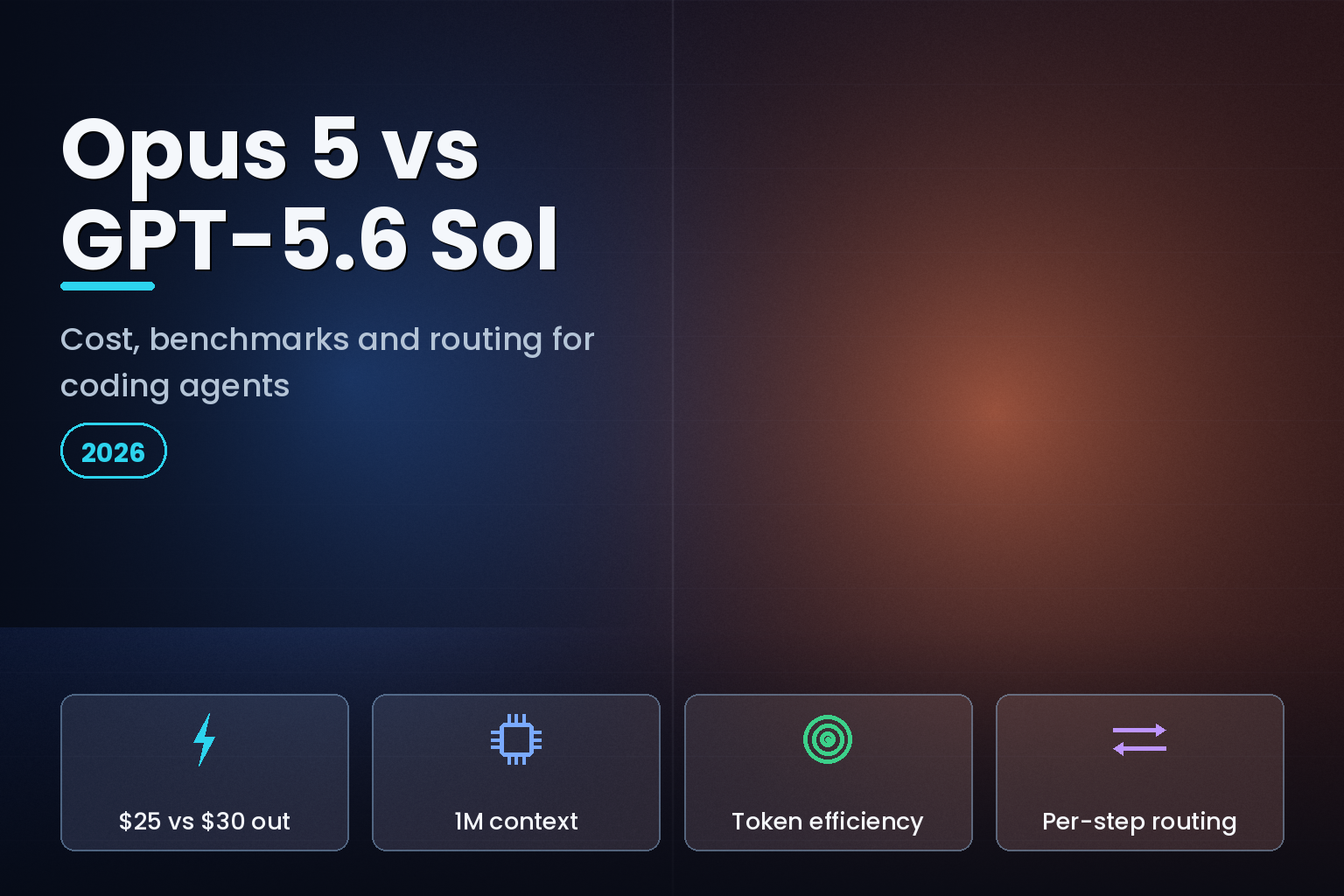
Summary. Two flagship models landed within three weeks of each other. OpenAI released GPT-5.6 on 9 July 2026 in three tiers, Sol, Terra and Luna, and Anthropic released Claude Opus 5 on 24 July 2026. For the top tier the sticker prices nearly match on input and split on output: Claude Opus 5 costs $5 per million input tokens and $25 per million output tokens, while GPT-5.6 Sol costs $5 input and $30 output. Both carry a 1 million token context window. On reported third-party benchmarks Opus 5 leads on agentic coding, with Anthropic citing 43.3% on Frontier-Bench v0.1 against Opus 4.8's 18.7%. But for coding agents the sticker price is the wrong number to optimise: one early customer, legal AI firm Harvey, said Opus 5 matched the output quality of Opus 4.8 at maximum reasoning while cutting token use by 26%. This guide sets out the real price math, the benchmark picture with its caveats, and when each model wins.
Two launches, three weeks apart
GPT-5.6 shipped as a family, not a single model. Sol is the flagship for the hardest work, Terra is the balanced everyday tier at about half Sol's price, and Luna is the fastest and cheapest. All three carry a 1 million token context window, and Sol's price held flat versus GPT-5.5, per pricing trackers such as Finout and aipricing.guru.
Claude Opus 5 takes over as the default on Claude Max and the top model on Claude Pro, and it ships at half the price of Fable 5, Anthropic's most powerful model from June, which runs $10 and $50 per million tokens. Quartz reported the Opus 5 price and positioning at launch: suited to daily professional work, while Fable 5 remains the pick for the longest autonomous tasks, per Quartz's launch coverage. Developers call it as claude-opus-5 on the Claude API.
Price: the number everyone quotes
Sticker price is where most comparisons start, so here it is across the tiers a coding team would actually consider. Prices are per million tokens, current as of July 2026.
| Model | Input ($/M) | Output ($/M) | Context | Notes |
|---|---|---|---|---|
| Claude Opus 5 | 5 | 25 | 1M | Default on Claude Max |
| Claude Opus 5 Fast | 10 | 50 | 1M | ~2.5x speed, double price |
| GPT-5.6 Sol | 5 | 30 | 1M | OpenAI flagship tier |
| GPT-5.6 Terra | 2.50 | 15 | 1M | Balanced tier |
| GPT-5.6 Luna | 1 | 6 | 1M | Budget tier |
| Claude Sonnet 5 | 2 | 10 | 1M | Rises to 3/15 after 31 Aug 2026 |
| Claude Haiku 4.5 | 1 | 5 | — | Cheapest Claude tier |
On the flagship line the two match on input at $5 and split on output, where Opus 5's $25 undercuts Sol's $30 by 17%. Coding agents are output-heavy, since they generate code, diffs and tool calls, so that output gap matters more than it looks. Below the flagship, OpenAI's Terra and Luna undercut on the mid and budget tiers, and Anthropic answers with Sonnet 5 and Haiku 4.5. The Sonnet 5 rate rises from $2/$10 to $3/$15 after 31 August 2026, a change worth planning for and covered in our Claude Sonnet 5 migration and price-cliff note.
Benchmarks: strong signal, real caveats
Benchmarks move fast and vendors pick favourable ones, so treat these as direction, not gospel, and re-run your own evals before committing. Anthropic's own figures put Opus 5 at 43.3% on Frontier-Bench v0.1, an agentic coding benchmark, up from Opus 4.8's 18.7% and Fable 5's 33.7%, and it says Opus 5 beat Fable 5 on the OSWorld 2.0 computer-use benchmark at roughly a third of the cost, per Quartz. Third-party aggregators then compared the two flagships directly.
| Benchmark (reported) | Claude Opus 5 | GPT-5.6 Sol | Source type |
|---|---|---|---|
| SWE-bench Verified | 96.0% | not stated | Aggregator |
| SWE-bench Pro | 79.2% | 64.6% | Aggregator |
| Frontier-Bench v0.1 | 43.3% | 34.4% | Vendor + aggregator |
| ARC-AGI-3 (novel reasoning) | 30.2% | 7.8% | Aggregator |
| Positioning | Daily pro coding | Flagship generalist | Vendor |
The GPT-5.6 Sol columns come from third-party benchmark aggregators such as CodingFleet and Codersera, not from OpenAI's own materials, so verify them against your workload before relying on the gap. The consistent story across sources is that Opus 5 leads on agentic coding and novel-reasoning tasks, while GPT-5.6 Sol stays competitive as a generalist and its Terra and Luna tiers change the cost equation lower down.
The number that actually decides cost: tokens per task
For a coding agent, price per million tokens is an input to the real figure, which is dollars per completed task. A model that costs more per token but finishes in fewer tokens, with fewer retries, can be cheaper in production. Two early Opus 5 customers put numbers on this. Niko Grupen, head of applied research at Harvey, said Opus 5 "matched the output quality of Opus 4.8 running at maximum reasoning while cutting average token usage by 26%." Wade Build, chief executive of Zapier, said Opus 5 completed a churn-prevention workflow on the company's AutomationBench that earlier models had failed, without spending more tokens than earlier Claude models. Both quotes appear in Quartz's launch report.
The lesson for agent builders: a 17% output-price edge plus a reported double-digit token-efficiency gain can compound into a materially lower cost per merged pull request, even before benchmark scores enter the picture. This is why our enterprise GPT-5.6 inference-cost breakdown and our Opus 5 cost-versus-Fable analysis both push teams to measure real workloads rather than compare rate cards.
Features that matter for agents
Both models bring a 1 million token window and a tunable effort or reasoning control that trades output quality for speed and lower token spend. Opus 5 adds an effort dial, a Fast mode at about 2.5x speed for double the base price, automatic fallback routing built into the API, and support for swapping tools mid-conversation without busting the prompt cache, per Quartz. Prompt-cache stability matters for long agent sessions, where a cache miss forces expensive re-reads of context. GPT-5.6's three-tier split lets you route easy steps to Luna or Terra and hard steps to Sol, which is its own cost lever if your orchestration supports per-step model choice, a trade-off we weigh in our Gemini 3.5 Pro, GPT-5.6 and Claude Fable 5 comparison.
When to pick which
- Pick Claude Opus 5 when accuracy on agentic coding is the priority, when your sessions are long and prompt-cache stability saves money, or when token efficiency on hard tasks lowers your cost per task. Its $25 output rate and reported benchmark lead suit daily professional coding work.
- Pick GPT-5.6 Sol when you are standardised on OpenAI tooling, want a strong generalist flagship, or need Sol for the hardest steps while routing routine steps to cheaper Terra and Luna tiers.
- Go mixed for most high-volume products: run a cheap tier (Luna, Haiku 4.5, or Terra, Sonnet 5) for the bulk of calls and reserve a flagship for the hard 10-20% of steps. Per-step routing usually beats a single-model policy on cost.
India and global considerations
For Indian teams, token spend converts directly to rupee cost, so the output-price gap and token-efficiency claims map onto real monthly bills at scale. A team running an internal coding agent across a large engineering org should model both flagships against a representative task set, then decide the routing mix, rather than pick on the headline price. Data-residency and procurement terms differ by provider and region, so factor those into the decision alongside cost and accuracy, especially where code or prompts include sensitive material governed by the Digital Personal Data Protection Act 2023 (DPDP).
FAQ
How eCorpIT can help
eCorpIT is a Gurugram-based, senior-led engineering organisation, founded in 2021, that builds and runs production AI agents for engineering and business teams. We benchmark models against your real tasks, design per-step routing to control token spend, and wire in evaluation so quality does not slip when models change. If you want help choosing and operating a coding-agent stack, contact us.
References
_Last updated: 31 July 2026._