On this page · 12 sections
- The real problem: teams want agents, not a vendor
- What a harness actually is
- The four agents you are standardising across
- The portability seams that make a harness real
- Where the lock-in actually hides
- Pricing moves under you, so plan for it
- How to build the harness, in order
- India-specific considerations
- The decision: standardise the seams, not the tool
- FAQ
- How eCorpIT can help
- References
Summary. By mid-2026 most engineering teams run more than one AI coding agent, and the four they actually evaluate are Claude Code, OpenAI Codex CLI, Google Gemini CLI and GitHub Copilot. The problem is not picking one; it is that any one of them can change under you. On June 1, 2026, GitHub moved every Copilot plan to usage-based billing, where 1 AI credit equals $0.01 and Copilot Enterprise runs $39 per user per month with 3,900 credits included. Codex now defaults to OpenAI's GPT-5.5 series. The teams that stay sane do not bet the organisation on a vendor; they build a harness, a thin layer of shared prompts, policies, evaluation gates and telemetry that every agent plugs into. This guide, written for engineering leads standardising agents across a team, covers what a harness is, the portability seams that make it real (the Model Context Protocol, per-tool config files, and OpenTelemetry's gen_ai telemetry conventions), and how to decide what to standardise now.
The real problem: teams want agents, not a vendor
Ask an engineering leader what keeps them up about AI coding agents in 2026 and the answer is rarely "can it code." The models are good and getting harder to tell apart. The worry is control: can we measure what the agent does, can we keep it inside policy, and what happens when the vendor changes the price or retires a product we built a workflow around.
That last fear is not hypothetical. GitHub moved all Copilot plans onto usage-based billing on June 1, 2026, so a cost model that was a flat seat price became a credit meter. A team that wrote its runbooks around one billing shape had to relearn it overnight. The lesson generalises: the agent you standardise on today may reprice, rename or reroute its default model next quarter.
The response that has actually held up is to stop treating the agent as the platform and start treating it as a replaceable part. Amit Zavery, president, COO and CPO of ServiceNow, framed the enterprise version of this when the company signed deals with both OpenAI and Anthropic in January 2026: "Enterprise customers want model choice. They want the right model for the right job while keeping governance, security, and auditability consistent on the ServiceNow AI Platform." The same logic applies one layer down, at the coding agent your developers run in the terminal.
What a harness actually is
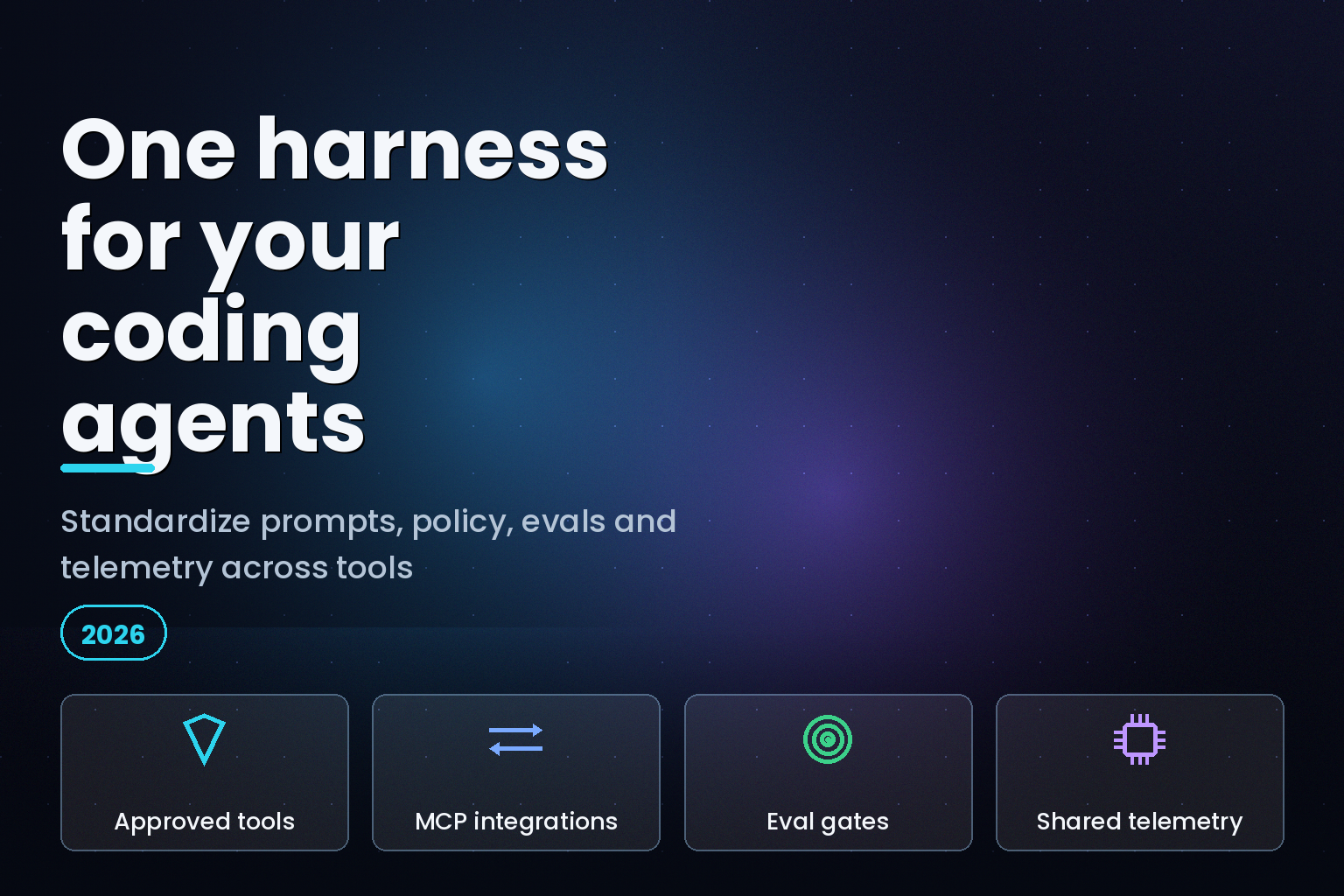
A harness is the set of things you standardise once and reuse across every agent, so switching tools is a config change, not a rebuild. It is not a product you buy; it is a discipline, and by 2026 it has its own name, harness engineering, with community catalogues of patterns and tools. For AI coding, a workable harness has five layers.
| Harness layer | What you standardise | Portable standard to lean on |
|---|---|---|
| Approved tools | Which agents and MCP servers are allowed, and for what | An allow-list plus the Model Context Protocol |
| Model and data policy | Which models may see which code and data | Policy-as-code checked in your repo |
| Prompts and workflows | Shared system prompts, task templates, guardrails | Per-tool config files (see below) |
| Evaluation gates | Tests an agent's output must pass before merge | Eval suites wired into CI |
| Telemetry | What every agent run emits so you can see cost and behaviour | OpenTelemetry gen_ai conventions |
The point of the table is the right-hand column. Each layer has an emerging portable standard, so you are not inventing a proprietary wrapper you will regret. Build against the standards, and the agent underneath becomes swappable.
The four agents you are standardising across
Before you can wrap them, you need an honest read on what each terminal agent is in 2026. They differ on the things that matter under load: context window, approval and sandbox model, CI ergonomics, and cost per real task.
| Agent | Model backing (July 2026) | Extensibility | Pricing shape |
|---|---|---|---|
| Claude Code | Anthropic Claude, including Opus 5 and Sonnet, with per-subagent model choice | MCP, SKILL.md, strong multi-file refactoring | Subscription (Max tiers) or API metering |
| OpenAI Codex CLI | OpenAI GPT-5.5 series, with a coding-tuned GPT-5.3-Codex snapshot | MCP, AGENTS.md, config.toml, sandbox and approval model | Bundled with ChatGPT plans or API metering |
| Google Gemini CLI | Google Gemini, largest raw context of the four | MCP, generous free tier | Free tier with a daily request cap, then paid |
| GitHub Copilot | Multi-model catalogue across providers | Deep GitHub and IDE integration, cloud agent | Usage-based credits since June 1, 2026 |
Three practical notes. Claude Code is the most mature terminal agent and gives you per-subagent model control, which matters when you want a cheap model for scaffolding and an expensive one for hard refactors. Codex CLI reads your codebase, runs commands in an OS-level sandbox and patches files, with GPT-5.5 routed by default. Gemini CLI's free tier is genuinely usable for everyday work, which makes it a good default for exploratory tasks. Copilot's strength is that it lives where your code review already happens, but its move to usage-based billing means you now manage a credit budget, not a flat seat. For the full seat-versus-token arithmetic, our breakdown of BYOK versus subscription cost math for AI coding tools works through the numbers, and the head-to-head on Claude Opus 5 versus GPT-5.6 for coding agents covers the model tier itself.
The portability seams that make a harness real
A harness is only as portable as the standards it rests on. Three seams do most of the work in 2026.
The first is the Model Context Protocol (MCP). All four agents support MCP servers, which expose databases, internal APIs, vector stores and project tools to an agent through one protocol instead of a custom integration per tool. If your internal tools are behind MCP servers, they work the same whether the developer is in Claude Code, Codex CLI, Gemini CLI or Copilot. That single decision, put your tools behind MCP, is the highest-use portability move you can make, and it is why teams that run agents seriously also invest in MCP server development and integration.
The second seam is the per-tool config file. Codex reads AGENTS.md and a config.toml; Claude Code reads its own project instructions and SKILL.md files. These are not interchangeable byte-for-byte, but they express the same things: repository conventions, allowed actions, house style. Keep the source of truth in your repo, generate each tool's file from it, and a new agent is a template away rather than a migration.
The third seam is telemetry. OpenTelemetry's GenAI semantic conventions define a common vocabulary, the gen_ai.* span and metric attributes, so any instrumentation library can emit them and any backend can read them, covering the model called, input and output token counts, tool calls and cost. Be clear-eyed here: as of 2026 these conventions are still in development, pre-1.0, and the project split out a dedicated GenAI repository mid-year, so expect churn. Adopt them anyway. A telemetry standard that is 80 percent settled still beats a per-vendor dashboard you cannot compare across tools.
Where the lock-in actually hides
Not every layer is equally sticky. Map your lock-in before you standardise, because the cheap-to-switch layers do not need a harness and the expensive ones do.
| Layer | Locked to the tool? | How to keep it portable |
|---|---|---|
| The model | Low, models converge and swap easily | Route by task; avoid one-model assumptions in prompts |
| Tool and data integrations | High if custom-built per agent | Put integrations behind MCP servers once |
| Prompts and instructions | Medium, phrased per tool | Keep one source of truth, generate per-tool files |
| Evaluation and quality gates | Low if you own them | Run evals in CI, independent of the agent |
| Telemetry and cost data | High if you use vendor dashboards | Emit gen_ai.* to your own backend |
The pattern is clear. The model is the least sticky part, despite being what vendors market on, because the field is converging and routing is easy. The stickiness is in integrations and telemetry, which is exactly where teams tend not to plan. Build the harness around those two, and the rest is a preference you can change on a Friday.
Pricing moves under you, so plan for it
The strongest argument for a harness is financial, not technical. Consider what changed in a single year. GitHub priced Copilot per seat, then moved every plan to usage-based billing on June 1, 2026, with 1 AI credit equal to $0.01 and Copilot Enterprise at $39 per user per month including 3,900 credits on GitHub Enterprise Cloud. Codex is bundled into ChatGPT plans, so its effective cost depends on a subscription you may hold for other reasons. Open, bring-your-own-key agents such as Aider, OpenCode and Cline move the cost entirely onto your API bill, which can be cheaper or far more expensive depending on usage.
None of those shapes is wrong. The risk is committing your workflows to one shape and then watching it change. A harness lets you re-point at the cheaper option when the market moves, because the prompts, evals and telemetry do not care which agent produced the diff. If you already track spend per tool, our guide to Copilot AI credit pools and enterprise cost control and the piece on request-level model routing to cut cost show the levers in detail.
How to build the harness, in order
Do not try to standardise everything at once. Build the harness in the order that removes the most risk first.
Start with an approved-tools allow-list: name the agents and MCP servers developers may use, and the tasks each is allowed to touch. Next, put your internal tools behind MCP servers so integrations survive an agent switch. Then move prompts and repository conventions into one source of truth in the repo, and generate each tool's config file from it. Add evaluation gates into CI so an agent's output must pass the same tests a human's would before it merges; our write-up on AI agent evals and silent failures in CI/CD covers what those gates should catch. Finally, wire telemetry: have every agent run emit gen_ai.* attributes to your own observability backend, so cost and behaviour are visible in one place regardless of tool.
Sequenced this way, each step pays off on its own, and you are never blocked waiting for the whole harness to exist. The honest read from teams doing this: the model choice is the easy part, and the integrations plus telemetry are the work that decides whether switching agents is a config change or a project.
India-specific considerations
For teams in India, two harness layers carry extra weight. The model-and-data-policy layer is where you encode Digital Personal Data Protection Act (DPDP), 2023 expectations: which models may see personal data, whether prompts can include customer records, and where the agent's traffic and logs are allowed to go. Writing that as policy-as-code in the harness means it applies uniformly across Claude Code, Codex and Copilot, instead of being re-explained per tool.
The cost layer matters too. With Copilot on usage-based credits at $0.01 each and BYOK agents billing straight to your API account, a rupee budget can drift quickly across a large team. Fold agent spend into the same review as the rest of your cloud bill; the discipline in our guide to FinOps moves for Indian cloud teams applies directly to agent credits and tokens. Treating agent cost as just another metered line, watched monthly, keeps the harness honest.
The decision: standardise the seams, not the tool
The mistake is to run a bake-off, crown one agent, and mandate it. Models converge, prices move, and the winner you pick in July may not be the winner in October. The better decision is to standardise the seams, the allow-list, MCP integrations, prompt source of truth, eval gates and telemetry, and let teams choose the agent that fits the task inside those rails. That is the difference between an organisation that switches agents in an afternoon and one that treats every change as a migration. The advantage in 2026 is not which agent you run; it is how sturdy the harness around it is.
FAQ
How eCorpIT can help
eCorpIT is a Gurugram-based, senior-led engineering organisation, CMMI Level 5 and ISO 27001:2022 certified, that helps teams put AI coding agents into production without vendor lock-in. We build the MCP servers that keep your tools portable, wire evaluation gates and gen_ai.* telemetry so agent cost and behaviour are visible, and encode DPDP-aligned model and data policy into the harness. If you want a coding-agent harness that survives the next pricing change, talk to our AI engineering team about our AI evals and observability work.
References
_Last updated: July 31, 2026._