On this page · 9 sections
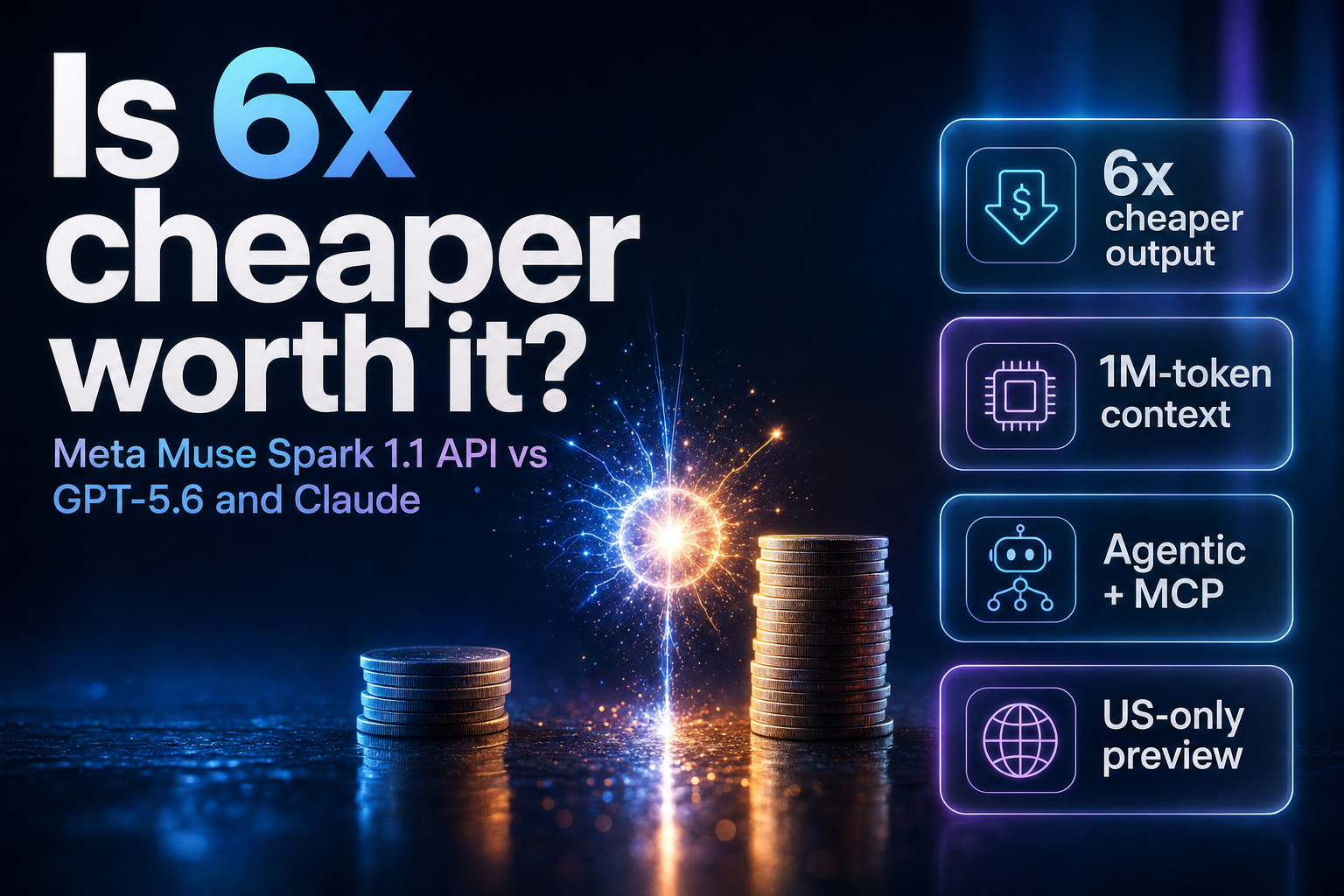
Summary. Meta opened its first paid model API on July 9, 2026 with Muse Spark 1.1 priced at $1.25 per million input tokens and $4.25 per million output tokens, plus $20 in free credits. That output rate is about 7x below GPT-5.6 Sol's $30 and Claude Opus 4.8's $25, and Meta CEO Mark Zuckerberg put it at roughly 25% of what OpenAI and Anthropic charge for comparable models. Muse Spark 1.1 is a multimodal, agentic model with a 1-million-token context window, native subagents, MCP support and computer use, and it leads Opus 4.8 and GPT-5.5 on some tool-use benchmarks (88.1 on MCP Atlas, 54.7 on JobBench). It also trails the flagships on pure coding, and the preview is US-only. For a coding-agent team burning 20M input and 5M output tokens a day, Muse Spark costs about $1,388 a month against roughly $7,500 for GPT-5.6 Sol and $6,750 for Opus 4.8. Here is the real cost math, the benchmark reality, and when a switch makes sense.
The pitch is simple and, at these numbers, hard to ignore: agent-grade quality at budget-tier prices. The catch is everything around the sticker price. This is a decision guide for teams running agents in production, not a launch recap.
What Muse Spark 1.1 is, and what it costs
Muse Spark 1.1 is Meta's multimodal reasoning model built for agentic and coding work. Per Meta's announcement, it ships with a self-managed 1-million-token context window, native primary-agent and subagent orchestration, Model Context Protocol (MCP) support, custom skills, and direct computer control. The Meta Model API is OpenAI-compatible, with structured output and parallel tool calling, which keeps migration cost low for anyone already on an OpenAI-style SDK.
Zuckerberg was blunt about the strategy. "Our focus is on delivering strong agentic and multimodal models at very low cost," he wrote in a post on X, per Quartz, and called it "the first time that we're doing a real serious API." The list price backs the claim.
| Model | Input $/M | Output $/M | Context | Notes |
|---|---|---|---|---|
| Muse Spark 1.1 | $1.25 | $4.25 | 1,000,000 | US-only preview, $20 credits |
| GPT-5.6 Sol | $5.00 | $30.00 | large | Flagship reasoning |
| GPT-5.6 Terra | $2.50 | $15.00 | large | Balanced tier |
| GPT-5.6 Luna | $1.00 | $6.00 | large | High-volume tier |
| Claude Opus 4.8 | $5.00 | $25.00 | large | Flagship; Fast Mode $10/$50 |
| Claude Sonnet 5 | $3.00 | $15.00 | large | Intro $2/$10 to Aug 31, 2026 |
| Claude Haiku 4.5 | $1.00 | $5.00 | large | Cheapest current-gen |
Rates are list prices per million tokens as of July 2026, from the OpenAI and Anthropic pricing pages and Meta's launch. The pattern is clear: Muse Spark 1.1 output is priced next to Claude Haiku 4.5 ($5) and GPT-5.6 Luna ($6), the cheapest tiers, not next to the flagships it benchmarks against.
The real cost math
Sticker prices mislead, because agent workloads are dominated by output tokens, and output costs six times input on GPT-5.6 and five times on Opus 4.8. So model the blended bill, not the input rate.
Take a realistic agentic team: many parallel coding and research agents that together consume 20 million input tokens and generate 5 million output tokens per day. That input-heavy ratio is typical, because agents read large contexts and tool results, then write comparatively less. Here is the monthly cost at list price, 30 days, no caching.
| Model | Cost per day | Cost per month | Multiple of Muse Spark |
|---|---|---|---|
| Muse Spark 1.1 | $46.25 | $1,388 | 1.0x |
| Claude Haiku 4.5 | $45.00 | $1,350 | 1.0x |
| GPT-5.6 Luna | $50.00 | $1,500 | 1.1x |
| GPT-5.6 Terra | $125.00 | $3,750 | 2.7x |
| Claude Sonnet 5 | $135.00 | $4,050 | 2.9x |
| Claude Opus 4.8 | $225.00 | $6,750 | 4.9x |
| GPT-5.6 Sol | $250.00 | $7,500 | 5.4x |
The headline "6x cheaper" holds against the flagships: Muse Spark 1.1 runs about 5.4x under GPT-5.6 Sol and 4.9x under Claude Opus 4.8 on this blended workload, and about 7x under Sol on output alone. But notice the bottom of the table. Muse Spark sits almost exactly on top of Claude Haiku 4.5 and GPT-5.6 Luna. Against the budget tiers, the price gap nearly vanishes.
That reframes the real question. You are not choosing between Muse Spark and a flagship on price, because nobody runs high-volume agents on flagship output rates for long. You are choosing between Muse Spark and the other cheap tiers, and there the deciding factor is quality per dollar, not the dollar.
One more adjustment matters. All three vendors discount heavily for caching and batch: OpenAI gives a 90% cache-read discount, Anthropic prompt caching cuts input up to 90%, and both halve cost on batch jobs. Agents that re-send the same large system prompt and tools every step benefit enormously from caching. If your workload caches well, the effective gaps shrink, and a mature caching stack on Claude or GPT-5.6 can close much of the distance on repeated-context agents.
Where Muse Spark actually wins
The reason to look past the "priced like Haiku" framing is the benchmarks. Meta's published numbers put Muse Spark 1.1 ahead of the flagships on tool use and agentic tasks, not just the budget tier.
| Benchmark (with tools) | Muse Spark 1.1 | Claude Opus 4.8 | GPT-5.5 |
|---|---|---|---|
| MCP Atlas (scaled tool use) | 88.1 | high 70s to low 80s | high 70s to low 80s |
| JobBench (professional tool use) | 54.7 | 48.4 | 38.3 |
| Humanity's Last Exam (with tools) | 62.1 | 57.9 | not cited |
Those figures come from Meta's release as reported by OfficeChai and DataCamp. The JobBench gap is the standout: 54.7 against Opus 4.8's 48.4 and GPT-5.5's 38.3 is a wide margin on professional tool use. If your agents mostly orchestrate tools, call MCP servers, and chain subagents, Muse Spark 1.1 is doing the thing it was built for, and doing it at a fraction of flagship cost.
The 1-million-token context and native subagent orchestration reinforce that. An agent that must hold a large codebase or a long research trail in context, then delegate to subagents, is exactly the shape Meta optimised for.
Where it loses, and the risks
The benchmarks flip on pure coding. Muse Spark 1.1 trails the flagship releases, including OpenAI's GPT-5.6 and Anthropic's Fable 5 and Mythos 5, on straight code-generation tasks, per the same reporting. If your workload is single-shot code generation rather than tool-heavy orchestration, the flagships still win on quality, and the cheaper Luna or Haiku tiers may match Muse Spark without the switch.
Four risks sit around the price:
The preview is US-only. Meta launched the Meta Model API in US-only public preview with no announced timeline for other regions, so teams in the EU, India and elsewhere have no direct access path at launch. Routing through a US entity or a reseller is a compliance and latency question, not a checkbox.
It is brand new. Muse Spark 1.1 is Meta's first serious paid API, launched July 9, 2026. Rate limits, uptime, support and roadmap are unproven next to OpenAI's and Anthropic's multi-year track records. Betting a production agent fleet on a two-week-old API is a real operational risk.
Single-vendor concentration. Moving agents onto one new provider trades one dependency for another. The safer pattern is a routing layer that sends cheap, tool-heavy calls to Muse Spark and hard coding calls to a flagship, which we cover in the LLM hybrid-routing spend framework.
Caching maturity. The flagship providers have mature caching and batch tooling. Muse Spark's discount structure is newer, so the list-price advantage may not translate one-to-one once you account for how well each provider caches your specific traffic.
How to decide
Match the model to the workload, not the headline.
Switch tool-heavy agents first. If most of your token spend is MCP tool calls, subagent orchestration and long-context research, Muse Spark 1.1's benchmark lead plus its price make it the strongest value, and an OpenAI-compatible API keeps the migration cheap.
Keep flagships for hard coding. For single-shot code generation and the trickiest reasoning, GPT-5.6 Sol or Anthropic's Fable 5 still lead on quality. Route those calls there.
Compare against the budget tier, not the flagship, on price. On a blended agent workload, Muse Spark costs about the same as Claude Haiku 4.5 and GPT-5.6 Luna. If those already meet your quality bar, the savings from switching are small.
Pilot before you commit. Run a two-week shadow test on real traffic, measure quality and cost side by side, and keep a routing fallback. Do not move a production fleet onto a two-week-old API in one step.
India-specific considerations
For Indian teams, the US-only preview is the immediate blocker: there is no direct, first-party access path at launch, so most of the savings are theoretical until Meta expands availability. In the meantime, a routing layer that keeps flagship and budget models from OpenAI and Anthropic under one spend controller is the practical move, and it also hedges the single-vendor risk.
Cost still matters acutely here, where a startup's dollar API bill converts to a larger rupee number. A blended agent workload that costs $1,388 a month on Muse Spark versus $7,500 on GPT-5.6 Sol is a difference of roughly ₹5 lakh a month at mid-2026 rates, which is real runway for an early-stage team. We compare US and rupee-denominated pricing in our note on Claude's India pricing versus US teams. On data protection, sending prompts to a US-only API raises data-residency questions under the Digital Personal Data Protection Act 2023, so treat any cross-border routing as a compliance decision, not just a latency one. Our GPT-5.6 enterprise inference-cost guide and tier-selection guide go deeper on modelling spend.
FAQ
How eCorpIT can help
eCorpIT is a Gurugram-based, senior-led engineering organisation (founded 2021, CMMI Level 5, MSME certified) that builds and operates LLM agents in production. We design model-routing layers that send each call to the right model on cost and quality, run shadow tests to measure a new model like Muse Spark 1.1 against your current stack on real traffic, and build guardrails so a cheaper model does not quietly degrade output. If you want to cut agent spend without risking quality, talk to our team. See also our work on enterprise AI agent development and AI agent security and guardrails.
References
- Muse Spark 1.1: Meta's agentic model and API - DataCamp
- Meta announces Muse Spark 1.1 benchmarks - OfficeChai
- GPT-5.6 pricing (July 2026): Sol, Terra, and Luna - AI Pricing Guru
- Claude Platform pricing - Anthropic
- The new GPT-5.6 family: Luna, Terra, Sol - Simon Willison
_Last updated: July 18, 2026._