On this page · 12 sections
- What OpenAI shipped on 28 July 2026
- gpt-transcribe: recorded files and batch jobs
- gpt-live-transcribe: streaming and low latency
- Price: what each model actually costs
- Accuracy: the benchmark picture, and its caveats
- Feature comparison: gpt-transcribe vs gpt-live-transcribe
- How to choose: a decision guide
- Migrating from Whisper or gpt-4o-transcribe
- India-specific considerations
- FAQ
- How eCorpIT can help
- References
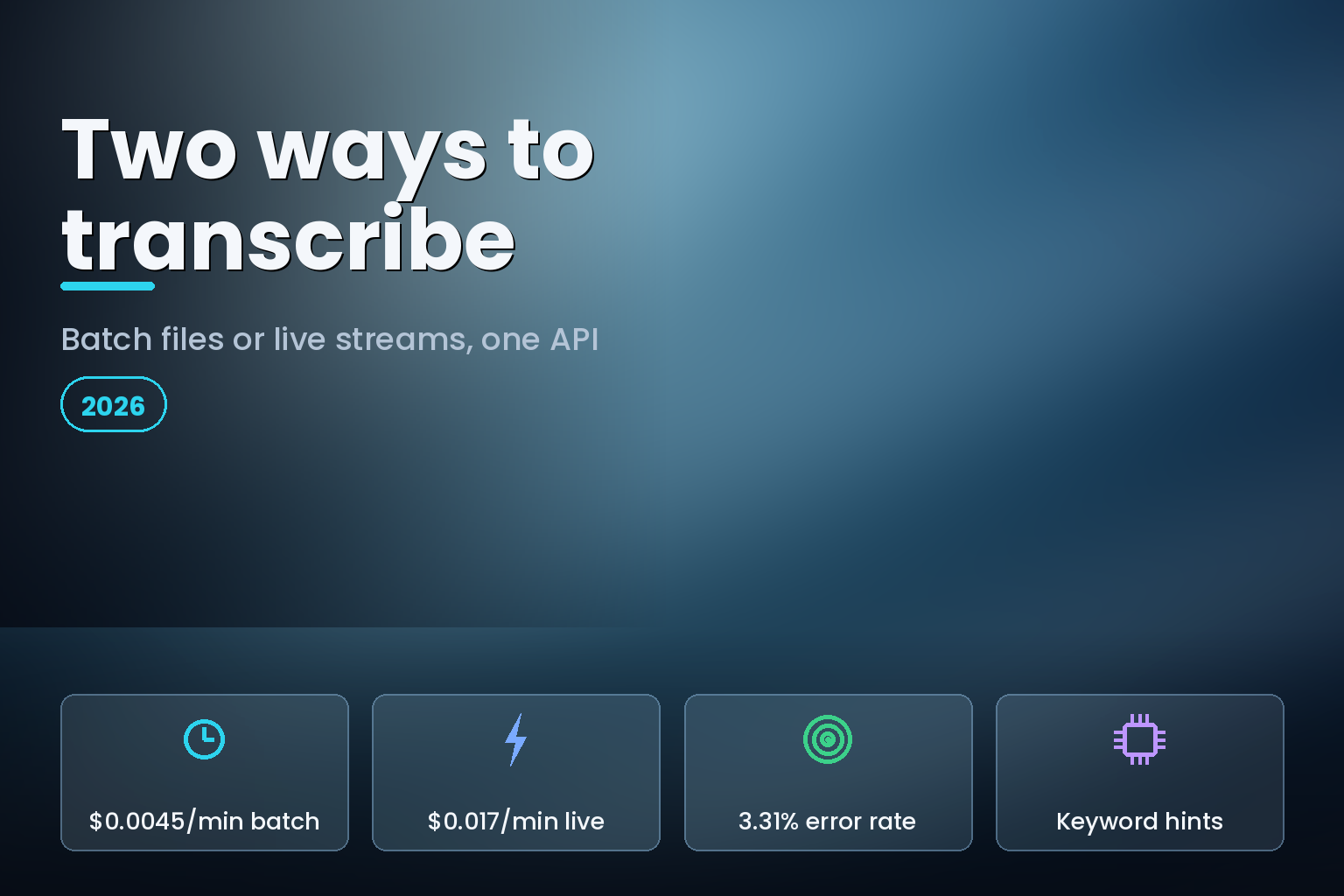
Summary. On 28 July 2026 OpenAI released two speech-to-text models in its API: gpt-transcribe, for recorded files and batch jobs at $0.0045 per minute, and gpt-live-transcribe, for low-latency streaming at $0.017 per minute. The batch model is 25% cheaper than last year's gpt-4o-transcribe ($0.006/min) and, on the Artificial Analysis AA-WER leaderboard, posts a 3.31% word error rate, a 0.7-point gain over its predecessor. It still trails ElevenLabs Scribe v2 (2.3%), Google's Gemini 3 Pro (2.9%) and Mistral's Voxtral Small (3.0%). The two OpenAI models solve different problems: one waits for a finished file, the other emits partial transcripts as a person is still speaking. This guide compares them on price, accuracy, latency and features, and gives a decision table for picking one.
The naming invites a quick, wrong assumption: that GPT Live Transcribe is simply GPT Transcribe with lower latency. It is not. They are separate models with different price points, different accuracy trade-offs and different integration paths. Choosing the wrong one is expensive, because the streaming model costs 3.8 times more per minute and you rarely need it.
What OpenAI shipped on 28 July 2026
OpenAI announced both models through its OpenAI Developers account, describing gpt-live-transcribe as "built for low-latency live transcription" and gpt-transcribe as "optimized for asynchronous transcription of completed audio files and batch workloads," per the OpenAI Developers launch post. The same post says both models "better understand context and deliver more accurate transcription on real world audio across accents and languages, including for short phrases, numbers, specialized terminology, and speech with loud background noise."
The models replace the older Whisper-based and gpt-4o transcription options for new builds. According to OpenAI's figures summarised by AlphaSignal, gpt-transcribe cuts word error rate from 40.37% to 19.27% against whisper-1 on the Common Voice dataset across 22 languages, roughly a 52% relative reduction. Both models are also available outside OpenAI's own platform: Microsoft published a Foundry integration on 30 July 2026, so Azure teams can call the same two models without leaving their existing stack.
Two accuracy numbers appear above, and they look contradictory: 3.31% on one benchmark, 19.27% on another. They are not in conflict. The 3.31% figure is the AA-WER score on the Artificial Analysis non-streaming leaderboard, run on relatively clean English audio. The 19.27% figure is Common Voice across 22 languages, a harder multilingual set with accents and noise. The gap between them is the single most useful fact in this whole comparison: transcription accuracy is entirely a function of your audio, not a fixed model property. A vendor's headline WER tells you almost nothing until you know the dataset behind it.
gpt-transcribe: recorded files and batch jobs
gpt-transcribe is the model you use when the audio already exists. It handles completed audio files, streamed file transcripts, and the committed turns of a Realtime session over WebSocket, as documented in OpenAI's transcription guide. It processes recorded audio about 34 times faster than real time, per The Decoder, so a 60-minute recording returns in under two minutes of wall-clock time.
This is the right default for most transcription work: meeting recordings, podcast episodes, call-centre archives, voicemail, uploaded video, compliance capture. None of these need a word to appear on screen while someone is still talking. They need an accurate transcript of a finished recording, cheaply, at volume. At $0.0045 per minute, gpt-transcribe is priced for exactly that pattern.
The model accepts three inputs beyond the audio itself, all of which lift accuracy at inference time without any fine-tuning: a free-form text prompt for unstructured context, a list of keyword hints, and one or more language hints. If you are transcribing an internal engineering call, passing your product names, service names and a few acronyms as keyword hints is the cheapest accuracy improvement available. The gpt-transcribe model page documents the supported parameters.
gpt-live-transcribe: streaming and low latency
gpt-live-transcribe is the model you use when the audio does not exist yet, because it is being spoken right now and you need words on screen within a few hundred milliseconds. You open a Realtime API session, stream audio as it is captured, and handle incremental transcript deltas as they arrive, following OpenAI's realtime transcription guide.
The distinguishing feature is tunable latency: you set the latency-versus-accuracy trade-off yourself. Push for the lowest latency and you get faster partial results with more revisions; allow a little more delay and each partial is steadier and closer to final. That control matters because streaming transcription is genuinely harder than batch. The model has to commit to words before the sentence that would disambiguate them has finished, so streaming WER is always worse than the same audio transcribed as a finished file.
Live transcription earns its 3.8x price premium in a narrow set of cases: live captioning for accessibility, real-time agent-assist that reads a customer's words as they speak, courtroom or broadcast captioning, and any interface where a visible delay breaks the experience. If your product does not have a human waiting on the words in real time, you are paying for latency you will never use. For conversational voice agents specifically, transcription is only one layer; our guide to full-duplex voice agents on the Realtime API covers the turn-taking and interruption handling that sit above it.
Price: what each model actually costs
Per-minute pricing is the clearest axis. The table below sets the two new models against their OpenAI predecessors and the main third-party alternatives, using published per-minute rates as of July 2026.
| Model | Provider | Mode | Price per minute | Notes |
|---|---|---|---|---|
| gpt-transcribe | OpenAI | Batch / file | $0.0045 | 25% cheaper than gpt-4o-transcribe |
| gpt-live-transcribe | OpenAI | Streaming | $0.017 | Matches GPT-Realtime-Whisper (May 2026) |
| gpt-4o-transcribe | OpenAI | Batch / file | $0.006 | Prior generation, still available |
| gpt-4o-mini-transcribe | OpenAI | Batch / file | $0.003 | Cheapest OpenAI option, lower accuracy |
| Voxtral Transcribe V2 | Mistral | Batch / streaming | $0.003 | Undercuts OpenAI on price |
| Scribe v2 | ElevenLabs | Batch | (varies by plan) | AA-WER leader at 2.3% |
The prices come from OpenAI's model pages and reporting by The Decoder, with Voxtral's rate from Mistral. Put these into a monthly figure and the gap between batch and streaming becomes hard to ignore. Take a team transcribing 10,000 minutes a month, roughly 167 hours of audio:
| Workload: 10,000 min/month | Model | Monthly cost | Approx. ₹ (at ~₹86/$) |
|---|---|---|---|
| Batch, new | gpt-transcribe | $45 | ~₹3,900 |
| Batch, prior gen | gpt-4o-transcribe | $60 | ~₹5,160 |
| Batch, budget | Voxtral Transcribe V2 | $30 | ~₹2,580 |
| Streaming | gpt-live-transcribe | $170 | ~₹14,620 |
Streaming the same volume costs $170 against $45 for batch, an extra $1,500 a year for a single modest workload. The lesson is blunt: default to batch, and reserve gpt-live-transcribe for the specific screens where a human is reading live output. Teams modelling API spend across several models at once will find the same logic in our GPT-5.6 inference cost breakdown and the wider Gemini 3.5 Pro vs GPT-5.6 vs Claude Fable 5 comparison.
Accuracy: the benchmark picture, and its caveats
On the Artificial Analysis AA-WER non-streaming leaderboard, gpt-transcribe records a 3.31% word error rate. That is a real improvement on gpt-4o-transcribe, but it does not lead the field.
| Model | AA-WER (non-streaming) | Rank note |
|---|---|---|
| ElevenLabs Scribe v2 | 2.3% | Benchmark leader |
| Google Gemini 3 Pro | 2.9% | Second |
| Mistral Voxtral Small | 3.0% | Third |
| OpenAI gpt-transcribe | 3.31% | Improved, not leading |
| OpenAI gpt-4o-transcribe | ~4.0% | Prior generation |
Jonathan Kemper, reporter at The Decoder, summed up the release plainly: GPT Transcribe "improves on its predecessor but can't catch ElevenLabs, Google, or Mistral on error rates." For a senior engineer choosing an API, that is the honest framing. OpenAI is now competitive on clean audio, materially cheaper than it was, and behind the accuracy leaders by roughly one percentage point of WER.
The bigger caveat is domain shift. An independent July 2026 benchmark by Novascribe, covering 904 files across 16 datasets, ranked AssemblyAI Universal-3.5 first on aggregate accuracy at 7.0% average WER, and found gpt-4o-transcribe collapsing to 43.8% WER on financial-call audio despite winning on short, clean clips. The takeaway holds for the new model too: a leaderboard win on clean English does not survive contact with jargon-dense, noisy, real-world calls. Benchmark on your own audio before you commit.
Feature comparison: gpt-transcribe vs gpt-live-transcribe
Price and accuracy aside, the two models differ on how you integrate them and what they are built to do.
| Dimension | gpt-transcribe | gpt-live-transcribe |
|---|---|---|
| Primary use | Recorded files, batch, committed Realtime turns | Live streaming transcription |
| Latency | Non-real-time (about 34x faster than real time) | Low latency, tunable |
| Integration | File upload / streamed file transcript | Realtime API session over WebSocket |
| Price per minute | $0.0045 | $0.017 |
| Accuracy on finished audio | Higher (full context available) | Lower (must commit before context arrives) |
| Context, keyword, language hints | Yes | Yes |
| Best for | Meetings, podcasts, call archives, voicemail | Live captions, agent-assist, broadcast captioning |
Both models share the same accuracy levers, keyword hints, free-form context and language hints, so the code you write to boost accuracy transfers between them. What does not transfer is the integration path. Batch transcription is a request-and-response job; live transcription is a persistent WebSocket session with delta events and revision handling. Budget more engineering time for the streaming path.
How to choose: a decision guide
The decision reduces to one question: is a human reading the words while they are still being spoken? If no, use gpt-transcribe. If yes, use gpt-live-transcribe. The table maps common cases.
| Use case | Live reader? | Recommended model |
|---|---|---|
| Meeting and call recordings | No | gpt-transcribe |
| Podcast and video subtitles | No | gpt-transcribe |
| Voicemail and IVR archives | No | gpt-transcribe |
| Compliance and QA transcription | No | gpt-transcribe |
| Live captioning for accessibility | Yes | gpt-live-transcribe |
| Real-time agent-assist | Yes | gpt-live-transcribe |
| Broadcast or event captioning | Yes | gpt-live-transcribe |
| Budget batch at scale | No | gpt-4o-mini-transcribe or Voxtral |
One nuance sits inside the Realtime API. If you are already running a Realtime voice session, gpt-transcribe produces the final, accurate transcript of each committed turn, while gpt-live-transcribe gives you the running partials during the turn. Many production voice apps use both: live partials for responsiveness, then a clean committed transcript for logging and analytics. Our GPT-Realtime 2.1 voice agents build guide walks through that split in a full agent.
Migrating from Whisper or gpt-4o-transcribe
If you are on whisper-1 today, the case to move is strong: OpenAI's own numbers show gpt-transcribe roughly halving word error rate on multilingual Common Voice audio, and the per-minute price is competitive. The API surface is close enough that most migrations are a model-string change plus adding keyword and context hints you did not have before.
If you are on gpt-4o-transcribe, the move to gpt-transcribe is almost pure upside: 25% lower cost and a 0.7-point WER improvement on the AA-WER benchmark, with the same integration. The one reason to wait is a validated pipeline you cannot easily re-test; if your current accuracy is acceptable and re-benchmarking is costly, there is no urgency. Nothing about gpt-4o-transcribe was withdrawn on launch day.
For teams that want the pure text-to-speech side of the audio stack rather than transcription, the same cost-first logic appears in our Gemini 3.1 Flash TTS build guide.
India-specific considerations
For Indian product teams, three factors change the calculus. First, cost: at roughly ₹86 to the US dollar in mid-2026, gpt-transcribe runs about ₹0.39 per minute of audio against roughly ₹1.46 for the streaming model. For a call-centre archive of 100,000 minutes a month, that is about ₹3.9 lakh a year on batch versus ₹14.6 lakh on streaming, so the batch-first rule matters more, not less, at Indian volumes.
Second, language. The AA-WER leaderboard is English-weighted, and India's audio is multilingual and code-switched: Hindi, English and a regional language inside a single call. The Common Voice 22-language result is a better proxy than the clean-English 3.31%, and even that will not match your real accuracy on Hinglish support calls. If your workload is heavily Indian-language, benchmark against a India-specific stack; our guide to multilingual voice agents built on Bhashini covers the government language models that often beat general APIs on regional speech.
Third, data protection. Transcription sends personal voice data, and often personal financial or health details, to a third-party API. Under the Digital Personal Data Protection Act 2023, that processing needs a lawful basis and clear handling rules, and call recordings are personal data. Decide early whether audio can leave India at all, whether you need the Azure Foundry route for regional control, and how long transcripts are retained. Build the consent and retention design in before the first API call, not after.
FAQ
How eCorpIT can help
eCorpIT builds speech-to-text and voice features into production applications for teams across India and beyond, from call-centre transcription pipelines to live-captioning and agent-assist tools. Our senior engineering teams benchmark models such as GPT Transcribe, GPT Live Transcribe, Voxtral and Bhashini against your own audio, then design the ingestion, retention and DPDP-aligned handling around them. As an ISO 27001:2022 certified, CMMI Level 5 organisation, we treat voice data as the personal data it is. To scope a transcription or voice build, talk to our team or explore our AI voice agent development service.
References
- OpenAI transcription guide — OpenAI API documentation.
- OpenAI realtime transcription guide — OpenAI API documentation.
- gpt-transcribe model page — OpenAI API documentation.
- gpt-live-transcribe model page — OpenAI API documentation.
- OpenAI Developers launch post — model announcement, 28 July 2026.
- OpenAI developer changelog — release record.
- GPT Transcribe improves on its predecessor — Jonathan Kemper, The Decoder, 29 July 2026.
- Artificial Analysis speech-to-text (non-streaming) leaderboard — AA-WER benchmark.
- Voxtral Transcribe 2 — Mistral AI newsroom.
- Introducing gpt-transcribe and gpt-live-transcribe in Microsoft Foundry — Microsoft Community Hub, 30 July 2026.
- Transcription accuracy comparison, July 2026 — Novascribe independent benchmark.
- gpt-4o-transcribe model page — OpenAI API documentation.
- gpt-4o-mini-transcribe model page — OpenAI API documentation.
_Last updated: 30 July 2026._