On this page · 10 sections
- What OpenAI actually shipped on July 6, 2026
- The five reasoning-effort levels, and when to raise them
- The real cost: what a minute of voice actually costs
- How to architect a production voice agent
- gpt-realtime-2.1 versus Gemini Live API
- Where this is already working
- India-specific considerations
- FAQ
- How eCorpIT can help
- References
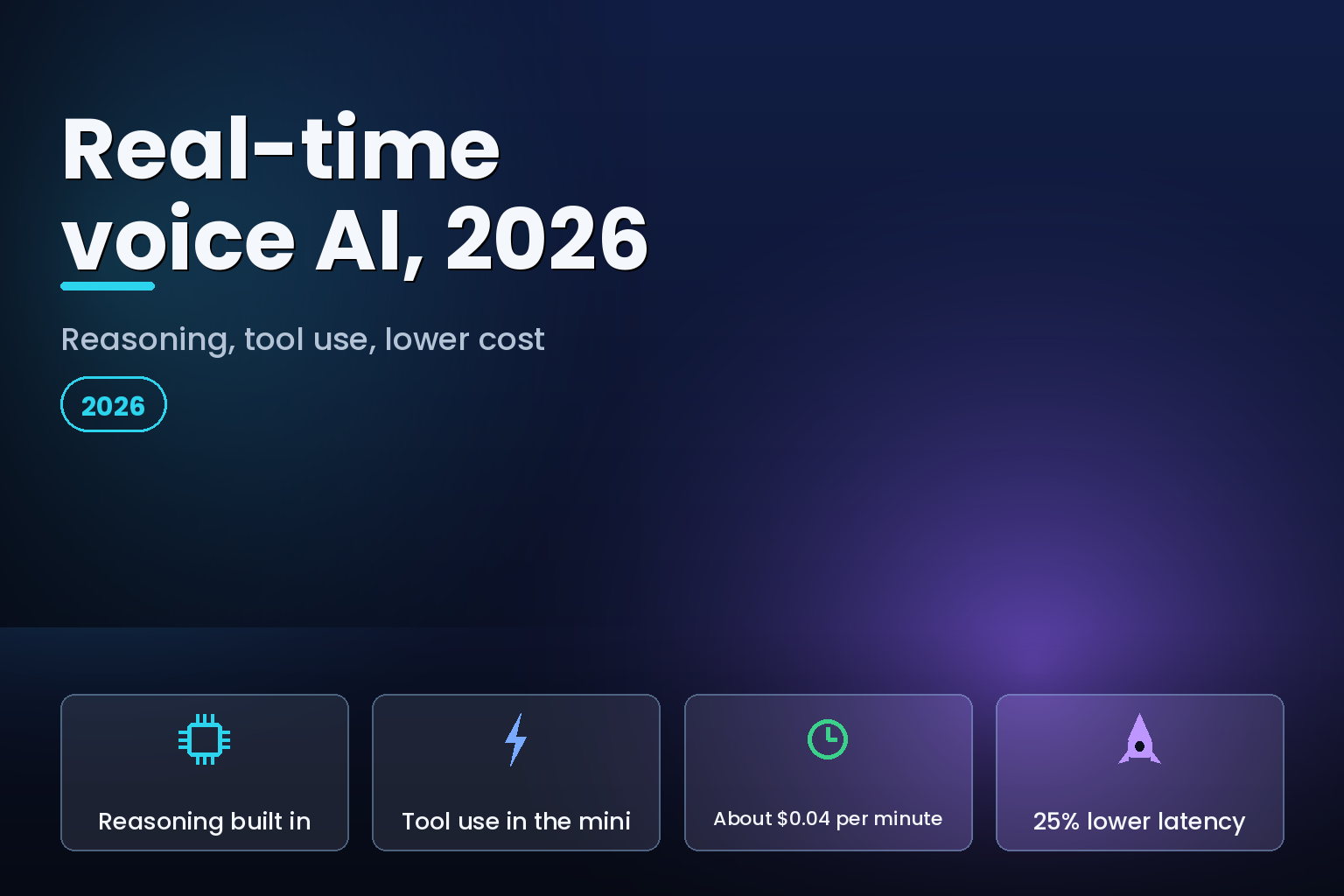
Summary. On July 6, 2026, OpenAI shipped two speech-to-speech models, gpt-realtime-2.1 and gpt-realtime-2.1-mini, and for the first time put configurable reasoning and tool use inside a low-latency voice model. Audio on the full model costs $32 per 1M input tokens and $64 per 1M output tokens, with cached input at $0.40. The mini lands near $10 and $20 for the same, which is why a real support call, with voice-activity detection and prompt caching, runs closer to $0.04 a minute than the sticker math suggests. OpenAI also cut p95 latency by about 25% across its Realtime voice models. This guide covers what changed, the five reasoning-effort levels, the true per-minute cost, and a production architecture you can ship.
Voice used to be the part of the AI stack you avoided. Before this release you either bolted three services together, a speech-to-text model, a text model, and a text-to-speech model, and ate 800 milliseconds of round-trip latency, or you used a single speech-to-speech model that could not reason or call a function. gpt-realtime-2.1 closes that gap. It keeps one live audio connection open, and inside that connection the model can now think before it speaks and call your tools mid-conversation. For anyone building an IVR replacement, a support line, or an outbound qualifier, the July 6 release is the first version that is honestly production-ready, and the mini makes the unit economics work at call-center volume.
What OpenAI actually shipped on July 6, 2026
The Realtime API gained two snapshots. gpt-realtime-2.1 is the flagship, described in OpenAI's model documentation as a model that "supports speech-to-speech interactions with configurable reasoning effort, instruction following, and tool use for complex voice-agent workflows." It updates the earlier gpt-realtime-2 with better alphanumeric recognition (account numbers, order IDs, one-time codes), improved silence and noise handling, and cleaner interruption behavior. The context window is 128,000 tokens and maximum output is 32,000 tokens.
gpt-realtime-2.1-mini is the news that matters for cost. OpenAI put reasoning and tool use into the mini tier at the same price as the previous gpt-realtime-mini, so you get planning and function calling without paying flagship rates. OpenAI positions the mini as the model for high-volume or latency-sensitive applications where speed and price matter more than maximum reasoning depth.
Three practical changes stand out:
- Reasoning inside the voice loop. The model can plan a step, decide it needs data, and only then answer, instead of blurting a guess.
- Tool use in both tiers. The model can call a function (look up an order, check a balance, book a slot) during the spoken turn and speak the result.
- Lower latency. OpenAI reports a p95 latency reduction of about 25% across Realtime voice models, driven by improved caching. First-audio response times commonly sit in the 300 to 500 millisecond range on a warm connection.
The five reasoning-effort levels, and when to raise them
The single most important new knob is reasoning_effort. It is configurable across five levels, and the default is deliberately low so simple turns stay fast.
| Reasoning effort | What it is for | Cost and latency impact |
|---|---|---|
| minimal | Greetings, confirmations, single-slot answers | Lowest latency, fewest reasoning tokens |
| low (default) | Most support turns, FAQ, simple lookups | Low latency, keeps the call snappy |
| medium | Multi-step tool chains, light disambiguation | Noticeable added latency and tokens |
| high | Policy decisions, refunds, eligibility logic | Higher latency, more output tokens |
| xhigh | Rare, complex reasoning where accuracy beats speed | Highest latency and token usage |
The engineering lesson is to set effort per turn, not per session. A greeting does not need the same budget as a refund decision. Route most turns at low, and only escalate to high or xhigh when the tool context says the caller is in a branch that actually needs it. Higher effort increases both latency and output-token usage, so raising it globally is the fastest way to wreck both your response time and your bill.
The real cost: what a minute of voice actually costs
Per-token pricing on audio looks frightening until you translate it into minutes. Here are the published rates, confirmed on OpenAI's own model and pricing pages for the full model, and reported across launch coverage for the mini.
| Model (per 1M tokens) | Audio input | Cached audio input | Audio output | Text input / output |
|---|---|---|---|---|
| gpt-realtime-2.1 | $32.00 | $0.40 | $64.00 | $4.00 / $24.00 |
| gpt-realtime-2.1-mini | $10.00 | $0.30 | $20.00 | matches prior mini snapshot |
Two facts turn those numbers into cents. First, a minute of speech in each direction is only thousands of tokens, not millions, so per-minute cost is far below what the per-1M rate suggests. Second, most of a voice session is your own instructions and prior turns replayed on every response, and cached input is about 80 times cheaper than fresh input ($0.40 against $32.00 on the full model). Turn on prompt caching and server-side voice-activity detection, which stops you from streaming and paying for silence, and the blended cost drops hard.
The result, reported consistently across independent cost analyses, is that real speech-to-speech traffic runs near $0.04 a minute on the mini once caching and voice-activity detection are working, with the full model landing roughly in the $0.06 to $0.11 a minute band and the mini in the $0.02 to $0.05 band. At mid-2026 exchange rates, $0.04 is roughly ₹3 to ₹4 a minute. For a support line handling 10,000 minutes a month, that is on the order of $400 at $0.04 a minute, well under what naive per-token math would suggest. The gap between the two numbers is entirely caching and voice-activity detection, which is why they are not optional in production. If you are sizing a broader agent budget, the same caching discipline shows up in our note on enterprise inference cost for GPT-5.6.
How to architect a production voice agent
A Realtime voice agent is one persistent connection carrying audio in and audio out, with the model reasoning and calling tools in between. You pick a connection method based on where the audio originates.
- WebRTC for browser and mobile clients, where you want the platform to handle jitter, echo cancellation, and packet loss.
- WebSocket for server-to-server audio, where your backend already holds the stream.
- SIP for real telephone calls. OpenAI ships a native SIP endpoint, currently in beta, so you can connect a phone number without a third-party media bridge.
The session is configured with a single event. You set the model, the voice, the turn-detection mode, the reasoning effort, and the tools the model is allowed to call. A minimal WebSocket session update looks like this:
            {
  "type": "session.update",
  "session": {
    "model": "gpt-realtime-2.1-mini",
    "modalities": ["audio", "text"],
    "voice": "cedar",
    "instructions": "You are a support agent for an Indian D2C brand. Verify the order ID before sharing status. Keep answers under two sentences.",
    "turn_detection": { "type": "server_vad", "threshold": 0.5, "silence_duration_ms": 500 },
    "reasoning_effort": "low",
    "tools": [
      {
        "type": "function",
        "name": "get_order_status",
        "description": "Look up an order by its ID and return status and ETA.",
        "parameters": {
          "type": "object",
          "properties": { "order_id": { "type": "string" } },
          "required": ["order_id"]
        }
      }
    ]
  }
}
When the caller speaks, server voice-activity detection decides the turn is over, the model reasons at the configured effort, and if it needs data it emits a function call. Your server runs get_order_status, returns the JSON result on the same connection, and the model speaks the answer. For a step that needs judgment, raise reasoning_effort to high on that single response and drop back to low afterward. Barge-in works because the model handles interruptions natively: when the caller talks over the agent, you cancel the in-flight response and let the new audio take over.
Two rules keep this stable in production. Keep your system instructions short and stable so they cache well, because a 2,000-token prompt replayed on every turn is your biggest avoidable cost. And treat every tool call as untrusted input to your backend, validating the order ID or account number before you act, since a spoken value can be misheard or injected. We cover that attack surface in our guide to prompt-injection guardrails for AI agents.
gpt-realtime-2.1 versus Gemini Live API
OpenAI is not the only real-time voice option. Google's Gemini Live API is the main alternative, and the two make different trade-offs.
| Factor | gpt-realtime-2.1 | Gemini Live API |
|---|---|---|
| Audio input price | $32 per 1M (full), $10 (mini) | Substantially lower per input token |
| Reasoning in the voice loop | Configurable, five levels | Thinking levels available |
| Telephony | Native SIP endpoint (beta) | No native SIP; needs a Twilio or Telnyx bridge |
| Session length | Long sessions supported | Strong on video and language coverage |
| Best fit | Expressive English agents, compliance, long calls | Cost-sensitive, multilingual, or video-first apps |
The honest read is that Gemini Live wins on raw input price and language breadth, while gpt-realtime-2.1 wins on expressive English conversation, native telephony, and long compliance-sensitive sessions. For an Indian support line that is mostly English and Hindi over the phone, the native SIP path and the mini's economics make OpenAI the faster route to production, and you can test Gemini where multilingual coverage or video matters more. This mirrors the build-versus-buy math in our AI customer-support agent cost analysis.
Where this is already working
OpenAI has published that Perplexity built its voice search on the Realtime API, serving it to millions of users, which is a useful existence proof that the stack holds up at scale. The more common enterprise pattern is narrower: a single high-volume workflow such as order-status, appointment booking, or first-line triage, where a voice agent deflects the repetitive 60% of calls and hands the rest to a human with a summary. Starting narrow is the right call, because it caps both the reasoning budget and the number of tools the model can get wrong. Our field notes on conversational agent patterns go deeper on that scoping.
India-specific considerations
For Indian deployments, three things matter beyond price. Language: many support lines are code-mixed Hindi and English, so test recognition on real call recordings before committing, and consider a Bhashini-backed path for regional languages, which we detail in our multilingual voice-agent build guide. Telephony: the native SIP beta connects to Indian numbers through a SIP trunk, but confirm your provider supports the codecs and DTMF you need. Data protection: call audio and transcripts are personal data under the Digital Personal Data Protection Act 2023, so record consent, minimise what you store, and keep a deletion path. Enterprises weighing a managed rollout can compare approaches in our look at enterprise voice AI for Indian CX teams.
FAQ
How eCorpIT can help
eCorpIT (eCorp Information Technologies Private Limited), founded in 2021 and based in Gurugram, builds production voice and text agents for support, sales, and operations. Our senior engineering teams handle the parts that decide whether a voice agent survives contact with real callers: turn-detection tuning, prompt caching for cost control, tool-call validation, SIP telephony, and data-protection alignment with the DPDP Act. As a CMMI Level 5 and MSME-certified organisation working with AWS, Microsoft, and Google, we design deployments aligned with your compliance requirements. See our AI support-agent build service and enterprise AI agent development, or contact us to scope a pilot.
References
_Last updated: July 19, 2026._