On this page · 10 sections
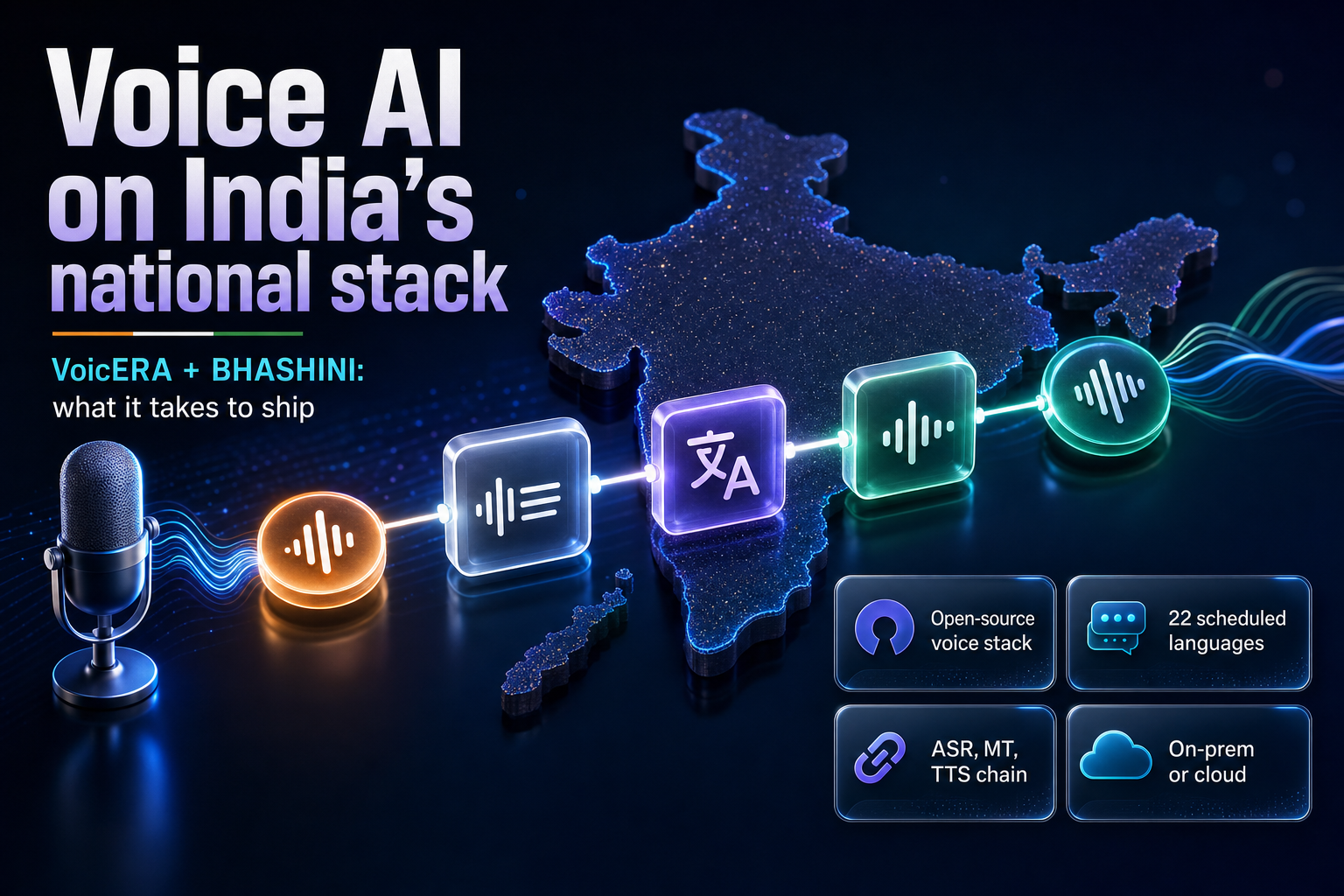
Summary. The Digital India BHASHINI Division launched VoicERA, an open-source end-to-end voice AI stack, at the India AI Impact Summit 2026 on 18 February 2026. It runs on the BHASHINI National Language Infrastructure and was built with the EkStep Foundation, COSS, IIIT Bengaluru and AI4Bharat. The model layer underneath is real and already open: AI4Bharat's IndicConformer covers all 22 official Indian languages for speech recognition under an MIT licence, with a 600M-parameter multilingual model and 22 monolingual ones. What VoicERA gives you is an execution layer that is open, pluggable, cloud deployable and on-premise ready. What it does not give you is a finished product. The comparison that matters for a buyer: Azure Speech real-time transcription runs ₹94.394 per hour in Central India as of 17 July 2026, so a 100,000-call-a-month contact centre at 4 minutes a call costs roughly ₹6.29 lakh a month in transcription alone. Self-hosting changes that number. It does not remove the work.
What MeitY actually launched
VoicERA came out of the Digital India BHASHINI Division (DIBD), which sits under the Digital India Corporation (DIC) within the Ministry of Electronics and Information Technology. The launch was led by Amitabh Nag, CEO of DIBD, with the EkStep Foundation, in collaboration with COSS, IIIT Bengaluru and AI4Bharat.
The design goals in the government's own announcement are specific: open, pluggable, interoperable, cloud deployable and on-premise ready. The stated purpose is to modularise the voice stack so departments stop rebuilding it, which "reduces duplication of effort and eliminates vendor lock in".
Amitabh Nag, Chief Executive Officer of the Digital India BHASHINI Division, framed it this way at the launch: "It is about dignity, access, and ensuring every citizen can speak to the State and be understood."
Shankar Maruwada, Co-Founder and Chief Executive Officer of the EkStep Foundation, put the lineage plainly: BHASHINI has spent three years proving language as Digital Public Infrastructure, and "With VoicERA, that vision now extends to voice."
The named target use cases are citizen-facing: agriculture advisories, education support, livelihood services, grievance redressal, citizen feedback and scheme discovery. That list tells you what the stack is tuned for. It is a form-filling, query-answering, entitlement-checking machine, not a sales agent.
What is actually underneath
VoicERA is an execution layer. The intelligence comes from the model work AI4Bharat has been publishing out of IIT Madras for years, most of which is already on GitHub and Hugging Face.
The speech recognition layer is the strongest piece. IndicConformer is a suite of ASR models covering all 22 official Indian languages, released under the MIT licence. There is a 600M-parameter multilingual hybrid RNNT checkpoint, plus 22 monolingual large models, one per language: Assamese, Bengali, Bodo, Dogri, Gujarati, Hindi, Kannada, Konkani, Kashmiri, Maithili, Malayalam, Manipuri, Marathi, Nepali, Odia, Punjabi, Sanskrit, Santali, Sindhi, Tamil, Telugu and Urdu. Loading or fine-tuning them needs AI4Bharat's NeMo fork, not upstream NVIDIA NeMo, which is the first thing that catches teams out.
Translation is handled by IndicTrans2, a neural machine translation model across the 22 scheduled languages with separate Indic-to-English and English-to-Indic variants. Speech synthesis comes from Indic-TTS. Note the asymmetry there: recognition coverage is broader than synthesis coverage. Your agent can understand more languages than it can speak back in. For a grievance-redressal flow where the citizen speaks and the State replies, that asymmetry is the constraint that shapes your language rollout, and it is the single most common thing missed in planning decks.
MIT and Apache-2.0 licensing across most of this layer is why the on-premise story is credible. You can run the weights inside your own boundary. That matters more in Indian government and regulated-sector work than any benchmark number.
The architecture you actually end up building
A voice agent is not a model. It is a latency budget with models in it.
The chain for a citizen-facing agent on this stack looks like this:
            telephony (SIP/PSTN)
  -> VAD + endpointing
    -> ASR (IndicConformer, streaming)
      -> language ID  (which of 22?)
        -> NLU / intent + slot filling
          -> business system (scheme DB, grievance API)
            -> response generation
              -> MT (IndicTrans2, if reasoning in English)
                -> TTS (Indic-TTS)
                  -> back down the telephony leg
Every arrow is a place to lose 100 milliseconds. The perceptual budget for a phone conversation is roughly 800 milliseconds from the caller finishing to hearing something back; past that, callers talk over the agent and your barge-in handling starts earning its keep.
Three of those boxes are not in VoicERA and never were:
- Endpointing. Deciding when a caller has stopped speaking, in a language you have not identified yet, over a noisy PSTN leg. Get this wrong and every other component is fast for nothing.
- Dialogue state. What the caller already told you, what you still need, what happens when they change their mind at slot four of six.
- The business system. The scheme database, the grievance API, the CRM. This is where projects actually run over.
An honest engineering read after building this shape more than once: the models are the part you do not have to worry about. The telephony leg and the state machine are where the schedule goes.
Build on VoicERA or buy a commercial API?
This is the decision most teams are actually making, so here are the numbers side by side. Azure Speech prices are for Central India in rupees, retrieved on 17 July 2026.
| Dimension | VoicERA / BHASHINI (self-hosted) | Azure Speech (managed) | Azure Speech (batch) |
|---|---|---|---|
| Indic ASR language coverage | 22 official languages (IndicConformer) | Broad, but Indic coverage varies by language | Same as real-time |
| Unit price | No licence fee; you pay for compute | ₹94.394 per hour, real-time | ₹16.991 per hour |
| Custom model training | Fine-tune yourself on your own GPUs | ₹943.938 per compute hour | ₹943.938 per compute hour |
| Custom endpoint hosting | Your own infrastructure | ₹5.0737 per model per hour | ₹5.0737 per model per hour |
| Data boundary | Fully in your VPC or on-premise | Microsoft-managed region | Microsoft-managed region |
| Licence | MIT / Apache-2.0 on the model layer | Commercial terms | Commercial terms |
| Who operates it | You | Microsoft | Microsoft |
Run it against a real workload. A citizen helpline taking 100,000 calls a month at 4 minutes a call is 6,667 hours of audio:
| Option | Monthly transcription cost | What you also carry |
|---|---|---|
| Azure Speech, real-time | ₹6,29,293 | Nothing; it is operated for you |
| Azure Speech, fast transcription | ₹2,26,547 | Not real-time; no live barge-in |
| Azure Speech, batch | ₹1,13,273 | Offline only; no conversation |
| VoicERA self-hosted | GPU hours only | Ops, scaling, model updates, on-call |
The managed real-time number is the one that makes CFOs look at self-hosting. Note what the table does not say: it does not say self-hosting is cheaper. It says the cost moves from a per-hour line item to a team. Whether that trade is good depends on volume and on whether you already run GPUs. Below roughly a few thousand hours a month, a managed API almost always wins on total cost. Above it, and especially where the data cannot leave your boundary, the equation flips.
The data boundary row is often the one that decides it, not the price row.
Where this gets hard
Code-switching is the first wall. Indian callers do not speak one of 22 languages; they speak Hindi with English nouns, or Tamil with Hindi numerals. A monolingual IndicConformer checkpoint is more accurate on clean single-language audio and worse the moment the caller switches. The multilingual 600M checkpoint degrades more gracefully. Which one you pick is a product decision about your callers, not a benchmark decision.
Telephony audio is the second. Models are trained on wideband audio; PSTN gives you 8 kHz narrowband, lossy codecs and packet loss. Accuracy measured on a clean test set does not survive the phone line. Budget for a real drop and test on recordings from your actual carrier.
Named entity accuracy is the third and the most expensive. A voice agent that mishears a scheme name, a village name or an account number is worse than no agent. These are exactly the tokens with the least training data, and they are the tokens your business logic keys on. Plan a domain lexicon and a confirmation turn for anything consequential.
Voice is personal data, which puts this work inside the Digital Personal Data Protection Act 2023 regime. Consent for recording, purpose limitation and retention are design inputs, not a legal review at the end. We have written about what DPDP compliance actually costs Indian startups and about privacy-first AI architecture in the enterprise; the short version for voice is that on-premise deployment simplifies the notice and consent story considerably, which is a large part of why the on-premise-ready design goal exists.
Who should build on this
Build on VoicERA if you are a government department or a regulated enterprise, your data cannot leave your boundary, your languages are in the 22, and your volume is high enough that per-hour API pricing is a real line item. The licensing and the on-premise support are doing genuine work for you there.
Do not build on it if you need one language, low volume, and a product in six weeks. A managed API and a good dialogue layer will beat you to production and cost less all-in. The open stack is not a shortcut; it is a sovereignty and scale decision.
The interesting middle is the shape we see most: an enterprise that starts on a managed API to validate the product, then moves the ASR leg in-house once volume and data-residency pressure both arrive. VoicERA makes that second step much cheaper than it used to be, because you are moving onto a stack the State is maintaining rather than one you assembled.
India-specific considerations
BHASHINI's positioning as Digital Public Infrastructure is the strategic point, and it is worth taking seriously rather than treating as branding. The DPI pattern in India has a track record: define a shared layer, keep it open, let the market build on top. That is what happened with payments. VoicERA is an attempt to do the same for voice, and the government's framing, expanding BHASHINI "from translation and language technologies to real time speech systems, conversational AI, and multilingual telephony at population scale", is explicit about the ambition.
For Indian product teams the practical read is about optionality. Building on an open, government-maintained execution layer with MIT-licensed models means your voice stack is not a vendor relationship you have to renegotiate. That is a different risk profile from any commercial API, and it compounds over a multi-year programme. Our note on India's sovereign AI push and the IndiaAI Mission covers the wider policy backdrop.
The caveat: VoicERA launched in February 2026. It is young. Treat the execution layer as something you pin a version of and test hard, not something you assume is stable under you.
FAQ
How eCorpIT can help
eCorpIT is a CMMI Level 5 certified, MSME-registered technology organisation based in Gurugram, founded in 2021, with partnerships across AWS, Microsoft and Google. Our senior engineering teams build multilingual voice and conversational systems end to end: the telephony leg, the ASR and TTS integration, the dialogue state machine, and the integration into the scheme database or CRM where the value actually sits. We design these systems aligned with DPDP requirements, and we will tell you honestly when a managed API beats a self-hosted stack for your volume. If you are scoping a voice agent on VoicERA, BHASHINI or a commercial stack and want the build-versus-buy maths done against your real call volumes, talk to our team.
References
- VoicERA Launched on BHASHINI National Infrastructure at India AI Impact Summit 2026 - Press Information Bureau, Ministry of Electronics & IT, 18 February 2026.
- VoicERA launch announcement - Digital India, MeitY.
- MeitY Launches Open-Source VoicERA Voice AI Stack on BHASHINI Infrastructure - DD News, February 2026.
- BHASHINI Unveils Voice AI Stack VoicERA At AI Impact Summit - MediaNama, February 2026.
- AI4Bharat IndicConformerASR - GitHub, MIT licence, 22-language ASR model suite.
- AI4Bharat NeMo fork - GitHub, required to load and fine-tune IndicConformer.
- AI4Bharat IndicTrans2 - GitHub, neural machine translation across the 22 scheduled languages.
- AI4Bharat Indic-TTS - GitHub, text-to-speech for languages of India.
- AI4Bharat - open-source language AI research lab, IIT Madras.
- IndicConformer model collection - Hugging Face.
- Azure Speech pricing - Microsoft Azure, Central India rates retrieved 17 July 2026.
- Indic-Conformer model for ASR - AIKosh, IndiaAI.
- NeGD press release: VoicERA - National e-Governance Division.
Last updated: 17 July 2026.