On this page · 11 sections
- The published rate cards, side by side
- The 7 line items that move the real number
- Cost per outcome is the only number worth comparing
- Voice AI against a human agent, honestly
- Where voice agents earn their cost, and where they do not
- Build against buy, at Indian volumes
- The compliance costs nobody quotes
- What we would do in week one
- FAQ
- How eCorpIT can help
- References
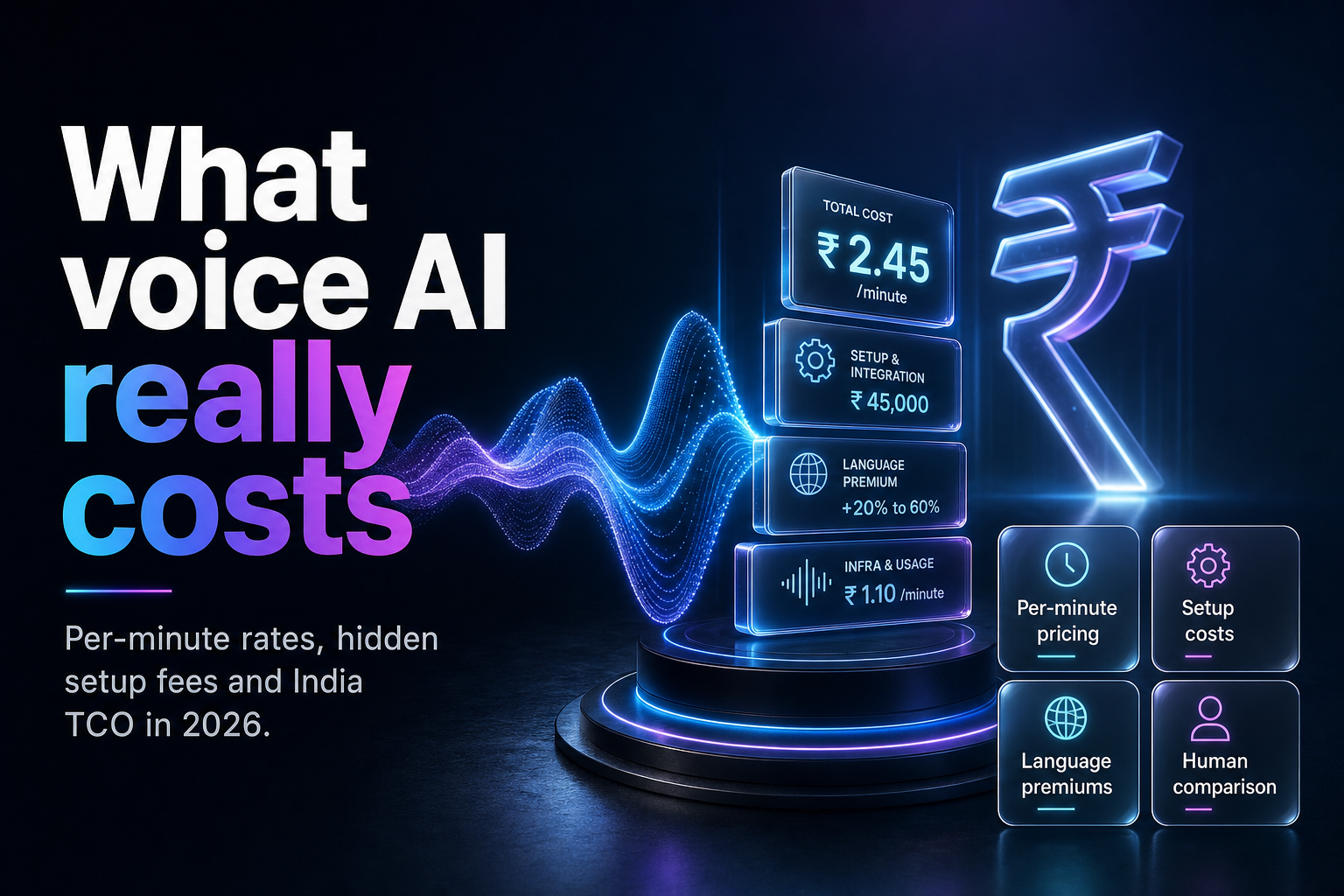
Summary. Published per-minute rates for voice AI in India sit between ₹2 and ₹12 as of 2026, with ₹3 to ₹6 the most common mid-market band, according to a rate analysis published by Indian vendor Caller Digital on 15 April 2026. The same analysis puts the effective cost at 2 to 4 times the headline number once platform fees, telephony markup and connect-rate losses are counted, so a ₹3 per minute quote typically lands at ₹6 to ₹9 in production. Individual rate cards vary more than the range suggests: MyOperator's 17 July 2026 comparison lists Bolti at a flat ₹6 per minute with no monthly minimum, Tabbly.io at ₹2.7 to ₹3.9 depending on tier, Vyora AI from ₹799 per month, HuskyVoice AI from ₹1,999 per month, and enterprise platforms such as Gnani AI and Yellow.AI on custom quotes only, with Haptik estimated by third parties from about $5,000 a year. A tier-2 city collections BPO charges ₹18,000 to ₹25,000 a month per agent handling 80 to 120 connected calls a day, which works out to ₹7 to ₹13 per connected call. That last number is the one that decides most business cases, and it is closer to voice AI pricing than the marketing on either side admits.
If you are evaluating voice agents for support, collections, appointment booking or lead qualification, the per-minute rate is the least useful number in the proposal. This guide covers what actually lands on the invoice.
The published rate cards, side by side
Vendors price on three different bases, which is why quotes are hard to compare. The table below uses the lowest published entry point from MyOperator's July 2026 comparison. Higher tiers and add-ons move these numbers.
| Platform | Published starting price | Pricing basis |
|---|---|---|
| Tabbly.io | ₹2.7 to ₹3.9 per minute | Per minute, tier-dependent |
| Bolti | ₹6 per minute, no minimum | Per minute, free 50-minute trial |
| Vyora AI | From ₹799 per month | Monthly subscription, self-serve |
| HuskyVoice AI | From ₹1,999 per month | Monthly subscription, base tier |
| Caller Digital | ₹5 to ₹25 per connected call | Per connected call or per outcome |
| MyOperator | ₹10,000 per month plus ₹20,000 onboarding | Subscription with managed onboarding |
| Gnani AI, Yellow.AI | Custom quote | Usage or outcome-based, enterprise |
| Haptik | About $5,000 a year, third-party estimate | Enterprise contract, rates unpublished |
One detail in that comparison is worth pausing on, because it shows how unreliable published pricing is in this category. MyOperator describes Caller Digital's platform fees as starting at ₹5 per connected minute, while Caller Digital's own pricing page states there is no platform fee on its per-minute tier. Both were published in 2026. When two sources disagree about a vendor's own rate card, the only resolution is a written quote with every line item broken out.
The 7 line items that move the real number
Caller Digital's guide sets out where cost hides in Indian voice AI contracts. These are the items to make every vendor disclose separately in an RFP.
| Line item | Typical range quoted | Why it matters |
|---|---|---|
| Platform or SaaS fee | ₹15,000 to ₹2,00,000 a month | Adds ₹1 to ₹3 a minute at low volume |
| Telephony markup | TRAI rates are about ₹0.25 to ₹0.50 a minute | Some vendors mark this up 2 to 5 times |
| Language surcharge | ₹1 to ₹3 a minute extra | Applies to Hindi and regional languages |
| LLM inference pass-through | ₹0.50 to ₹2.00 a minute | Often buried in a usage-based compute line |
| Minimum monthly commitment | ₹50,000 to ₹5,00,000 | Use-it-or-lose-it terms inflate the real rate |
| Integration and onboarding | ₹1,00,000 to ₹10,00,000 one-time | Belongs in first-year TCO, not year two |
| Storage and compliance | ₹0.10 to ₹1.00 a minute of audio | Retention periods make this compound |
The language surcharge deserves particular attention in the Indian market. Caller Digital's analysis puts 70% to 85% of borrower conversations in Indian collections in Hindi or a regional language. A per-language premium of ₹1 to ₹3 a minute against an English base rate therefore does not apply to a minority of your traffic. It applies to most of it, and can raise a blended rate by 30% to 50%.
Ask the question directly in the first vendor call: is Hindi included in the base rate, and is code-switching between Hindi and English charged differently? A vendor who has genuinely built for India answers immediately.
Cost per outcome is the only number worth comparing
A per-minute rate tells you what dial time costs. It tells you nothing about what a result costs, and results are what you are buying.
The chain has three multipliers. Call duration turns a per-minute rate into a per-call cost. Connect rate turns a per-call cost into a per-attempt cost, and Caller Digital reports connect rates for Indian outbound campaigns ranging from 30% to 65% depending on the days-past-due bucket, time of day and do-not-disturb filtering. Outcome rate turns that into a cost per result.
Work a collections example with the numbers from that guide. A vendor quoting ₹4 a minute, with ₹0.80 telephony and a ₹1.50 Hindi surcharge, is at ₹6.30 per connected minute. At an average 1.5-minute call, that is ₹9.45 per connected call. At a 45% connect rate you need 2.22 attempts per connection, and at a 22% promise-to-pay rate you need 4.55 connections per promise. That is 10.1 attempts, or ₹95.45 per promise-to-pay, before a ₹50,000 monthly platform fee.
Now take a vendor quoting ₹9 a minute with no telephony markup, no language surcharge, no platform fee and a 65% connect rate at the same 22% conversion. Cost per connected call is ₹13.50, attempts per promise drop to 7.0, and the cost per promise-to-pay is ₹94.50. The vendor charging more than twice as much per minute is marginally cheaper per result, and considerably cheaper once the platform fee is added.
That is not a trick of the arithmetic. Connect rate and surcharges swamp the headline rate, and the headline rate is the only thing most procurement comparisons look at.
Voice AI against a human agent, honestly
The strongest claim vendors make is that voice AI is far cheaper than people. On the Indian numbers, the per-call comparison is much closer than that.
| Measure | Tier-2 city collections BPO agent | Voice AI at a blended rate |
|---|---|---|
| Cost basis | ₹18,000 to ₹25,000 per month per agent | ₹6 to ₹9 per minute blended |
| Throughput | 80 to 120 connected calls a day | Effectively unbounded concurrency |
| Cost per connected call | ₹7 to ₹13 | ₹6 to ₹13.50 at 1 to 1.5 minutes |
| Scaling time | 3 to 6 months to grow a team tenfold | Immediate |
| Consistency | Varies by agent, shift and fatigue | Same script and guardrails every call |
Caller Digital's own analysis concedes the point: the economic advantage of voice AI is not per-call cost, it is scale without recruitment, consistency of script and compliance behaviour, and structured data capture on every call without manual logging.
We agree with that framing, and we would add a fourth factor that rarely appears in vendor material. The cost you avoid is not only the agent salary. It is the hiring, the training cycle, the attrition replacement and the quality monitoring that a 200-seat calling floor needs. Those costs are real and they do not appear in a per-call comparison.
The blunt version for a buyer: if your business case depends on voice AI being three times cheaper per call than a person in Indore, check it before you sign. If it depends on handling a festival-season volume spike without hiring 300 people, the case is much stronger.
Where voice agents earn their cost, and where they do not
The cost-effectiveness varies sharply by how hard the conversation is. Caller Digital's breakdown by days-past-due bucket is the clearest published version of this, and the pattern generalises well beyond lending.
Short, structured, high-connect conversations are where voice AI wins. Payment reminders, appointment confirmation, order confirmation for cash on delivery, delivery slot changes, feedback capture. Calls run 30 to 60 seconds, connect rates are at the top of the range, and the agent never has to negotiate.
Medium-difficulty conversations are marginal and worth piloting rather than assuming. Renewal reminders, lead qualification with more than three criteria, first-line support with a knowledge base behind it. Calls run 60 to 90 seconds and conversion drops.
Conversations that require judgement, negotiation or empathy are where the case weakens. Restructuring a payment plan, handling a complaint from an angry customer, anything where the right answer depends on reading the person rather than the script. Voice AI can still work as a first-pass filter that routes to a human with full context, which is usually the correct architecture anyway.
The design rule we apply: let the agent handle the call it can finish, and hand off with the transcript and the intent attached the moment it cannot. A voice agent that transfers to a human who then asks the customer to repeat everything has destroyed more value than it created.
Build against buy, at Indian volumes
Most Indian buyers should start on a platform. The question is when owning more of the stack starts to pay.
Buying makes sense while volumes are uncertain, when you need TRAI and DPDP handling out of the box, and when the use cases are standard enough that a configured agent gets you 80% of the way. Self-serve platforms go live in hours, and a managed vendor typically in one to three weeks.
Building or assembling makes sense at three specific points. First, when per-minute economics at your volume exceed what direct model and telephony costs would be, which is a spreadsheet exercise rather than an opinion. Second, when the conversation logic is genuinely proprietary, such as an underwriting flow or a clinical triage script that no vendor template covers. Third, when data residency or model choice is contractually constrained by your client or regulator, and a vendor's shared platform cannot satisfy it.
The middle path is the one most teams end up on: a vendor platform for telephony, ASR and TTS, with your own orchestration, prompts, evaluation harness and CRM integration around it. That keeps the parts that are commodity as commodity, and keeps the parts that carry your business logic under your control. We cover the equivalent decision for text channels in our guide to the build against buy cost of an AI customer support agent in India, and the model-side cost mechanics in our build guide for realtime voice agents.
The compliance costs nobody quotes
Three Indian regimes apply, and none of them appear on a rate card.
The Digital Personal Data Protection Act 2023 governs the personal data captured on every call, including the recording itself. The practical requirements are consent capture, retention limits, erasure that actually works, and knowing where the data sits. A vendor who cannot demonstrate programmatic erasure is selling you a migration later. Our DPDP engineering playbook for Indian startups covers the implementation side.
TRAI's DLT registration and do-not-disturb scrubbing apply to outbound commercial calling. Confirm in writing which party carries that obligation, because "the platform handles it" is not the same as the platform being contractually liable for it.
RBI expectations apply if you are a bank, an NBFC or calling on their behalf, covering outsourcing standards, audit and monitoring rights, and record retention on borrower communications. Retention periods for financial records run to years, and storage priced per minute of audio compounds over that horizon. Put it in the model.
Voice agents also raise a disclosure question that Indian regulation is still settling. Our position is simple and we have not seen a good argument against it: tell the person they are speaking to an automated system, early, in the language of the call. Buyers who plan for disclosure from day one are not the ones who have to re-record every prompt when guidance tightens.
What we would do in week one
If you are starting an evaluation now, this is the sequence that produces a defensible decision rather than a vendor preference.
Pick one use case with a measurable outcome and a known baseline. Payment reminders or appointment confirmation, not "customer support". You cannot prove an improvement against a number you do not have.
Get a fully loaded rate card from every shortlisted vendor, broken into the seven line items above. Any vendor who will not break out telephony markup against actual TRAI rates has told you something useful.
Run a 30-day pilot on live traffic, not a demo dataset. Measure connect rate, average duration, outcome rate and containment, then compute cost per outcome for each vendor with your own numbers.
Test the language behaviour properly. Have someone switch from English to Hindi mid-sentence, in an ordinary accent, on a noisy line. Most platforms list a dozen Indian languages. Fewer handle code-switching without dropping the thread, which is a point MyOperator's comparison makes about the whole category.
Read the exit clause before the pricing page. A 12-month lock-in with a 3-month notice period commits you for 15 months from signature.
FAQ
How eCorpIT can help
eCorpIT is a CMMI Level 5 certified, MSME registered technology consultancy founded in 2021 and based in Gurugram, and our senior engineering teams build voice agents the way we build any production system: one measurable use case first, a real pilot on live traffic, and a cost-per-outcome model you can defend to a CFO. We work across the middle path most Indian buyers need, using a vendor platform for telephony, speech recognition and synthesis while building the orchestration, prompts, evaluation harness and CRM integration that carry your business logic. We design these deployments aligned with Digital Personal Data Protection Act 2023 requirements, including consent capture, retention limits and erasure, and we will tell you plainly when a use case does not justify the spend. If you are shortlisting vendors or scoping a pilot, talk to us about a costed evaluation.
Related reading: our build guide for realtime voice agents and their reasoning costs, a look at multilingual voice agents built on Bhashini, our review of enterprise voice AI for Indian customer experience teams, and our enterprise AI agent development service for teams that need the orchestration layer built rather than bought.
References
- Voice AI pricing in India: per minute rates, per call and outcome benchmarks, Caller Digital, 15 April 2026.
- Best voice AI agents in India (2026): top 10 platforms compared, Aman Dasgupta, MyOperator, updated 17 July 2026.
- AI voice agent pricing in India: cost guide, VaniAgent.
- Bolti voice AI platform, Bolti.
- Vyora AI voice agent platform, Vyora AI.
- Why ₹3 a minute voice AI is more expensive than ₹9 a minute, Caller Digital.
Last updated: 20 July 2026.