On this page · 10 sections
- What GPT-Live actually is
- Why full-duplex is hard, and why the demo is not the product
- The catch: GPT-Live has no developer API yet
- Realtime API pricing, and the cost math that actually bites
- GPT-Live vs Gemini 3.1 Flash Live vs ElevenLabs vs the Realtime API
- The 4 things full-duplex actually changes for your voice agents
- India-specific considerations
- FAQ
- How eCorpIT can help
- References
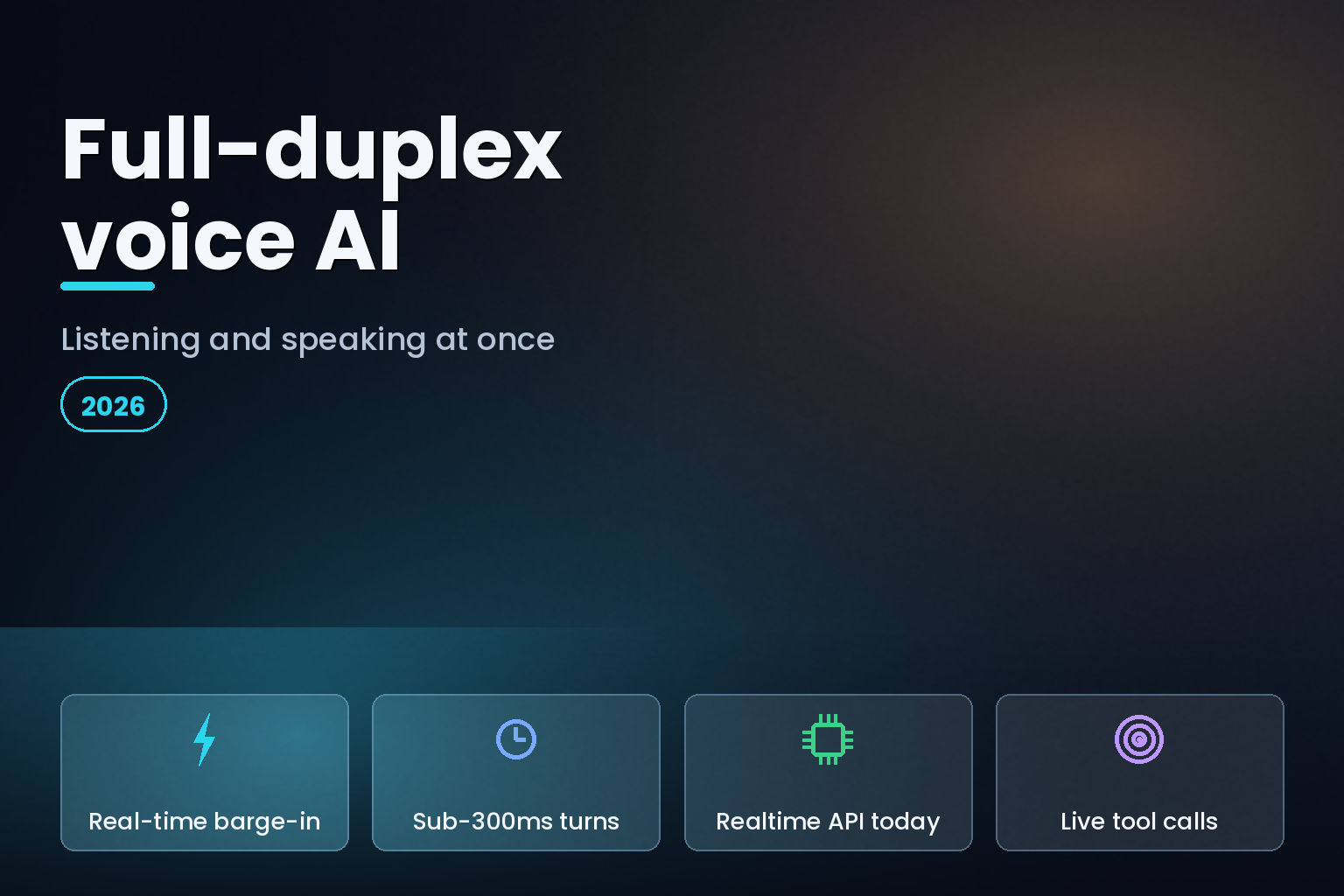
Summary. OpenAI released GPT-Live on 8 July 2026, a voice model that listens and speaks at the same time instead of taking turns. Two variants shipped: GPT-Live-1 for paid ChatGPT tiers and GPT-Live-1 mini for free users, both delegating harder questions to GPT-5.5 in the background. It is a real architectural shift away from the old speech-to-text, then large language model, then text-to-speech pipeline. There is one catch for builders: GPT-Live has no developer API yet. As of 29 July 2026 you can only join a waitlist, so production voice agents still run on the Realtime API and gpt-realtime-2.1, priced at $32 per million audio-input tokens and $64 per million audio-output tokens, which works out to roughly $0.06 to $0.11 per minute of conversation once prompt caching is on. This article covers what full-duplex changes, what it does not, and the four decisions it forces for teams shipping voice agents in 2026.
What GPT-Live actually is
The old ChatGPT voice mode chained three separate models together: a speech-to-text transcriber, a language model, and a text-to-speech voice. Each hop added delay and dropped information, tone, hesitation, and timing that never survived the round trip to text. GPT-Live collapses that chain. OpenAI's announcement describes it plainly: "Instead of processing a sequence of separate messages, GPT-Live continuously processes input while generating output. The model can therefore make interaction decisions many times per second: whether to speak, continue listening, pause, interrupt, or invoke a tool."
That single sentence is the whole story. A turn-based system waits for you to stop, then thinks, then answers. A full-duplex model runs a decision loop many times a second and holds both channels open at once. In practice, as VentureBeat reported, GPT-Live says "mhmm", "yeah", and "got it" while you are still talking, and it waits instead of interrupting when you pause to think. MLQ News confirmed the two-model split and the global rollout across iOS, Android, and web, replacing the previous Advanced Voice Mode.
The background delegation matters more than the backchannels. GPT-Live keeps the conversation flowing and hands off reasoning or web search to GPT-5.5 without going silent. For a voice agent, dead air reads as a broken call. A model that can fill the gap with a genuine acknowledgement while it fetches an answer is closer to how a competent human agent behaves on the phone.
Why full-duplex is hard, and why the demo is not the product
Full-duplex sounds like a small upgrade. It is not. The reason turn-based systems dominated until 2026 is that arbitrating two open audio channels in real time is a difficult control problem, not a modelling one.
A half-duplex agent works like a walkie-talkie: one side speaks, the other listens, and interruptions are handled badly or ignored. A full-duplex agent has to decide, continuously, whether the sound it hears is a real interruption it should yield to, a backchannel it should acknowledge, or background noise it should ignore. Analysis from Evalgent puts the bar at a 100 to 300 millisecond transition between listening and speaking, the window where conversation feels human. Miss it and the agent either talks over the caller or leaves an awkward gap.
The engineering that makes this work is a turn-taking controller: a streaming voice-activity detector tuned to the specific speaker, plus a semantic end-of-turn detector that understands when a multi-part thought is actually finished rather than just paused. The gains are measurable. ByteDance's Seeduplex system, released in April 2026, reported a roughly 50 percent reduction in combined false-response and false-interruption rates, end-of-turn detection 250 milliseconds faster, and 40 percent fewer talk-over incidents against a turn-based baseline.
Here is the part that gets lost in the launch coverage. GPT-Live shipping inside the ChatGPT app is a consumer feature. It is not something you can call from your own backend. Testing teams noticed this immediately: Roark AI's write-up on testing full-duplex agents after GPT-Live points out that the moment two channels are always open, your evaluation harness has to model overlap, barge-in, and backchannel timing, none of which a scripted turn-based test suite captures. The demo is impressive. The product you ship is still your own stack.
The catch: GPT-Live has no developer API yet
This is the single most important fact for anyone planning a build, and most of the launch coverage buried it. GPT-Live is available in ChatGPT. It is not available in the API. OpenAI is collecting names through a form at openai.com/form/gpt-live-1-in-the-api, and that is the entire developer story as of 29 July 2026.
For teams building voice agents right now, the model you actually integrate is gpt-realtime-2.1, exposed through the Realtime API over WebRTC, WebSocket, or SIP. It is a strong model, and it supports barge-in and low-latency audio. It is not the same full-duplex architecture as GPT-Live, and it will not suddenly become GPT-Live because you upgraded a version string. If your roadmap assumes GPT-Live-grade conversation in your product this quarter, that assumption is wrong, and it is worth correcting before it reaches a customer deck.
The practical read: treat GPT-Live as a signal of where the platform is going, not as a dependency you can schedule around. Build on the Realtime API and gpt-realtime-2.1 today, keep your speech layer swappable, and be ready to test a full-duplex API when it arrives rather than betting a launch on a date OpenAI has not given.
Realtime API pricing, and the cost math that actually bites
Voice agents are billed on audio tokens, and audio tokens add up faster than teams expect. As of July 2026, gpt-realtime-2.1 costs $32 per million audio-input tokens and $64 per million audio-output tokens, per multiple measured pricing breakdowns. The mini model is about a third of that at $10 and $20. Audio converts at roughly one token per 100 milliseconds of user speech and one token per 50 milliseconds of assistant speech, so a minute of listening is about 600 tokens and a minute of the agent speaking is about 1,200 tokens.
| Realtime API cost vector | gpt-realtime-2.1 | gpt-realtime-2.1 mini |
|---|---|---|
| Audio input, per 1M tokens | $32 | $10 |
| Audio output, per 1M tokens | $64 | $20 |
| Typical cost per minute, caching on | $0.06 to $0.11 | $0.02 to $0.05 |
| Cost per minute, no caching, long calls | $0.18 to $0.46 | lower, still rises |
| Connection transports | WebRTC, WebSocket, SIP | WebRTC, WebSocket, SIP |
The number that catches teams out is the no-caching row. TokenMix's breakdown shows long, context-heavy calls climbing to $0.18 to $0.46 per minute when prompt caching is not configured, because the full system prompt and running transcript are re-sent on every model turn. At 10,000 minutes of monthly call volume, the gap between a cached $0.08 per minute and an uncached $0.30 per minute is $800 versus $3,000. Caching is not a nice-to-have; it is the difference between a viable unit economic and a bad one.
GPT-Live vs Gemini 3.1 Flash Live vs ElevenLabs vs the Realtime API
If you are choosing a voice stack in 2026, GPT-Live is not yet on the menu for developers, so the real comparison is between what you can call today. Google shipped Gemini 3.1 Flash Live in March 2026 as a full-duplex multimodal model over WebSockets, and ElevenLabs runs a modular pipeline tuned for voice quality.
| Vector | OpenAI Realtime (gpt-realtime-2.1) | Google Gemini 3.1 Flash Live | ElevenLabs conversational AI |
|---|---|---|---|
| Architecture | Real-time speech model | Full-duplex multimodal | Modular: ASR plus LLM plus TTS |
| Simultaneous listen and speak | Barge-in supported | Yes, over WebSockets | Pipeline, weaker overlap |
| Languages | Broad | 90-plus, largest shipped set | Around 30 for conversational AI |
| Latency, end to end | Low, sub-second | 300 to 500 ms | 500 to 800 ms, under 400 ms with Flash TTS |
| Headline pricing | $32/$64 per 1M audio tokens | About $0.01/min audio (Flash class) | Priced on voice quality tier |
| Best fit | Tool-heavy agents, phone via SIP | Multilingual, video plus audio | Brand voice, cloning, polish |
Read that table as three real trade-offs, drawn from a side-by-side of the platforms. Gemini Flash Live leads on languages and cheap audio, which matters for multilingual markets. ElevenLabs still wins on raw voice polish, so it stays the pick for brand voice and content. The Realtime API is the strongest option for tool-calling agents that need to take real actions and connect to telephony over SIP. GPT-Live, when its API lands, will most directly pressure the Gemini Live position on conversational naturalness. None of that helps a team that needs to ship this month; for that, the platform decision comes down to the Realtime API versus a managed layer.
The 4 things full-duplex actually changes for your voice agents
Strip away the launch noise and full-duplex forces four concrete decisions.
First, your evaluation harness has to change. A turn-based test plays a prompt, waits, and checks the reply. A full-duplex agent has to be tested for what it does while the user is still speaking: does it back off on a real interruption, hold steady through a backchannel, and ignore a background voice? If your test suite cannot script overlap, it cannot certify a full-duplex agent.
Second, latency stops being a single number. In a turn-based system you measure time-to-first-token. In a full-duplex system you measure how fast the agent yields when interrupted and how fast it resumes, on top of first-token latency. A model that is fast to answer but slow to stop talking will feel worse, not better.
Third, silence handling becomes a feature you design, not a bug you tolerate. Background delegation to a reasoning model, the pattern GPT-Live uses with GPT-5.5, means your agent can acknowledge and keep the line warm while it fetches an answer. That behaviour has to be built and tuned; it does not come free with a model upgrade.
Fourth, cost forecasting gets harder because always-open audio means you are billed for listening time you used to get for free between turns. The Realtime API pricing above is per audio token in both directions, so an agent that listens attentively for a two-minute call is paying for those two minutes of input, not just the seconds it spoke.
India-specific considerations
For teams building voice agents for Indian users, three points sit on top of the global picture. Language coverage is the first filter: a support line that has to switch between Hindi, English, and a regional language mid-call will weigh Gemini Flash Live's 90-plus languages against the Realtime API's coverage, and should test code-switching directly rather than trusting a language count. Cost reads differently in rupees: at roughly $0.08 per minute, a 10,000-minute month is about ₹70,000 at late-July 2026 exchange rates, so caching and model tiering are not optional at Indian price points.
The third point is data protection. A voice agent records and processes personal data, which brings it under the Digital Personal Data Protection Act 2023. That means explicit consent for recording, clear purpose limitation, and a defensible answer on where audio and transcripts are stored and for how long. We design voice systems aligned with DPDP requirements, including consent capture at the start of a call and data-residency choices for the audio path. For the build itself, our voice agent development work in India sits inside the wider discipline of shipping enterprise AI agents that survive production.
FAQ
How eCorpIT can help
eCorpIT builds and ships production voice agents for teams that need real conversations, not demos. We work on the Realtime API and gpt-realtime-2.1 today, design the turn-taking and barge-in behaviour your calls actually need, wire in tool-calling and telephony over SIP, and set up the caching and model tiering that keep per-minute cost defensible. For Indian deployments we design consent capture and data handling aligned with DPDP Act 2023 requirements. As a CMMI Level 5 and ISO 27001:2022 certified organisation, our senior engineering teams can help you build now and stay ready for full-duplex APIs as they land. Start a conversation at /contact-us/.
References
_Last updated: 29 July 2026._