On this page · 10 sections
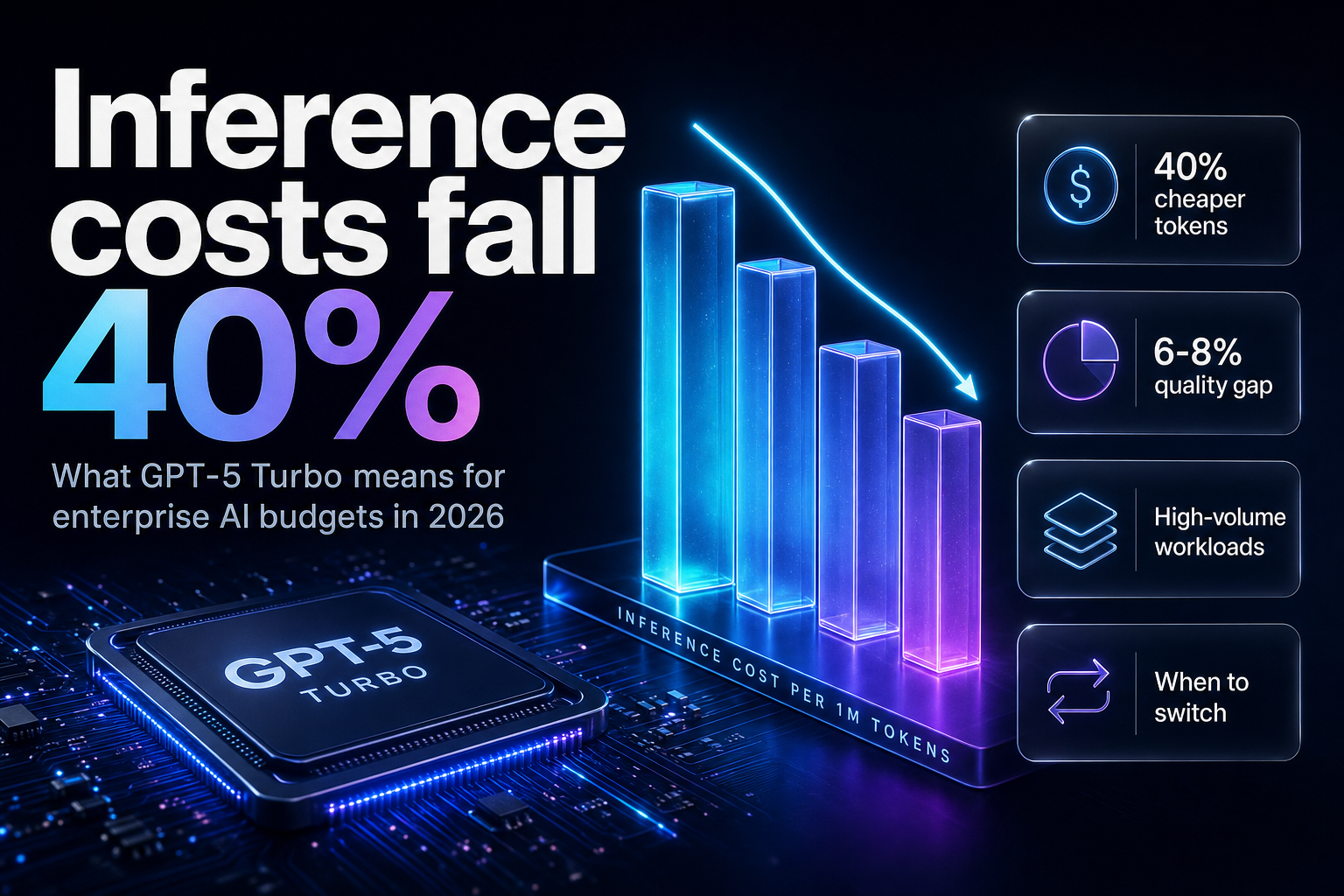
Summary. OpenAI shipped GPT-5.6 on July 9, 2026 in three tiers, Sol, Terra and Luna, with Luna priced at $1 per million input tokens and $6 per million output tokens. CEO Sam Altman told CNBC that the flagship Sol is "54% more token efficient" on agentic coding tasks. Terra arrives at $2.50/$15 per million tokens with what OpenAI describes as GPT-5.5-competitive performance at roughly half the cost. For a CTO signing off on a 2026 AI budget, the figure that matters is not the sticker price but the blended cost per resolved task, and the combination of new tiers, prompt caching and model routing can cut that number by 60 to 80 percent.
The launch closed a 12-day approval window. The U.S. Department of Commerce cleared the broad release after additional testing and meetings with government agencies, and all three models went public for every user on Thursday, July 9. This piece breaks down the pricing, sets it against Claude Sonnet 5 and Google Gemini, and lays out the three levers that decide what an enterprise actually pays.
What OpenAI shipped on July 9
GPT-5.6 is a family, not a single model. Sol is built for frontier reasoning and long-horizon agentic work. Terra is the balanced everyday model, positioned at GPT-5.5-competitive quality for about half the price. Luna is the fastest and cheapest member, aimed at high-volume, latency-sensitive traffic.
Two engineering details drive the cost story. First, efficiency: Altman's 54% token-efficiency figure means Sol reaches the same result while emitting far fewer tokens on agentic coding, so the bill falls even when the per-token rate does not. Second, caching: OpenAI added more predictable prompt caching for the series, with explicit cache breakpoints and a 30-minute minimum cache life, which lowers the cost of the repeated context that agents and RAG systems send on every call.
The plain reading for buyers: OpenAI is competing on effective cost per task, not on headline token prices. That reframes how you should compare it with rivals.
GPT-5.6 pricing, tier by tier
Published API rates for the family, in US dollars per million tokens, sit as follows. Sol has a standard tier and a higher-throughput fast mode.
| Model | Input (per 1M tokens) | Output (per 1M tokens) |
|---|---|---|
| GPT-5.6 Sol (standard) | $5.00 | $30.00 |
| GPT-5.6 Sol (fast mode) | $12.50 | $75.00 |
| GPT-5.6 Terra | $2.50 | $15.00 |
| GPT-5.6 Luna | $1.00 | $6.00 |
| GPT-5.5 (prior flagship) | $5.00 | $30.00 |
Luna at $1/$6 is the number that changes budgets. A support-triage or classification workload that ran on a $5/$30 flagship can move to Luna and pay one-fifth of the input rate, before any caching or batching. Terra gives teams a middle option that OpenAI benchmarks against GPT-5.5 while charging Terra rates.
How GPT-5.6 compares with Claude Sonnet 5 and Gemini
Pricing only means something in context. Anthropic and Google both ship budget and mid tiers, and the gaps are narrow at the bottom of the market as of July 2026.
| Model | Input (per 1M tokens) | Output (per 1M tokens) |
|---|---|---|
| GPT-5.6 Luna | $1.00 | $6.00 |
| GPT-5.6 Terra | $2.50 | $15.00 |
| Claude Sonnet 5 (intro, to Aug 31) | $2.00 | $10.00 |
| Claude Sonnet 5 (standard, from Sep 1) | $3.00 | $15.00 |
| Gemini 3.1 Pro | $2.00 | $12.00 |
| Gemini 3 Flash | $0.50 | $3.00 |
Two caveats shape any comparison. Claude Sonnet 5 runs introductory pricing of $2/$10 through August 31, 2026, then moves to $3/$15, so a model chosen on price in July may cost 50 percent more in September. Gemini 3.1 Pro doubles its input rate above a 200,000-token prompt, from $2 to $4, which matters for long-context agents. Gemini 3 Flash, at $0.50/$3, is the cheapest listed option, but the right question is which model clears your evaluations, not which row is lowest.
Why the sticker price is the wrong number
The per-token rate is the input to your bill, not the bill. What you actually pay is rate multiplied by tokens multiplied by retries, and a cheaper model that fails more often can cost more once a human has to review or rerun its output. Public benchmark work on the prior generation showed the pattern: GPT-5.5 improved on 9 of 10 shared tests versus GPT-5.4 and often reached a better answer with fewer tokens and fewer retries, which offset a higher headline rate on coding tasks.
That is why GPT-5.6's efficiency claim carries weight. A 54 percent cut in tokens per agentic task is a direct reduction in spend at any given rate. The discipline for a 2026 buyer is to measure cost per resolved task on your own traffic, not cost per million tokens on a pricing page. For a wider view of where model spend fits enterprise planning, our guide to enterprise AI strategy in 2026 covers the budgeting side, and our GPT-5.6 versus Claude Sonnet 5 comparison for agents looks at task quality head to head.
The three levers that decide what you pay
Model choice sets your ceiling. Three engineering levers set your floor, and they stack.
| Lever | Typical saving | Main tradeoff |
|---|---|---|
| Model routing | 40 to 70 percent | Classifier and eval overhead |
| Prompt caching | 41 to 80 percent | Cache design; time-to-first-token |
| Batch API | 50 percent | Results within 24 hours, not real time |
| Right-sizing the tier | Varies by mix | Requires per-task evals |
| Stacking all three | 60 to 80 percent | Only where the workload fits |
Routing sends each request to the cheapest model that still passes your evaluations, classifying prompts by difficulty and reserving a flagship such as Sol for genuinely hard work while cheap traffic goes to Luna. Prompt caching cuts the prefill cost of repeated context and improves time-to-first-token by 13 to 31 percent, provided you cache the stable system prompt and keep dynamic tool results at the end of the prompt rather than inside the cached prefix. The batch API, offered by both OpenAI and Anthropic, processes asynchronous requests at a 50 percent discount, which is close to free money for any job where a user is not waiting on the reply, such as overnight enrichment or evaluation runs. Teams that combine all three commonly reach a 60 to 80 percent lower bill, but only when the traffic mix suits each lever. Tracking that spend matters as much as cutting it; see our note on free tools to measure LLM costs.
India-specific considerations
For teams in India, the currency swing changes the framing. At roughly ₹83 to the dollar, Luna output at $6 per million tokens is about ₹500 per million tokens, so a workload processing 50 million output tokens a month sits near ₹25,000 before caching or batching. That is the difference between a line item a founder approves without a meeting and one that needs a FinOps review. Our FinOps guide for Indian cloud teams applies the same commitment and tagging discipline to model spend.
Data residency is the second factor. Sending customer records to a US-hosted API pulls the Digital Personal Data Protection Act, 2023 (DPDP) into scope for consent and purpose limitation. Route personal data through a documented consent path, keep prompts free of unnecessary identifiers, and prefer providers and regions that match your governance posture. The cheapest model is not a saving if it forces a compliance exception.
What to do this quarter
Start by pulling one week of production traffic and labelling each request by difficulty. Send the easy majority to Luna or Gemini 3 Flash, keep a flagship for the hard tail, and measure cost per resolved task rather than per token. Turn on prompt caching for any workload with a stable system prompt, and move every non-interactive job to a batch API. Re-run the numbers before September 1, when Claude Sonnet 5 introductory pricing ends, because a July decision made on price alone may no longer hold.
FAQ
How eCorpIT can help
eCorpIT is a Gurugram-based, CMMI Level 5 technology consultancy that helps enterprises pick, route and run large language models without overpaying. Our senior engineering teams build evaluation suites on your real traffic, design routing and caching layers across providers such as OpenAI, Anthropic and Google, and put FinOps guardrails around model spend. If you want a costed plan for GPT-5.6 or a multi-model stack, talk to our team.
References
- OpenAI's newest AI model is 54% more token efficient on agentic coding, Altman tells CNBC - CNBC, July 9, 2026.
- Introducing GPT-5.6 series: Sol, Terra and Luna - OpenAI Developer Community.
- OpenAI Launches GPT-5.6 With Sol, Terra, And Luna Models - Dataconomy, July 10, 2026.
- GPT-5.6 Pricing (July 2026): Sol, Terra, Luna per 1M tokens - AI Pricing Guru.
- OpenAI sets GPT-5.6 pricing with a three-tier model family - Crypto Briefing.
- GPT-5.6 Goes Public After 12-Day White House Gate - Tech Times, July 9, 2026.
- Introducing Claude Sonnet 5 - Anthropic.
- AI API pricing comparison 2026: Grok vs Gemini vs OpenAI vs Claude - IntuitionLabs.
_Last updated: July 10, 2026._