On this page · 12 sections
- What changed, and on which day
- The published prices, side by side
- Why that matters against the no-markup promise
- What it costs on a real month
- The billing trap underneath the price
- What neither gateway's promo table covers
- India-specific considerations
- What to do this week
- What is still unknown
- FAQ
- How eCorpIT can help
- References
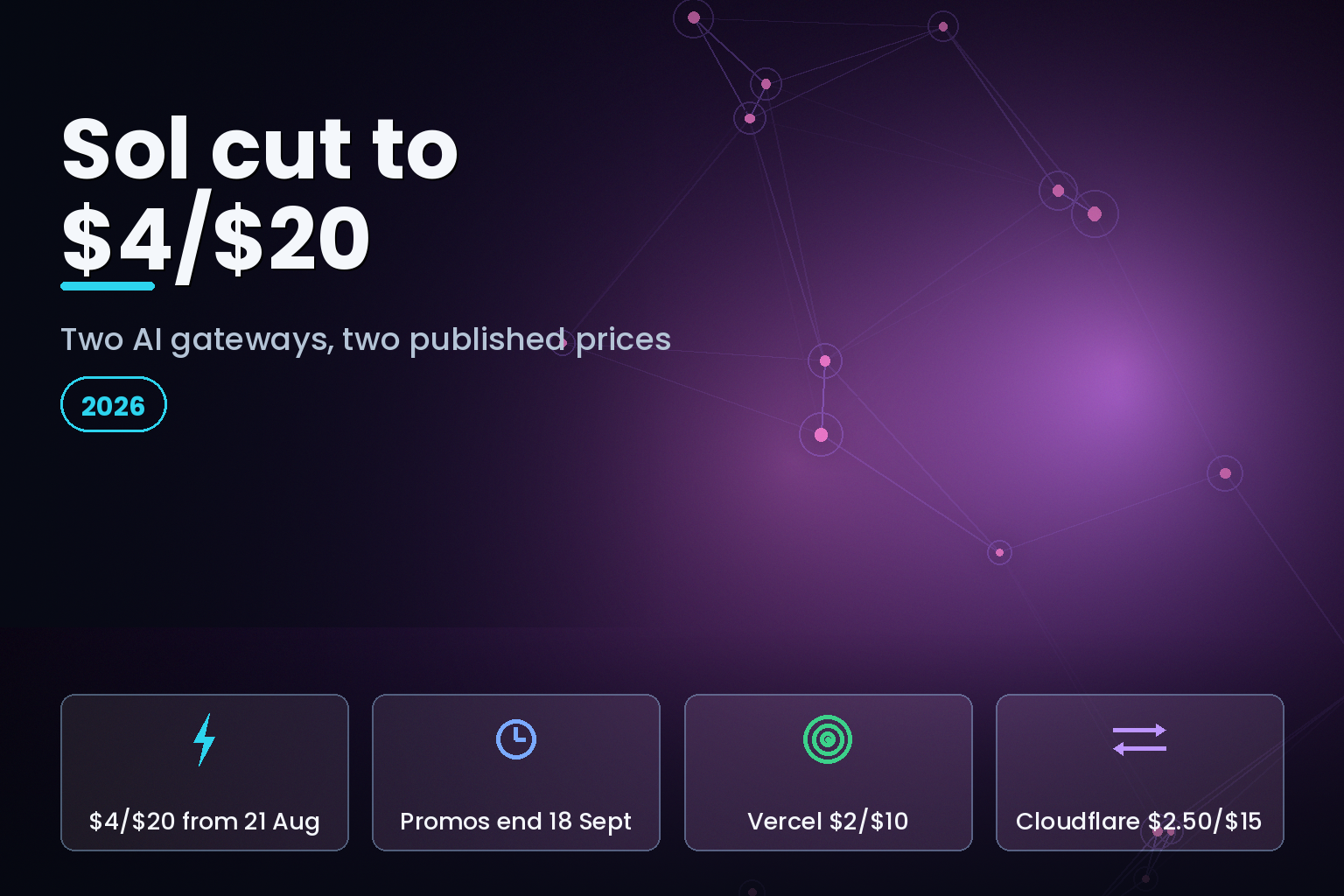
Summary. OpenAI cut GPT-5.6 Sol list pricing on 21 August 2026 to $4 per 1M input tokens and $20 per 1M output tokens, a 20% input cut and a 33% output cut, and says that rate holds "at least through November 21, 2026". Vercel rebased its 50% AI Gateway discount to the new list the same day, taking Sol to $2/$10. Cloudflare announced its own 50% Sol discount two days earlier, on 19 August, against a standard price of $5 input and $30 output, and that changelog post still carries a dateModified of 2026-08-19 with the old numbers. Both gateways publish a no-markup promise. On a 100M-input, 20M-output month the two published rate cards differ by $150, and after 18 September 2026 the gap widens to $300.
What changed, and on which day
Three dated events sit inside five days, and they do not line up.
On 19 August 2026, Cloudflare's changelog announced that GPT-5.6 Sol is 50% off through AI Gateway for Unified Billing users only. The post prints a two-column table: promotional input $2.50 per 1M tokens against a standard price of $5, promotional output $15 against a standard $30, and promotional cache read $0.25 against $0.50. It ends the promotion on 18 September 2026, after which "GPT-5.6 Sol requests return to standard pricing".
On 21 August 2026, the OpenAI API changelog recorded the cut: "GPT-5.6 Sol now costs $4 per million input tokens and $20 per million output tokens, representing 20% lower input pricing and 33% lower output pricing." The pricing page carries the same figures, plus $0.40 cached input and $5.00 cache writes, and repeats that the promotional rate runs at least to 21 November 2026.
Also on 21 August 2026, Vercel published GPT-5.6 Sol is now 50% off a lower price. Jerilyn Zheng, Product, AI Gateway at Vercel, wrote: "OpenAI lowered list pricing for GPT-5.6 Sol, and the 50% AI Gateway discount now applies to the new, lower price through September 18." The post's own table lists the default tier at $2.00 input and $10.00 output, against a new list of $4.00/$20.00 and a "you paid before" column of $2.50/$15.00.
That last column is the tell. Vercel's superseded price is Cloudflare's current published price.
The published prices, side by side
Rates below are per 1M tokens, short-context (requests up to 272K tokens), standard service tier, as published on 23 August 2026.
| Route | Input | Output | Cache read | Promotion ends |
|---|---|---|---|---|
| OpenAI direct, list | $4.00 | $20.00 | $0.40 | At least 21 Nov 2026 |
| Vercel AI Gateway, discounted | $2.00 | $10.00 | $0.20 | 18 Sept 2026 |
| Cloudflare AI Gateway, discounted | $2.50 | $15.00 | $0.25 | 18 Sept 2026 |
| Cloudflare AI Gateway, standard as published | $5.00 | $30.00 | $0.50 | n/a |
| OpenAI direct, Fast mode | $8.00 | $40.00 | $0.80 | At least 21 Nov 2026 |
Two things follow. Cloudflare's discounted output rate is 50% above Vercel's for the same model on the same day. And Cloudflare's published standard rate, the one its own post says requests revert to on 19 September, is 25% above OpenAI's current list on input and 50% above it on output.
Why that matters against the no-markup promise
Cloudflare's Unified Billing documentation, last updated 7 August 2026, states: "Inference pricing from providers is passed through with no markup — you pay the same per-token rates as you would directly with the provider." The same page adds a 5% fee on credits purchased, so a $100 top-up bills $105. The fee sits on the credit purchase, not the tokens.
Vercel's AI Gateway pricing page makes the matching claim: "AI Gateway charges no markup and no platform fee on tokens. You pay the provider's list price on a pay-as-you-go basis." It also notes that customers carry any payment processing fees, unless an Enterprise team moves to invoiced billing.
Both statements cannot describe the same rate card. Either Cloudflare's dashboard has already rebased Sol to $4/$20 and the changelog table is stale, or the changelog table is live and the pass-through promise has drifted. Cloudflare's own GPT-5.6 Sol model page does not settle it: under Pricing it links to the Cloudflare dashboard instead of printing a rate. The only Sol prices Cloudflare publishes outside a login are the ones in the 19 August post.
What it costs on a real month
Take a support-triage or code-review workload running 100M input tokens and 20M output tokens a month, short-context, standard tier.
| Route | Input cost | Output cost | Monthly total |
|---|---|---|---|
| OpenAI direct at $4/$20 | $400 | $400 | $800 |
| Vercel at $2/$10 | $200 | $200 | $400 |
| Cloudflare at $2.50/$15 | $250 | $300 | $550 |
| Cloudflare at $2.50/$15 plus the 5% credit fee | $250 | $300 | $577.50 |
| Cloudflare at published standard $5/$30, from 19 Sept | $500 | $600 | $1,100 |
The $150 monthly delta during the promotion is survivable. The 19 September step is not, if the published standard rate is what actually bills: $1,100 against $800 for calling OpenAI directly, on a model whose own list price is scheduled to stay at $4/$20 until at least 21 November 2026. A gateway you adopted to save money would then cost 37.5% more than no gateway at all.
The billing trap underneath the price
There is a second thing to check before September. Cloudflare documents a credential precedence order: a provider key on the request wins, then a stored bring-your-own-key under the default alias, then Unified Billing. The page carries an explicit warning for requests routed through Unified Billing endpoints such as env.AI.run() or /ai/v1/chat/completions: only a BYOK key stored under the default alias prevents fall-through. "Keys stored under other aliases are not consulted on this path — a request will fall through to Unified Billing even if you have a key stored under, for example, production or testing."
So a team that stored its OpenAI key under production, believing it was paying OpenAI's $4/$20 directly, can be billed against Cloudflare credits at the gateway's rate without any request-level error. The promotion applies to Unified Billing and not to BYOK, which means the same misconfiguration that moves you onto Cloudflare's rate card is the one that qualifies you for its discount. That is easy to miss in a monthly invoice review and hard to reconstruct afterwards.
What neither gateway's promo table covers
Sol has a 1,050,000-token context window, 922,000 maximum input tokens and 128,000 maximum output tokens, per OpenAI's model page. Requests above 272K input tokens are billed at 2x input and 1.5x output, so $8.00/$30.00 at current list. Cache writes bill at 1.25x uncached input, $5.00 per 1M.
Cloudflare's promotional table has three rows: input, output, cache read. It carries no long-context row and no cache-write row, on a model where a single 300K-token request changes the arithmetic. It also says nothing about service tiers. Vercel's post does: it prices default, Flex and Priority separately, and states that cached tokens, cache writes, long-context requests above 272K and US regional rates "all move by the same proportion". OpenAI's Fast mode guide confirms the tier maths, at $8 input and $40 output short-context and $16/$60 long-context, for up to 2.5x the standard speed.
If your traffic is long-context, the published Cloudflare rate card does not tell you what you will pay.
India-specific considerations
Indian teams with a data residency requirement carry a separate charge that no gateway promotion touches. OpenAI's data controls guide states that data residency endpoints are charged a 10% uplift for models released on or after 5 March 2026 that are eligible for data residency, and that residency applies to storage at rest in the selected region, with in-region inference only where a region is specifically identified as supporting regional processing. Non-US regions also require approval for abuse monitoring controls and a Modified Retention amendment. On 21 August 2026 OpenAI added per-request region selection through a prefixed domain for API keys in a project with Global geography, which is covered in our note on per-request regional processing for India.
For a DPDP-scoped workload the sequence matters: settle where inference runs first, then price the tokens. A 50% gateway discount on a route that cannot meet the residency requirement is not a saving.
What to do this week
Log into the Cloudflare dashboard and read the live per-token price for openai/gpt-5.6-sol against your account, because that number, not the changelog table, is what bills. Diary 18 September 2026 as a hard date on both gateways and 21 November 2026 as the end of OpenAI's own promotional rate. Audit your BYOK aliases and move any production OpenAI key to the default alias if you intended to pay OpenAI directly. Then re-run your own token counts at $4/$20 rather than $5/$30, because every routing decision made before 21 August was priced against a rate card that no longer exists.
The real cost here is usually not the per-token delta. It is discovering in October that a September rate change moved silently through a gateway nobody was watching. Teams sizing this properly should read it alongside our breakdown of GPT-5.6 inference cost for enterprise workloads, the OpenAI GPT-5.6 price cut and Fast mode migration, the 18 September AI Gateway billing cliff on Vercel, and the wider frontier model comparison.
What is still unknown
Cloudflare has not published, outside the dashboard, whether its 50% promotion rebases onto OpenAI's $4/$20 list or stays anchored to $5/$30. The 19 August changelog post carries a dateModified of 2026-08-19 and was unchanged when checked on 23 August 2026. Nor has Cloudflare said what the standard price becomes on 19 September 2026. Until one of those is published, the honest planning assumption is the number your dashboard shows today.
FAQ
How eCorpIT can help
eCorpIT builds and runs LLM routing layers for teams whose model spend has outgrown a single API key, including token accounting, per-tier routing and gateway fall-through audits of the kind described above. Our engineering teams are CMMI Level 5 and ISO 27001:2022 certified, and we design applications aligned with DPDP requirements where residency is in scope. If your September budget was built on a $5/$30 rate card, book a model-spend review with our AI engineering team and we will re-cost it against the current rates.
References
Last updated 23 August 2026.