On this page · 11 sections
- The suffix decides whether you get a bill or an outage
- Characters and bytes are the same price and different amounts
- Where the transcription price actually lands
- The second cliff on the same date
- What else AI Gateway charges for
- India-specific considerations
- What to do before 18 September 2026
- What is still unknown
- FAQ
- How eCorpIT can help
- References
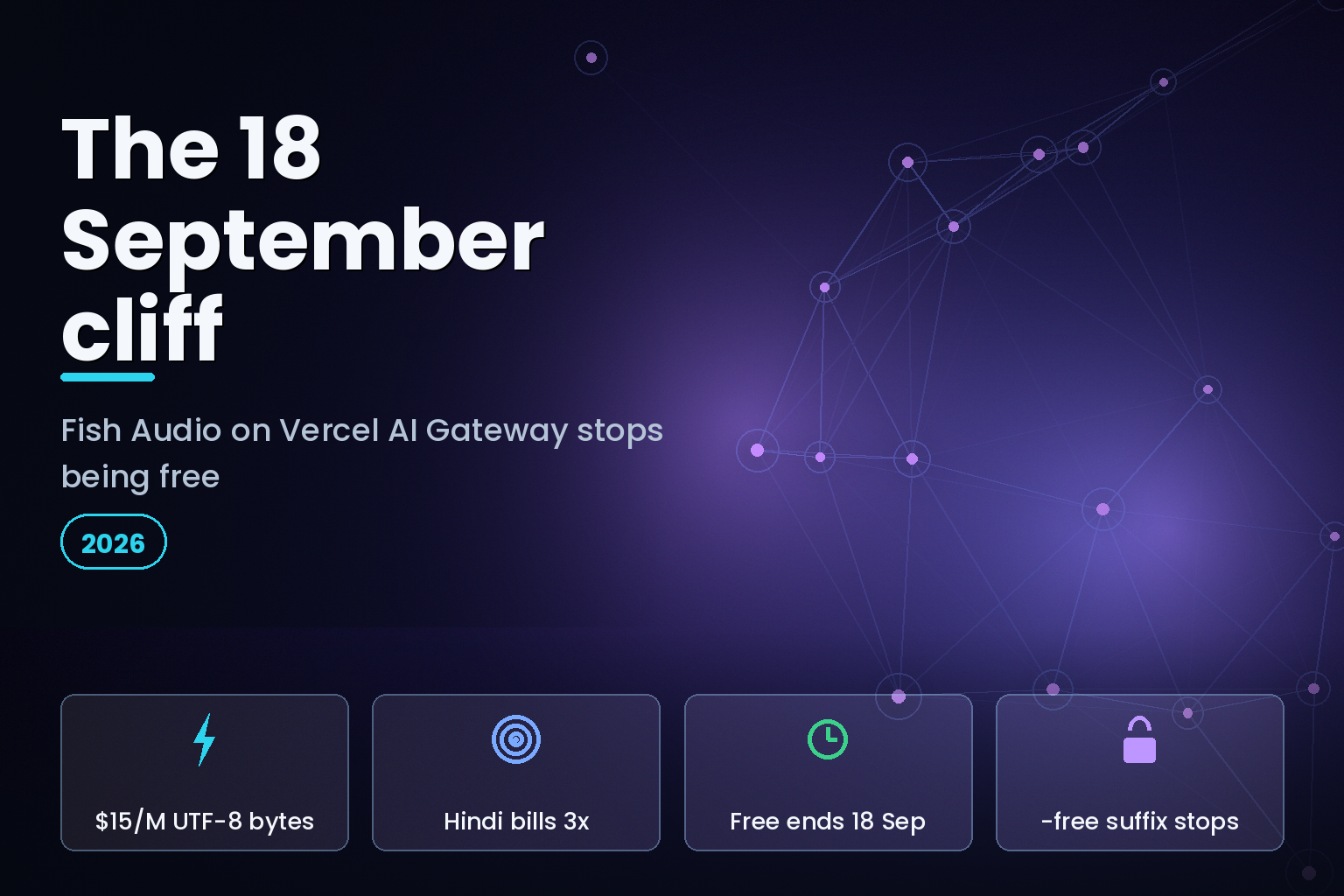
Summary. Vercel put every Fish Audio model on AI Gateway free for 30 days on 19 August 2026, and its changelog quotes the regular rate as $15.00 per million characters for text-to-speech and $0.36 per hour of audio for speech-to-text. Fish Audio's own rate card prices the same three TTS models at $15.00 per million UTF-8 bytes. Those units are identical for English and roughly three times apart for Hindi, Chinese or Japanese, because RFC 3629 encodes every code point from U+0800 to U+FFFF in three octets. Two Vercel promotions expire on the same day, 18 September 2026: the Fish Audio free period and the 50% discount on GPT-5.6 Sol announced on 17 August, which cuts the default tier from $5.00/$30.00 to $2.50/$15.00 per million tokens. And the free period ends in one of two ways depending on a suffix you chose weeks earlier.
The suffix decides whether you get a bill or an outage
This is the part worth reading twice. Vercel's changelog, written by Walter Korman and Jerilyn Zheng of Vercel, spells out both branches:
"Using the standard model name (i.e., fish-audio/s2.1-pro) is free, but will automatically begin billing when the offer period ends."
"To ensure you aren't billed after the free period, add the -free suffix to the standard name, and the model will stop serving when the offer ends (i.e., fish-audio/s2.1-pro-free)."
So on 19 September 2026 a service pinned to fish-audio/s2.1-pro keeps working and starts costing money, and a service pinned to fish-audio/s2.1-pro-free stops working and costs nothing. Neither is a wrong default. But the choice is being made now, by whoever copies a model ID out of a changelog, and it will be discovered a month later either on an invoice or in an incident channel.
Fish Audio documents the -free variants as real SKUs on its own rate card at $0.00, so this is a vendor-level construct rather than a Vercel wrapper. Both names resolve today.
Our engineering read: pin the standard name in production and set a calendar alert for 18 September, and pin the -free name in staging. An outage in staging on a known date is cheap information. An unexpected invoice is not.
Characters and bytes are the same price and different amounts
Vercel's changelog gives this table for the regular rate.
| Capability | Vercel changelog, 19 Aug 2026 | Fish Audio rate card | Free through 18 Sep 2026 |
|---|---|---|---|
| Text-to-speech | $15.00 per million characters | $15.00 per million UTF-8 bytes | Yes |
| Speech-to-text | $0.36 per hour of audio | $0.36 per audio hour | Yes |
The dollar figures match, which confirms Vercel's stated policy that AI Gateway "charges no markup and no platform fee on tokens". The denominators do not match, and only one of them is the billed unit.
Fish Audio's developer documentation is explicit: "TTS pricing is based on the size of input text, measured in millions of UTF-8 bytes." It lists s2.1-pro, s2-pro and s1 at $15.00 per million UTF-8 bytes, transcribe-1 at $0.36 per audio hour, and voice-design-1 at $0.01 per successful API request. It also gives a useful yardstick: "1M UTF-8 bytes is approximately 180,000 English words, or about 12 hours of speech."
RFC 3629, the UTF-8 standard published in November 2003 as STD 63, sets out the octet sequences. Code points U+0000 to U+007F take one octet. U+0080 to U+07FF take two. U+0800 to U+FFFF take three. Devanagari occupies U+0900 to U+097F. CJK unified ideographs start at U+4E00. Hiragana starts at U+3040. All three sit in the three-octet range.
| Script | Sample code point | UTF-8 octets per character | Cost per 1M characters at $15.00/M bytes |
|---|---|---|---|
| English (ASCII) | U+0041 | 1 | $15.00 |
| Latin with accents | U+00E9 | 2 | $30.00 |
| Devanagari (Hindi, Marathi) | U+0928 | 3 | $45.00 |
| Chinese | U+4E2D | 3 | $45.00 |
| Japanese hiragana | U+3042 | 3 | $45.00 |
The right-hand column is arithmetic on two sourced numbers, not a quoted price: characters multiplied by octets, at the documented per-byte rate. Vercel's headline is accurate for an English-language app and understates the bill for an Indian-language one by around three times. Anyone budgeting a Hindi or Marathi voice product from the changelog figure will be wrong, and wrong in the expensive direction. This is the same class of unit mismatch we flagged when comparing Gemini 3.1 Flash TTS build costs and audio tags: the number is easy to check, the unit is the thing nobody checks.
Where the transcription price actually lands
Speech-to-text is the cleaner comparison, because everyone prices it in time.
Fish Audio's transcribe-1 is $0.36 per audio hour, which is $0.006 per minute. OpenAI's published pricing puts Whisper and gpt-4o-transcribe at $0.006 per minute, gpt-transcribe at $0.0045 per minute, gpt-4o-mini-transcribe at $0.003 per minute, and gpt-live-transcribe at $0.017 per minute.
| Model | Price as published | Per minute | Per audio hour |
|---|---|---|---|
Fish transcribe-1 |
$0.36 / audio hour | $0.006 | $0.36 |
| OpenAI Whisper | $0.006 / minute | $0.006 | $0.36 |
OpenAI gpt-transcribe |
$0.0045 / minute | $0.0045 | $0.27 |
OpenAI gpt-4o-mini-transcribe |
$0.003 / minute | $0.003 | $0.18 |
OpenAI gpt-live-transcribe |
$0.017 / minute | $0.017 | $1.02 |
Per-hour figures are the published per-minute rates multiplied by 60. On price alone Fish transcribe-1 matches Whisper and sits above gpt-transcribe. What it adds, per Vercel's description, is that it "returns the text along with the duration of the audio and timestamped segments, down to individual words". Word-level timestamps are the reason to pick it, not the rate. Fish also notes that ASR duration is "rounded up to the nearest second", which matters if your workload is thousands of short clips rather than a few long ones. Teams weighing this against the batch and live options should read it next to our comparison of gpt-transcribe and gpt-live-transcribe on cost and accuracy.
On text-to-speech, OpenAI's tts-1 is $15.00 per million characters and tts-1-hd is $30.00 per million characters. Against tts-1, Fish is the same headline number in a different unit, so for English they are level and for Indic or CJK text OpenAI's per-character unit is the cheaper contract.
The second cliff on the same date
Vercel's 17 August 2026 entry cut GPT-5.6 Sol by half on AI Gateway, also through 18 September 2026.
| Service tier | Discounted, to 18 Sep 2026 | Regular |
|---|---|---|
| Default | $2.50 in / $15.00 out per M tokens | $5.00 / $30.00 |
| Flex | $1.25 / $7.50 | $2.50 / $15.00 |
| Priority (fast mode) | $5.00 / $30.00 | $10.00 / $60.00 |
Two details decide whether this reaches you. Vercel states the discount "is available only on requests running directly through AI Gateway (not BYOK)", so a team that brought its own OpenAI key gets nothing and keeps paying its own contracted rate. And "the model ID is unchanged, so requests you already send pick up the discounted rate with no code change", which is convenient in August and means the reversal on 19 September is equally silent. There is no -free style escape hatch on this one. If you have been sizing agent budgets against August invoices, those invoices are half price, and the comparison work in Grok 4.6 versus GPT-5.6 Sol on agent cost is worth redoing at list price before you commit.
What else AI Gateway charges for
The no-markup claim is real and narrow. Vercel's pricing documentation, last updated 1 August 2026, states in bold that "AI Gateway charges no markup and no platform fee on tokens" and repeats it for bring-your-own-key. The fees that do exist are around the edges.
| Add-on | Price |
|---|---|
| Custom Reporting, writes | $0.075 per 1,000 tag, user ID or quota entity ID writes |
| Custom Reporting, queries | $5 per 1,000 queries to the reporting endpoint |
| Team-wide provider allowlist | $0.10 per 1,000 successful requests (Pro and Enterprise) |
| Team-wide zero data retention | $0.10 per 1,000 requests (Pro and Enterprise) |
Per-request ZDR or only filter |
No additional cost |
Two more clauses are worth knowing before an audit. Vercel says you are "responsible for any payment processing fees that may apply", with invoicing available on Enterprise instead. And on BYOK failure handling: "When a request with your credentials fails, AI Gateway retries it with system credentials for reliability, and that fallback usage is charged against your credits balance." A BYOK setup can therefore produce gateway charges you did not plan for, in exactly the incident window where nobody is reading the billing page. If you route across several providers, this belongs in the same review as AI gateway model routing and FinOps.
Fish Audio also caps concurrency by spend: 5 concurrent requests under $100 paid, 15 at $100 or more, 50 at $1,000 or more, and custom above that. A free trial does not buy concurrency, so a load test during the promotion will not tell you what September looks like.
India-specific considerations
The byte-versus-character gap lands hardest here. A Hindi, Marathi or Bengali voice product priced from Vercel's changelog figure will underestimate text-to-speech spend by roughly three times, because those scripts sit in the three-octet UTF-8 range. Transliterated Hinglish written in Latin script bills at one byte per character, so two products that sound the same to a user can differ threefold on the invoice depending on how the text was authored upstream. That is a data-pipeline decision, not a model decision, and it is worth settling before the free period ends.
Where the audio contains personal data, the Digital Personal Data Protection Act 2023 applies to the transcript as much as to the recording, so the zero data retention options above are a compliance control and not only a privacy preference. We build these systems as AI voice agent development engagements and the retention question is usually settled before the model choice is.
What to do before 18 September 2026
- Grep your codebase for
fish-audio/and record which names carry the-freesuffix. That single fact decides bill or outage.
- Convert your actual prompt corpus to UTF-8 and measure bytes, not characters. One line of code gives you the real denominator.
- Re-run your agent cost model at GPT-5.6 Sol list prices, not the August rate.
- Check whether you are on BYOK. If so, neither promotion applies to you, and the fallback-retry clause does.
- Put 18 September 2026 in the same calendar as your renewal dates. Two unrelated line items move that day.
What is still unknown
Vercel has not said what happens to in-flight requests at the moment the offer ends, nor whether the -free models return a specific error code when they stop serving. Fish Audio's rate card carries no publication date, so the $15.00 figure is current but not dated. Neither company has said whether the promotions will be extended. Treat 18 September as firm until one of them says otherwise.
FAQ
How eCorpIT can help
eCorpIT builds and costs voice and transcription features for Indian-language and multilingual products, including the unit-economics work this article describes: measuring real corpora in bytes, choosing between per-character and per-byte contracts, and setting retention controls that hold up under DPDP scrutiny. We are ISO 27001:2022 certified and CMMI Level 5 appraised, and our senior engineering teams run these reviews before a promotion expires rather than after. Get in touch through /contact-us/.
References
- Fish Audio models now available on Vercel AI Gateway for free — Vercel, 19 August 2026.
- GPT-5.6 Sol is 50% off on AI Gateway for the next month — Vercel, 17 August 2026.
- AI Gateway pricing — Vercel Docs, last updated 1 August 2026.
- Realtime voice, speech, and transcription now supported on AI Gateway — Vercel, 29 June 2026.
- Fish Audio pricing and rate limits — Fish Audio developer documentation.
- Fish Audio models on Vercel AI Gateway — Vercel AI Gateway model catalogue.
- RFC 3629: UTF-8, a transformation format of ISO 10646 — IETF, STD 63, November 2003.
- OpenAI API pricing — OpenAI, audio and transcription rates.
- AI Gateway getting started — Vercel Docs.
- Vercel AI Gateway model catalogue — Vercel.
- Vercel changelog — Vercel, index of dated platform entries.
Last updated: 20 August 2026.