On this page · 10 sections
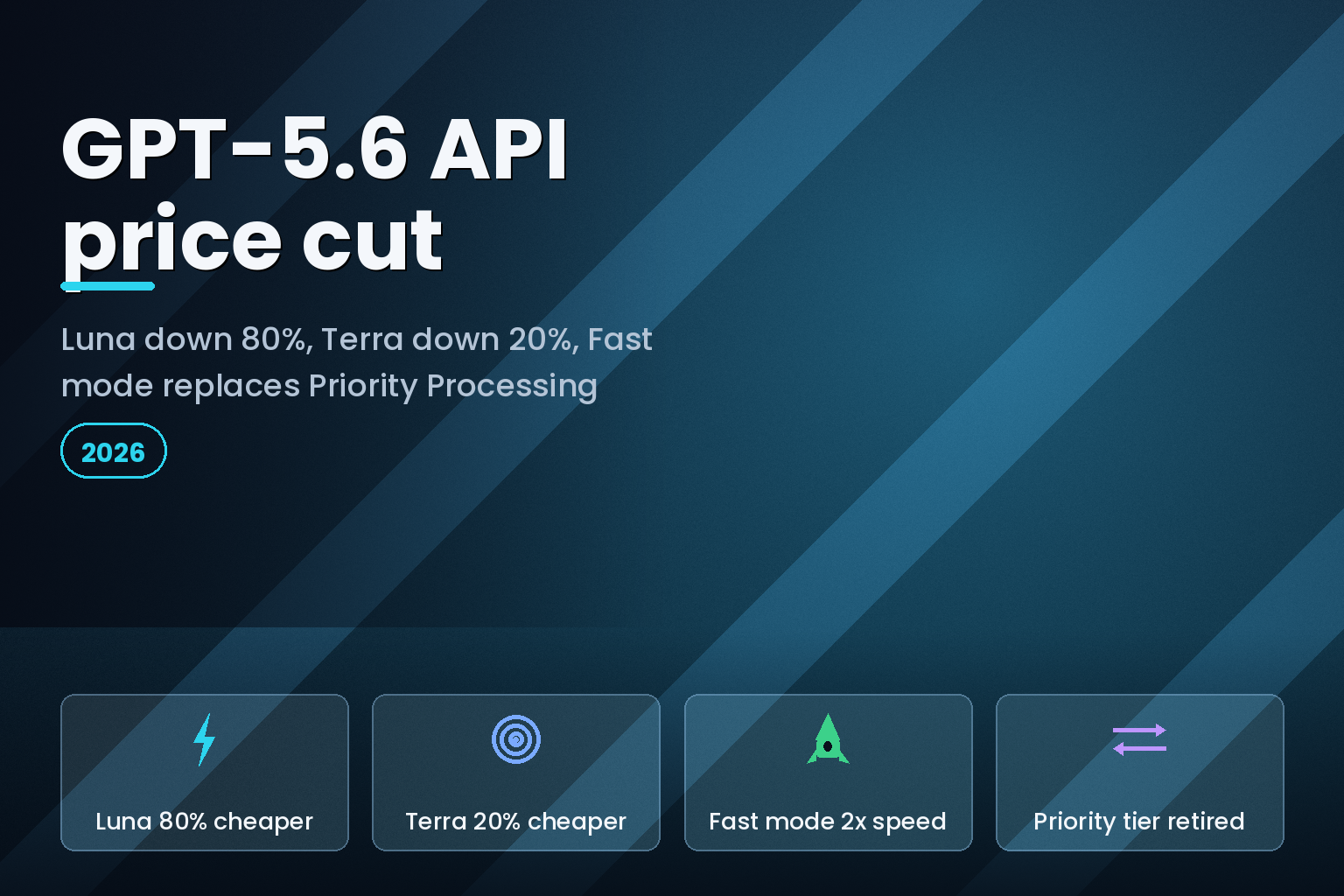
Summary. On July 30, 2026 OpenAI cut the API price of GPT-5.6 Luna by 80%, to $0.20 per million input tokens and $1.20 per million output tokens, and cut GPT-5.6 Terra by 20%, to $2 and $12. GPT-5.6 Sol stayed at $5 and $30. The same day OpenAI renamed Priority Processing to Fast mode, which runs Sol up to 2.5x faster than Standard at twice the price with no change in intelligence. If you route LLM traffic in production, three things change at once: your cheapest tier just got much cheaper, your premium-latency tier has a new name and a clean pay-as-you-go model, and any request you already tagged priority keeps working. This is the cost math and the migration.
The announcement, Advancing the price-performance frontier with GPT-5.6, framed the cut as passing on efficiency gains: OpenAI says kernel work done partly by Sol itself cut the end-to-end cost of serving the model by 20% and raised token-generation efficiency by more than 15%. For buyers, the framing matters less than the invoice. A high-volume workload sitting on Luna now costs a fifth of what it did on July 29.
What actually changed on July 30
Two separate moves landed together, and it is worth keeping them apart.
The first is a Standard-tier price cut on the two cheaper GPT-5.6 models. Luna, OpenAI's fastest and most affordable tier, dropped from $1 and $6 per million tokens to $0.20 and $1.20. Terra, the balanced tier for everyday work, dropped from $2.50 and $15 to $2 and $12. Sol, the frontier tier, did not move. OpenAI also said the lower Luna and Terra rates now consume fewer credits inside Codex and ChatGPT Work, and that the API changes would roll out on AWS the same day.
The second is a rename with a pricing model attached. Priority Processing, the tier you used when you needed predictable low latency, is now called Fast mode. You reach it with service_tier: fast or the old service_tier: priority; both resolve to the same tier. For Sol, Fast mode is up to 2.5x faster than Standard and is billed per token at twice the Standard rate. Nothing about the model's quality changes; you are paying for speed and consistency, not a smarter model.
The new numbers
Here is the full GPT-5.6 matrix after July 30, 2026, in US dollars per million tokens. Standard is the default tier; Fast mode is the premium-latency tier that replaced Priority Processing. For every GPT-5.6 model, Fast mode is exactly double the Standard rate.
| Model and tier | Input per 1M tokens | Output per 1M tokens |
|---|---|---|
| GPT-5.6 Sol, Standard | $5.00 | $30.00 |
| GPT-5.6 Sol, Fast mode | $10.00 | $60.00 |
| GPT-5.6 Terra, Standard | $2.00 | $12.00 |
| GPT-5.6 Terra, Fast mode | $4.00 | $24.00 |
| GPT-5.6 Luna, Standard | $0.20 | $1.20 |
| GPT-5.6 Luna, Fast mode | $0.40 | $2.40 |
The cut itself, before against after, is smaller to read but larger in effect:
| Model | Before (input / output) | After (input / output) | Standard price change |
|---|---|---|---|
| GPT-5.6 Luna | $1.00 / $6.00 | $0.20 / $1.20 | down 80% |
| GPT-5.6 Terra | $2.50 / $15.00 | $2.00 / $12.00 | down 20% |
| GPT-5.6 Sol | $5.00 / $30.00 | $5.00 / $30.00 | unchanged |
Cached input tokens keep the same 50%, 75%, or 90% discount they get on Standard, so a cache-heavy agent loop benefits twice: from the headline cut and from cache reuse. For a fuller picture of how these three tiers sit against rival frontier models, see our breakdown of how the GPT-5.6 tiers compare with Gemini and Claude and the deeper GPT-5.6 tier selection guide.
What the cut does to a real bill
Take a support-triage and classification workload that reads 1 billion input tokens and writes 200 million output tokens a month on Luna. On the old rate that was 1,000 x $1 plus 200 x $6, or $1,000 plus $1,200, a total of $2,200 a month. On the new rate it is 1,000 x $0.20 plus 200 x $1.20, or $200 plus $240, a total of $440 a month. Same tokens, same model, $1,760 less every month, or about $21,120 a year, with no code change beyond confirming the model ID.
The effect is largest exactly where high-volume teams live: retrieval-augmented answers, log and ticket classification, extraction, and background agent steps. Several named customers in OpenAI's announcement reported the same shape of result. Stanislas Polu, co-founder and CTO of Dust, said that "given the same agentic tasks, GPT-5.6 Luna is 40% faster and 40% cheaper than our previous default model." Sid Pardeshi, CTO and co-founder of Blitzy, described moving from a single structured-output call to a full tool-calling loop on Luna and "increasing prompt-cache reuse from 24% to 90%," handling "2.2x more context with 8.5x fewer output tokens, at 87% lower cost than GPT-5.4 mini." Those are vendor-supplied figures, not independent benchmarks, but the direction is consistent with the published rate card.
Fast mode, and how it differs from Priority Processing
Fast mode is the part most teams will get wrong, because the rename hides a small set of real changes. The tier does the same job Priority Processing did: predictably low latency, billed pay-as-you-go instead of a provisioned commitment. What is new is the naming and the Codex alignment.
You select it per request with service_tier: "fast". Requests still tagged service_tier: "priority" continue to work and resolve to the same tier, so nothing breaks on deploy. You can also set a project default under Project settings, Default Service Tier, Fast, which is the same as selecting Priority. In the usage dashboard, requests using either priority or fast still show up grouped as priority for now. Fast mode aligns with /fast in Codex, so the API tier and the coding tool now use one vocabulary.
Two operational details matter for anyone moving real traffic. First, Fast mode has ramp rate limits: the current limit is defined as processing at least 1 million tokens per minute and increasing traffic by more than 50% in under 15 minutes. Cross it during degraded performance and some requests spill to Standard, which is billed at Standard rates and carries no Fast latency objective. Second, Fast mode is compatible with Zero Data Retention and the Business Associate Agreement, so a regulated workload does not have to choose between speed and its data terms.
| Attribute | Standard tier | Fast mode (was Priority Processing) |
|---|---|---|
| Selector | default, or service_tier: "default" |
service_tier: "fast" or "priority" |
| Sol price vs Standard | baseline ($5 / $30) | 2x baseline ($10 / $60) |
| Sol speed target | standard throughput | up to 2.5x faster, 99% over 80 tokens/sec |
| Best for | batch, async, cost-led work | latency-critical, user-facing calls |
| Ramp limit | not applicable | 1M tokens/min and over 50% rise in 15 min |
How to route after the change
The cut widens the gap between your cheapest and most capable tiers, which makes tier routing the highest-use decision on the bill. OpenAI's own example is a coding workflow that uses Sol to resolve uncertainty and write the plan, then hands well-specified changes to Luna to implement, test, and evaluate. The principle generalises: spend Sol's intelligence only where the cost of being wrong is high, and push volume to Luna once the task is well defined.
| Workload | Tier to start with | Why | First cost lever |
|---|---|---|---|
| High-volume classification, extraction | Luna, Standard | quality now cheap at scale | raise cache reuse |
| Everyday agent Q&A and scoped tasks | Terra, Standard | balanced cost and quality | trim output tokens |
| Planning, ambiguous or high-stakes steps | Sol, Standard | frontier reasoning where errors cost | keep prompts tight |
| User-facing, latency-critical Sol calls | Sol, Fast mode | 2.5x speed when response time sells | cap to hot paths only |
| Batch and asynchronous jobs | Standard, any model | Fast mode wasted on jobs that can wait | never default to Fast |
The judgement worth stating plainly: Fast mode is a scalpel, not a default. Hoda Noorian of Notion's AI product team said Terra "delivered comparable quality to GPT-5.5 at half the cost per task and in 60% less time" for scoped work, which is the sort of task where paying a Fast-mode premium adds nothing. Reserve the 2x rate for the handful of user-facing paths where latency is the product. For a structured way to codify these rules, our GPT-5.6 inference cost analysis and the comparison of Claude Opus 5 versus GPT-5.6 Sol for coding agents both walk through the routing math in more detail.
A migration checklist
For teams already on GPT-5.6, the change is low risk if you treat it as a review rather than a rewrite.
Confirm your model IDs and re-price your top five workloads against the new Luna and Terra Standard rates; the savings apply automatically, but your budget forecasts and internal chargeback rates should reflect them. Audit every place you send service_tier: "priority" and decide, path by path, whether that request truly needs Fast mode or was tagged priority out of habit; each unnecessary Fast call now costs double. Set a project default of Standard and opt specific routes into Fast, rather than the reverse. Check your Fast traffic against the ramp limit of 1 million tokens per minute and a 50% rise inside 15 minutes, and stage model transitions with a feature flag over a few hours so you do not trip it. Keep large batch and asynchronous jobs on Standard. Finally, if you run under Zero Data Retention or a Business Associate Agreement, confirm the flag is set, since Fast mode supports both.
India-specific considerations
For Indian teams the cut lands on the exact workloads that were previously hard to justify at volume: WhatsApp and support triage, document extraction for lending and insurance, and retrieval answers over large local corpora. Luna at $0.20 and $1.20 per million tokens makes a national-scale support agent an operating-expense line rather than a project. OpenAI also lists data residency for ChatGPT Enterprise across ten regions including India, which matters when the workload touches personal data governed by the Digital Personal Data Protection Act 2023. Treat the API's data terms separately from the ChatGPT product terms, name the DPDP obligations in your data-processing records, and design the pipeline so that personal data handling is explicit rather than assumed. Cheaper tokens do not lower the compliance bar; they only make more use cases economically worth building to that bar.
FAQ
How eCorpIT can help
eCorpIT is a Gurugram-based, senior-led engineering organisation, founded in 2021 and assessed at CMMI Level 5, that builds and runs production LLM systems for teams that care about the invoice as much as the output. We map your workloads to the right GPT-5.6 tier, wire Standard and Fast mode routing behind a gateway, instrument per-route cost and latency, and design the data handling to align with DPDP Act 2023 requirements. If you want a second read on where the July 2026 cut changes your architecture, talk to our team and we will size the savings against your real traffic.
References
- OpenAI, Advancing the price-performance frontier with GPT-5.6, July 30, 2026.
- OpenAI, Fast mode for API customers, accessed August 2, 2026.
- OpenAI, GPT-5.6 Sol model documentation, accessed August 2, 2026.
- OpenAI, GPT-5.6 Luna model documentation, accessed August 2, 2026.
- OpenAI, GPT-5.6 Terra model documentation, accessed August 2, 2026.
- OpenAI, GPT-5.6, model overview, accessed August 2, 2026.
- OpenAI, ChatGPT and API pricing, accessed August 2, 2026.
- Unite.AI, OpenAI cuts API prices on its two cheaper GPT-5.6 tiers, July 2026.
- Crypto Briefing, OpenAI cuts GPT-5.6 Luna pricing by 80% and accelerates Sol API, July 30, 2026.
- Apidog, OpenAI slashes GPT-5.6 API prices: Luna down 80%, July 2026.
- Eden AI, GPT-5.6 Sol: benchmarks, pricing and API access guide, 2026.
_Last updated: August 2, 2026._