On this page · 12 sections
- Why most AI projects die after the demo
- Lesson 1: the model is the easy part
- Lesson 2: write the evaluation harness before the feature
- Lesson 3: an agent is a system, not a prompt
- Lesson 4: respect the last mile
- Lesson 5: layer guardrails by business risk
- Lesson 6: meter cost from the first commit
- Lesson 7: keep the model swappable and the data governed
- Putting the seven lessons to work
- How eCorpIT can help
- FAQ
- References
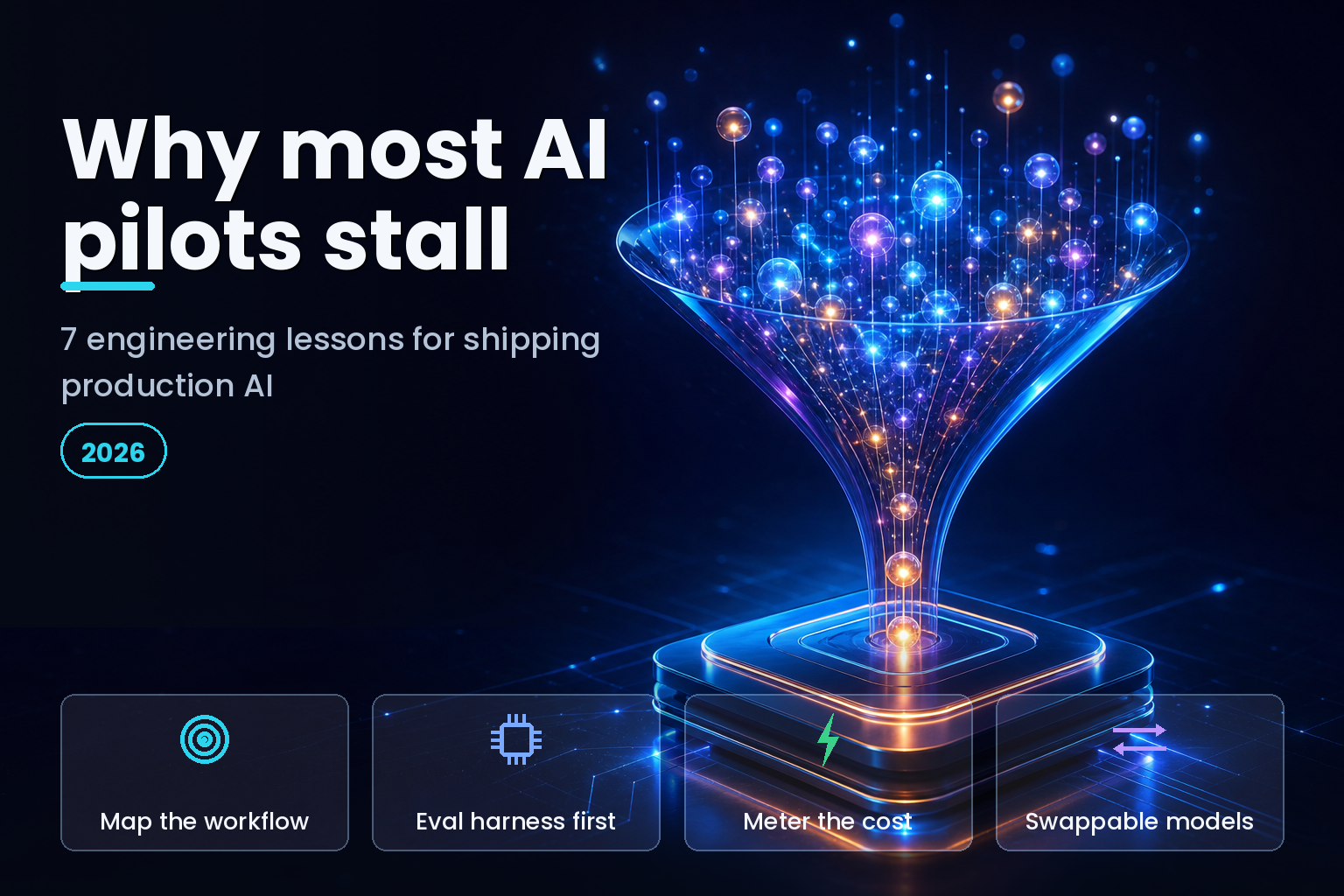
Summary. Most enterprise AI never ships. MIT's Project NANDA report, The GenAI Divide: State of AI in Business 2025, found that despite $30-40 billion in enterprise spend, about 95% of generative AI pilots produced no measurable profit-and-loss impact, while only 5% reached production and returned real value. The RAND Corporation puts the broader AI project failure rate above 80%, roughly twice the rate of comparable IT projects. S&P Global Market Intelligence found 42% of companies abandoned most of their AI initiatives in 2025, up sharply from 17% a year earlier. The pattern across that data is consistent: projects fail in delivery, not in the model. MIT's central finding is that the barrier is learning and integration, not infrastructure, regulation, or talent. These seven lessons come from eCorpIT's engineering work shipping production AI for enterprises, and each one maps to a failure mode the numbers describe. They are written for engineering leaders and founders who have a working demo and now have to make it survive contact with real users, real data, and real cost.
Why most AI projects die after the demo
The gap is not capability. The same MIT research found that over 80% of organizations have piloted tools like ChatGPT or Copilot and nearly 40% report some deployment, yet most of that only lifts individual productivity rather than moving the business. The funnel is brutal: 60% of organizations evaluated enterprise-grade systems, 20% reached a pilot, and just 5% reached production. The report's explanation is plain, and worth quoting: "Most GenAI systems do not retain feedback, adapt to context, or improve over time."
That sentence is an engineering brief disguised as a research finding. A demo proves a model can do a task once, under supervision, with a clean input. Production means doing it thousands of times, unsupervised, with messy inputs, inside a system that must log, recover, and stay within budget. The seven lessons below are what closes that distance.
Two more findings from the same report sharpen the picture. A shadow AI economy has formed: only about 40% of companies bought an official model subscription, yet workers at more than 90% of companies use personal AI tools for work, so unmanaged usage is already inside your organization whether or not a project shipped. And how you build matters. MIT found that buying from specialized vendors and forming partnerships succeeded about 67% of the time, while internal-only builds succeeded roughly a third as often. The takeaway is not to avoid building, it is to be honest about which capabilities are differentiated enough to justify building them yourself. eCorpIT has written companion field notes in engineering lessons from shipping enterprise AI agents and production AI agent delivery lessons; this piece is the condensed version.
| Lesson | Failure mode it prevents | Core artifact |
|---|---|---|
| 1. The model is the easy part | Building around a model instead of a workflow | Workflow map with the human decision named |
| 2. Write the eval harness first | Shipping changes you cannot measure | Task-level evaluation set with a pass bar |
| 3. An agent is a system, not a prompt | Trusting model output with no runtime control | Deterministic harness that validates and logs |
| 4. Respect the last mile | Mistaking a demo for 80% done | Production readiness checklist |
| 5. Layer guardrails by risk | Uniform controls that slow everything | Risk-tiered guardrail policy |
| 6. Meter cost from the first commit | Token cost discovered in the invoice | Cost-per-task dashboard with alerts |
| 7. Keep the model swappable | Single-vendor lock-in and forced rewrites | Model-agnostic gateway plus data governance |
Lesson 1: the model is the easy part
Teams default to the model because it is the exciting part, and that is the first mistake. The MIT data is clear that pilots stall on integration and organizational learning, not on raw model quality. The work that decides success is mapping the actual workflow: where the task starts, what data it touches, which step a human still owns, and what "done correctly" means in a way you can check.
Start every project by writing that workflow down before any prompt. Name the decision the AI is making and the cost of getting it wrong. If the team cannot state, in one sentence, what the system decides and who is accountable when it is wrong, the project is not ready for a model yet. This is also the cheapest place to discover that a problem does not need generative AI at all, which saves the budget for the ones that do.
Lesson 2: write the evaluation harness before the feature
You cannot ship what you cannot measure, and AI output resists casual measurement because it looks plausible even when it is wrong. The hardest-won lesson in production AI is to build the evaluation set first: a representative collection of real tasks with known good outcomes, plus a scoring method, before building the feature it grades.
Evaluation in 2026 has moved past scoring a single response. For any multi-step or agentic system, you evaluate the full trajectory: was the tool choice correct, were the arguments valid, how many steps did it take, what did it cost, did it stay within policy. Score programmatically wherever the task allows, and reserve model-graded judgement for the dimensions that resist it, with the judge itself calibrated against human labels. Without this harness, every change is a guess and every regression ships silently. With it, you can refactor, swap models, and tighten prompts with a number that tells you whether you helped or hurt. A concrete version costs little: collect 50 to 100 real requests, label the correct outcome for each, and write a scorer that checks it. Run that set on every change and inside continuous integration, so a prompt tweak that fixes one case while breaking three is caught before it ships rather than after a user reports it.
Lesson 3: an agent is a system, not a prompt
In a demo, an agent looks like a clever prompt. In production, an agent is a distributed system in which the model is the planner and executor, and the reliable part is everything around it. The pattern that holds up is a deterministic harness: a runtime layer that wraps the model and validates, authorizes, executes, and logs every action the model proposes, instead of trusting the model to act on the world directly.
Treat model output as a proposal, not a command. The harness checks each proposed tool call against a schema, confirms the caller is allowed to take that action, executes it through your own code, and records the full trace for replay. This is what turns an impressive but unpredictable model into a system you can debug, audit, and trust with real permissions. eCorpIT's deeper treatment of this sits in enterprise AI agent governance layers.
Lesson 4: respect the last mile
The demo is roughly the first 20% of the work, and teams keep budgeting as if it were the last 80%. The funnel proves it: evaluation to pilot to production drops from 60% to 20% to 5%, and S&P Global Market Intelligence found 42% of companies abandoned most of their AI initiatives, more than double the 17% who did so the year before, with the average organization scrapping nearly half of its proofs of concept before production. Projects do not usually fail at a dramatic moment. They run out of budget and patience in the long tail of edge cases, error handling, monitoring, and integration that no one scoped.
Scope the last mile explicitly. Before a pilot starts, write a production readiness checklist: how the system fails safely, how errors surface to a human, how you monitor quality in real time, how it integrates with the systems of record, and who owns it after launch. Funding the demo and hoping for production is the single most common way an AI project joins the 95%.
Make the checklist a gate, not a wish list. A workable bar before any pilot graduates to production: a rollback path that disables the AI and reverts to the prior process in minutes; structured logging of every model decision for audit and replay; a real-time quality monitor with a threshold that pages a human; a named owner with an on-call rotation; and a documented cost ceiling per task. If any line is unanswered, the system is still a demo wearing a deadline. The launches that quietly degrade over weeks are almost always the ones where no one agreed, in advance, on the number that would trigger a human to step in.
Lesson 5: layer guardrails by business risk
Uniform safety controls are a tax that makes a system slow and expensive everywhere to handle the few places that are genuinely high-stakes. The production approach is risk-based: adjust the depth of checking to the risk of the specific request. A low-stakes summarization does not need the verification a financial action or a medical-adjacent answer does.
Build accuracy first, then add guardrails in layers matched to risk. Cut errors at the source with retrieval and reasoning techniques, then apply heavier verification only where the cost of a mistake justifies it. This keeps the system responsive for the common, low-risk path while concentrating scrutiny where it matters. The alternative, one heavy guardrail on every call, is how teams make a system so slow that users route around it, which is its own failure mode.
Lesson 6: meter cost from the first commit
Token cost is invisible in a demo and brutal at scale, because an agent's cost compounds with every reasoning step and tool call. A workflow that costs a fraction of a rupee once can become the largest line on a cloud bill when it runs across every transaction. Teams that discover this in the monthly invoice are already over budget.
Put a cost meter on the system from the first commit. Track cost per task, not just total spend, and set alerts for anomalies: a sudden jump in cost per task, a drop in completion rate, a rise in hallucination rate. These often move together and signal a regression before users complain. Treating AI spend as a first-class engineering metric, the way you treat latency, is what keeps a successful pilot from becoming an unaffordable production system. eCorpIT maintains a practical list in free AI cost tools for engineering teams.
Lesson 7: keep the model swappable and the data governed
The last lesson got more urgent in June 2026, when a US export-control order forced a vendor to suspend two frontier models worldwide within hours. Whatever the cause, vendor outage, price change, regulation, or a model deprecation, the team that wired its application directly to one vendor's SDK faces a rewrite under pressure, while the team that routed calls through a model-agnostic gateway changes a configuration value.
Make the model a swappable component and govern the data that flows through it. Route model calls through an internal abstraction so the underlying model is configuration, not code, and give critical workflows a tested fallback. Classify the data each workflow touches and keep regulated data on infrastructure you control. The continuity case is covered in our enterprise AI export-control compliance playbook, and the privacy architecture in privacy-first AI architecture lessons.
India-specific considerations
Indian engineering teams carry an extra constraint that makes lessons 6 and 7 sharper. A large share of Indian AI products are built on US foundation-model APIs, so model-continuity risk is a structural exposure, not a hypothetical, and a tested fallback is closer to mandatory than optional. On data, the Digital Personal Data Protection Act, 2023 runs cross-border personal-data transfers against a government-maintained permitted-country list, which pushes regulated workloads toward regional or on-premise deployment. For a cost lens, on-premise and regional inference can also blunt token-pricing exposure for high-volume workflows, though it trades capex and operational load for that control. The compliance detail is in our DPDP consent-manager readiness guide.
Putting the seven lessons to work
You do not need all seven in place before you ship, you need them in the right order. Start with lesson 1 and lesson 2, the workflow map and the evaluation harness, because they are cheap and they decide whether the rest is worth doing. Stand up lesson 3, the deterministic harness, the moment the system takes any real action on a user's behalf. Lessons 4 through 6, the last-mile checklist, risk-tiered guardrails, and cost metering, belong in the pilot phase, before the system meets every user. Lesson 7, swappable models and governed data, is the one teams defer and later regret, so wire the gateway in early when it is a small change rather than a forced migration. None of this is exotic. It is the difference between the 5% of projects that reach production and the 95% that stall, and the gap is engineering discipline applied before the demo flatters everyone into believing the hard part is finished.
How eCorpIT can help
eCorpIT (eCorp Information Technologies Private Limited) is a senior-led technology consultancy in Gurugram, founded in 2021 and assessed at CMMI Level 5. Our engineering teams help enterprises move AI out of the pilot stage and into production: workflow mapping, evaluation harnesses, deterministic agent runtimes, risk-tiered guardrails, cost instrumentation, and model-agnostic, DPDP-aligned architecture. We design systems aligned with privacy and export-control requirements rather than claiming certifications we do not hold. To pressure-test an AI project before it joins the 95%, contact our team.
FAQ
References
Last updated: June 29, 2026.