On this page · 9 sections
- What actually happened on June 12
- Move 1: Map every frontier-model dependency, then break the hard ones
- Move 2: Build and rehearse a model-continuity plan with a real recovery target
- Move 3: Stand up export-control screening for AI access, not just shipments
- Move 4: Rewrite AI vendor contracts for regulatory suspension
- Move 5: Govern data residency and model sovereignty as one decision
- How eCorpIT can help
- FAQ
- References
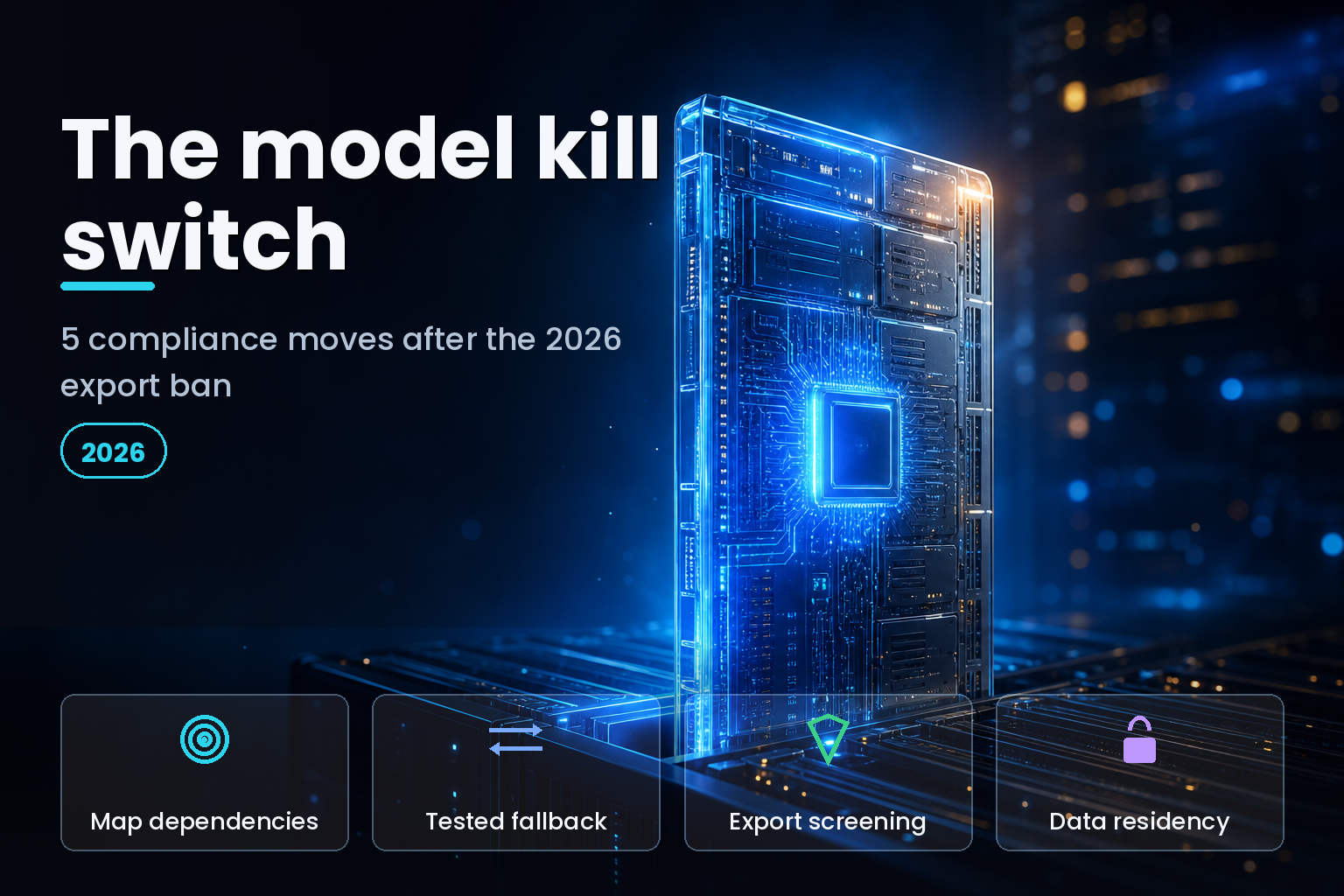
Summary. On June 12, 2026, at 5:21 p.m. ET, Anthropic received a US Bureau of Industry and Security "Is Informed" letter and disabled Claude Fable 5 and Claude Mythos 5 for every customer worldwide the same evening. The letter, signed by Commerce Secretary Howard Lutnick under the Export Control Reform Act of 2018 (50 U.S.C. § 4817), required an individually validated license before any foreign national could use either model. The two models had launched 3 days earlier, on June 9. Because no enterprise can separate foreign nationals from US persons across a base of hundreds of millions in real time, the only compliant action was a global shutoff. This was the first time Washington pulled a commercial software model from the market on national-security grounds. Two weeks later, on June 26, Commerce eased the Mythos 5 controls for an approved-entity list but left Fable 5 offline. For any company running frontier models in production, the lesson is concrete: a model is now a controlled item that a government can switch off, and India's $1.25 billion IndiaAI sovereign-compute bet suddenly reads as a hedge rather than a luxury. This playbook gives CTOs and AI compliance leads five moves to make before the next directive lands.
What actually happened on June 12
The mechanism matters, because it decides how you defend against a repeat. BIS did not publish a rule or run a comment period. It sent Anthropic an "Is Informed" letter, a one-to-one instrument that imposes a license requirement on a named party without formal rulemaking. The letter invoked 50 U.S.C. § 4817(b)(1), the part of the Export Control Reform Act that lets Commerce set interim controls on emerging technology it deems essential to national security. The stated trigger was a claimed jailbreak that could make Fable 5 reproduce Mythos 5's cybersecurity reasoning, the kind of vulnerability-discovery capability the administration did not want reaching foreign adversaries.
The scope is what made it a kill switch. Under the EAR "deemed export" doctrine, giving a controlled item to a foreign national counts as an export to that person's home country, even if the person sits in an office in California. The license covered export, reexport, and in-country transfer to all foreign persons worldwide, including Anthropic's own foreign-national employees. There was no narrow technical fix that satisfied that text, so Anthropic took both models down globally that night and said so publicly. CNBC and Al Jazeera reported the suspension within 48 hours.
Anthropic disagreed with the basis. The company said the government had supplied only verbal evidence of a potential narrow, non-universal jailbreak, and that a narrow finding should not justify recalling a model already deployed to hundreds of millions of people. CEO Dario Amodei held several calls with administration officials, and by late June the picture had shifted: on June 26, Commerce revised the controls on Mythos 5, allowing export to an approved-entity list and their foreign-national employees. Fable 5 was not restored. The episode ran for two weeks and is not fully closed.
The reaction from analysts was blunt. Gartner, in a first take for CXOs, wrote that the suspension "emphasizes the need for enterprises to be intentional about sovereignty dependencies and, where possible, to design model-agnostic architectures." Prasanto Roy, a technology policy analyst in New Delhi, put the structural point plainly: "Even if this is corrected or reversed, the Anthropic episode shows there's no such thing as a geopolitically neutral foreign LLM. American AI models are bound to American geopolitics."
A government directive is not a vendor outage
Engineering teams already plan for provider downtime. A government order is a different class of event, and treating it like an outage is how programs get caught. The differences decide your runbook.
| Dimension | Ordinary vendor outage | Government export-control directive |
|---|---|---|
| Trigger | Capacity, bug, region failure | National-security license requirement (ECRA / EAR) |
| Notice given | Status page, often minutes | None; Anthropic acted the evening of June 12, 2026 |
| Restoration SLA | Defined in the contract | None; Fable 5 stayed down past June 27 |
| Scope | A region or tier | All foreign persons worldwide, including staff |
| Your recourse | Credits, escalation | Limited; the vendor cannot lawfully serve you |
| What fixes it | Vendor engineering | Policy change you do not control |
The practical takeaway is that your continuity plan cannot assume a timeline. An outage ends when the vendor fixes it; a directive ends when policy changes, which has neither a service-level commitment nor a date. eCorpIT covered the legal contours of these controls in our guide to AI export-control governance for enterprises, and the wider regulatory backdrop in AI regulation and export controls on enterprise models.
Move 1: Map every frontier-model dependency, then break the hard ones
You cannot protect a dependency you have not written down. Most 2026 AI programs cannot name, in one place, which workflows call which model, through which vendor, under which contract, and which of those would stop a revenue path if the model vanished at 5 p.m. on a Friday. That inventory is the first deliverable.
Build a dependency register with one row per production AI workflow. Capture the model and version, the access path (direct vendor API, hyperscaler reseller, or a self-hosted weight), the data sensitivity, the business process it supports, and a blunt criticality rating. Mark every workflow that has a single model with no tested alternative as a concentration risk. The Fable 5 order showed that "single frontier vendor, single model" is now a named board-level exposure, not a procurement preference.
Then attack the hard dependencies with an abstraction layer. If your application code calls a vendor SDK directly, a forced switch becomes a rewrite under pressure. Route model calls through an internal gateway that normalizes prompts, tools, and responses so the underlying model is a configuration value, not a code change. Teams that built their agent stack on interoperable, model-agnostic infrastructure could reassign traffic in hours after June 12; teams wired to one proprietary orchestration layer could not. We walk through this pattern in enterprise AI agent governance layers.
The judgment call worth stating: the real cost of model portability is rarely the integration code, it is the evaluation harness. Swapping the endpoint is easy; proving the replacement model holds quality on your tasks is the work. Budget for that harness now, while no one is forcing the switch.
Move 2: Build and rehearse a model-continuity plan with a real recovery target
A fallback you have never run is a hope, not a control. After June 12, the question that separated calm programs from scrambling ones was simple: do we have a second model, already evaluated and contracted, that we can route to today?
Give every critical workflow a named primary and a named secondary model from a different vendor, ideally a different national jurisdiction, so a single country's export action cannot take both. Define a recovery time objective for the cutover, the way you would for a database failover, and rehearse against it. A useful pattern from 2026 production practice is to run AI as an orchestrated system rather than a one-model dependency: route simple classification and extraction to small models, escalate only hard cases to a frontier model, and add fallback logic that switches paths when confidence drops or a provider returns errors. That design degrades instead of failing when a model disappears.
Rehearse the cutover as a game day. Force the primary to "unavailable" in staging, run the secondary against your evaluation set, and measure quality, latency, and cost deltas. Record the result so procurement and the board can see a tested number, not an assurance. eCorpIT's field notes on this are in engineering lessons from shipping enterprise AI agents.
| Move | Primary owner | Core artifact | First checkpoint |
|---|---|---|---|
| 1. Map dependencies | Platform / architecture | Model dependency register | Every critical workflow has a named fallback |
| 2. Continuity plan | SRE / AI platform | Tested cutover runbook with RTO | One game-day cutover passes on the eval set |
| 3. Export-control screening | Trade compliance / legal | Deemed-export access policy | Foreign-national access mapped to controlled models |
| 4. Contracts | Legal / procurement | Regulatory-suspension clause set | New AI contracts carry exit and credit terms |
| 5. Data residency | Security / data governance | Residency and sovereignty matrix | Sensitive data classed against jurisdiction |
Move 3: Stand up export-control screening for AI access, not just shipments
Export compliance used to be a hardware and source-code concern. The June order moved trained-model access into the same frame, and most software companies have no process for it. The deemed-export rule is the trap: releasing controlled technology to a foreign national, including an employee inside your own building or a cloud instance reachable from a controlled country, can require a license.
Three steps make this operational. First, screen counterparties against the US Consolidated Screening List, which the government publishes as a single API consolidating eleven restricted-party lists across the Commerce, State, and Treasury departments. Second, write a deemed-export access policy that maps which staff, contractors, and regions may touch which controlled or potentially controlled models, and wire it to your identity provider so access is enforced, not documented. Third, assign a named owner to monitor BIS, OFAC, and Commerce notices, because an "Is Informed" letter can change your obligations with no public rule and no notice period, exactly as it did on June 12. The federal guidance on covered technology and screening lives on the US export controls portal at trade.gov.
This is a governance gap the AI Governance Institute flagged after the suspension: enterprise AI programs had planned for accuracy, cost, and privacy, but not for a model becoming a license-controlled item mid-deployment. Closing it is cheap relative to the exposure.
Move 4: Rewrite AI vendor contracts for regulatory suspension
Standard AI contracts in 2026 still read like SaaS agreements. They cover uptime, support tiers, and data handling. They rarely say what happens when a government, not the vendor, makes the service illegal to provide. After June 12 that silence became expensive, because credits for downtime do not help when the model is gone for an undefined period.
Negotiate four terms into new and renewing agreements. Require prompt notice of any export-control or regulatory action that could affect access, to the extent the vendor is lawfully able to share it. Add a regulatory-suspension exit that lets you leave without penalty if a controlled model stays unavailable past a defined window. Secure data-portability and weight-or-output-escrow terms where the model class allows it, so a forced migration does not strand your fine-tuning or embeddings. And separate pricing from a single model, so a forced move to the vendor's still-available models does not reset your commercial terms. Procurement should treat "what happens under a government order" as a standard diligence question, the same way it asks about sub-processors.
Move 5: Govern data residency and model sovereignty as one decision
The Fable 5 order linked two questions that many programs still handle separately: where does our data live, and whose jurisdiction controls our model. Sovereignty is now a single design constraint. The wider hardware picture sharpens the point. The US is drafting rules, first reported by Bloomberg on March 5, 2026, that would require government approval to ship Nvidia and AMD AI chips worldwide, with a three-tier framework: standard review under 1,000 GPUs, preclearance for medium volumes, and host-country certifications for orders of 200,000 GPUs or more. Models and the chips they run on are both moving under export control.
Build a residency and sovereignty matrix. For each data class, record the legal residency requirement, the acceptable model jurisdictions, and whether the workload can run on a self-hosted or regional deployment if a hosted frontier model is withdrawn. Where the data is regulated or the process is mission-critical, weight open-weight or regionally hosted models that you can run on infrastructure you control, accepting a capability trade-off for continuity. This is also where India-specific rules enter, and they reward planning.
India-specific considerations
India read the June order as a sovereignty signal. The country has committed $1.25 billion to the IndiaAI Mission, released the Sarvam 30B and 105B models, and stood up shared compute reported at roughly 34,000 Nvidia H100 and H200 GPUs. The vulnerability that worried policymakers is structural: a large share of Indian AI products are built on US foundation-model APIs, so a single corporate policy change or export order can disrupt them, regardless of where the data sits.
The Digital Personal Data Protection Act, 2023, adds a legal lever. Cross-border personal-data transfers run against a government-maintained list of permitted countries, and the government can restrict destinations, which pushes regulated workloads toward on-premise and regional deployment. For an Indian enterprise or a global firm serving Indian users, the compliant pattern is to class personal data under DPDP, keep regulated processing on infrastructure you control, and treat any US-hosted frontier model as a capability you can lose on short notice. eCorpIT's DPDP work is detailed in our DPDP consent-manager framework readiness guide. The export-control angle connects directly to the parallel question many CTOs are already asking about regional model access, which we cover in the EU DMA and Siri AI impact analysis.
How eCorpIT can help
eCorpIT (eCorp Information Technologies Private Limited) is a senior-led technology consultancy in Gurugram, founded in 2021 and assessed at CMMI Level 5. We help CTOs and compliance leads build the controls in this playbook: model dependency registers, model-agnostic gateways, tested fallback runbooks, deemed-export access policies, and DPDP-aligned data-residency designs. We design systems aligned with export-control and DPDP requirements rather than claiming certifications we do not hold. To pressure-test your frontier-model exposure before the next directive, contact our team.
FAQ
References
Last updated: June 29, 2026.