On this page · 13 sections
- Why privacy moved into the architecture
- Lesson 1: Default to on-device, minimise what leaves
- Lesson 2: Root trust in attested hardware, not vendors
- Lesson 3: Make the privacy claim verifiable, not just stated
- Lesson 4: Keep inference stateless and non-targetable
- Lesson 5: Stay provider-swappable, avoid model lock-in
- Lesson 6: Build provenance and disclosure in
- Putting the layers together
- India-specific considerations
- Where to start
- FAQ
- How eCorpIT can help
- References
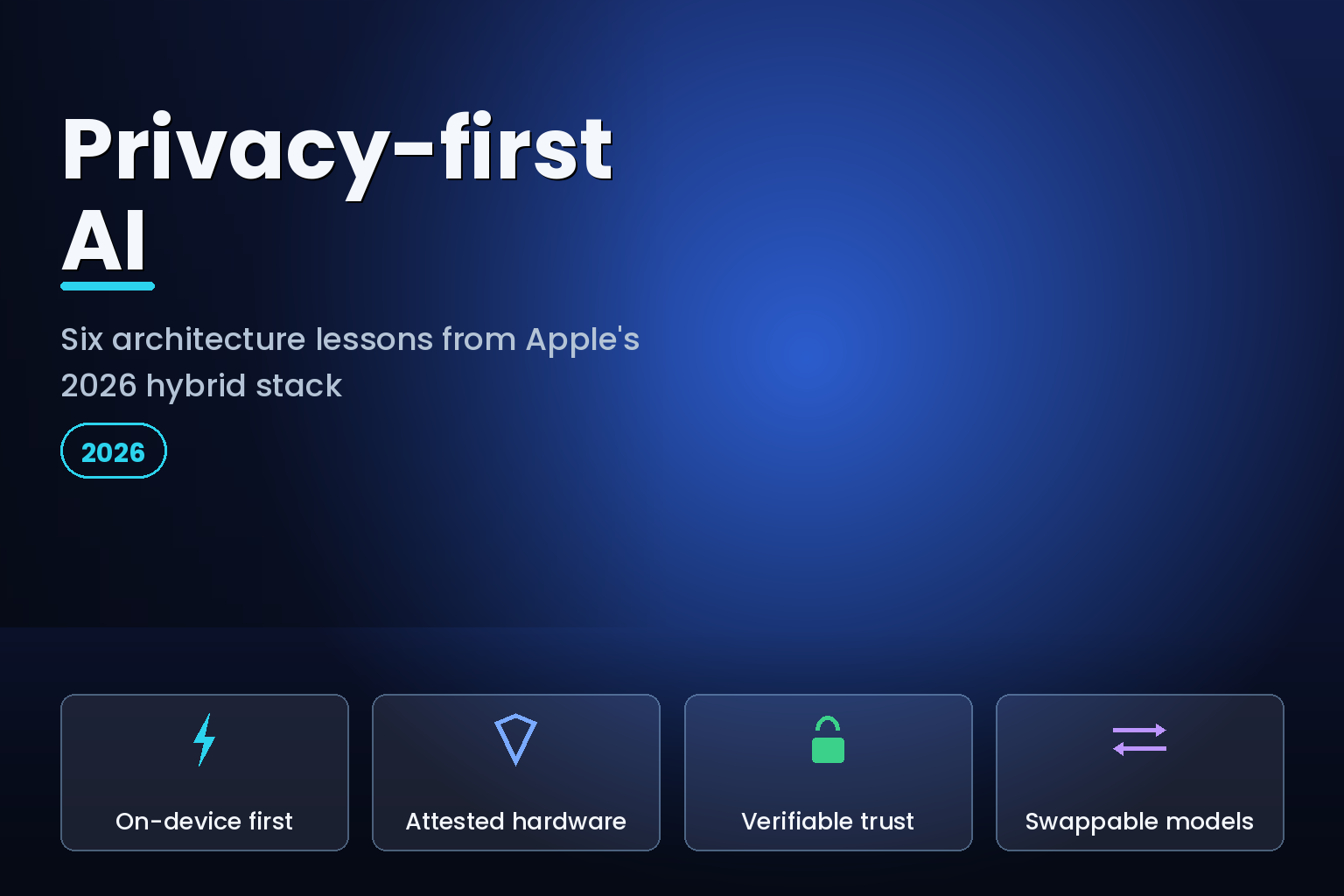
Summary. Privacy is now an architecture decision, not a policy line. The confidential computing market that underpins private AI is projected to reach $42.74 billion in 2026 on the way to $463.89 billion by 2034, and Gartner expects more than 75% of processing in untrusted infrastructure to be secured in use by confidential computing by 2029. Most enterprise AI workloads will touch sensitive data in 2026. Apple's hybrid stack, rebuilt at WWDC 2026, is the clearest production example of how to handle that: an on-device-first model tier, Private Cloud Compute for harder work, and trust rooted in attested hardware rather than a vendor's word. Here are six lessons for founders and engineering leaders, with the general principle behind each.
Apple is a useful case study for one reason: it had to run a frontier-class AI feature for hundreds of millions of users while keeping a public privacy promise that external researchers could test. That is the same problem most regulated businesses face in 2026, only at a different scale. The lessons below are not about copying Apple's code. They are about copying the decisions, each of which has a general form you can apply on a smaller budget. For the deep dive on the infrastructure itself, see our piece on Apple Intelligence on Nvidia GPUs.
Why privacy moved into the architecture
Two forces pushed privacy from the legal team into the system design. The first is regulation: Article 5 of the GDPR mandates data minimization, and India's Digital Personal Data Protection Act 2023 attaches penalties up to ₹250 crore to weak safeguards, so where data is processed is now a design constraint. The second is the data itself, because most enterprise AI workloads will involve sensitive data in 2026, and you cannot send that to a public model endpoint without consequences. Gartner now lists confidential computing among the core technologies shaping enterprise infrastructure for the next five years, which is a sign the architecture-level answer has won.
The six lessons that follow are the architecture-level answer, read from the most complete production example available.
| Lesson | What Apple did | What to do in your stack |
|---|---|---|
| 1. Default on-device | On-device model tier handles routine work | Process locally unless a task truly needs more |
| 2. Trust attested hardware | NVIDIA CC, Intel TDX, Google Titan | Require attestation before sending data |
| 3. Make privacy verifiable | Transparency log, published binaries | Produce audit evidence, not promises |
| 4. Keep inference stateless | No retention, short-lived processes | Architect for no retention and isolation |
| 5. Stay provider-swappable | One API across on-device and cloud | Avoid model lock-in at the app layer |
| 6. Build in provenance | SynthID watermark on AI edits | Mark AI output and preserve the signal |
Lesson 1: Default to on-device, minimise what leaves
Apple's first move is the cheapest and the most effective: keep work on the device unless it genuinely needs more. The on-device tier runs a 3-billion-parameter model for routine tasks, and only harder requests reach the cloud. That is data minimization expressed in architecture, and it maps directly onto GDPR Article 5 and DPDP, because data that never leaves the device needs no transfer agreement and creates no transit risk.
The general principle is to set a routing boundary based on data sensitivity, not model capability. Most teams reach for the largest model by default and add redaction later. Reverse that. Decide which classes of request may leave your trust boundary, keep the rest local, and feed any model only the data it actually needs, using pseudonymised or redacted inputs where full data is unnecessary. On-device AI is production-ready in 2026, so this is no longer a theoretical option.
Lesson 2: Root trust in attested hardware, not vendors
When Apple extended Private Cloud Compute to Google Cloud, it did not extend trust to Google as a company. It extended trust to specific, measured hardware states using NVIDIA Confidential Computing, Intel CPUs with TDX, and Google's Titan security chip. A request is only released to a node after the node proves, cryptographically, that it runs the exact software Apple approved.
This is the most transferable idea in the stack, because confidential computing is now broadly available. Trusted execution environments exist across Intel, AMD, and ARM platforms, and confidential GPU modes ship on current data-center hardware. The principle is to make remote attestation a precondition: never send sensitive data to a machine that has not proven its identity and software state first. Confidential computing is not flawless, and Apple itself noted it does not rely on it alone against attacks that use privileged access outside a confidential VM, so treat attestation as one layer, not the whole defence.
Lesson 3: Make the privacy claim verifiable, not just stated
Apple's distinguishing move is verifiable transparency. Its Private Cloud Compute requirements are stateless computation, enforceable guarantees, no privileged runtime access, non-targetability, and verifiable transparency, and it backs the last one with a cryptographically signed, append-only ledger of the hardware in its fleet, published binaries for inspection, and software attestation rooted in at least two independent roots of trust. As Apple's senior vice president of software engineering, Craig Federighi, put it, the on-device orchestrator that governs this is "key to the privacy architecture of our entire system," per CNBC.
For your stack, the principle is to design for external verification from the start. If your only answer to "prove you did not retain my data" is a contract clause, you have a promise. A tamper-evident log of what ran, plus measurements an outside party can match, is what turns a privacy statement into something an auditor, a regulator, or a customer can actually test. You will not match Apple's scale, but you can keep an append-only record of what processed what, and you can let a third party check it.
Lesson 4: Keep inference stateless and non-targetable
Apple's runtime is built to forget. Each request is parsed in a dedicated process inside its own namespace, shared inference software is recycled on a short time-to-live so no session accumulates state, and attested keys live in a separate confidential machine isolated from external inputs. Two properties fall out: user data is used only to serve the request and is never stored, and an attacker cannot steer a chosen user's request to a compromised machine.
The principle is to make a node forget by design. Short-lived processes, per-request isolation, and keys held away from the inference path limit the blast radius when a single machine is compromised. It is harder to build than a long-running service that caches everything, and it is the difference between a breach of one request and a breach of a database. For regulated data, statelessness is not a luxury; it is the property that makes a breach survivable.
Lesson 5: Stay provider-swappable, avoid model lock-in
Apple ships one Swift API that reaches the on-device model, Private Cloud Compute, and third-party clouds through the same call site, so a feature can move between tiers by changing a dependency. It also kept its models its own: Apple AI vice president Amar Subramanya said the cloud models are "custom builds for Apple Silicon, trained using proprietary data, and refined using outputs from Gemini frontier models," which means Gemini is a teacher signal in training, not the model answering at runtime.
The principle is to treat the model as a swappable component, not a foundation you pour concrete around. Keep your call site identical across providers so you can change vendors without rewriting application logic, and document what each tier is, who trained it, and what data it may see. Vendor coupling at the model layer is a privacy and continuity risk; even Apple, which could have built a single closed stack, chose an architecture that keeps providers interchangeable.
Lesson 6: Build provenance and disclosure in
The last lesson is about output, not input. Every AI-edited photo in iOS 27 carries a SynthID watermark identifying it as machine-modified, an automatic provenance signal rather than an opt-in. Apple paired it with C2PA Content Credentials, the open provenance standard, so a marked image carries both a pixel-level signal and signed metadata. As Google DeepMind chief executive Demis Hassabis said of the technology, "while SynthID isn't a silver bullet for misinformation, it's a promising technical solution to some of today's pressing AI safety issues."
The principle is to mark what your system generates and preserve provenance through your pipeline. If you produce or edit media, attach a provenance signal and do not strip it on re-export. If you consume media, read provenance on ingestion and treat a missing signal as inconclusive rather than proof of authenticity. Disclosure is becoming an expectation and, in places, a requirement, so building it in now is cheaper than retrofitting it later.
Putting the layers together
| Trust layer | Mechanism | Example in practice |
|---|---|---|
| Data residency | On-device or in-region processing | Routine requests never leave the device |
| Hardware root | Remote attestation, confidential computing | Attest a node before sending data |
| Statelessness | Short-lived, isolated inference | No retention, per-request namespaces |
| Verifiability | Transparency log, published code | An auditor can match what ran |
| Provider control | One swappable call site | Change model vendors without a rewrite |
| Provenance | Watermark plus signed credentials | Mark and preserve AI-generated output |
Read together, the six lessons are layers of one design: minimise what leaves the device, prove the hardware that receives it, forget it immediately, let outsiders verify all of that, keep your providers swappable, and mark what you make. None of these is exotic in 2026. Confidential computing is mainstream, on-device models are production-ready, and provenance standards are shipping. The work is in the discipline of wiring them together.
India-specific considerations
For Indian founders and engineering leaders, these lessons land directly on DPDP. The Act's penalty structure reaches up to ₹250 crore for a breach caused by inadequate safeguards, so the on-device default in Lesson 1 and the statelessness in Lesson 4 are not only good engineering; they reduce the personal data you hold and move, which is the surface a Data Protection Board review would examine. Keeping processing on-device or in an approved region also simplifies residency questions before they become audit findings.
The cost picture favours the same choices. On-device inference carries no per-request GPU bill, while cloud inference runs on hardware billed in dollars and budgeted in rupees at volume, so the privacy-preserving path is often the cheaper one too. We design and build privacy-first AI systems aligned with DPDP requirements across cloud platforms including AWS, Microsoft, and Google. For the strategic frame, see our guide to generative AI enterprise strategy.
Where to start
If you are building this quarter, start with the routing boundary, because it delivers the most privacy for the least effort: decide what may leave the device and keep the rest local. Add attestation before you trust any cloud node, design your inference to retain nothing, and keep a record an outsider could check. Keep your model providers swappable, and mark what your system generates. The market has decided this is the architecture, with confidential computing on a path past $42.74 billion in 2026, so the question for most teams is not whether to build privacy-first, but how soon.
FAQ
How eCorpIT can help
eCorpIT (eCorp Information Technologies Private Limited) is a Gurugram-based, CMMI Level 5 technology organisation whose senior engineering teams design and build privacy-first AI systems. We help founders and engineering leaders set on-device versus cloud routing boundaries, add hardware attestation and audit logging, keep model providers swappable, and design applications aligned with DPDP requirements across AWS, Microsoft, and Google. Read more about us, or contact our team to design your privacy-first AI architecture.
References
- Apple Security Research, Expanding Private Cloud Compute, June 8, 2026.
- Apple Security Research, Private Cloud Compute: A new frontier for AI privacy in the cloud, 2024.
- Nvidia Blog, NVIDIA Confidential Computing to Help Expand Apple's Private Cloud Compute, June 9, 2026.
- CNBC, Apple partnering with Google and Nvidia for most advanced AI model, June 8, 2026.
- Gartner, Top Strategic Technology Trends for 2026, 2026.
- Fortune Business Insights, Confidential Computing Market, Forecast to 2034, 2026.
- Apple Machine Learning Research, Introducing the Third Generation of Apple's Foundation Models, 2026.
- Google DeepMind, SynthID, 2026.
- Parloa, AI Privacy: GDPR, the EU AI Act, and U.S. Law, 2026.
- Cygnet, On-Device vs Cloud AI: Enterprise Choices for 2026, 2026.
- The Next Web, Google DeepMind unveils AI watermarking tool, 2023.
- DPDPA.com, DPDPA Penalties Explained: Rs 50 Crore to Rs 250 Crore Fines, 2026.
- C2PA, Content Credentials Explainer, 2026.
_Last updated: June 22, 2026._