On this page · 12 sections
- What changed on 30 July 2026
- The current price table
- What the Bedrock parity finding invalidates
- The rename that quietly repriced a tier
- What a real workload costs now
- Long context is now the main cost lever
- India and data residency
- A 6-step re-evaluation
- What we got wrong, and why it matters
- FAQ
- How eCorpIT can help
- References
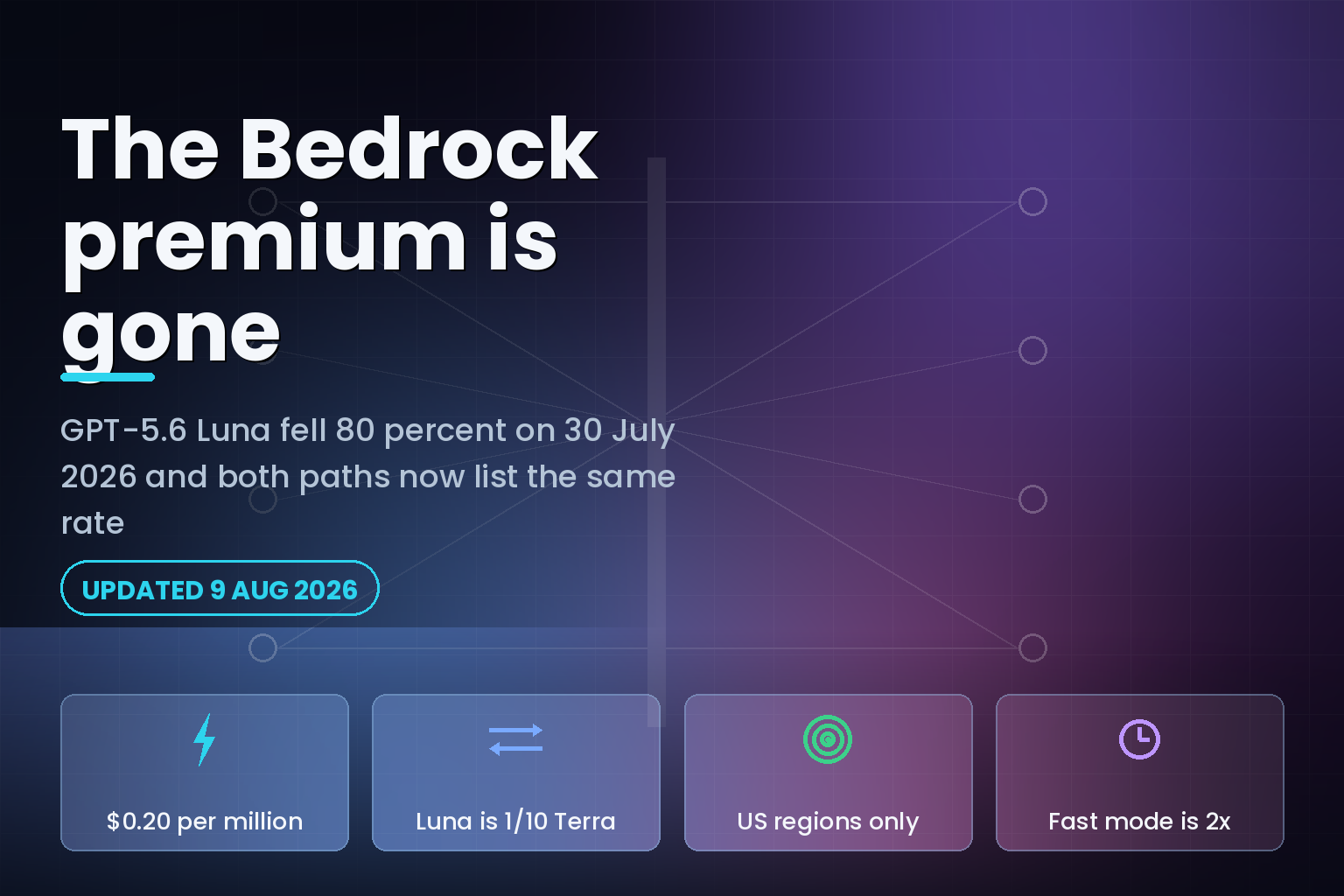
Summary. On 30 July 2026 OpenAI cut GPT-5.6 Luna API pricing by 80% and Terra by 20%, taking Luna to $0.20 per million input tokens and $1.20 per million output tokens. Amazon Bedrock applied the same reductions on the same day, and the AWS Weekly Roundup of 3 August 2026 quotes Bedrock Luna at $0.20 and $1.20, matching OpenAI's own list. That single fact retires the assumption most build-versus-buy models still carry, that routing through Bedrock costs roughly 10% more than going direct. The decision now turns on three things that are not price: Luna and Terra run on Bedrock only in US East (N. Virginia), US East (Ohio) and US West (Oregon) through the bedrock-mantle endpoint; Priority Processing was renamed Fast mode on 30 July, so service_tier: "priority" now bills at twice Standard for Sol; and long-context requests cost exactly double short-context on every tier. At 5 billion input and 1 billion output tokens a month, Luna is $2,200 against $22,000 on Terra and $55,000 on Sol. This article replaces our earlier cost math, which assumed a Bedrock premium that no longer applies.
What changed on 30 July 2026
OpenAI's announcement is specific: "Starting July 30, API pricing is $2 per million input tokens and $12 per million output tokens for Terra, and $0.20 per million input tokens and $1.20 per million output tokens for Luna. Sol pricing remains unchanged."
AWS posted the pass-through the same day: "Effective July 30, 2026, on-demand inference prices on Amazon Bedrock for GPT-5.6 Luna are reduced by 80%, while prices for GPT-5.6 Terra are reduced by 20%. These reductions are in-line with OpenAI's first-party pricing changes for these models."
The AWS Weekly Roundup of 3 August 2026 then gives the resulting Bedrock numbers directly: "Luna now costs $0.20 per million input tokens and $1.20 per million output tokens" and "These price reductions apply automatically - no action required on your part."
Two reductions, two providers, one effective date, and no migration work. The interesting part is what it does to a decision most teams settled months ago.
The current price table
Figures below are OpenAI list prices as published on 9 August 2026. Batch and Fast mode rates are for the tiers noted.
| Tier | Input per 1M | Output per 1M | Notes |
|---|---|---|---|
| GPT-5.6 Sol | $5.00 | $30.00 | Unchanged on 30 July 2026 |
| GPT-5.6 Sol, Fast mode | $10.00 | $60.00 | Up to 2.5x faster than Standard, twice the price, same intelligence |
| GPT-5.6 Terra | $2.00 | $12.00 | Cut 20% on 30 July 2026 |
| GPT-5.6 Luna, short context | $0.20 | $1.20 | Cut 80% on 30 July 2026 |
| GPT-5.6 Luna, long context | $0.40 | $1.80 | Exactly double the short-context input rate |
| GPT-5.6 Luna, batch | $0.10 | $0.60 | Half the standard rate |
Three ratios fall out of that table and they are worth committing to memory, because they decide more architecture than any benchmark score does.
Luna is one tenth of Terra on input and one tenth on output. Terra is two fifths of Sol on input. And Fast mode on Sol is twice Standard, which is the same multiplier as moving a Luna workload from short context to long context. When a router decision and a context-window decision carry the same cost multiplier, the context window is usually the cheaper thing to fix.
What the Bedrock parity finding invalidates
Our previous version of this analysis, and a good deal of the advice still circulating, assumed Bedrock carried a roughly 10% uplift over OpenAI list for the same model. On the evidence published on 30 July and 3 August 2026, that assumption does not hold for Luna: AWS states the reduction is in line with OpenAI's first-party pricing change, and the roundup quotes the same $0.20 and $1.20 figures OpenAI publishes.
Be precise about the scope of that claim. AWS published exact Bedrock figures for Luna. For Terra, the announcement states a 20% reduction in line with OpenAI's change without restating the resulting rate. So the correct working position today is: treat Luna as at parity, and verify Terra against the Bedrock pricing page for your specific region before you build a model on it. Vendor pricing pages beat summaries, including this one.
What this changes in practice is the shape of the argument. If price is equal, the case for calling OpenAI directly rests on features and release timing, and the case for Bedrock rests on the surrounding platform: IAM instead of a separate API key, VPC endpoints, CloudTrail, existing enterprise agreements, and a single bill. Those were always the real reasons. The premium was the objection people reached for when they wanted to avoid the migration.
| Factor | OpenAI direct | Amazon Bedrock |
|---|---|---|
| Luna list price per 1M input | $0.20 | $0.20, per the AWS roundup of 3 August 2026 |
| Regions for Luna and Terra | OpenAI's global endpoints | US East (N. Virginia), US East (Ohio), US West (Oregon) only |
| Access path | OpenAI API | OpenAI Responses API on the bedrock-mantle endpoint |
| Identity and audit | API key management | IAM roles, CloudTrail, VPC endpoints |
| Data residency in India | Regional processing endpoints, with a 10% uplift | No India region for these models today |
| Billing | Separate vendor invoice | Consolidated on the AWS bill |
| Feature lag | New tiers appear first | Follows OpenAI's release |
The region row is the one that ends most discussions. Luna and Terra on Bedrock are available in three US regions through the bedrock-mantle endpoint. If your requirement is that inference happens in India or the EU, Bedrock does not currently offer these two models there, and no amount of price parity fixes that.
The rename that quietly repriced a tier
Priority Processing was renamed Fast mode on 30 July 2026. OpenAI's pricing documentation notes that both values still work: "You can use either service_tier: \"priority\" or service_tier: \"fast\" in your API requests."
Backward compatibility is convenient and it is also the trap. Any service with service_tier: "priority" hardcoded from an earlier integration now bills at Fast mode rates, which on Sol is $10.00 input and $60.00 output, twice Standard. OpenAI describes the trade: Fast mode "delivers up to 2.5× faster speeds than Standard processing at twice the price, with no change in intelligence."
That is a defensible deal for an interactive path where latency is the product. It is money set on fire for a nightly batch job that inherited the parameter from a copy-pasted client config.
Grep your codebase for service_tier this week. It is a five-minute check with a four-figure monthly answer for anyone running Sol at volume. On a workload of 5 billion input and 1 billion output tokens a month, Sol Standard is $55,000 and Sol Fast mode is $110,000.
What a real workload costs now
Take a month of 5 billion input tokens and 1 billion output tokens, which is a mid-sized production assistant or a moderate document-processing pipeline.
| Configuration | Monthly cost | Versus Luna Standard |
|---|---|---|
| Luna, batch | $1,100 | 0.5x |
| Luna, standard short context | $2,200 | Baseline |
| Luna, long context | $4,000 | 1.8x |
| Terra, standard | $22,000 | 10x |
| Sol, standard | $55,000 | 25x |
| Sol, Fast mode | $110,000 | 50x |
Before the 30 July cut, that same Luna workload cost $11,000 a month at the pre-cut rates implied by an 80% reduction. So the saving is $8,800 a month on one workload, applied automatically, with no code change on either path.
The uncomfortable implication for most architectures is that the model choice now dominates every other optimisation you were planning. Prompt compression that saves 20% of input tokens on Sol saves $5,000 a month. Moving the same workload to Luna saves $52,800. Do the routing work before the prompt-engineering work.
That is the same conclusion our hybrid routing framework for API spend reaches from the other direction, and the reason a routing layer earns its keep even at these prices. The enterprise inference cost analysis for GPT-5.6 covers the per-token maths in more detail.
Long context is now the main cost lever
Luna long-context input at $0.40 is exactly twice short-context at $0.20, and output at $1.80 is 1.5 times $1.20. Because the tier multiplier and the context multiplier are the same order of magnitude, context discipline has moved from hygiene to the primary lever.
Three things pay for themselves quickly at these prices. Truncate retrieved context to what the answer needs rather than what the retriever returned, because a top-20 retrieval that could have been top-5 is a straight multiplier on every request. Cache aggressively, since a repeated system prompt is the cheapest thing to eliminate. And measure the context length distribution, not the mean, because a small tail of very long requests usually drives the long-context billing.
A team that halves median context length on a $4,000 long-context Luna workload lands near $2,200, which is the same saving as a moderately painful vendor negotiation and takes a sprint.
India and data residency
For Indian teams the price cut does not change the residency question, and the residency question carries its own uplift.
OpenAI applies a standing 10% uplift on regional-processing endpoints for models released on or after 5 March 2026, which is how data-residency deployments are priced. On the workload above, that turns a $2,200 Luna month into roughly $2,420. Ten per cent for residency is cheap by any reasonable measure, and materially cheaper than the alternative of self-hosting an open-weight model to keep data in-country.
Bedrock does not currently offer Luna or Terra outside the three US regions listed, so an India-residency requirement rules out the Bedrock path for these two models regardless of price. Teams with a hard residency clause in a client contract should read that as a constraint, not a preference.
Under the Digital Personal Data Protection Act 2023, cross-border transfer is permitted except to countries the government restricts, so US inference is not prohibited by default. The practical exposure is contractual rather than statutory: enterprise and BFSI clients increasingly write residency into the MSA, and a regulator-facing entity will be asked where inference happened. Decide the answer before you pick the endpoint, because switching later means re-running your evaluations against a different tier and region.
Pricing everything in dollars while billing in rupees also leaves an unhedged exposure that grows with usage. A $2,200 monthly workload is small. The same architecture at 20 times the volume is not, and the FX line should sit in the same forecast as the token line.
A 6-step re-evaluation
- Grep for
service_tieracross every service and CI config. Anything set to"priority"is now billing at Fast mode rates.
- Pull last month's token volumes by workload, split into input, output and long-context requests. Estimates are not good enough at a 25x spread between tiers.
- Re-run the tier decision on current prices. Workloads placed on Terra to avoid Sol costs may now belong on Luna, which is one tenth of Terra.
- Move every non-interactive workload to the batch tier. Luna batch at $0.10 and $0.60 halves the bill for anything that can tolerate a delay.
- Re-verify the Bedrock rate for Terra in your region against the AWS pricing page before you commit a model to it. Only Luna has published parity figures.
- Re-run your evaluation suite after any tier move. A price change is not a quality change, and Luna at one tenth of Terra is a different model, not a discount on the same one.
The FinOps Foundation's February 2026 survey found that 98% of its 1,192 respondents now manage AI spend, up from 31% two years earlier, across organisations representing more than $83 billion in annual cloud spend. J.R. Storment, Executive Director of the FinOps Foundation, framed the reason this keeps landing on engineering teams: "As companies pursue transformation via AI, with the resulting increases in AI costs, FinOps practices will be critical to enable c-level decisions about multi-year strategic technology investments across infrastructure types."
What we got wrong, and why it matters
The earlier version of this article priced Bedrock at a premium over OpenAI list. On the 30 July and 3 August 2026 evidence, that was either wrong or has been overtaken, at least for Luna. We have corrected it here rather than leaving it to age quietly.
The general lesson is worth more than the specific number. Model pricing in 2026 changes on a scale of weeks, and a comparison written against last quarter's rates will produce a confidently wrong recommendation. Any build-versus-buy document with a token price in it needs a review date on the same page, and a promotional or newly cut rate can reverse a verdict that looked settled. Check the vendor's own pricing page on the day you decide, not the analysis you bookmarked. Our comparison of Gemini 3.5 Pro, GPT-5.6 and Claude Fable 5 carries the same caveat.
FAQ
How eCorpIT can help
eCorpIT is a Gurugram-based engineering organisation, CMMI Level 5 assessed and ISO 27001:2022 certified, and an AWS and Microsoft partner. Our senior engineering teams build the routing, evaluation and cost-attribution layer that makes a model change like this safe: an evaluation suite on your own tasks, a gateway that can move traffic between tiers without a redeploy, and per-workload token accounting your finance team can read. We design applications aligned with DPDP requirements, which matters when the residency decision and the pricing decision land in the same architecture review. If your GPT-5.6 bill has not moved since 30 July, talk to our AI infrastructure team.
References
Last updated: 9 August 2026.