On this page · 11 sections
- Why warehouse apps are being bought now, not next year
- Buy a WMS, extend your ERP, or build the app
- What the app has to do on day one
- Offline-first is the architecture decision that matters
- Hardware: rugged handheld or consumer Android
- India-specific considerations
- What it costs and how long it takes
- How we scope a warehouse build
- FAQ
- How eCorpIT can help
- References
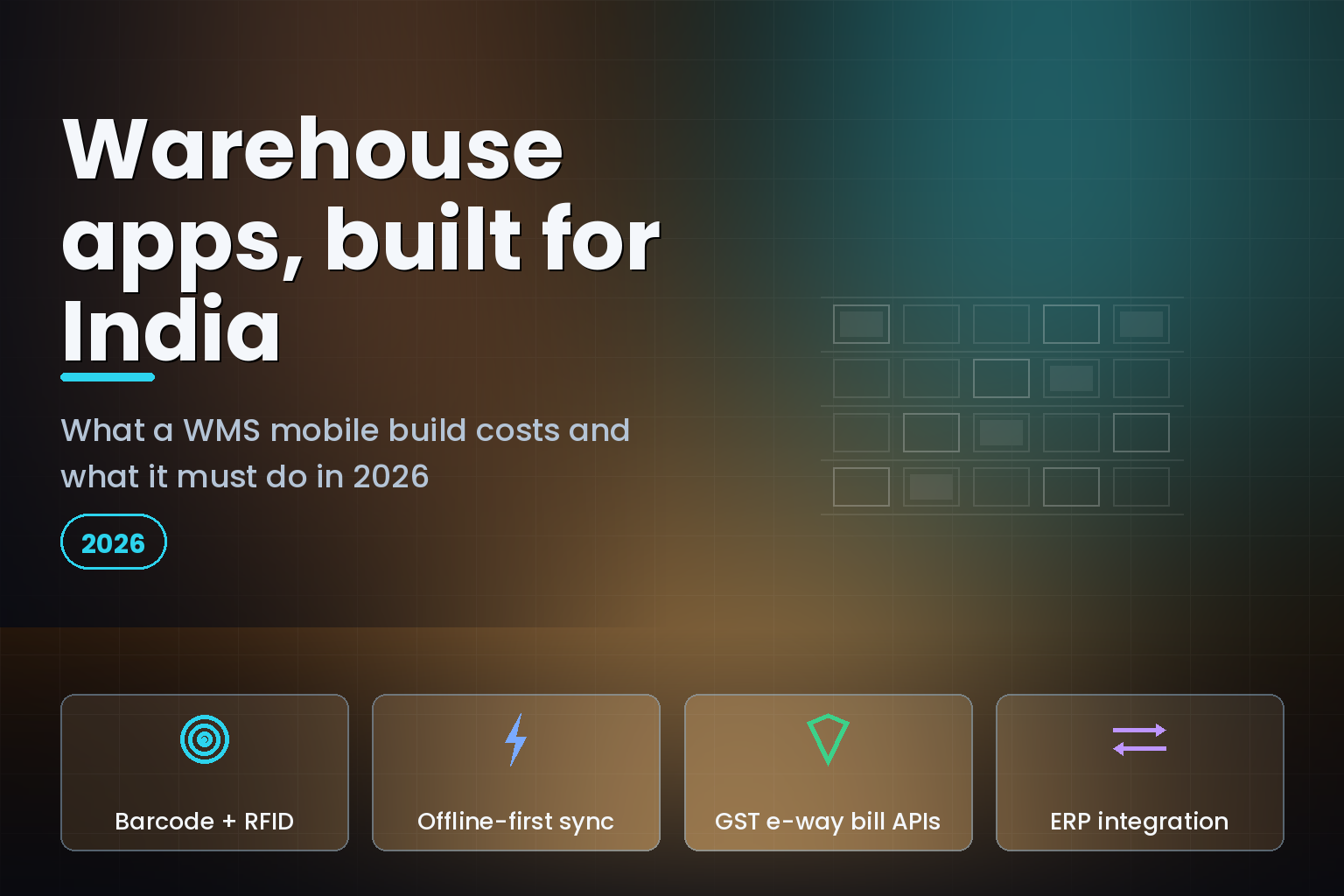
Summary. India's industrial and warehousing stock reached 514 million sq ft in Q1 2026 and JLL projects 850 million sq ft by 2030, so the operations teams filling that space are buying software faster than they are buying racking. Zebra Technologies' 2025 Warehousing Vision Study, which surveyed more than 1,700 associates and decision-makers, found 85% of warehouse workers agree that without technology investment their employer will not meet business objectives, and 74% say they spend too much time on tasks that could be automated. Meanwhile, 47% of managers named order preparation against service level agreements as a top operational problem. In India the deadline pressure is sharper: a GSTN advisory dated 17 June 2026 made Ship-to GSTIN mandatory in the e-Invoice and e-Way Bill by IRN APIs from 1 August 2026, which means a dispatch screen that does not send that field can stop goods at the dock. Indian agencies bill a blended $25 to $60 per hour for this work, and a full mid-market build lands between ₹12 lakh and ₹35 lakh. This guide covers what the app must do, which sync engine to choose, what the handhelds cost, and where teams overspend.
Why warehouse apps are being bought now, not next year
The demand-side numbers are the easy part. India's industrial and warehousing stock stood at 514 million sq ft in Q1 2026, on JLL's projection to 850 million sq ft by 2030, and quick commerce alone accounts for 4,081 operational dark stores across Blinkit (1,954), Zepto (1,089) and Swiggy Instamart (1,038) as of March 2026. Each of those sites needs receiving, putaway, picking and cycle counting, and none of them can wait for a desktop terminal at the end of an aisle.
The supply-side pressure is labour. Interact Analysis expects global warehouse floor space to grow 27% by 2030, reaching 3.9 billion square metres from 3.06 billion in 2023, with warehouse labour spending compounding at 7% a year through 2030. You cannot hire your way through that curve in Gurugram, Bhiwandi or Hosur at 2026 wage levels.
What surprised Zebra's own researchers is that the floor wants the software. In its 2025 study, 91% of associates asked for task management tools, 88% wanted collaborative robot support, 88% wanted ergonomic mobile devices, and 87% wanted communications applications with RFID. Ninety-three percent agreed that better availability of automation and mobile technology would help attract and retain warehouse staff, and 89% said they feel more valued when given those tools.
"It's good to hear so many warehouse leaders plan to digitize, automate and add intelligence to their frontline operations, and we are here to help," said Andres Boullosa, Zebra's director of supply chain warehouse global vertical strategies, in comments to RFID Journal in April 2025. Boullosa also noted that the operators who responded most positively about technology were between 36 and 50 years old, not the youngest cohort, which contradicts the usual assumption that resistance is generational.
The real cost is rarely the code. It is the year you spend reconciling two versions of stock.
Buy a WMS, extend your ERP, or build the app
Three routes exist, and picking wrong is expensive in a way that only shows up in month nine.
| Route | What you get | Where it breaks | Best fit |
|---|---|---|---|
| SaaS WMS (Unicommerce, Increff) | Ready receiving, picking, packing, marketplace connectors | Custom workflows fight the product; Increff publishes no public price and Unicommerce is listed from about $100 per month by ITQlick, both quoted per deal | Marketplace-heavy D2C sellers with standard flows |
| ERP warehouse module | One data model, one ledger, no reconciliation | Handheld UX is usually a web view; poor performance on 2G-grade Wi-Fi at rack level | Manufacturers already deep in SAP, Oracle or Dynamics |
| Custom mobile app over your existing stock system | Exact workflow, offline-first, your hardware, your barcode symbologies | You own the roadmap, the device fleet and the GST API changes | Multi-node operations, dark stores, 3PLs, cold chain |
| Hybrid: SaaS WMS core plus custom mobile front end | Vendor keeps the core current, you control the floor experience | Two vendors in one incident; API rate limits become your problem | Teams with a working WMS and an unusable handheld app |
Most Indian operations teams we scope for are in the fourth row and do not know it yet. They have a WMS that is fine at the database layer and an Android app that pickers actively avoid. The remedy is not a rip-and-replace of the WMS. It is a mobile front end built against the WMS API with a local database underneath it.
If your problem is upstream of the warehouse, the decision looks different: a B2B commerce and distributor ordering portal solves order capture, not stock movement, and the two are frequently confused in the same RFP.
What the app has to do on day one
A warehouse app that ships without these is a demo, not a system.
Receiving and gate-in. Scan the ASN or purchase order, capture the vehicle number, record short and damaged quantities against the line, and generate a putaway task. In India the gate register is still often paper; digitising it first gives you the cleanest early win because the data was never in any system.
Putaway with location logic. Bin-level suggestions beat "put it wherever" by a wide margin, but only if bin master data is accurate. Budget a physical relabelling exercise before go-live. Teams that skip it spend the first month blaming the app.
Picking. Wave, batch, zone or cluster. The picking strategy is a business decision that determines the data model, so decide it before the sprint plan, not during it. Cluster picking for a dark store with 3,000 SKUs looks nothing like wave picking for an apparel 3PL.
Cycle counting. Continuous counting of selected SKUs rather than a full annual stock take. Unicommerce's own guidance describes cycle counting as a continuous auditing method that keeps accuracy up without shutting the floor. Build it as a first-class screen with a blind-count mode, or your counters will simply confirm what the system already believes.
Packing, manifesting and dispatch. This is where GST lands, and where the 1 August 2026 API change bites.
Serialisation where it pays. RFID Journal reported that RevLogical, a Kansas City freight forwarder, built its own RFID-driven flow and saw inventory accuracy approach 100%. Randy Dunn, Zebra's customer success director, described the mechanism plainly: "When something's got a really unique, individual identity you can follow that all the way through a process and score that process." Serialisation is not for every SKU. It is for the ones whose loss is expensive or whose recall is regulated.
Offline-first is the architecture decision that matters
Warehouse Wi-Fi fails. It fails in the freezer aisle, behind metal racking, in the mezzanine, and at the dock door where the truck body blocks the access point. Any design that assumes a live connection to your API for every scan will fail its first Diwali peak.
The pattern is: write to a local database first, show the picker the result immediately, sync in the background. The engineering question is which sync engine, and the honest answer depends on how much conflict you can tolerate.
| Sync approach | How it resolves conflicts | Operational cost | Fits |
|---|---|---|---|
| WatermelonDB over SQLite | Last write wins on the record | Open source, you run the sync endpoint | Single-picker-per-task flows where two devices rarely touch one record |
| PowerSync | Change data capture from Postgres, MongoDB or MySQL streams filtered subsets into on-device SQLite | Managed service listed from $49 per month | Teams already on Postgres who want the sync layer to be someone else's on-call |
| CRDT libraries (Yjs, Automerge, ElectricSQL) | Automatic merge, no lost writes | Highest modelling effort; you design every counter as a mergeable type | Shared counts, collaborative cycle counting, multi-device putaway |
| Hand-rolled queue plus idempotent API | You write the rules | Cheapest to start, most expensive to maintain | Small single-site deployments with a short roadmap |
Two rules survive every project. First, make every mutation idempotent and carry a client-generated operation ID, because the device will retry. Second, never let the app compute authoritative stock; the device proposes movements, the server accepts or rejects them. Stock is a server truth with an optimistic local view, not a local truth that gets uploaded.
Cycle counting is the exception worth engineering properly. Two counters on the same bin with last-write-wins produces a silent wrong number, which is worse than an error. That is the one screen where a CRDT counter, or a server-side merge of both counts with a variance flag, earns its complexity.
Hardware: rugged handheld or consumer Android
The device choice sets your app's constraints more than the framework does.
| Option | Indicative 2026 price | Trade-off |
|---|---|---|
| Zebra TC22/TC27 rugged handheld | Indian reseller listings ran from about ₹28,500 to ₹35,000 per unit in June 2026, with an IndiaMART listing at ₹35,000 | IP67, 6-inch display, Wi-Fi 6E, integrated 1D/2D scan engine, Android 14 upgradeable to Android 16 on a Qualcomm 5430 hex-core with 6 GB or 8 GB RAM |
| Consumer Android phone plus Bluetooth ring scanner | Lower unit cost, no enterprise device management by default | Camera scanning is slower per pick and degrades on damaged labels; expect breakage and a shorter refresh cycle |
| Consumer Android with camera-only scanning | Lowest capital cost | Acceptable for cycle counting and audits, painful for high-rate picking |
The integrated scan engine is the point. A trained picker with a hardware trigger clears scans at a rate a phone camera does not match, and the difference compounds across a shift. Where the count is low and the workflow is occasional, camera scanning is fine. Where a picker does 800 scans a shift, it is not.
One planning note that saves grief later: the TC22 and TC27 ship on Android 14 with an upgrade path to Android 16. Google Play requires new app submissions and updates to target API level 36 by 31 August 2026, so your enterprise build has the same target SDK obligation as any consumer app if you distribute through Play, including managed Google Play. Plan the target SDK bump in the same release train as the device OS upgrade.
India-specific considerations
The GST e-way bill API change that landed on 1 August 2026
GSTN issued an advisory dated 17 June 2026 covering three APIs: the e-Invoice API, the e-Way Bill by IRN API and the EWB Closure API. Two changes matter for a dispatch screen.
First, Ship-to GSTIN becomes mandatory wherever Ship-to details are present and an e-way bill is required. Where the consignee is unregistered, the literal value URP is sent instead. The changes were released in the sandbox environment on 17 June 2026 and went live in production on 1 August 2026.
Second, GSTN introduced a voluntary e-way bill closure facility, which lets a taxpayer record a "delivery confirmed" state against an e-way bill. It carries no penalty today for non-use, but it is the field that turns your e-way bill register from a generation log into a delivery ledger. Build the API call now even if you do not enforce it.
The practical consequence for a warehouse app is that the Ship-to GSTIN must be captured or derived at the point of dispatch, validated before the IRN request, and stored against the shipment. If your app hands a payload to a GSP or ASP without that field, the request fails and the vehicle waits.
DPDP and worker data
A warehouse app collects worker identity, shift timing, device location and productivity metrics per person. Under the Digital Personal Data Protection Act 2023, that is personal data of a data principal who happens to be your employee, and consent, purpose limitation and retention still apply. Two design habits keep this clean: keep productivity telemetry aggregated at the task level rather than the individual level unless there is a stated purpose, and put a real retention window on device location history rather than keeping it forever because storage is cheap. We design applications aligned with DPDP Act requirements rather than claiming certification against them.
Multi-state stock and place of supply
Indian operations rarely run one warehouse. Stock transfers between states are taxable events with their own documentation, so a stock transfer screen is not the same screen as a sales dispatch even though the physical action looks identical. Model them separately from the first sprint. Retrofitting the distinction after go-live means reworking every movement record you have already written.
Quick commerce changes the shape of the problem
A dark store is a warehouse with a ten-minute promise and a few thousand SKUs, which inverts the usual priorities: replenishment frequency and per-micro-market assortment matter more than storage density. If that is your operating model, the app design differs enough that it deserves its own treatment, which we cover in quick commerce and dark store app development and in our broader read on retail digital transformation across D2C and quick commerce in India.
For plants rather than distribution centres, the sensor and line-data side of the problem dominates, which we treat separately in smart manufacturing and IoT for Indian factories.
What it costs and how long it takes
Published Indian market rates for 2026 give a usable frame. Junior developers bill ₹800 to ₹1,500 per hour, mid-level developers ₹1,500 to ₹3,500 per hour, and senior developers and architects ₹3,500 to ₹8,000 or more per hour. At the agency level, Indian firms bill a blended $25 to $60 per hour, against $120 to $200 per hour for equivalent senior talent in Western markets. A mid-level app with full features and a backend runs ₹12 lakh to ₹35 lakh, while complex enterprise or regulated platforms run ₹30 lakh to ₹1 crore or more.
Those bands are wide because scope is wide. The variables that actually move a warehouse app budget:
- Number of workflows in phase one. Receiving plus putaway plus picking plus cycle count is roughly four times the work of receiving alone, and each carries its own exception handling.
- Integration surface. One ERP is a project. One ERP plus a WMS plus a GSP for e-invoicing plus two courier APIs is a programme.
- Offline complexity. Last-write-wins sync is weeks. A properly merged concurrent cycle count is a different order of effort.
- Device fleet and MDM. Fifty devices across three sites with a managed Play enrolment is real work that rarely appears in the original estimate.
- Label and barcode reality. Damaged labels, multiple symbologies and vendor cartons that arrive unlabelled will each generate a workflow.
A defensible phasing that we see work: a receiving and putaway release in weeks one to eight, picking and packing in weeks nine to sixteen, cycle counting and dashboards after that. Ship the receiving module into one site and let it run for two weeks before writing the picking code. The exceptions the floor throws at receiving will change your picking design.
For a fuller treatment of why Indian build economics differ from Western ones, see our comparison of India versus US app development cost, and for the wider architecture and delivery questions, the enterprise mobile app development guide.
How we scope a warehouse build
The scoping questions that separate a working system from an expensive one are boring and non-technical.
Which movement does the business dispute most often? That is usually where accuracy is worst and where the first release should land. Who owns bin master data after go-live, and do they have time? An app cannot fix a bin map nobody maintains. What happens when the network is down for four hours, and who decides to keep picking? That answer determines your conflict model. What is the peak scan rate per picker per shift, and on what device? That determines whether camera scanning is viable. Which compliance artefacts leave the building with the truck, and which API produces them?
Answer those five before writing a line of code and the estimate stops being a guess.
FAQ
How eCorpIT can help
eCorpIT is a Gurugram-based technology organisation founded in 2021, with senior-led, multi-disciplinary teams building mobile and backend systems for Indian operations businesses. We are CMMI Level 5 assessed, MSME certified and ISO 27001:2022 certified, and we work with AWS, Microsoft, Google and Shopify. For warehouse and inventory work we scope the movement your business disputes most, build the offline-first mobile layer over your existing WMS or ERP, and wire the GST e-invoice and e-way bill calls so dispatch does not stall at the gate. Tell us your sites, SKU count and peak scan rate at /contact-us/ and we will come back with a phased plan rather than a licence quote.
References
- India's Industrial and Warehousing Stock Reaches 514 Million Sq Ft, Set to Touch 850 Million Sq Ft by 2030: JLL, Logistics Insider, 2026.
- Zebra Study: Warehouse Operators Prefer to Work with Technology, RFID Journal, 7 April 2025.
- Zebra Technologies study reveals insights into the future of warehouse automation, Robotics and Automation, 28 February 2025.
- Warehousing Vision Study, Zebra Technologies.
- Mandatory Ship-To GSTIN and Voluntary Closures: A Legal Guide To August 2026 E-Way Bill Update, LiveLaw, 2026.
- E-Way Bill Changes from 1st August 2026: Mandatory Ship-To GSTIN and New EWB Closure Facility, ClearTax, 2026.
- GSTN Issues Important FAQs for e-Way Bill System Readiness, A2Z Taxcorp LLP, 2026.
- India Quick Commerce Map 2026: 4,081 Dark Stores Mapped, Quick Commerce Map, March 2026.
- TC22/TC27 Mobile Computers Specification Sheet, Zebra Technologies.
- Zebra Handheld TC27 price listing, IndiaMART, June 2026.
- Best Offline-First Tech Stack for 2026, CSS Author, 2026.
- Unicommerce Pricing 2026, ITQlick.
- Mobile App Development Cost in India 2026: Complete Pricing Guide, Astha Technologies.
- Meet Google Play's target API level requirement, Android Developers.
Last updated: 6 August 2026.