On this page · 10 sections
- Decision 1: whether your buyers actually want a portal
- Decision 2: the platform, and what the vendors actually publish
- Decision 3: what Shopify B2B actually does, if that is your platform
- Decision 4: the GST surface, including the change that landed two days ago
- Decision 5: the ERP integration, which is where the estimate lives
- Where ONDC fits, honestly
- What we build, and how the engagement works
- FAQ
- How eCorpIT can help
- References
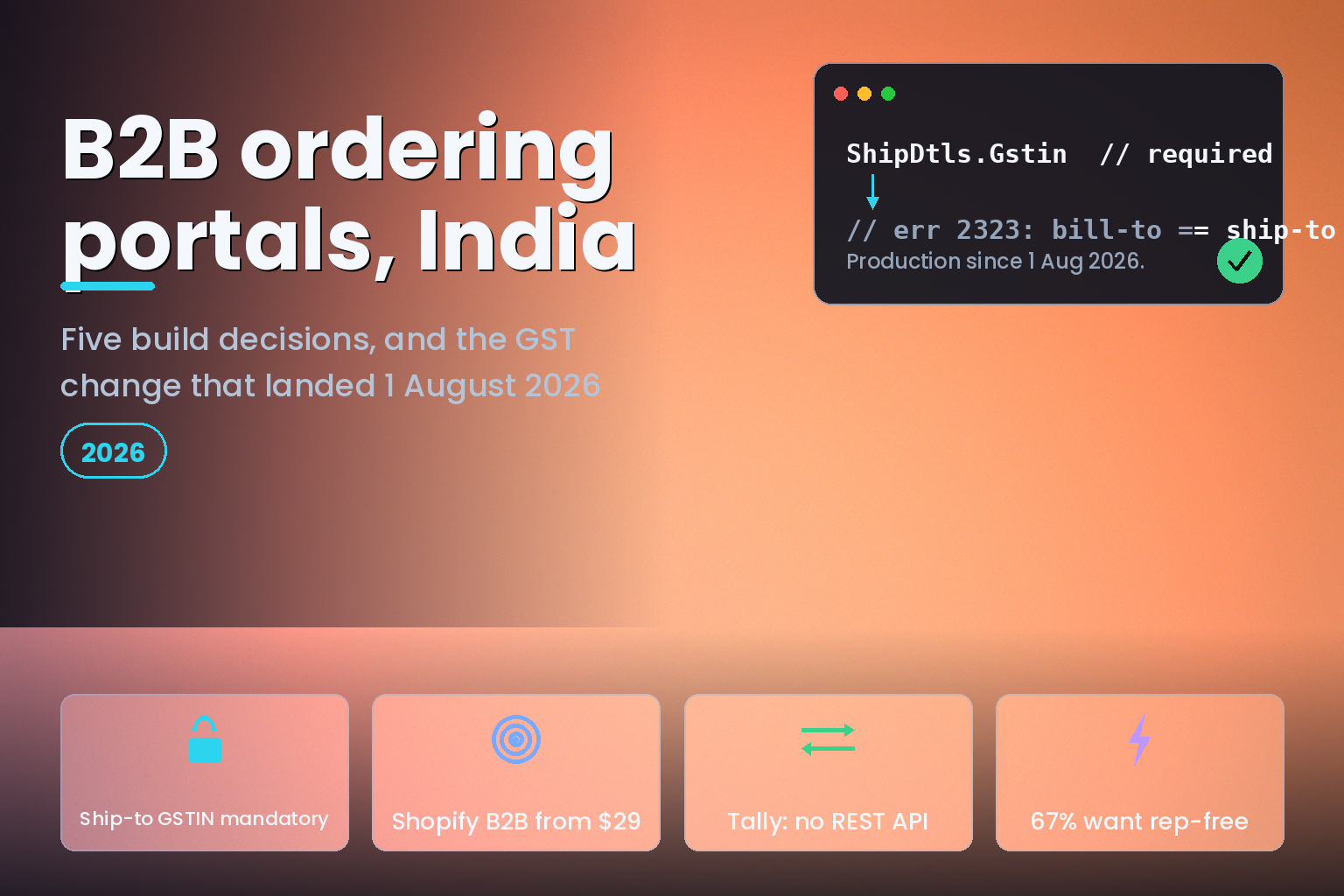
Summary. As of 1 August 2026, GSTN's production systems require the Ship-to GSTIN field on IRN generation wherever ship-to details are supplied and an e-way bill is needed, with a hard validation that the Bill-to and Ship-to parties must be different. Any dealer portal doing bill-to/ship-to or drop-ship that has not shipped ShipDtls.Gstin is failing IRN generation right now, with error code 5002. That is one of five decisions that set the real cost of a B2B ordering portal in India. The others: Shopify B2B is no longer restricted to Plus, running from the $29 per month Basic plan upward, but the 3-catalog cap and the absence of company-level catalog assignment below Plus is what forces the jump to $2,300 per month. Adobe Commerce, Salesforce B2B Commerce and BigCommerce B2B Edition publish no price at all, and Salesforce states its model is a percentage of gross merchandise value without publishing the percentage. TallyPrime, as of its own documentation dated 11 June 2026, still has no REST API. And Gartner found in a survey of 646 B2B buyers that 67% prefer a rep-free experience. The e-invoicing threshold is aggregate turnover above ₹5 crore, and the 30-day IRN reporting limit now applies from ₹10 crore.
This is written for the person who has to scope the project, not the person who has to approve the budget. It goes platform rate card by rate card, ERP by ERP, and rule by rule.
Decision 1: whether your buyers actually want a portal
Start with the demand evidence, because a dealer portal nobody uses is the most expensive outcome available.
The strongest current figure is from Gartner, published 9 March 2026: "67% of B2B buyers state that they prefer a rep-free experience". The methodology is stated on the same page, a survey of 646 B2B buyers conducted from August through September 2025, with 45% reporting they used AI during a recent purchase. Gartner's equivalent June 2025 release put the figure at 61%.
McKinsey's B2B Pulse, published 28 May 2026 from a sample of nearly 4,000 decision-makers across 13 countries, adds the commercial shape: "Seventy-one percent of respondents report that their organizations offer e-commerce, and among those that do, roughly one-third of total revenue now flows through digital channels, making it the top revenue-generating channel." On order size, "In the 2022 survey, 59 percent of respondents were comfortable placing orders of more than $50,000 online. This year, that number has jumped to 73 percent."
There is a counter-signal in the same report that most vendor decks omit, and it is worth knowing before you build a business case on an ever-rising line. At the highest order values, willingness fell: 61% of "seekers", 29% of "innovators" and 18% of "adapters" were willing to spend $500,000 or more online, down 8, 8 and 1 percentage points respectively year on year. Self-service is winning in the middle of the order-value distribution, not uniformly across it.
For India specifically, we could not locate a current, independent, primary measurement of Indian B2B buyer digital-channel preference from a named research organisation. The nearest data points each carry a caveat: Bain and Accel projected in December 2022 that B2B e-commerce marketplace GMV would grow five times to $55 billion by 2027, which is a four-year-old forecast rather than a measurement. Anyone quoting a precise current Indian B2B ecommerce market size to you should be asked which organisation produced it and on what page.
Decision 2: the platform, and what the vendors actually publish
Half the platform shortlists we review carry numbers that are not on any vendor page. Here is what the rate cards say, read on 3 August 2026.
| Platform | Published price | B2B capability at that price |
|---|---|---|
| Shopify Basic | $29/month billed yearly, $39 monthly | Shopify B2B, up to 3 catalogs |
| Shopify Grow | $79/month billed yearly | B2B, same 3-catalog cap |
| Shopify Advanced | $299/month billed yearly | B2B, 3-catalog cap; contextual checkout available |
| Shopify Plus | From $2,300/month on a 3-year term, $2,500 on a 1-year term | Unlimited B2B catalogs, direct company catalog assignment, deposits |
| BigCommerce Standard / Plus / Pro | $29 / $79 / $299 per month billed yearly | Price Lists are Enterprise-only, so dealer pricing is out |
| BigCommerce Enterprise and B2B Edition | Not published, quote only | Price Lists, unlimited API calls |
| Adobe Commerce | Not published, "Get pricing" only | B2B commerce operations in both Commerce packages |
| Salesforce B2B Growth / Advanced | Not published; "We take a percentage of Gross Merchandise Value (GMV) based on commerce functionality needed" | 6 or 10 storefronts, Order Management Lite or Full |
| StoreHippo Enterprise | ₹30,000/month, exclusive of taxes | B2B features, multi-pricing, custom roles |
Three notes that change shortlists.
Shopify B2B is no longer Plus-only, and this is the biggest change to the Indian mid-market build decision. Shopify's plan features page states: "You can use Shopify B2B on the Basic, Grow, Advanced, and Shopify Plus plans. The features available to you depend on your plan. Most B2B features are available on all plans, including companies, catalogs, net payment terms, self-serve ordering, and Shopify Flow automations."
But the catalog gate is what forces Plus, not the feature list. From the same page: "On the Basic, Grow, and Advanced plans, you can assign up to 3 active catalogs across all your B2B markets", and, decisively, "Direct catalog assignment isn't available on the Basic, Grow, or Advanced plans." Direct catalog assignment is how you give a specific dealer a specific price list. If your commercial model is three or four standard slabs, Advanced at $299 works. If every distributor has negotiated terms, you are on Plus. That single sentence is worth more than any feature comparison chart.
BigCommerce's equivalent gate is Price Lists, which the pricing page marks Enterprise-only alongside unlimited API calls. Its Pro tier also carries a GMV meter: "Starting at $399/month for up to $400,000 in trailing 12-month online sales (GMV). An additional $150/month applies for each $200,000 in GMV beyond the initial $400,000", with automatic upgrade to Enterprise above $1 million trailing GMV.
On the vendors that publish nothing, resist the estimates. Adobe's Commerce pricing page shows a "Get pricing" button for all three packages, and its Commerce Optimizer package explicitly marks B2B commerce operations as "Handled by existing solution", meaning Optimizer is merchandising and does not bring B2B ordering. Salesforce shows "Contact for Pricing" in every currency and states the model as a percentage of GMV, defined on the same page as "the total revenue through your website, minus tax and shipping". Two Salesforce cost traps worth surfacing early: orders taken outside the Commerce Cloud storefront require buying Salesforce Order Management standalone, and the Premier Success Plan is priced at 30% of net license fees.
One live example of why to check the rate card yourself: search results widely report StoreHippo as starting around ₹2,999 per month. StoreHippo's own pricing page lists Business at ₹15,000 per month, Enterprise at ₹30,000, and Platinum from ₹1,20,000 per month on a minimum one-year term, all exclusive of taxes, with a 10% discount on annual and 20% on biennial prepayment. B2B features sit on Enterprise.
Shopify's India rate card in rupees is not obtainable from a Shopify page that renders; every INR figure circulating for Shopify India comes from agency blogs. Price in USD and budget for currency movement.
Decision 3: what Shopify B2B actually does, if that is your platform
eCorpIT is a Shopify partner, so we get asked this constantly. The honest answer for a dealer portal is that the primitives are good and the gaps are specific.
What runs on every plan from Basic upward: companies, company locations, location-level permissions including ordering-only roles, quantity rules with minimums, maximums and increments, quantity price breaks, net payment terms, payment reminders, vaulted cards, draft order to invoice, checkout to draft, easy reorders, purchase order numbers, sales staff permissions, the Trade theme, quick order list, and Shopify Flow with B2B objects.
The payment terms set is fixed and worth knowing before you promise a customer anything: Shopify's payment terms documentation states "The available terms are net 7, net 15, net 30, net 45, net 60, and net 90. All terms start from the day the order is placed", alongside no terms, due on fulfillment, and fixed date for draft orders.
Two operational details that surprise finance teams. First, verbatim from Shopify: "Payments aren't automatically captured when the payment terms expire", so a saved card still requires a manual capture in admin. Second, deposit requirements, partial payments and payment requests per fulfillment are Plus-only. Dynamic terms driven by cart value or customer metafields need a custom app using the Payment Customization Function API.
On pricing resolution, Shopify's catalogs documentation is explicit: "If there are multiple catalogs and prices for a specific product, then the lowest price displays to the customer." Overlapping catalogs do not stack, they race to the bottom. Design the catalog hierarchy on that assumption.
For developers, the B2B app documentation exposes Company, CompanyLocation and CompanyContact objects, with the constraint that "catalogs can be assigned only to a company location". Two limitations to read before committing: "Only dev stores, Shopify Plus Partners, and Shopify affiliates are able to access the GraphQL Admin API's B2B resources", and "B2B doesn't support purchase options, such as subscriptions, pre-orders, and try before you buy." Standing-order and scheduled-replenishment models, which are common in FMCG distribution, need building rather than configuring. Teams already weighing a headless Shopify rebuild should settle the catalog and terms model first, because it constrains the storefront architecture rather than the other way round.
Decision 4: the GST surface, including the change that landed two days ago
This is where an India build differs most from a template, and where the schedule risk lives.
The 1 August 2026 Ship-to GSTIN change. GSTN's advisory dated 17 June 2026 set production implementation for 1 August 2026. On IRN generation, ShipDtls.Gstin becomes conditionally mandatory wherever ship-to details are provided and e-way bill generation is required, with "URP" used where the consignee is unregistered. On the e-way bill by IRN API, ExpShipDtls.Gstin is mandatory. The validation that catches people is stated plainly: the Bill-to party and Ship-to party "are expected to be distinct persons", so Ship-to GSTIN must not equal Bill-to GSTIN. The published error codes are 5002 for a missing Ship-to GSTIN, 2323 for Bill-to equalling Ship-to, 2325 and 4074 for state code mismatches, and 3039 for a PIN and state mismatch.
The same advisory introduces a voluntary e-way bill closure API taking an EWB number, closure date and remarks, with two caveats stated in the document: there is no API to capture the driver mobile number, which remains portal-only, and no API to retrieve closed e-way bills, with a "Closed" status "proposed to be introduced in due course".
Thresholds, and one stale official page. E-invoicing applies to aggregate turnover above ₹5 crore in any financial year from 2017-18 onward, per Notification No. 10/2023-Central Tax dated 10 May 2023, effective 1 August 2023. Note the test is "any" financial year: once crossed, always applicable. Be careful with the source here, because the NIC e-invoice portal homepage still displays the superseded ₹10 crore threshold from the 2022 notification.
The 30-day rule moved. GSTN's advisory of 5 November 2024 states that "from 1st April 2025, taxpayers with an AATO of 10 crores and above would not be allowed to report e-Invoices older than 30 days from the date of reporting on IRP portals", and that "This restriction would apply to all document types (Invoices/Credit Notes/Debit Notes)." The earlier ₹100 crore figure is stale. Below ₹10 crore there is no reporting time restriction as of now.
Why a missing IRN is not a paperwork problem. CGST Rule 48(5) provides that an invoice issued otherwise than as required by Rule 48(4) "shall not be treated as an invoice". No IRN means no valid tax invoice, which puts the buyer's input tax credit at risk. In a dealer network that turns a technical bug into a commercial dispute within one billing cycle.
E-way bills. The threshold is a consignment value exceeding ₹50,000 including GST and cess, under Section 68 and Rule 138, with Form GST EWB-01 and a 12-digit EBN. Movements that are not supplies still count: job work, SKD and CKD consignments, sales returns, exhibitions, own use, and sale on approval. For the bill-to/ship-to three-party flow that drop-shipping produces, only one e-way bill is generated. The recipient is deemed to have accepted after 72 hours, and cancellation is possible within 24 hours.
TDS, under the new Act. Section 194Q no longer exists. The Income-tax Act 2025 has been in force since 1 April 2026, and the successor provision is Section 393. Table serial 8(ii) covers "Any sum exceeding fifty lakh rupees for purchase of any goods" by a buyer, at 0.1%, with tax deducted on the sum exceeding ₹50 lakh and no deduction where tax is deductible or collectible under another provision.
Serial 8(v) is the one that catches portal builders. It sets 0.1% of the gross amount with a nil threshold, payable by the e-commerce operator, and the note provides that a payment made by a purchaser directly to an e-commerce participant "shall be deemed to be the amount credited or paid by the e-commerce operator", who "shall be deemed to be the person responsible for paying". So even a pure order-brokering portal where the dealer pays the supplier directly carries the obligation, with no threshold. If you are building a multi-seller distributor marketplace rather than a single-brand portal, that is a structural decision, not a configuration one.
Separately, under CGST Section 52 an operator that collects the consideration must collect tax at "not exceeding one per cent" of the net value of taxable supplies, pay it and file GSTR-8 within ten days after month-end, with an annual statement by 31 December.
One operational item that breaks unattended automation: multi-factor authentication has been mandatory on IRP login since 10 July 2025. Any integration built on stored username and password without MFA handling will fail.
Decision 5: the ERP integration, which is where the estimate lives
The portal is rarely the hard part. Getting stock, pricing and order status in and out of the ERP is.
| ERP | Documented protocol | Sales order endpoint | Auth |
|---|---|---|---|
| Dynamics 365 Business Central | REST and OData v4, API v2.0 | salesOrders, full GET, POST, PATCH, DELETE |
OAuth 2.0, service-to-service |
| Zoho Inventory | REST and JSON | /inventory/v1/salesorders |
OAuth 2.0 bearer token |
| SAP Business One | OData via the Service Layer, /b1s/v1 or /b1s/v2 |
Orders entity set |
POST /Login, B1SESSION cookie |
| Odoo 18 and 19 | XML-RPC and JSON-RPC; Odoo 19 adds an HTTP-JSON route | Generic sale.order model, no dedicated endpoint |
API key or user and password |
| TallyPrime | XML or JSON over HTTP on a local port; no REST API | Voucher import request | None documented |
Two items on that table drive most of the variance in a fixed-price quote.
Tally has no REST API, and this is Tally's own documentation talking. The integration methods page, which states it was last updated on 11 June 2026, lists exactly four methods: TDL, JSON integration using TDL, XML integration using TDL, and DLL integration. Tally's developer reference describes the mechanism as "Tally can act as an HTTP Server capable of receiving an XML Request and responding with an XML Response", with the prerequisite that TallyPrime is running on a port such as 9000. There is no resource model, no OAuth-secured data API and no cloud data connector. Do not be misled by TallyPrime 7.1's OAuth headline, which is titled "Secure E-mailing with OAuth" and concerns sending mail, not integration authentication.
The practical consequence for the very large share of Indian mid-market manufacturers running Tally: integration means middleware speaking Tally-native XML or JSON to a local port on a machine inside the office network, plus a sync queue, plus a reconciliation job. That is a project line item measured in weeks, not a connector toggle. Anyone quoting a Tally-connected portal at the same price as a Business Central-connected one has not read the documentation.
Odoo gates its API by plan. The Odoo documentation states that access to data via the external API is available only on Custom pricing plans, and is not available on One App Free or Standard plans. The XML-RPC and JSON-RPC endpoints are also documented as scheduled for removal in Odoo 20. If your customer is on an Odoo Standard plan, the integration budget starts with a plan upgrade.
One more constraint for Business Central builds, verbatim from Microsoft: "Extending APIs with additional fields isn't currently possible in Business Central. If you need this, you must copy the AL code for the API and create a custom API based on that." Custom fields on a sales order mean a custom API, not a query parameter. This is the same class of work as any API integration and modernisation programme, and it should be scoped separately from the storefront.
Where ONDC fits, honestly
ONDC does support B2B, but as a mode inside the retail specification rather than as a separate live vertical. The ONDC retail specifications repository publishes B2B Retail version 2.0.2 and describes the framework as "accommodating both B2C and B2B models".
Two things to be clear-eyed about. The domain groups listed on ONDC's own site do not include a B2B or wholesale domain; the B2B-adjacent primitives available are the agriculture domain and financial services, the latter including unsecured GST-based invoice loans, unsecured purchase finance and unsecured working capital lines, which is genuinely interesting for dealer credit. And the scale figures on ondc.org carry no current date, with the only dated one, 16 million total orders, labelled for May 2025.
On liability, ONDC's network policy states that "the title for the goods is transferred from the seller to the buyer through the invoice", and ONDC's own disclaimer says "ONDC is not a central mediator or intermediary, neither does it interface with buyers and sellers. ONDC is merely a communication protocol." The consequence for your architecture is that ONDC is not the e-commerce operator for tax purposes. The seller app or buyer app participant that collects the consideration is, and it carries the Section 52 collection obligation, the Section 393 serial 8(v) deduction and the IRN and e-way bill obligations. Teams building an ONDC seller-side scale playbook should settle that question before writing any settlement code.
What we build, and how the engagement works
eCorpIT builds dealer and distributor ordering portals for Indian manufacturers and B2B brands, as part of our ecommerce application development practice and the wider retail and D2C digital work we do.
The scope of a typical build: company and company-location modelling with role-based ordering permissions, catalog and price-list architecture designed against the platform's actual resolution rules, credit terms and credit-limit enforcement, quick order and reorder flows built from purchase history, an ERP synchronisation layer with a durable queue and reconciliation, GST-compliant invoicing including IRN generation with the Ship-to GSTIN handling described above, e-way bill generation, and dealer-facing order tracking and statements.
How we work: a two-week discovery that produces a platform recommendation with the vendor's published rate card attached rather than an estimate, an integration specification for the specific ERP version in use, and a phased plan that puts the ERP synchronisation and the GST compliance path in phase one, because those are the two things that cannot be deferred without rework. eCorpIT was founded in 2021 and is based in Gurugram, with senior-led, multi-disciplinary teams. We are CMMI Level 5, MSME certified and ISO 27001:2022 certified, and we are a Shopify partner alongside AWS, Microsoft and Google. We design applications aligned with DPDP requirements where dealer and buyer personal data is processed.
Who this is for: manufacturers and distributors with a dealer network large enough that phone and WhatsApp order-taking is now a cost centre, and with an ERP of record that the portal must not duplicate.
FAQ
How eCorpIT can help
eCorpIT designs and builds dealer and distributor ordering portals for Indian manufacturers, with the ERP synchronisation layer and the GST compliance path treated as phase-one work rather than a later integration. We start with a platform recommendation grounded in the vendor's own published rate card and an integration specification for the exact ERP version you run, so the estimate reflects whether you are on Business Central or on Tally. We are CMMI Level 5, MSME certified and ISO 27001:2022 certified, a Shopify partner, and we design applications aligned with DPDP requirements. To scope a dealer portal against your current order volume and ERP, contact us.
References
- Advisory on e-Invoice API and e-Way Bill by IRN API changes for mandatory capture of Ship-to GSTIN, Team GSTN, 17 June 2026, production implementation 1 August 2026.
- GSTN advisory: time limit for reporting e-invoice on the IRP portal, lowering of threshold to AATO 10 crores and above, 5 November 2024.
- Trade notice on e-invoicing applicability, ₹5 crore threshold, CGST Commissionerate, citing Notification No. 10/2023-Central Tax dated 10 May 2023.
- CGST Rule 48, manner of issuing invoice, CBIC tax information portal.
- CGST Section 52, collection of tax at source, CBIC tax information portal.
- Electronic way bill in GST, GST Council.
- Section 393, Income-tax Act 2025, Income Tax Department.
- Shopify pricing and Shopify Plus pricing, read 3 August 2026.
- Shopify B2B plan features, Shopify Help Center.
- Shopify B2B catalogs and B2B payment terms, Shopify Help Center.
- Build B2B apps, Shopify developer documentation.
- BigCommerce pricing and enterprise pricing, read 3 August 2026.
- Adobe Commerce pricing, Adobe.
- Salesforce B2B Commerce pricing, page modified 1 July 2026.
- StoreHippo pricing, read 3 August 2026.
- Tally integration methods and technologies, page states last updated 11 June 2026, and integration with TallyPrime.
- Business Central salesOrder API v2.0, Microsoft Learn.
- Gartner sales survey finds 67 percent of B2B buyers prefer a rep-free experience, Gartner, 9 March 2026.
- The surprising economics of B2B growth, McKinsey B2B Pulse, 28 May 2026.
- Online marketplaces in India to reach $350 billion in gross merchandise value by 2027, Bain and Accel, 1 December 2022.
Last updated: 3 August 2026.