On this page · 10 sections
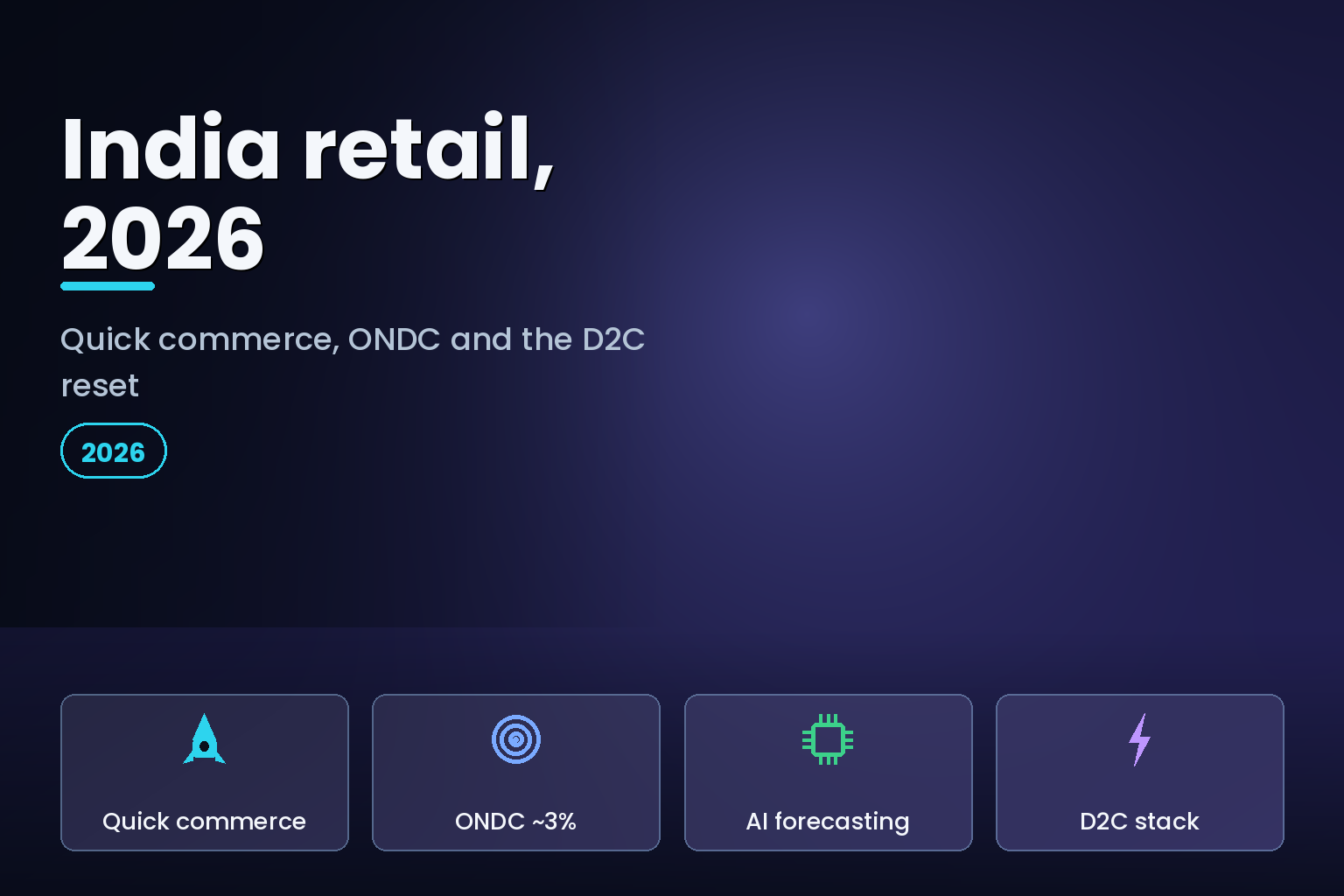
Summary. India's direct-to-consumer market is estimated at USD 108.76 billion in 2026 and is forecast to reach USD 322.1 billion by 2031, a 24.30% CAGR, per Mordor Intelligence. Quick commerce is the fastest-moving layer: Blinkit holds about 46% of the market by GMV, Swiggy Instamart around 24%, and Zepto around 22%. The economics are still hard. Zepto reported FY26 revenue of ₹22,623.58 crore against a loss of ₹5,905.19 crore, and delivery platforms typically consume 30% to 35% of a brand's revenue in listing fees, ad spend, commission, and operations. Meanwhile ONDC offers a lower-commission route near 3%, against the 15% to 25% that incumbent marketplaces charge. This guide covers the numbers, the channel trade-offs, and the retail technology decisions a D2C brand faces in 2026.
Retail in India stopped being a single-channel question years ago. In 2026 a D2C brand sells through its own app and site, through Blinkit and Zepto for 10-minute delivery, through Amazon and Flipkart for reach, through ONDC for low-commission discovery, and often through physical shelves too. Each channel has a different take rate, a different data relationship, and a different technology cost. The transformation is not "go digital." It is deciding which channels to run, and building the stack that keeps inventory, pricing, and customer data consistent across all of them.
The 2026 numbers, and why they disagree
Market-size figures for Indian retail vary widely because sources measure different things: gross merchandise value (GMV), platform revenue, or total addressable market. It is worth seeing them side by side rather than picking one.
| Source | Figure | What it measures | Horizon |
|---|---|---|---|
| Mordor Intelligence | USD 3.65bn (2026) to 6.64bn | Quick commerce market revenue, 12.74% CAGR | 2026 to 2031 |
| Research report (GlobeNewswire) | USD 12.97bn | Quick commerce market | by 2029 |
| GrabOn | ~USD 7bn | Quick commerce GMV | 2025 |
| Mordor Intelligence | USD 108.76bn to 322.1bn | India D2C e-commerce market, 24.30% CAGR | 2026 to 2031 |
| Opsio | USD 1.8 trillion | Total India retail market, digital growing ~25%/yr | by 2030 |
The takeaway is not a single headline number. It is that every layer of Indian retail, from total retail to D2C to quick commerce, is growing at double digits, and quick commerce is growing fastest off the smallest base. For a founder, that means the channel mix will keep shifting for years, so the stack has to be built to add and drop channels without a rewrite. Our quick-commerce tech stack guide for D2C brands breaks down the integration work behind that.
Quick commerce: who leads, and can anyone make money
Quick commerce is the headline story of Indian retail in 2026, and it is consolidating around three names. Blinkit, owned by Eternal (formerly Zomato), leads at roughly 46% of GMV, with Swiggy Instamart near 24% and Zepto near 22%, per profitability analysis from Laffaz. The competitive question is no longer growth, it is unit economics.
The pressure shows in the accounts. Zepto reported FY26 revenue of ₹22,623.58 crore and a loss of ₹5,905.19 crore, and its cash reserves of USD 600 million to 700 million as of March 2026 sat well below Blinkit's USD 1.9 billion and Swiggy's USD 1.7 billion, per Laffaz. Blinkit has an advantage rivals cannot easily copy: Eternal's profitable food-delivery business funds its dark-store expansion, letting it stay disciplined on discounts while others chase volume.
Profitability is arriving unevenly. Bernstein estimated that 3,600 of the top 3,800 stores across the big-eight cities are profitable, while tier-2 stores still lose money, per Laffaz. Zepto's annualised advertising revenue has crossed ₹1,000 crore, a high-margin stream that changes the maths if it scales. Albinder Dhindsa, chief executive of Blinkit, framed the discipline plainly: "If everything goes as planned (which usually doesn't), we plan to get to 2,000 stores, latest by the end of 2026 while remaining profitable," he told FranchiseIndia. Business Standard reported in December 2025 that Dhindsa also warned of a quick-commerce shakeout amid a capital crunch, which is the honest reading: the leaders can fund the fight, the smaller players cannot.
For a D2C brand, the practical point is the take rate. Getting onto quick commerce is fast reach, but platforms consume 30% to 35% of revenue between listing fees, mandatory ad spend, commission, and operations, per unit-economics analysis from GlobalWebsters. That is a channel to use deliberately, not a default.
ONDC: the low-commission alternative
The Open Network for Digital Commerce (ONDC) is the structural counterweight to marketplace and quick-commerce take rates. It provides an interoperable buyer-seller discovery layer with commission ceilings near 3%, against the 15% to 25% typical of incumbent marketplaces. More than 700,000 vendors have joined, and the network is live in over 400 cities, per India e-commerce coverage from IBEF and market reports.
ONDC does not replace quick commerce or Amazon. It adds a channel where the margin structure is different, which matters most for lower-priced, high-frequency goods where a 20% marketplace commission erases the margin. For a D2C brand, the decision is whether the engineering cost of ONDC integration is repaid by the volume and margin it unlocks. Our ONDC scale playbook for D2C sellers covers the seller-side build in detail.
The channel decision: where should a D2C brand sell
The core 2026 decision is channel mix. Each route trades commission against control, reach, and data ownership. The table below compares the main options a D2C brand weighs.
| Channel | Typical take / commission | Data ownership | Best for |
|---|---|---|---|
| Own D2C app and website | Payment and logistics costs only | Full first-party data | Brand, margin, repeat customers |
| Quick commerce (Blinkit, Zepto, Instamart) | 30% to 35% of revenue all-in | Minimal, platform holds it | Impulse, high-frequency, urban reach |
| Marketplace (Amazon, Flipkart) | 15% to 25% commission | Limited | Discovery, national reach |
| ONDC | ~3% commission | Shared via the network | Low-margin, high-frequency goods |
| Physical retail | Distributor and retailer margins | None | Trust, categories that need touch |
No single row wins. The strongest D2C brands run several channels and use their own app and site to build the first-party data and repeat purchases that keep customer-acquisition cost down, while treating quick commerce and marketplaces as reach they pay a premium for. The engineering job is to keep inventory, pricing, and orders consistent across all of them, which is where most of the real transformation budget goes. For teams weighing where to build, our comparison of India versus US app development cost sets the baseline.
AI moves from pilot to inventory
The other half of retail transformation in 2026 is AI moving out of chatbots and into operations. The highest-return use is demand forecasting: AI-based systems can improve inventory accuracy by 20% to 30%, cutting both stockouts and dead stock. Personalisation is the second lever, with the India Brand Equity Foundation reporting that personalised marketing can lift sales by up to 20%.
For a quick-commerce or D2C operation, forecasting is not a nice-to-have. When a dark store carries a few thousand SKUs and promises delivery in 10 minutes, getting the assortment and stock levels right per micro-market is the difference between a profitable store and one that bleeds. That is why AI forecasting, dynamic pricing, and micro-market assortment are the retail AI investments that actually pay back, ahead of front-end gimmicks.
| Retail AI use | What it does | Reported benefit |
|---|---|---|
| Demand forecasting | Predicts stock needs per store and SKU | 20% to 30% better inventory accuracy |
| Personalisation | Tailors offers and recommendations | Up to 20% sales lift (IBEF) |
| Dynamic pricing | Adjusts price by demand and competition | Higher margin on fast movers |
| Assortment optimisation | Chooses SKUs per micro-market | Fewer dead-stock write-offs |
India-specific considerations
Three factors shape any Indian retail build. First, logistics: GST-enabled efficiencies have cut interstate transit costs by 20% to 25% and made fulfilment from any store or dark store to more than 19,000 pin codes practical, per Opsio, which is what makes 10-minute and next-day delivery viable outside metros. Second, tier-2 and tier-3 demand: smartphone adoption there is driving the next wave of D2C growth, but it also means vernacular content, cash-on-delivery handling, and lighter apps for slower networks. Third, data protection: D2C and retail run on customer personal data, so any stack that stores order history, addresses, or payment tokens falls under the Digital Personal Data Protection Act 2023 (DPDP Act), and consent and data handling must be built in, not bolted on.
For brands selling across channels, the recurring failure is data fragmentation: customer and inventory data trapped in each platform, with no single source of truth. Fixing that with a central commerce layer is the least glamorous and most valuable transformation project a D2C brand runs.
The bottom line
India retail in 2026 is a multi-channel, data-heavy business. Quick commerce is consolidating around Blinkit, Zepto, and Swiggy Instamart, and only the well-funded leaders can absorb the losses to reach profitability. ONDC offers a genuine low-commission alternative near 3%. AI pays back first in forecasting and assortment, not front-end novelty. The transformation that matters is not picking one channel, it is building a stack that keeps inventory, pricing, and first-party customer data consistent across all of them, under DPDP Act rules. That is an engineering problem before it is a marketing one.
How eCorpIT can help
eCorpIT is a Gurugram-based technology organisation, founded in 2021 and CMMI Level 5 and ISO 27001:2022 certified, with senior-led teams building retail and D2C platforms. We build the commerce layer that keeps inventory, pricing, and orders consistent across a brand's own app, quick commerce, marketplaces, and ONDC, with AI forecasting and a data architecture designed aligned with DPDP Act 2023 requirements. To scope a channel strategy and the stack behind it, talk to us.