On this page · 11 sections
- What makes enterprise mobile different from startup mobile
- The enterprise mobile cost range
- The procurement-grade vendor checklist
- The compliance overlay framework
- Enterprise integration architecture
- Governance and ongoing ownership
- The 14-day enterprise onboarding
- Frequently asked questions
- A short closing note
- Further reading
- References
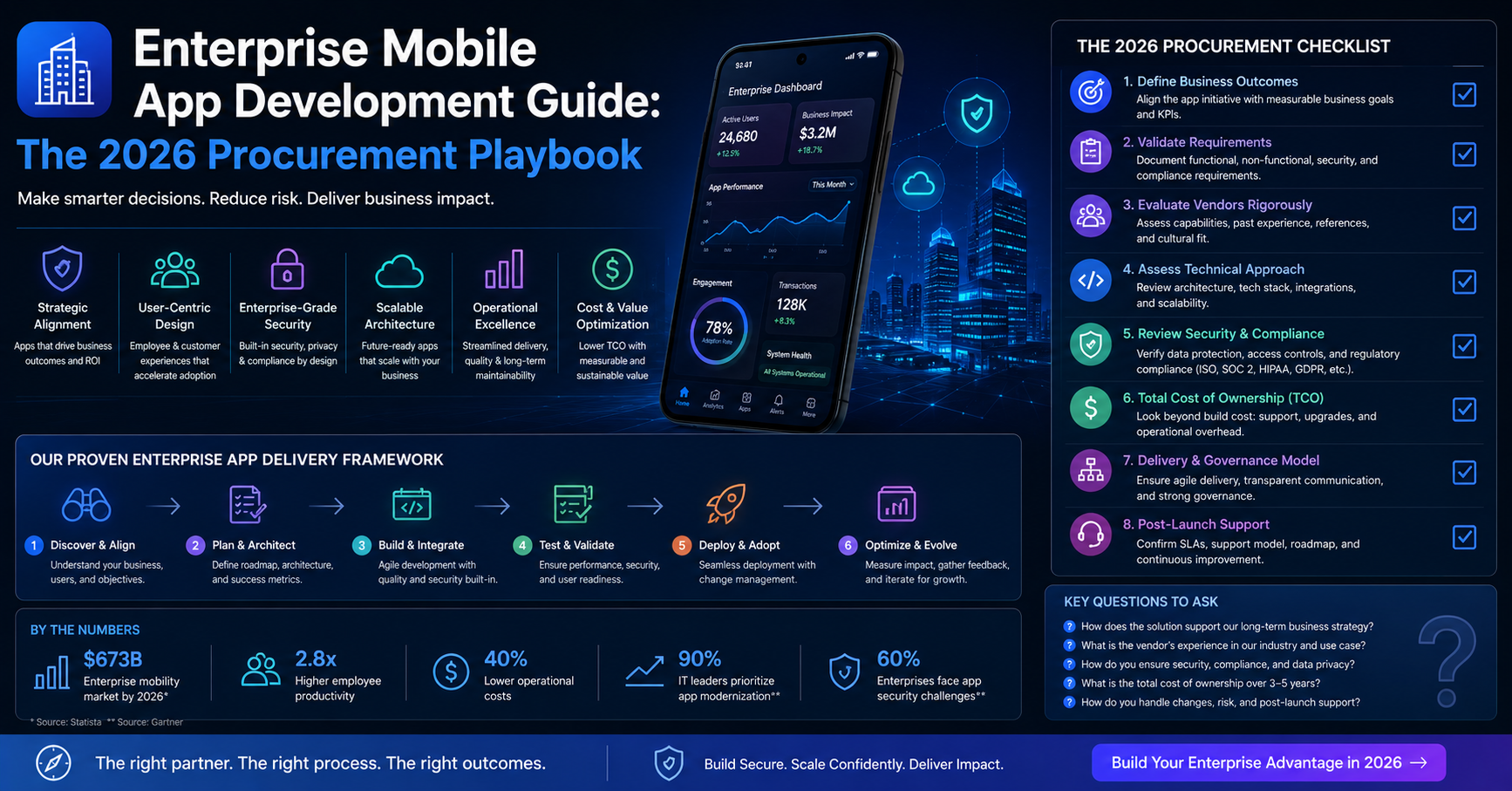
Summary. Enterprise mobile development is a procurement discipline first, an engineering discipline second. The vendor must hold CMMI Level 5, ISO/IEC 27001:2022, and named reference clients at enterprise scale. The build must integrate with existing enterprise systems (SSO, SCIM, IAM, EHRs, CRMs, ERPs) under the customer's identity provider. The compliance overlay (HIPAA, SOC 2, PCI-DSS, GDPR, FCA) must be designed in from Sprint 1. The cost range runs $80K to $500K+ depending on complexity. This guide gives you the procurement playbook, the compliance-aware design framework, and the governance structure that survives enterprise audits.
Talk to eCorpIT about an enterprise build · Hire Mobile App Developers
What makes enterprise mobile different from startup mobile
Five structural differences that change the engagement entirely.
Procurement runs the vendor selection, not the engineering team. US Fortune 500, UK FTSE 250, NHS Trusts, Indian conglomerates: procurement vetting can extend 4–12 weeks beyond the engineering decision. The vendor must pass procurement before engineering can sign.
Compliance overlay is mandatory, not optional. HIPAA for US health systems, SOC 2 for B2B SaaS sold to enterprise, PCI-DSS for payment-handling, GDPR + UK GDPR + DPA 2018 for European data, FCA operational resilience for UK financial firms, DPDP for Indian. The build must be designed for the audit, not retrofitted.
Integration with existing enterprise systems is the deciding architecture. SSO via SAML 2.0 or OIDC with the customer's identity provider as source of truth. SCIM 2.0 provisioning from HRIS. EHR integration (Epic, Cerner) for healthcare. CRM and ERP integration for B2B. The mobile app rarely lives in isolation.
Governance survives the engineering team's tenure. The build outlasts any single engineer's involvement. Documentation, MSA continuity, change-control processes, hand-off procedures must support multi-year ownership.
Budgets are larger but more scrutinised. $80K to $500K+ engagements with multi-stage approval. The vendor's pricing predictability and change-order discipline matter more than at startup scale.
The enterprise mobile cost range
Real ranges, sourced from TechAhead, Appinventiv, and eCorpIT's enterprise engagements.
Enterprise mobile MVP ($80K – $150K)
Standard enterprise auth (SSO + RBAC), 12–15 screens, custom backend with one major system integration (CRM, EHR, or HRIS), compliance overlay (GDPR or SOC 2), standard design.
- US agency: $120K – $250K
- eCorpIT: $35K – $80K
Mid-complexity enterprise app ($150K – $300K)
Multi-role auth, 20–30 screens, custom backend with 2–3 major system integrations, full compliance overlay (HIPAA / SOC 2 / PCI-DSS), custom design, accessibility audit.
- US agency: $200K – $400K
- eCorpIT: $60K – $130K
Complex enterprise platform ($300K – $500K+)
Multi-tenant architecture, 30+ screens, custom backend with 4+ major system integrations, full compliance overlay across multiple regimes, AI/LLM features, multi-region deployment, comprehensive accessibility audit, internationalisation.
- US agency: $300K – $500K+
- eCorpIT: $100K – $200K
The 60–70% cost arbitrage holds at enterprise scale because eCorpIT's senior-only rate of $44–$48 per hour applies regardless of project size. The procurement-grade credentials match what enterprise buyers require.
For your specific project the interactive cost calculator returns a personalised range in 90 seconds.
The procurement-grade vendor checklist
The certifications and registrations enterprise procurement teams ask for. The vendor must hold all of these.
CMMI Level 5 appraisal. Current (within 3 years), with the appraiser firm and date documented. The US government and Fortune 500 procurement standard.
ISO/IEC 27001:2022. Current 2022 revision specifically, not legacy 2013. UKAS-accredited for UK; ANAB for US; NABCB for India.
ISO 9001:2015. Quality management.
ISO/IEC 20000-1:2018. IT service management.
GDPR + UK GDPR + DPA 2018 alignment. Multi-jurisdiction data-protection coverage with documented data-processing register.
DPDP Act (India) compliant. For engagements involving Indian data subjects or Indian data residency.
D-U-N-S verified. Vendor-classification ready.
DPIIT recognised + MSME registered (India-based vendors). Indian government recognition standards relevant to vendor classification.
Named enterprise reference clients. Specific Fortune 500, FTSE 250, or comparable enterprise clients the vendor has shipped production work for. Anonymous "leading retailer" references do not count.
eCorpIT holds all of these. Many India-based volume vendors hold ISO 9001 and 27001 but not CMMI Level 5. Most US boutiques do not pursue CMMI but hold the ISO and US-equivalent certifications.
The compliance overlay framework
Five compliance regimes that commonly apply to enterprise mobile builds. Each adds engineering overhead that the vendor must price from Sprint 1.
HIPAA (US healthcare). Data classification at schema level, PHI in encrypted columns, audit-log tables for every PHI access, BAA-friendly cloud infrastructure, BAA signed between vendor and customer. Adds 25–35% to base build cost.
SOC 2 Type II (B2B SaaS). Multi-tenant data isolation, audit-trail logging, access-control review, sub-processor disclosures, Common Criteria mapping. Adds 20–25% to base build cost.
PCI-DSS (payment handling). PCI scope-reduction architecture, tokenisation at PSP layer, no PAN on device, audit trails. Adds 25–30% to base build cost.
GDPR + UK GDPR + DPA 2018 (European data). Consent flows, data subject access requests, right-to-erasure, ICO standard contractual clauses for cross-border data. Adds 10–15% to base build cost.
FCA operational resilience (UK financial firms). Customer-due-diligence flows, KYC/AML integrations, audit-cooperation clauses. Adds 15–25% to base build cost.
The vendor must price the compliance overlay explicitly at proposal stage. "Compliance-aware" without a cost line item is a procurement red flag.
Enterprise integration architecture
The integration question is what makes enterprise mobile builds expensive.
SSO (SAML 2.0 + OIDC). Okta, Microsoft Entra ID, Google Workspace, OneLogin, Auth0, JumpCloud. The customer's identity provider is the source of truth. The vendor must support both SP-initiated and IdP-initiated flows.
SCIM 2.0 provisioning. User lifecycle automation from the customer's HRIS. Required by enterprise customers with HRIS-driven access management. Adds 80–160 hours to typical builds.
RBAC and ABAC. Role-based and attribute-based access control with the customer's identity provider as source of truth. Fine-grained permission models that survive access-review processes.
EHR integration (healthcare). Epic, Cerner, Allscripts, EMIS, TPP SystmOne. FHIR R4/R5 with SMART on FHIR OAuth 2.0. HL7 v2 ADT/ORU/MDM segment handling for legacy workflows.
CRM and ERP integration. Salesforce, HubSpot, Microsoft Dynamics, SAP, Oracle. Real-time or batch sync depending on use case. Webhook discipline for event-driven flows.
Observability and SIEM integration. Customer's Datadog, Splunk, ELK, or equivalent observability stack. Log forwarding, security event integration, incident-response cooperation.
The integration architecture is where enterprise builds spend 30–50% of the engineering hours. The vendor must scope this explicitly.
Governance and ongoing ownership
The enterprise mobile build outlasts the engineering team that built it. Five governance elements that survive engineer transitions.
Architectural decision records (ADRs). Documented decisions with rationale, alternatives considered, and the team that approved. Survives engineer transitions.
Comprehensive code documentation. Inline comments for non-obvious code, API documentation, README files for each module, architecture diagrams. The next team should be able to onboard without the original engineers.
Documented runbook for operations. Deployment procedures, incident-response playbooks, monitoring dashboards, escalation contacts. Operations-team handover.
Change-control process. Written change-order procedures, milestone acceptance criteria, regression-testing requirements. Survives vendor transitions.
MSA continuity provisions. Vendor staff changes do not affect MSA terms. Source-code ownership stays with customer. Documentation hand-off triggers in MSA.
eCorpIT bakes all five into every enterprise engagement. The vendor's governance discipline matters more than any individual engineer's quality for enterprise builds.
The 14-day enterprise onboarding
Enterprise procurement constraints sometimes extend the timeline; the 14-day shipping target still holds for the engineering side.
Day 0 — NDA signed within 4 hours of first inbound.
Day 1 — 60-minute discovery call. Manu joins. We map the regulatory perimeter, integration scope, identity-provider choices, audit-trail requirements, and procurement constraints.
Days 2–7 (overlapping with procurement) — Anonymised CVs of senior engineers, interview-and-select cycle, MSA + DPA boilerplate sharing with customer's legal team for parallel review, BAA discussion for healthcare engagements, sub-processor disclosure for SOC 2.
Days 7–14 — Environment setup, repository, identity-provider sandbox, EHR/CRM sandbox, sprint planning, technical design document with compliance data-flow diagrams, founder-led kick-off, Sprint 1 build, first working demo.
For procurement-heavy enterprises, the procurement cycle (vendor classification, security questionnaire, MSA review) runs in parallel with the engineering onboarding. The build can start the moment procurement signs.
Frequently asked questions
A short closing note
Enterprise mobile development is a procurement-first discipline. The vendor's CMMI Level 5 + ISO 27001:2022 + named enterprise references matter as much as the engineering capability. The compliance overlay must be designed in from Sprint 1. The integration architecture determines whether the build ships on time. The governance structure determines whether the build survives engineer transitions.
If you want a senior read on whether eCorpIT fits your enterprise build, that is what we do on the discovery call. Manu joins every enterprise discovery call personally.
Further reading
- Hire Mobile App Developers · Hire SaaS App Developers · Hire FinTech App Developers · Hire Healthcare App Developers
References
Page last reviewed by Manu Shukla, Founder, eCorpIT, on 30 May 2026. Next review: August 2026.