On this page · 9 sections
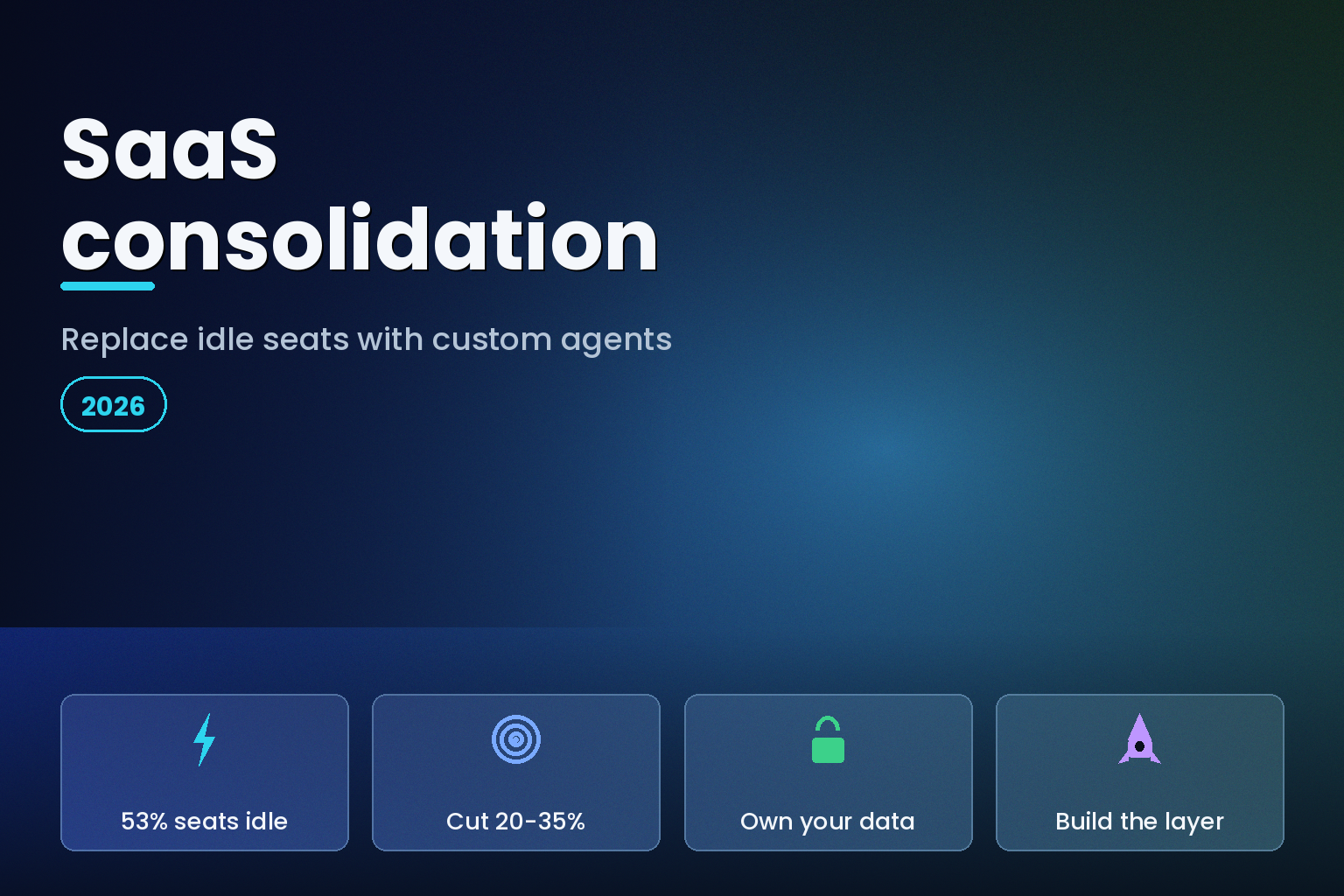
Summary. The average large enterprise runs about 660 SaaS applications, and Zylo's data shows 53% of SaaS licenses sit idle, roughly $21 million in wasted spend a year at a typical company. On 1 July 2026 Gartner put $234 billion of enterprise application spend, about 20% of SaaS spend by 2030, at risk from "agentic arbitrage," where an AI agent does the work across systems and the paid seat goes quiet. The two forces point the same way: consolidate the stack, and replace the idle seats with agents that reach your data directly. A custom agent can run at about $0.02 per conversation against platform pricing of $0.15 to $1.50, but it only pays off past real volume. This guide covers what to consolidate first, when to build rather than buy, and how eCorpIT delivers the work.
The cost of SaaS sprawl in 2026
SaaS sprawl is a spend problem before it is a tooling problem. Zylo's SaaS management data puts the average portfolio at roughly 152 applications for smaller firms and up to 660 at large enterprises, with 53% of licenses unused. Breeze's 2026 sprawl figures put the waste near $21 million a year at an average company. More than half of CIOs are now actively cutting vendors rather than adding them.
The agent shift makes idle seats worse, not better. When an AI agent completes a task across several applications, the human stops logging in, so seats you renewed on 2024 assumptions produce nothing. That is the mechanism behind Gartner's $234 billion agentic arbitrage estimate: value delivered directly by agents, seats left paying for interfaces nobody opens. We covered the buyer-side audit of that shift in the agentic arbitrage SaaS budget audit.
Consolidation returns real money. Zylo's consolidation analysis puts typical savings at 20% to 35% of stack cost within a year, and the savings compound when a single agent replaces the licensed seats of two or three overlapping tools. The question is not whether to consolidate. It is which layer to keep, which to replace, and where a custom build actually pays back.
Why agents change the consolidation maths
The old consolidation play was to merge overlapping SaaS tools into one bigger SaaS contract. Agents add a second option: replace the interface layer entirely and let an agent read and write to the systems underneath through their APIs. That changes the per-unit economics.
Platform agents carry a per-task markup. Salesforce sells Agentforce at $2 per conversation, or $0.10 per action through Flex Credits, per Salesforce's pricing page. A custom agent on your own hosting runs closer to $0.02 per conversation once the platform fee and per-task markup are gone, according to SearchUnify's TCO breakdown. The catch is the build cost. A three-year custom TCO lands between $400,000 and $1.8 million depending on scope, and Composio's build-versus-buy framework puts the crossover near 100,000 conversations a year for buying and past roughly 1 million a year for building.
| Vector | Keep or buy SaaS | Configure a platform agent | Build a custom agent |
|---|---|---|---|
| Time to market | Days | Weeks | 2 to 4 months |
| Upfront cost | Low, under $1,000 setup | Medium | $400K to $1.8M over 3 years |
| Running cost per task | $0.15 to $1.50 | $0.10 to $2.00 | About $0.02 |
| Maintenance owner | Vendor | Shared | Your team or partner |
| Data control | Vendor-hosted | Mostly vendor | Full, on your infrastructure |
| Best when | Low volume, generic work | Standard workflow, some tuning | High volume, proprietary process |
The honest read: buying wins on speed and simplicity at low volume, and building wins on per-unit cost only at scale or where the workflow is genuinely proprietary. Most enterprises want a mix. The skill is drawing the line in the right place. That decision, applied to one function, is worked through in AI agent unit economics and cost per task.
What to consolidate first
Start where seats are decaying and the work is automatable. The tools most exposed to consolidation are the ones built on data entry, logging, and retrieval, because an agent can do that work against the API without a person in the interface.
| Layer | Consolidation action | Saving lever |
|---|---|---|
| Overlapping point tools | Merge into one platform or one agent | Remove duplicate subscriptions |
| Data entry and logging seats | Replace seats with an agent writing via API | Cut idle licenses |
| Dashboard and viewer seats | Agent answers in natural language on governed data | Cut viewer-tier seats |
| Manual integration middleware | Consolidate into agent tool-calling | Reduce glue-code and connectors |
| Systems of record (ERP, finance) | Keep and protect | Not a target; agents depend on it |
The pattern worth stating plainly: the systems most exposed on seat price are often the ones you least want to remove, because they hold the governed data your agents need. The real cost is usually the integration and the change management, not the model. Consolidation is safest when you keep the system of record and retire the seats and middleware around it.
How eCorpIT delivers a SaaS-to-agent consolidation
We run this as an engineering programme, not a licence-swap. The sequence is deliberate. First, an application portfolio analysis: what you run, what it costs, and where logins are decaying against seats paid. Second, an exposure score per tool on login decay, task automatability, data reachability, and contract timing, so the priority order is evidence-based. Third, we replace the layer that pays back, building agents that call your existing systems through their APIs, using the Model Context Protocol where it fits, while the systems of record stay in place.
We build with verified capability rather than claims. eCorpIT is a senior-led engineering organisation in Gurugram, founded in 2021, certified for CMMI Level 5, MSME, and ISO 27001:2022, and we work across AWS, Microsoft, and Google platforms. We design agent access and data handling aligned with DPDP Act 2023 requirements, and we scope the build so you only pay to construct the custom layer that removes expensive manual work. The same delivery discipline runs through our enterprise AI agent development service and, for revenue teams, our GTM and RevOps AI agent service.
Build versus buy: when to keep the SaaS
Building is not the default. Buy standard capability, configure where the platform fits your process, and build only the custom layer that creates a measurable advantage or removes an expensive manual workaround. Custom work carries undifferentiated heavy lifting: hosting, vector stores, evaluation, and the compliance layer. If a function runs under about 100,000 conversations a year and the workflow is generic, a platform agent is the right call, and the money is better spent consolidating duplicate subscriptions. Above roughly 1 million conversations a year, or where the workflow touches proprietary data an off-the-shelf tool cannot reach cleanly, the custom build starts to earn its keep on per-task cost and data control.
India-specific considerations
Two points sharpen this for Indian enterprises and the global capability centres based here. Data portability is both use and compliance: under the DPDP Act 2023, clean data export supports lawful movement of personal data when you consolidate or replace vendors, so negotiate portability in the same cycle you plan the agent build. Currency and scale matter too. Much of a large SaaS bill is charged per seat in dollars and paid from a rupee budget, so a seat audit that trims idle licenses protects that budget directly. A GCC consolidating tooling across a parent group can run one exposure score and apply it across every entity, the kind of enterprise agent work described in our overview of enterprise AI agents in production.
FAQ
How eCorpIT can help
eCorpIT is a senior-led engineering organisation in Gurugram, founded in 2021 and certified for CMMI Level 5, MSME, and ISO 27001:2022. We audit your SaaS portfolio, score each tool's exposure to agentic arbitrage, and build the custom agents that let you retire idle seats while keeping your systems of record intact, with integrations designed aligned with DPDP Act 2023 requirements and delivered across AWS, Microsoft, and Google platforms. To map your consolidation plan before your next renewal, contact our team.
References
- Breeze, SaaS tool sprawl statistics you need to know (2026), 2026.
- Gartner, Gartner Says $234 Billion in Enterprise Application Software Spend Is at Risk from Agentic AI, 1 July 2026.
- Salesforce, Agentforce pricing, accessed August 2026.
- SearchUnify, AI agent costs in customer service: the complete breakdown, 2026.
- Composio, Build vs buy AI agent integrations: a 2026 decision framework, 2026.
- Digital Applied, Enterprise AI agents 2026: build vs buy decision guide, 2026.
- Tensoria, Custom AI agent vs SaaS: real cost comparison 2026, 2026.
- CIO Dive, Agentic AI to disrupt $234B in SaaS spending: Gartner, 2026.
- PADISO, AI vendor consolidation 2026: from 20 tools to 5, 2026.
Last updated: 2 August 2026.