On this page · 10 sections
Summary. Every major go-to-market platform now ships AI agents for sales and marketing. HubSpot launched Agent Hub and Agent Builder in public beta on 23 July 2026, included for Professional and Enterprise customers. Salesforce Agentforce sells three ways at once: $2 per conversation, Flex Credits at $500 per 100,000 ($0.10 per action), or $125 per user per month. Microsoft folds Copilot for Sales into Dynamics 365 licences. Gartner expects 40% of enterprise apps to embed task-specific agents by the end of 2026, up from under 5% in 2025, while warning that more than 40% of agentic AI projects will be cancelled by the end of 2027. The market itself is forecast to grow from $7.84 billion in 2025 to $52.62 billion by 2030. This guide covers what to automate first, what each option costs, the build-versus-buy maths, DPDP guardrails for Indian teams, and a 90-day rollout.
For a founder or a revenue leader in India, the question in 2026 is no longer whether AI agents belong in the sales and marketing stack. It is which tasks to hand over, which platform to pay for, and how to avoid landing in Gartner's cancelled-project statistic. The honest answer is that the technology is ready for a narrow set of jobs and still risky for the rest.
What an AI agent actually is in a GTM stack
An AI agent is software that takes a goal, plans a short sequence of steps, calls tools or your CRM, and acts, rather than only answering a question. A chatbot replies. An agent updates a record, books a meeting, drafts an email, or enriches a lead, then reports what it did. That distinction matters because the pricing and the risk both come from the actions, not the words.
In practice the useful GTM agents in 2026 sit on top of your CRM data. HubSpot's Agent Builder is a no-code canvas that assembles custom agents from the customer context already in its Smart CRM. Salesforce Agentforce builds agents on Salesforce records. Microsoft's Copilot for Sales works inside Dynamics 365 and Microsoft 365. The data gravity of your CRM usually decides which one you can adopt without a painful integration.
Two facts set expectations. First, adoption is real: PwC reported in April 2025 that 79% of US executives said their companies were adopting AI agents, and a McKinsey survey in November 2025 found 23% of organisations scaling agents in at least one function with a further 39% experimenting. Second, results are uneven. Anushree Verma, Senior Director Analyst at Gartner, said "most agentic AI projects right now are early stage experiments or proof of concepts that are mostly driven by hype and are often misapplied." Both things are true at once, which is why scope discipline is the whole game.
The seven GTM workflows worth automating first
Start where the work is repetitive, the data is structured, and a mistake is cheap to catch. The table below ranks the safest early wins for a sales and marketing team, what the agent should do, what a human must still own, and the tools that ship these agents in 2026.
| GTM workflow | What the agent does | What the human keeps | Where it ships (2026) |
|---|---|---|---|
| Lead capture and enrichment | Pulls firmographic data, dedupes, fills missing fields | Data-source approval, edge cases | HubSpot, Salesforce, custom |
| Lead qualification and routing | Scores against ICP rules, assigns owner, alerts rep | The scoring criteria and exceptions | HubSpot, Salesforce, Microsoft |
| Meeting booking and reminders | Proposes times, sends invites, nudges no-shows | Calendar rules, VIP handling | All platforms |
| CRM hygiene and data entry | Logs calls, updates stages, writes summaries | Field definitions, audit review | Microsoft, Salesforce, HubSpot |
| Outbound and follow-up drafts | Drafts first-touch and follow-up copy for approval | Send decision, tone, claims | HubSpot, Salesforce, custom |
| Campaign and content operations | Builds variants, schedules, tags UTM parameters | Strategy, budget, brand voice | HubSpot, custom |
| Support-to-sales handoff | Spots upsell signals, opens an opportunity | Qualification, pricing talk | Salesforce, Microsoft, custom |
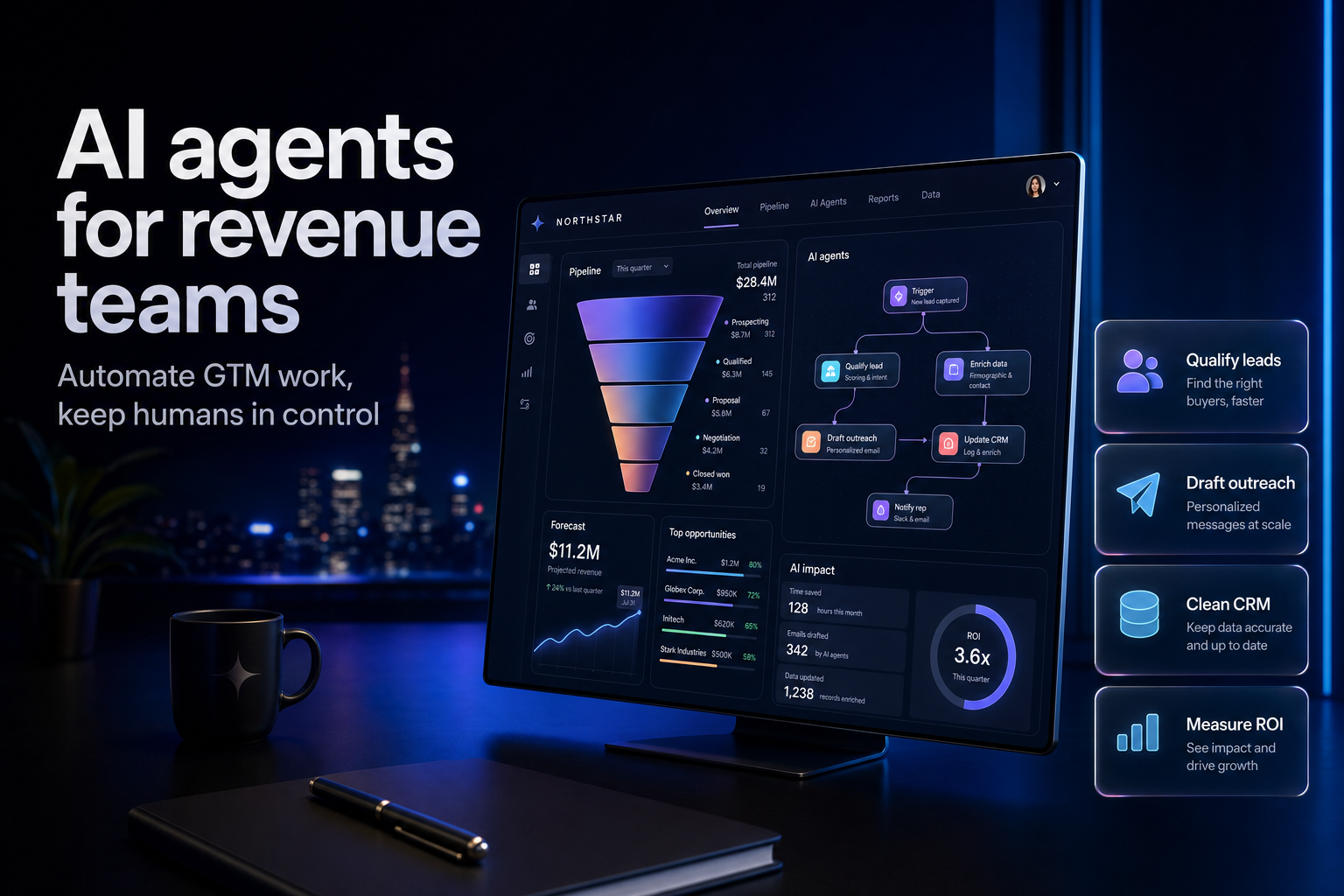
The pattern across all seven is human-in-the-loop for anything that touches a customer's inbox or a price. Draft-and-approve is where agents earn trust in the first quarter; full autonomy on outbound is where reputations get damaged. We build outbound agents in draft mode by default and only widen autonomy per workflow once the approval rate is consistently high.
If your first instinct is a customer-facing chat assistant instead, read the build-versus-buy maths for support agents in India before you commit, because the economics differ from internal GTM automation.
What the platforms cost in 2026
Pricing for agents has splintered because vendors are still working out how to bill for autonomous actions. Three models now coexist: per conversation, per action or credit, and per user. Confirm live numbers with each vendor before you budget, because several are mid-repricing.
| Platform (2026) | Pricing model | What is included | Best fit |
|---|---|---|---|
| HubSpot Agent Hub + Agent Builder | Consumption via HubSpot Credits; Agent Hub included in Professional and Enterprise during the public beta from 23 July 2026 | No-code Agent Builder on Smart CRM, one home for every agent | Marketing and sales teams already on HubSpot |
| Salesforce Agentforce | $2 per customer-facing conversation, or Flex Credits at $500 per 100,000 ($0.10 per action), or $125 per user per month | Prebuilt and custom agents on Salesforce data | Larger sales orgs already on Salesforce |
| Microsoft Copilot for Sales | Included in the matching Dynamics 365 SKU; role Copilots last confirmed at $50 per user per month standalone or $20 as an add-on; Premium bundles 1,000 Copilot Credits per user monthly | Sales agents inside Dynamics 365 and Microsoft 365 | Microsoft-stack enterprises |
| Custom build (open models + your CRM) | Engineering time plus model tokens and hosting; no per-seat licence | Full control of data, prompts, and guardrails | Teams with unusual workflows or strict data rules |
Two numbers put this in an Indian context. Salesforce's $125 per user per month is roughly ₹10,600 per user per month at about ₹85 to the dollar in July 2026, before implementation. Microsoft's older $50 standalone Copilot line is about ₹4,250 per user per month. Those are list references, not quotes; consumption models mean a heavy outbound month can cost more than a per-seat plan, and a quiet month can cost less. Model the volume, not the sticker.
Salesforce running $2 per conversation, $0.10 per action, and $125 per user at the same time is not an accident. As one industry write-up put it, having three live pricing models at once reflects the genuine difficulty of translating agentic usage into a bill a customer can predict. Budget for variance.
Build versus buy: a decision you can defend
Most Indian SMBs and startups should buy first and build later. Buying a platform agent gets you to first value in days, and the vendor carries the maintenance. Building makes sense when your workflow is unusual, your data cannot leave your own infrastructure, or per-seat and per-action costs would balloon at your volume.
| Factor | Buy a platform agent | Build custom |
|---|---|---|
| Time to first value | Days to a few weeks | 6 to 12 weeks |
| Upfront cost | Low (subscription or credits) | Higher (engineering time) |
| Data control | Vendor-hosted | Your own infrastructure |
| Fits unusual workflows | Limited to the platform | Full flexibility |
| Main ongoing cost | Per seat or per action | Tokens plus maintenance |
A custom build is not a licence saving so much as a control decision. You trade a predictable subscription for engineering ownership: your prompts, your guardrails, your data residency, your evaluation harness. The real cost of a custom agent is usually the integration and the ongoing evaluation, not the first prototype. Teams that skip evaluations that catch silent agent failures discover regressions in production, where they are most expensive. If you are weighing a broader agent programme, our notes on production AI-agent use cases cover where the pattern holds and where it does not.
India-specific considerations
The demand signal in India is clear. The country's CRM software market is projected to reach $5.4 billion by 2034 at an 8.66% CAGR across 2026 to 2034, and automation is now the feature buyers care about most, ranked top by 45% of CRM buyers. Constant Contact found that 54% of small business owners already use AI marketing tools, with another 27% planning to start in 2026. The tooling is arriving at SMB price points, not only enterprise ones.
The constraint is data protection. Sales and marketing agents run on exactly the personal data the Digital Personal Data Protection Act 2023 governs: names, phone numbers, email addresses, and behavioural signals. An outbound agent that enriches a lead or drafts a message is processing personal data, so consent, purpose limitation, and the ability to erase on request all apply. Design the agent to record the lawful basis for each contact and to honour deletion, rather than bolting compliance on later. Our DPDP engineering playbook for Indian startups sets out the data-flow work this needs.
Data residency is the second India question. If your buyers are regulated, or your enrichment sources sit offshore, a vendor-hosted agent may move data in ways your policy does not allow. That is often the single strongest argument for a custom build on infrastructure you control.
Why agent projects fail, and how to avoid it
Gartner's warning that more than 40% of agentic AI projects will be cancelled by the end of 2027 is not a reason to wait. It is a checklist of what goes wrong: escalating costs, unclear business value, and inadequate risk controls. Verma's point is that hype "can blind organizations to the real cost and complexity of deploying AI agents at scale, stalling projects from moving into production."
Three habits keep a GTM agent alive past the pilot. First, pick one workflow with a number attached, such as reply rate on follow-ups or hours saved on CRM entry, and measure it from week one; a project you cannot measure is a project you cannot defend. Second, keep a human approving anything customer-facing until the approval rate proves itself. Third, treat security as a build requirement, not an afterthought, because an agent that reads untrusted email and can act is an injection target. The controls in our note on guardrails against prompt injection apply directly to outbound and support agents.
Integration is where the value shows up. An agent that cannot read your CRM cleanly, or write back reliably, produces demos, not outcomes. This is unglamorous work, and it is the difference between a project that scales and one that stalls.
A 90-day rollout plan
Days 1 to 30: pick one workflow from the table, define the metric, and connect the agent to your CRM in draft-and-approve mode. Run it alongside the human process, not instead of it. Days 31 to 60: measure against the baseline, tighten prompts and routing rules, and fix the integration gaps the pilot exposes. Widen autonomy only on the steps that earned it. Days 61 to 90: add a second workflow, wire the DPDP consent and deletion paths, and stand up the evaluation harness so a model or prompt change cannot silently regress. If a workflow has not moved its metric by day 90, stop it rather than defend it.
When Microsoft's sales and service agents reached general availability this year, the teams that won were the ones that scoped narrowly and measured hard, which matches what we see in delivery. Our summary of Microsoft's sales and service agents at GA has the platform detail if you are on the Microsoft stack.
FAQ
How eCorpIT can help
eCorpIT is a Gurugram-based, senior-led engineering organisation, founded in 2021, CMMI Level 5 assessed and MSME certified, with partnerships across AWS, Microsoft, and Google. We help sales and marketing teams pick the right workflow, integrate a HubSpot, Salesforce, or Microsoft agent cleanly into your CRM, or build a custom agent on infrastructure you control when data residency or unusual workflows demand it, all designed aligned with DPDP Act requirements. If you want a scoped 90-day rollout with the metric agreed up front, talk to our team.
References
_Last updated: 26 July 2026._