On this page · 14 sections
- What changed on this page
- Why the denominator cannot be borrowed
- What a resolved task actually costs on the AI side
- Published vendor rates, August 2026
- The model
- Sensitivity: the answer at your own human cost
- Containment is not resolution
- The scaling trap
- Build versus buy
- India-specific considerations
- A checklist before you sign
- FAQ
- How eCorpIT can help
- References
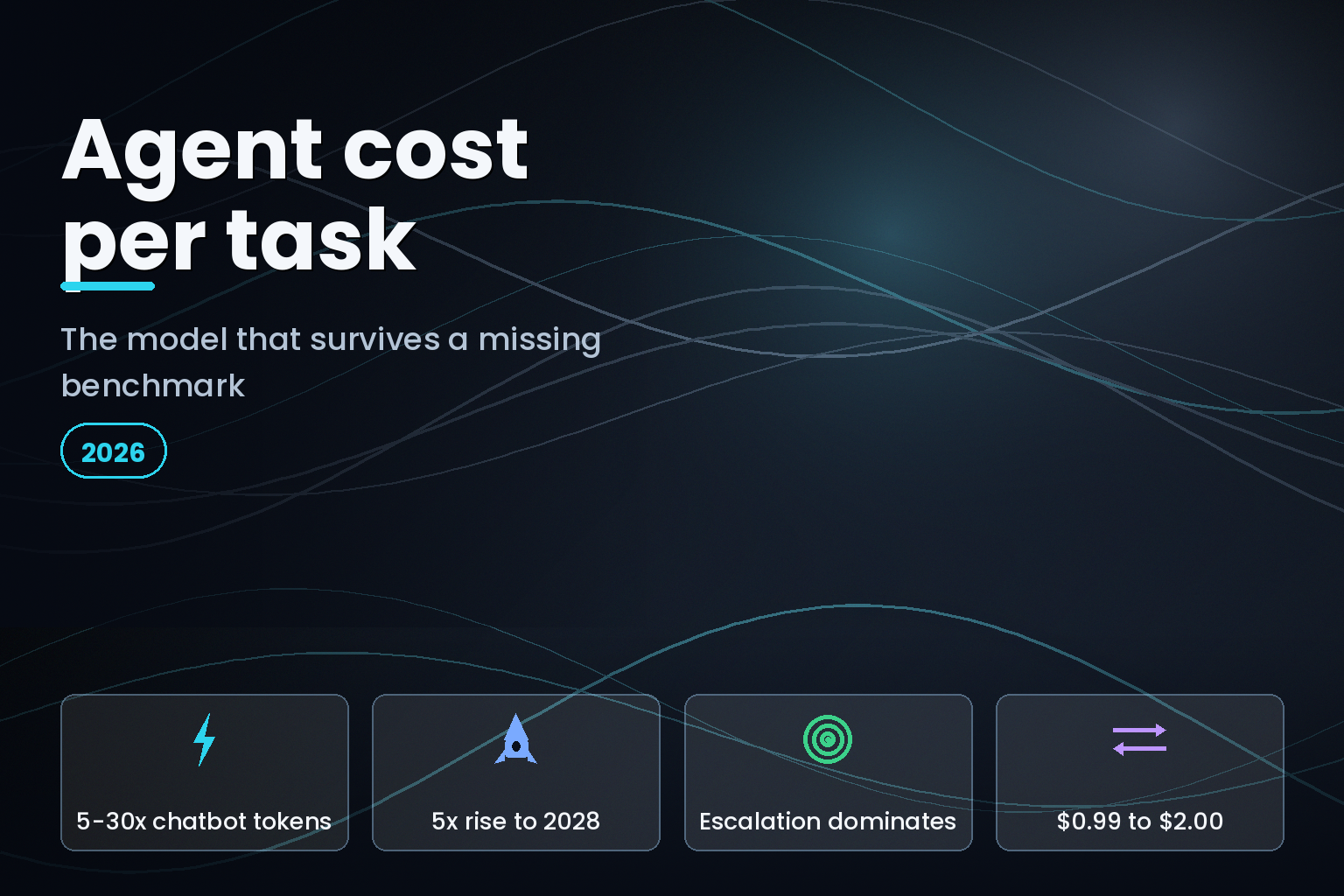
Summary. Gartner predicted on 17 August 2026 that AI inference costs per agentic workflow will rise more than fivefold through 2028, and its 25 March 2026 release puts agentic models at 5 to 30 times the tokens per task of a standard chatbot. Vendor list prices are public: Intercom Fin at $0.99 per outcome, Salesforce Agentforce at $2.00 per conversation or roughly $0.10 per action, Gorgias at $0.90 to $1.27, Freshdesk Freddy at $0.10 per session. What is not public, anywhere, is what a human resolution costs. This page previously divided by $7.40, attributed to a McKinsey 2026 sample that does not exist, and by a $13.50 per-contact figure credited to SQM and Forrester that traces only to vendor marketing. Both are withdrawn, along with the 41.2% and 58.7% deflection rates. The model below survives that removal, because the model was never the problem. The denominator was.
The useful finding is structural: in an agent business case, the escalation line dominates and the token line does not. That holds at any human cost you plug in. So the fix is not to find a better benchmark. It is to stop importing one.
What changed on this page
Published 31 July 2026, re-verified 21 August 2026. Three inputs failed verification and have been removed.
| Withdrawn figure | Previously attributed to | What verification found |
|---|---|---|
| $7.40 per human resolution | "McKinsey AI in Customer Service 2026 sample" | No McKinsey publication of that name exists |
| $13.50 per human contact | SQM and Forrester benchmarks | Traces to vendor marketing pages, not to either firm |
| 41.2% median, 58.7% top-quartile deflection | Enterprise CX programmes | Aggregator-only, credited to two different research houses |
Every worked example on the old page divided by $7.40, so every cost figure it produced inherited the error. Our companion piece on AI chatbot customer service costs carried the same numbers and was corrected the same day. If your own model uses $0.62 against $7.40, it is downstream of the same source.
Why the denominator cannot be borrowed
Every "AI is twelve times cheaper" claim is a fraction. The numerator is published and checkable. The denominator is not.
Vendors publish AI rates because they are selling them. No analyst firm publishes a reproducible 2026 cost for a human-handled resolution, and the figures in circulation disagree by more than a factor of two: $6.00 to $12.00 in one roundup, $8.00 to $12.00 in another, $13.50 in a third. They credit Gartner, Forrester and SQM variously, and none of those firms publishes the number under its own name.
Gartner does publish the one structural fact worth keeping, from its 31 August 2022 release: agent labour "can represent up to 95% of contact center costs". That tells you the human line dominates the cost base without pricing a ticket.
This is not a reason to abandon the model. Your fully loaded cost per human resolution is knowable inside your business, from payroll, benefits, tooling, management overhead and peak staffing. It is unknowable outside it. Treat it as an input you supply, not a constant you look up.
What a resolved task actually costs on the AI side
An agentic workflow is not one model call. It is a loop: read the ticket, retrieve context, call a tool, check the result, retry, respond. Gartner's 25 March 2026 release quantifies the effect: "Agentic models, for example, require between 5-30 times more tokens per task than a standard GenAI chatbot."
The August 2026 follow-up puts a direction on the trend. Compared to a basic chatbot interaction, Gartner states, "routing a task to an agentic reasoning model increases provider inference costs by at least five times, and often much more as task complexity grows."
Will Sommer, Sr. Director Analyst at Gartner, framed the trap this way in that release: "Product leaders cannot rely on more efficient token economics to rationalize AI costs. Each successive generation of AI capability will necessitate more, and often more expensive, tokens. There is no reliable, economical one-size-fits-all model on the horizon."
Gartner calls this the Inference Paradox, defined in the same release as "better unit economics escalating the overall cost of AI without providing a clear pathway to commensurate and predictable value". Per-token prices fall while total bills rise, because capability and token consumption grow faster than price declines. The March release says so directly: "As token consumption rises faster than token costs fall, overall inference costs are expected to increase."
Two qualifiers on the widely quoted 90% figure from that March release. It applies to inference on a one-trillion-parameter model, and the saving accrues to providers rather than buyers. Gartner adds that "falling GenAI provider token costs will not be fully passed on to enterprise customers". Anyone modelling a 90% cost cut into their own 2030 budget has misread it.
Published vendor rates, August 2026
If you buy rather than build, these are the rates you can read without a sales call. They are not comparable to each other, because each vendor bills a different event.
| Vendor | Billing event | Published rate |
|---|---|---|
| Intercom Fin | Per resolved outcome | $0.99 |
| Zendesk AI | Per Verified Resolution | ~$1.20-$1.50 committed |
| Salesforce Agentforce | Per conversation | $2.00 |
| Salesforce Agentforce | Per action, Flex Credits | ~$0.10, $500 per 100,000 credits |
| Gorgias | Per resolution, tiered | $0.90-$1.27 |
| Freshdesk Freddy AI | Per session | $0.10, $100 per 1,000 |
The billing event matters more than the rate. Per-conversation pricing bills interactions the agent failed to resolve. Per-session pricing bills each touch, so one issue spanning five sessions bills five times. Only per-resolution and per-outcome models tie spend to a solved problem, and even those depend on the vendor's own definition of what counts. Zendesk, for instance, bills only resolutions its evaluation model confirms within 72 hours and treats contained-but-unconfirmed conversations as free.
If you build instead, a five-step agent sending roughly 3,000 input and 500 output tokens per step spends about 15,000 input and 2,500 output tokens per task. At a mid-tier model near $2 per million input and $10 per million output, that is around $0.055 in raw tokens. Add embeddings, retrieval, orchestration and a slice of evaluation and monitoring, and $0.15 to $0.30 per attempt is a defensible planning figure. Keeping that line flat as volume grows is what LLM hybrid routing to control token spend is for: send the easy majority to a cheap model and reserve the expensive one for the hard minority.
The model
For every inbound task, the agent attempts it at cost C. A fraction R is genuinely resolved. The remainder escalates to a human at cost H. Both paths end in a solved problem, so:
Cost per resolved task = C + (1 − R) × H
Three inputs, and only one of them is contested. C you can measure from your own token bills or read off a vendor price list. R you must measure on your own tickets. H you compute from your own payroll. Nothing here requires a borrowed benchmark.
The structure of the equation carries the finding. C is cents. H is dollars. So the term that moves the answer is (1 − R) × H, the escalation line. Halving your token cost changes the total by cents. Lifting resolution from 40% to 60% removes a third of the escalations.
Sensitivity: the answer at your own human cost
Because H is the input nobody can source, the honest presentation is a grid rather than a single number. C is held at $0.20 per attempt throughout. Read down your own fully loaded human resolution cost, across your own measured resolution rate.
| Resolution rate | H = $6.00 | H = $9.00 | H = $12.00 |
|---|---|---|---|
| 40% | $3.80 | $5.60 | $7.40 |
| 55% | $2.90 | $4.25 | $5.60 |
| 70% | $2.00 | $2.90 | $3.80 |
| 85% | $1.10 | $1.55 | $2.00 |
Two things fall out. First, the agent is cheaper per resolved task at every cell in this grid, which is why almost any working agent looks good on a spreadsheet. Second, the spread across a row is wider than the spread down a column at low resolution rates, meaning your uncertainty about H can swamp your improvement in R. That is the practical cost of an unsourceable denominator, and it is the argument for measuring your own.
The marginal break-even is worth stating plainly. The agent wins when C + (1 − R) × H is less than H, which simplifies to R > C ÷ H. At C of $0.20 and H of $9.00, that is a resolution rate above about 2.2%. A trivially low bar, and a misleading one, because it counts only marginal cost. Add build and integration cost amortised over volume and the real break-even moves up sharply. Volume, not cleverness, is what makes agent economics work.
Containment is not resolution
R in that equation must be genuine resolution. Containment counts a task as handled whenever the interaction stayed inside the bot, including when the customer gave up. It is the easiest metric to inflate and the least connected to whether anything was solved.
Optimise for containment and the invoice looks excellent while the work leaks into repeat contacts and churn that never appear on the AI bill. A contained-but-unsolved task is not a saving. It is a deferred cost that returns as a second contact at full human price. When you evaluate a vendor, the pricing model matters less than two numbers: the measured resolution rate on your own tickets, and how fast it improves in the first 90 days. Instrumenting that honestly is the same discipline as catching AI agent evals that surface silent failures before they reach production.
The scaling trap
Unit cost is not constant, and agentic loops amplify the drift. Gartner's forecast of a fivefold rise in inference cost per agentic workflow through 2028 is a forecast about workflows getting more complex, not about prices going up. Your own agent will follow the same curve if you let its reasoning depth and tool usage grow unchecked.
The budget consequence is documented. Gartner states that "through 2028, at least 50% of GenAI projects will overrun their budgeted costs due to poor architectural choices and lack of operational know-how". Note the causes named: architecture and operations, not model pricing.
Nitish Tyagi, Sr. Principal Analyst at Gartner, described the governance failure in a 24 June 2026 release about AI coding agents: "Token discipline will not emerge through developer choice alone, as developers tend to optimize for speed and convenience over cost efficiency. Without a governed engineering operating model, costs can escalate faster than the productivity gains these tools are designed to deliver." That release covers coding agents specifically, not support agents, so treat the mechanism as instructive rather than as a measured result for your use case.
Model cost at projected volume, not pilot volume. Cap agentic retries, cache aggressively, and meter token spend per task in staging before real traffic locks the economics in. The wider governance picture sits in our work on agentic AI project cancellation and cost controls and the enterprise AI agents in production pillar.
Build versus buy
The vendor model and the build model price the same work differently.
| Decision vector | Buy, per-resolution vendor | Build, own stack |
|---|---|---|
| Cost per resolution | $0.90-$2.00, predictable | $0.15-$0.30 marginal at scale |
| Upfront cost | Low | Higher; platform and evals |
| Time to value | Days to weeks | Weeks to months |
| Control of resolution rate | Vendor-dependent | Yours to tune |
| Data path | Vendor terms | Your control |
| Best when | Volume is modest or uncertain | Volume is high and sustained |
The crossover is volume, because the build's advantage is a lower marginal cost that only pays back once amortisation is spread thin enough. Below a few tens of thousands of resolutions a month, buying is usually cheaper all-in once the platform team a build needs is counted. The same reasoning drives our build vs buy for an AI customer support agent analysis and the platform-level Agentforce vs Copilot Studio agent cost comparison.
One caution on the buy side. A per-resolution fee grows linearly with every resolution forever, and it does so at the vendor's definition of a resolution. Read that definition before the rate.
India-specific considerations
The model shifts where human labour is cheaper. India's support wage base is well below the United States, so H is lower, and a lower H raises the resolution rate an agent needs before it wins on cost and lengthens the payback on any build. The agent case remains strong at high volume and high resolution, but the margin is thinner, which makes containment-inflated numbers more dangerous: the human alternative was already inexpensive, so there is less headroom to absorb an error.
This is also the clearest argument against importing a US per-ticket figure. A model built on a $9.00 human resolution and run against an Indian cost base will overstate the saving by a wide margin.
Data protection enters the unit cost too. An agent processing the personal data of Indian residents falls under the Digital Personal Data Protection Act, 2023, which adds consent capture, retention limits and audit logging to the build and therefore to the amortised cost per task. We design agent systems aligned with Digital Personal Data Protection Act requirements so those controls are architectural rather than a retrofit.
A checklist before you sign
Measure true resolution rate, not containment, on your own tickets. Compute your own fully loaded human cost per resolution rather than importing one. Model token cost at projected volume with the agentic multiplier applied. Read the vendor's definition of a billable event before its rate. Decide build versus buy on volume. And meter cost and quality in staging, so the unit economics are visible before real traffic fixes them in place.
FAQ
How eCorpIT can help
eCorpIT is a Gurugram technology organisation, founded in 2021 and assessed at CMMI Level 5, MSME certified and ISO 27001:2022 certified. Our senior engineering teams build and evaluate enterprise AI agents with a unit-economics discipline: measuring true resolution rate on your tickets, metering token cost per task, and computing your own human baseline instead of importing one. We design agent systems aligned with Digital Personal Data Protection Act requirements. If you want a cost-per-resolved-task model you can defend in a budget review, talk to our team.
References
- Gartner predicts AI inference costs per agentic workflow will increase more than fivefold through 2028 — Gartner, August 17, 2026.
- Gartner predicts that by 2030, performing inference on an LLM with 1 trillion parameters will cost GenAI providers over 90% less than in 2025 — Gartner, March 25, 2026.
- Gartner predicts AI coding costs will surpass average developer's salary by 2028 as token consumption surges — Gartner, June 24, 2026.
- The 2026 hype cycle for GenAI — Gartner, July 22, 2026.
- Gartner predicts conversational AI will reduce contact center agent labor costs by $80 billion in 2026 — Gartner, August 31, 2022.
- AI customer service agent pricing comparison, 2026 — Intercom, July 8, 2026.
- Intercom pricing — Intercom.
- Zendesk introduces outcome-based pricing — Zendesk newsroom, August 28, 2024.
- Zendesk plans and pricing — Zendesk.
- Salesforce Agentforce pricing — Salesforce.
- AI service agents improve customer satisfaction: State of Service, AI Agents Edition — Salesforce, May 20, 2026.
- Gartner survey finds 91% of customer service leaders under pressure to implement AI in 2026 — Gartner, February 18, 2026.
- ROI of AI customer service agents: benchmarks and data — Fin.ai, March 19, 2026.
_Last updated: August 21, 2026._