On this page · 8 sections
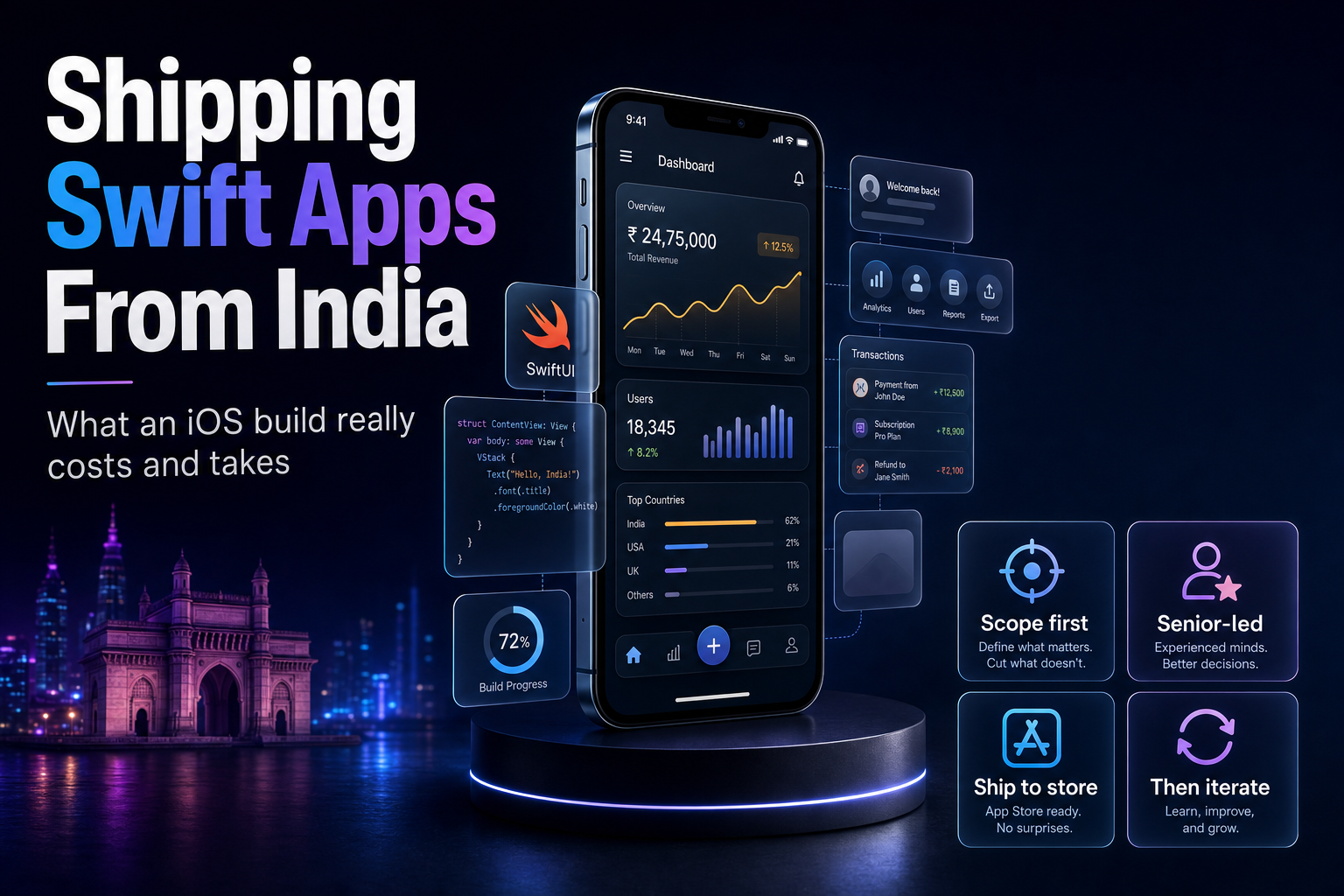
Summary. iOS app development in India runs from about $8,000 to $90,000 and above in 2026, with engineering rates between $25 and $60 per hour, roughly a 40% to 60% capital advantage against Western agencies. An MVP typically ships in 4 to 8 weeks at $8,000 to $15,000. Mid-level apps with real integrations land at ₹10,00,000 to ₹40,00,000, and complex enterprise builds with multiple APIs and extensive testing can cross ₹80,00,000. Timelines run 2 to 4 months for simple apps, 4 to 8 months for medium complexity, and 8 to 18 months for complex enterprise work. Two 2026 dates change the build: Apple announced iOS 27 at its WWDC keynote on June 8, 2026, and India's DPDP Consent Manager regime activates on November 14, 2026, with penalties reaching ₹250 crore per instance. The cost driver is almost never the screen count. It is what the app has to talk to.
What an iOS build costs in India in 2026
The published ranges are wide because they describe different products. Here is the shape.
| Tier | Indicative cost | Typical timeline |
|---|---|---|
| MVP or simple app | $8,000–$15,000 | 4–8 weeks for an MVP; 2–4 months for a simple app |
| Mid-level with integrations | ₹10,00,000–₹40,00,000 | 4–8 months |
| Complex enterprise | Can cross ₹80,00,000 | 8–18 months |
| Overall published band | $8,000–$90,000+ | Varies with integration responsibility |
| Engineering rate | $25–$60 per hour | India, against Western agency rates |
The 40% to 60% capital advantage against Western agencies is real, and it is also the least interesting number here, because it describes the rate rather than the total. A poorly scoped build at $30 an hour costs more than a well scoped one at $60. We worked through the geography question separately in India versus US app development cost.
What actually moves the number
Clients estimate with screen count. Estimates turn on something else.
| Cost driver | Effect on budget | Why |
|---|---|---|
| Integration responsibility | The single largest swing across the $8,000 to $90,000 band | Every external system is an interface you do not control |
| Advanced authentication | Adds 10–20% to total budget | Biometric login and token-based security touch every flow |
| Payment modules | Add $2,000–$7,000 | Reconciliation, failure states and compliance, not the SDK call |
| Backend scope | Moves a mid-level build toward enterprise pricing | Multiple APIs and extensive testing is where ₹80,00,000 comes from |
| Regulatory surface | Rises through 2026 into 2027 | DPDP obligations land on the data layer, not the UI |
Biometric login sounds like a checkbox and adds 10% to 20% to the total. It is an authentication decision that touches session handling, fallback paths, keychain storage and every place the app assumes a signed-in user. Payment modules run $2,000 to $7,000 for the same reason: the SDK call is an afternoon, and the reconciliation, failure states and edge cases are the rest.
The honest rule: the app is as expensive as the systems it talks to.
The iOS 27 changes that hit your build this year
Apple announced iOS 27 at the WWDC keynote on June 8, 2026, with developer betas the same week. iOS 27 builds with Xcode 27, which bundles the iOS and iPadOS 27 SDK and runs the Swift 6.4 compiler.
The submission floor has not moved yet, and that is the useful part.
| Item | Status as of July 2026 | What it means for you |
|---|---|---|
| App Store submission floor | iOS 26 SDK with Xcode 26, in effect since April 28, 2026 | You are not forced to the iOS 27 SDK yet |
| iOS 27 SDK deadline | No announced deadline forcing it | Migrate on your schedule, not in a panic |
| Launch screen | Apps built with the iOS 27 SDK must include one | The App Store rejects builds without it |
| UIKit scene-based lifecycle | Required for apps built with the iOS 27 SDK | Apps that skip it fail to launch |
| UIDesignRequiresCompatibility | Completely ignored in iOS 27 and Xcode 27 | Liquid Glass applies to your app automatically |
That last row is the one that surprises teams. The compatibility flag that let apps opt out of the new design is ignored once you build with Xcode 27, so the new appearance arrives whether or not the design was reviewed for it. Budget design QA into any iOS 27 SDK migration rather than treating it as a compiler bump. Our iOS 27 enterprise readiness checklist and the Xcode 27 and Swift 6.4 developer features piece go deeper.
The scene-based lifecycle requirement is a genuine migration for older codebases. An app that still uses the pre-scene app delegate lifecycle fails to launch under the iOS 27 SDK, with no warning stage in between. That work is findable and boring, and it is much cheaper to schedule than to discover.
DPDP is now a build requirement, not a legal review
For any app touching Indian users' personal data, the Digital Personal Data Protection Act 2023 has moved from something legal reads to something engineering builds.
| Milestone | Date | What it requires |
|---|---|---|
| Consent Manager regime activates | November 14, 2026 | A granular interface for users to see collected data and withdraw consent per item |
| Substantive operational obligations | May 14, 2027 | Notices, security safeguards, breach reporting, data principal rights |
| Penalty exposure | In force | Up to ₹250 crore per instance for non-compliance |
| Consent quality | In force | Clear, specific consent before collection, with a stated purpose |
| Notice language | In force | Simple language, including regional Indian languages where applicable |
The Consent Manager requirement has a detail that changes architecture: users must be able to withdraw consent for specific items at any time without losing access to the app's core functions. An app that treats consent as one boolean at signup cannot satisfy that. Granular, revocable, per-purpose consent has to exist in the data model, and retrofitting it after launch is the expensive version.
Apple's side reinforces it. Privacy manifests and signatures for third-party SDKs feed the Privacy Nutrition Labels, so every SDK you add is a disclosure you make. We cover this ground in DPDP-ready app development.
We design applications aligned with DPDP requirements. We do not certify compliance, and no engineering partner honestly can; that is your counsel's call. What we can do is make sure the data model supports the consent behaviour the Act describes, before November.
How we build iOS apps
eCorpIT is a CMMI Level 5 certified, MSME-registered technology organisation founded in 2021 and based in Gurugram. We are a partner of AWS, Microsoft, Google, Shopify and Kaspersky, and our iOS work is done by senior-led, multi-disciplinary teams.
The typical stack is unremarkable on purpose: Swift, SwiftUI or UIKit for the UI layer, CoreData for local storage, and TestFlight with App Store Connect for the release pipeline. Boring technology choices are how apps survive their third year.
The process, in the order it actually runs.
Scope against integrations first. We map every external system before estimating, because that is where the $8,000 to $90,000 spread lives. A five-screen app talking to three legacy systems costs more than a twenty-screen app talking to one clean API.
Fix the auth and payment decisions early. These carry a 10% to 20% and $2,000 to $7,000 swing respectively, and both are cheaper to decide than to revisit.
Build the consent model before the features. If Indian users are in scope, the November 14, 2026 Consent Manager date is a design input.
Ship to TestFlight early and often. An MVP in 4 to 8 weeks only happens when the release pipeline exists in week one.
Then iterate against real usage. The 8 to 18 month enterprise timelines describe a first release followed by everything you learn from it.
Who this suits: teams that need an iOS app built properly and want senior engineers scoping it, at Indian rates. Who it does not: anyone wanting the cheapest hourly number, since that optimises the variable that matters least.
If cross-platform is still open, the React Native and Flutter hiring decision is worth reading first, and our Flutter app development service covers that route.
FAQ
How eCorpIT can help
eCorpIT is a CMMI Level 5 certified, MSME-registered technology organisation in Gurugram, founded in 2021, and a partner of AWS, Microsoft, Google, Shopify and Kaspersky. Our senior-led iOS teams build in Swift with SwiftUI or UIKit, ship through TestFlight and App Store Connect, and scope against your integration surface rather than a screen count. We design applications aligned with DPDP requirements ahead of the November 14, 2026 Consent Manager date. To discuss an iOS build or an iOS 27 SDK migration, contact us.
References
- iPhone App Development Cost in India 2026: Pricing from MVP to Enterprise — Indian App Developers
- Enterprise iOS App Development Costs Guide 2026 — TechAhead
- iOS 27 for Developers: Breaking Changes and New APIs — Rabinarayan Patra
- Upcoming SDK minimum requirements — Apple Developer
- SDK and system requirements for Xcode — Apple Developer
- App Privacy Details on the App Store — Apple Developer
- India DPDP Act for Mobile Apps: Compliance Deadlines, Penalties, and What Developers Must Do Now — Respectlytics
- India DPDP Act 2026: Compliance Reality for App Developers — Make An App Like
- India's DPDP Timeline: Critical Compliance Deadlines for 2026-27 — India Briefing
_Last updated: July 15, 2026._