On this page · 10 sections
- Xcode 27, in one line: the AI moved on-device
- Agentic coding and the new Device Hub
- Foundation Models and Core AI: swap providers without rewrites
- Swift 6.4: three language changes worth your time
- What changed, and why it matters
- Should you upgrade, and what to check
- India-specific considerations
- FAQ
- How eCorpIT can help
- References
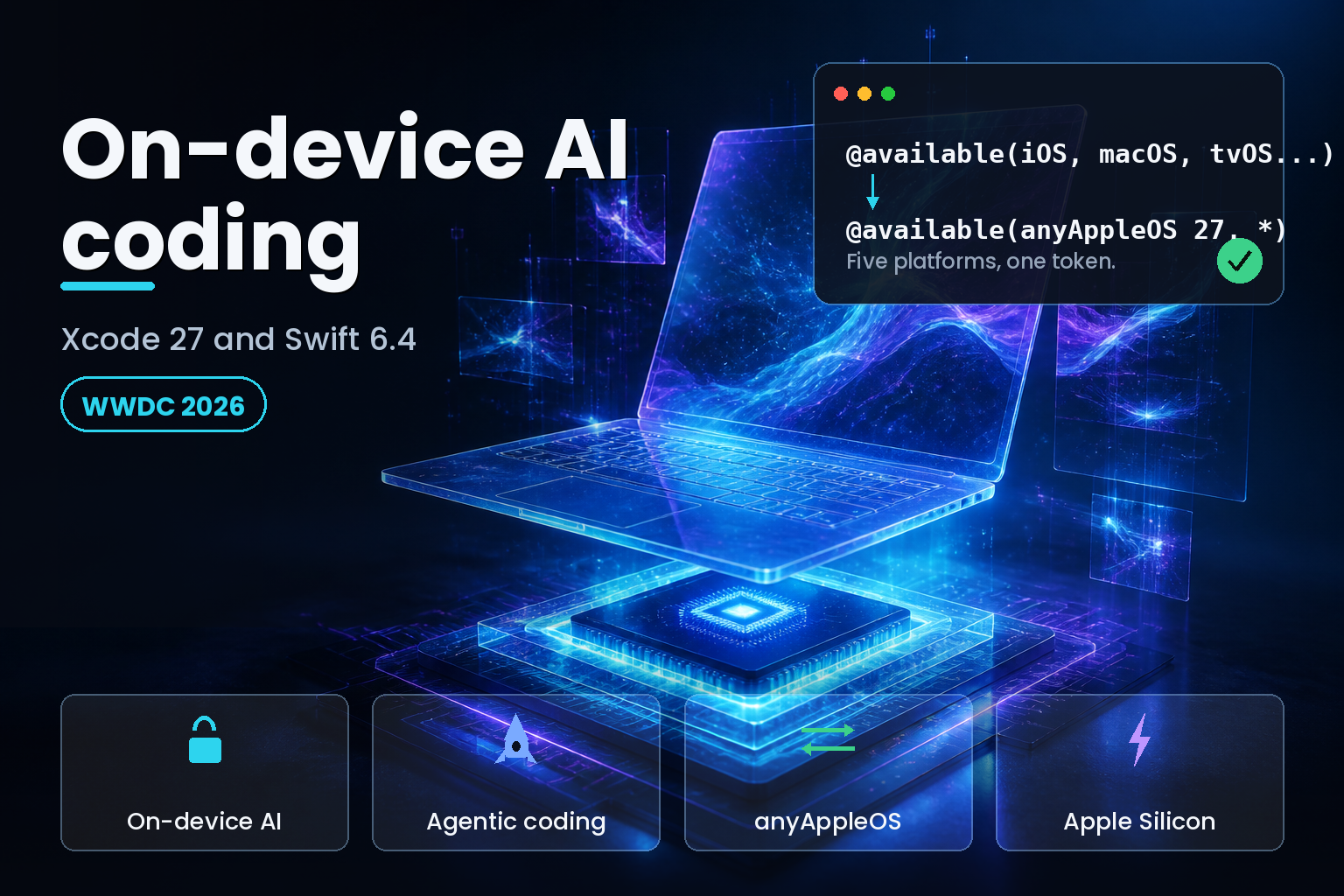
Summary. At WWDC 2026, Apple shipped Xcode 27 and Swift 6.4 in June 2026. The headline change: Xcode 27 runs inline AI code completion entirely on-device, on the Apple Silicon Neural Engine, so your source code never leaves the machine and adds $0 in cloud API cost, ₹0 per token. Xcode 27 is the first release to run only on Apple Silicon, and its app binary is 30 percent smaller than Xcode 26. Swift 6.4 is a smaller, backwards-compatible language update built around ergonomics: anyAppleOS, async defer, and cheap iteration over noncopyable types. This guide covers the six changes that actually affect how iOS and Swift developers work, and what to check before you upgrade.
Xcode 27, in one line: the AI moved on-device
The biggest shift is where the model runs. Inline code completions in Xcode 27 execute on a local, Neural Engine-tuned model on your Apple Silicon Mac. No source code is transmitted to any server. The model gives real-time code and documentation suggestions specific to your active Swift project and Apple SDK structure, and it does it with no per-token cloud bill.
That single decision changes the calculus for teams that could not send code to a third-party completion service for security or contract reasons. On-device completion sidesteps the data-egress question entirely.
Susan Prescott, Apple's vice president of Worldwide Developer Relations, framed the release this way: "Developers are at the heart of the Apple ecosystem, and our goal is to provide them with the best possible tools and technologies to build the future. With new intelligence frameworks and agentic coding in Xcode 27, developers have the tools they need to focus on what they do best: bringing their incredible ideas to life."
Agentic coding and the new Device Hub
Xcode 27 also brings coding agents into the editor, and it brings the best current models from Anthropic, Google and OpenAI directly into the workflow for the heavier work the on-device model does not handle.
What makes the agent useful rather than a novelty is that it can validate its own work. It can write and run tests, try ideas in isolation with Playgrounds, check visual changes with previews, and interact with the simulator through the new Device Hub. That closed loop lets an agent run autonomously for longer without a developer babysitting each step. The redesigned toolbar adds a dedicated coding-agent entry point and reorderable controls.
Foundation Models and Core AI: swap providers without rewrites
The Foundation Models framework is now a unified Swift API. It supports on-device models with image input, server-side model access, and custom skill development. Through a new language model protocol it also supports third-party models, including Claude and Gemini, and it adds Dynamic Profiles that update model behavior without shipping an app update.
The practical win is provider flexibility: you can move between Apple's on-device model and external models behind one API, which keeps model choice out of your business logic. This is the same multi-provider direction we covered in the iOS 27 Foundation Models any-provider guide and the Apple Foundation Models v3 API for Swift developers. Core AI, the layer beneath, is tuned for the unified memory and Neural Engine of Apple Silicon and lets you deploy full-scale LLMs locally, extending the on-device direction of the Core AI framework that replaced Core ML.
Swift 6.4: three language changes worth your time
Swift 6.4 is deliberately small and backwards compatible with Swift 6.x code; none of the new features are breaking changes. Three additions earn their keep.
First, anyAppleOS collapses platform availability. A single shorthand replaces all five platform names in an @available attribute or #if condition.
            // Before Swift 6.4
@available(iOS 27, macOS 27, tvOS 27, watchOS 27, visionOS 27, *)
func newFeature() { }

// Swift 6.4
@available(anyAppleOS 27, *)
func newFeature() { }
Second, async defer. Asynchronous code now works inside a defer block, so cleanup runs whether a function returns or throws, without spawning a detached task or duplicating the call.
            func process() async throws {
    let handle = try await open()
    defer { await handle.close() }   // async cleanup now allowed
    try await handle.work()
}
Third, cheaper iteration over noncopyable types. Swift 6.4 adds an Iterable protocol alongside Sequence. The difference is ownership: Sequence copies elements out of the collection, while Iterable borrows them. That matters for noncopyable types such as Span and InlineArray, where copying is prohibited or expensive.
What changed, and why it matters
| Change | What it does | Why it matters |
|---|---|---|
| On-device completion | Inline suggestions run on the Neural Engine | Source code never leaves the Mac; no cloud bill |
| Agentic coding + Device Hub | Agents run tests, previews and the simulator | Longer autonomous runs, less manual driving |
| Foundation Models protocol | One API over Apple, Claude and Gemini models | Swap providers without touching business logic |
| anyAppleOS | One token for five platforms in @available |
Less availability boilerplate to maintain |
| async defer | await allowed in defer cleanup |
Reliable async resource cleanup on any exit |
| Apple Silicon only | Xcode 27 drops Intel Macs | 30% smaller binary, faster setup, no Intel builds |
Should you upgrade, and what to check
For most teams, yes, but plan two things. First, hardware: Xcode 27 runs only on Apple Silicon, so any remaining Intel Mac in the build fleet or CI pool needs replacing before you move. Second, the language migration is low risk because Swift 6.4 is backwards compatible with 6.x, so the upgrade is mostly opt-in adoption of the new syntax rather than a forced rewrite.
The real payoff is not a single feature. It is that the routine parts of iOS work, availability annotations, async cleanup, and first-draft code, now take fewer keystrokes and less cloud dependency. The on-device shift is the durable part: it removes a data-governance objection that used to block AI completion in security-sensitive shops.
India-specific considerations
For Indian studios and in-house teams, two points stand out. The on-device model means client source code stays on the developer's Mac, which is easier to reconcile with India's data-protection rules and with client contracts that forbid sending code to overseas cloud services. And the cost structure is friendly: on-device completion adds ₹0 in per-token cloud spend, so a team can adopt AI assistance without a recurring dollar-denominated API bill. The one real cost is hardware, since the Apple Silicon-only requirement may force Mac upgrades for teams still on older machines.
FAQ
How eCorpIT can help
eCorpIT is a Gurugram-based, CMMI Level 5 technology consultancy with senior iOS and Swift teams. We help studios move to Xcode 27 and Swift 6.4 cleanly: planning the Apple Silicon transition, adopting on-device completion where code cannot leave the building, and wiring Foundation Models so provider choice stays out of business logic. For a migration and iOS delivery plan, contact our team.
References
_Last updated: July 9, 2026._