On this page · 10 sections
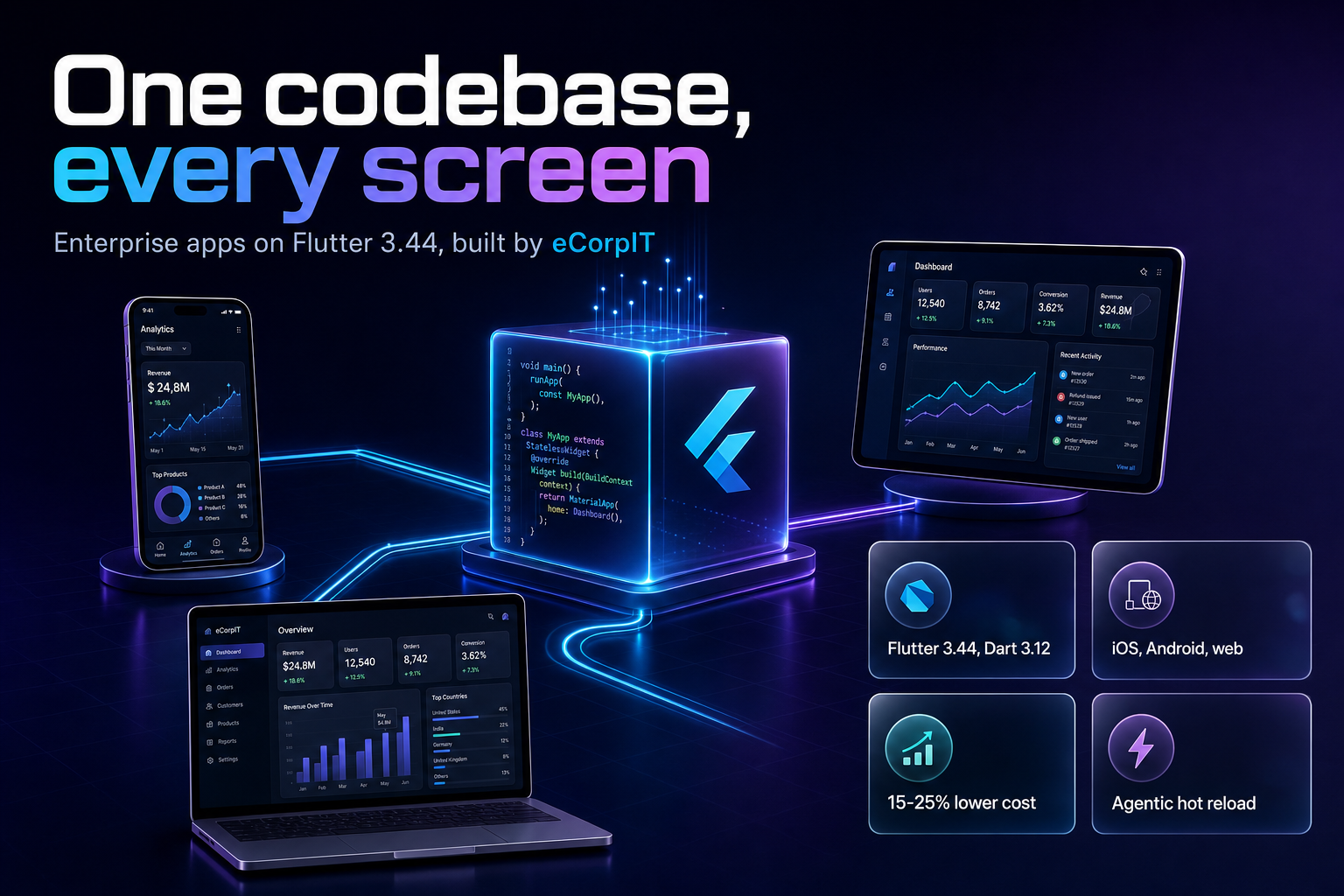
Summary. Flutter 3.44 arrived at Google I/O 2026 alongside Dart 3.12, and it makes cross-platform a stronger enterprise choice than ever: agentic hot reload lets AI coding agents edit and reload a running app, Widget Previews cut IDE memory by up to 50%, and Impeller gained better Vulkan support. The business case is cost. In India in 2026, a Flutter MVP starts around ₹2,00,000 against ₹3,00,000 for React Native, and Flutter runs about 15 to 25% cheaper at every tier because its own rendering engine removes the JavaScript-bridge debugging and platform-specific QA that React Native needs. eCorpIT, a Gurugram consultancy founded in 2021, builds and ships enterprise Flutter apps end to end. This article covers what changed in 3.44, how Flutter compares for enterprise work, what a build costs, and how we deliver it.
If you need one app on iOS, Android, web and desktop, the question in 2026 is not whether to go cross-platform but which framework carries the least hidden cost. Flutter 3.44 widened its lead on that measure, and the savings are largest on exactly the enterprise apps that used to justify going native. Here is the detail, the comparison, the pricing, and our process.
What Flutter 3.44 changed
The headline is AI in the loop. Agentic hot reload lets a Model Context Protocol server and coding agents connect to a running Dart or Flutter app, so when you prompt an agent to change the UI, it writes the code and triggers the hot reload automatically, per the Flutter 3.44 release notes. Widget Previews now lean on the Dart Analysis Server instead of spinning up a full simulator, cutting IDE memory use by up to 50%, per the same release. Impeller gained improved Vulkan support, the Skia backend is being removed for Android 10 and above, Swift Package Manager is the new iOS and macOS default, and DevTools now uses WASM by default, as the engineering write-up details.
| Flutter 3.44 feature | What it does | Who benefits |
|---|---|---|
| Agentic hot reload | AI agents edit and hot-reload a running app | Teams using AI-assisted development |
| Widget Previews on Analysis Server | Up to 50% less IDE memory | Developers on large apps |
| Impeller Vulkan improvements | Smoother rendering, Skia removed on Android 10+ | End users, performance-sensitive apps |
| Swift Package Manager default | Modern iOS and macOS dependency management | iOS and macOS builds |
| DevTools on WASM | Snappier, more responsive tooling | Everyday development |
| Dart 3.12 | New language features alongside the release | All Flutter teams |
Flutter versus React Native for enterprise
Both frameworks are strong in 2026, and the gap is smaller than it once was. The deciding factor for most enterprise builds is cost of ownership, and Flutter wins it because its own rendering engine avoids the JavaScript-bridge debugging and platform-specific QA hours React Native always requires, per an India cost comparison. The honest exception: React Native is the right call when your team already works daily in JavaScript or React, because staff fit outweighs the cost gap, as a CTO decision framework argues.
| Dimension | Flutter | React Native |
|---|---|---|
| Rendering | Own engine (Impeller) | Native components via bridge |
| Typical cost in India | 15 to 25% lower | Higher on QA and debugging |
| Best fit | New apps, UI-heavy, performance | Teams already fluent in JavaScript |
| Desktop and web | Strong single codebase | Weaker desktop story |
| Language | Dart | JavaScript or TypeScript |
What an enterprise Flutter build costs in India
Pricing scales with complexity, and the Indian market has clear 2026 bands. A Flutter MVP starts around ₹2,00,000, a mid-complexity app runs about ₹5,00,000 to ₹15,00,000, and an enterprise-grade app sits at ₹15,00,000 to ₹25,00,000 or more, per 2026 India cost data. React Native runs higher at each band, which is the cost-of-ownership gap in rupees.
| Project tier | Flutter (India, 2026) | React Native (India, 2026) |
|---|---|---|
| MVP | From about ₹2,00,000 | From about ₹3,00,000 |
| Mid-complexity | ₹5,00,000 to ₹15,00,000 | ₹6,00,000 to ₹18,00,000 |
| Enterprise-grade | ₹15,00,000 to ₹25,00,000+ | ₹16,00,000 to ₹28,00,000+ |
A note on reading these: the range inside a tier is real, driven by integrations, custom UI and backend work, so the honest answer to "what will it cost" is always after a scoping conversation, not before.
How eCorpIT builds Flutter apps
eCorpIT is a Gurugram-based technology consultancy, founded in 2021, CMMI Level 5 and MSME certified, with partners including AWS, Microsoft and Google. Our mobile work is senior-led and multi-disciplinary, not a junior pool: architecture, build, QA and release handled by engineers who have shipped production Flutter. We start with a scoping and architecture phase to fix the real cost drivers, build on Flutter 3.44 with a tested CI and release pipeline, and design data handling aligned with Digital Personal Data Protection Act, 2023, requirements from the first sprint rather than bolted on later. For the deeper feature view, see our write-up on the Flutter 3.44 widget previewer and AI tooling, and for planning, our enterprise mobile app development guide.
Who it is for
Flutter with a senior team fits businesses that need one app across iOS, Android and web without paying to build and maintain two or three native codebases. It suits founders shipping a first product, and established firms replacing an aging native app or an unstable React Native one. If your engineering team already lives in JavaScript and has no appetite to adopt Dart, React Native may fit better, and we will say so. Choosing a partner matters as much as the framework, which we cover in how to choose a mobile app development company.
India-specific considerations
Three points shape an Indian build. Cost is in rupees and Flutter's 15 to 25% edge compounds across the app's life, not just the first release. Data handling must be aligned with the Digital Personal Data Protection Act, 2023, from the start, especially for apps that collect personal data or use payments. And reach matters: Indian apps often need multiple languages, low-end device performance and offline behaviour, all of which Flutter's single codebase and own rendering engine handle well. For a global cost view, see our comparison of India versus US app development cost.
The bottom line
Flutter 3.44 made a strong cross-platform framework stronger, with AI-assisted development, lower IDE memory and better rendering, while keeping the cost advantage that matters most to enterprise buyers. For a new or replacement app that must run everywhere, Flutter is usually the cost-smarter, performance-stronger choice, and the exception is a team already committed to JavaScript. eCorpIT builds these apps with senior engineers and DPDP-aligned data handling from day one. The framework is decided by your workload; the outcome is decided by who builds it.
FAQ
How eCorpIT can help
eCorpIT is a Gurugram-based technology consultancy, founded in 2021, CMMI Level 5 and MSME certified, with senior-led mobile and cloud teams and partnerships across AWS, Microsoft and Google. We build enterprise Flutter apps on Flutter 3.44 for iOS, Android, web and desktop, with DPDP-aligned data handling and a tested release pipeline, at India-competitive rates. If you are planning a new app or replacing an aging one, talk to us for a scoping conversation.
References
_Last updated: July 11, 2026._