On this page · 10 sections
- The 5 checks at a glance
- Check 1: Audit device and Apple Intelligence tiers
- Check 2: Confirm MDM and Declarative Device Management
- Check 3: Test critical apps on the July public beta
- Check 4: Plan the App Intents move for Siri AI
- Check 5: Resolve privacy, security, and regional compliance
- A realistic 90-day timeline
- FAQ
- How eCorpIT can help
- References
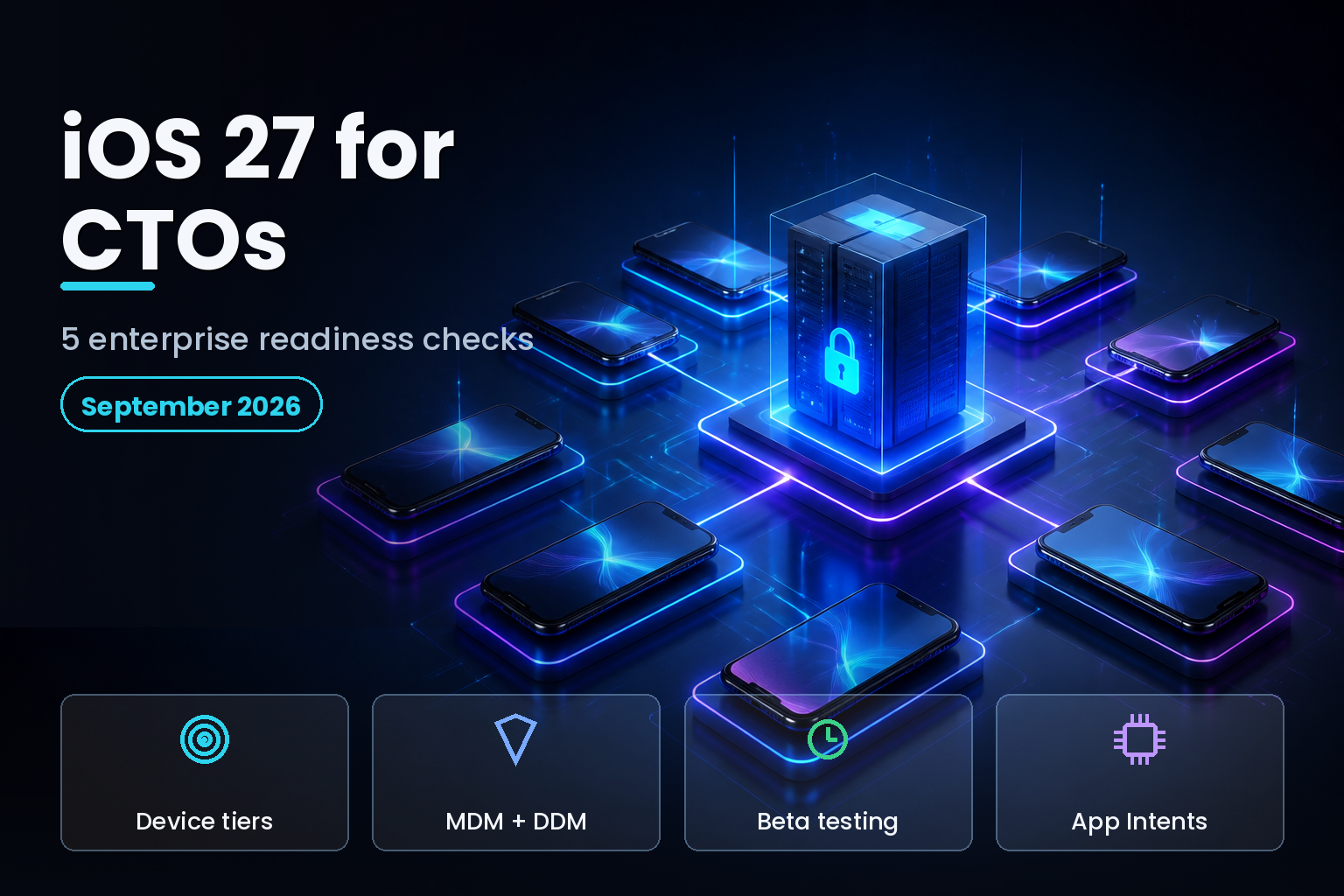
Summary. iOS 27 reaches the public in September 2026, with a public beta already due in July 2026 and a developer beta that opened on June 8, 2026. For a fleet of managed iPhones, the rollout is not a single toggle. There are 5 checks worth closing before employees tap update: audit which devices get iOS 27 and which get Apple Intelligence, confirm your MDM supports Declarative Device Management for update enforcement, test critical apps on the July beta, plan the mandatory App Intents move so Siri AI can still find your apps, and resolve regional compliance, starting with the European Union, where the new Siri AI is delayed. Two facts frame the planning: Apple Intelligence needs an iPhone 15 Pro or newer, and the rebuilt Siri runs on a custom Google Gemini model that Apple licensed for a reported $1 billion per year, according to Business Standard. This checklist turns those facts into owners and deadlines.
The 5 checks at a glance
Each check below maps to a section with the detail, the source, and the action. Assign an owner and a date to each before the September 2026 release.
| # | Check | What to verify | Target date |
|---|---|---|---|
| 1 | Device and AI tiers | Which devices run iOS 27; which run Apple Intelligence | July 2026 |
| 2 | MDM and DDM | Update enforcement via Declarative Device Management | July 2026 |
| 3 | App and compatibility testing | Critical apps validated on the public beta | August 2026 |
| 4 | App Intents and Siri AI | Customer apps migrated so Siri AI can find them | September 2026 |
| 5 | Privacy and compliance | EU Siri delay, DPDP and data governance resolved | Before rollout |
Check 1: Audit device and Apple Intelligence tiers
Start with an inventory, because iOS 27 splits your fleet into tiers. The base operating system supports iPhone 11 and every later model, plus the iPhone SE second and third generation, confirmed at WWDC 2026 and reported by 9to5Mac. The iPhone XS, XS Max, and XR do not make the cut, so any of those still in circulation need replacement or an exception.
The more important line is Apple Intelligence. Those features, including the receipt-scanning and Visual Intelligence flows, require an iPhone 15 Pro or newer, which in practice means the iPhone 15 Pro and Pro Max, and all iPhone 16 and iPhone 17 models, per Tom's Guide. Base iPhone 15 and 15 Plus units run iOS 27 but not Apple Intelligence. For a CTO, that distinction is a budget line: if your workforce needs the AI features, the refresh target is Apple Intelligence-capable hardware, and that spend belongs in the current fiscal plan rather than a surprise in Q4.
| Fleet tier | iOS 27 | Apple Intelligence | Recommended action |
|---|---|---|---|
| iPhone 17 and 16 (all) | Yes | Yes | Ready; prioritise for AI users |
| iPhone 15 Pro and Pro Max | Yes | Yes | Ready |
| iPhone 15, 15 Plus, 14, 13, 12, 11 | Yes | No | Update; refresh only if AI is needed |
| iPhone SE (2nd and 3rd gen) | Yes | No | Update; plan replacement cycle |
| iPhone XS, XS Max, XR | No | No | Replace before rollout |
Check 2: Confirm MDM and Declarative Device Management
The rollout mechanism matters as much as the devices. Since WWDC 2025, Declarative Device Management (DDM) is the standard for OS update enforcement, so confirm your MDM vendor supports it before you rely on a staged rollout, according to ManageEngine's WWDC 2026 device management summary. DDM lets you schedule and enforce the update rather than hope users tap it, and it is the clean way to hold a pilot group on iOS 27 while the rest of the fleet stays on the prior release.
iOS 27 also adds admin-side capability. Your MDM console can now detect the health status of critical hardware components, and you can collect sysdiagnose logs directly from the console once an AppleCare registration token is provided, so diagnostics flow to Apple's support infrastructure without manual steps, per the same source. Pair that with Apple Business Manager and Automated Device Enrollment for zero-touch setup, which Apple frames as getting a device from shrink-wrap to productive in about 60 seconds. Apple also launched a broader Apple Business Platform in April 2026, so check whether your management stack should consolidate onto it. The action here is concrete: verify DDM support, define a pilot ring, and stage the update rather than open the gates on day one.
Check 3: Test critical apps on the July public beta
The public beta in July 2026 exists so you do not test in production. Enroll a small pilot group through beta.apple.com or a managed configuration, then work through your critical apps: the internal line-of-business tools first, then the third-party apps your teams depend on. The costly surprise in an OS rollout is almost never the OS itself; it is the one internal app that assumed an API that quietly changed.
Give yourself the full window. The developer beta opened on June 8, 2026, the public beta arrives in July, and the stable release is expected around mid-September, in line with last year, when iOS 26 shipped on September 15, 2025, per 9to5Mac. That leaves roughly two months to log defects, get vendor fixes, and re-test. Track whether your critical apps pass on the beta, and keep the countdown visible; eCorpIT maintains a live iOS 27 countdown and a is it out yet reference for exactly this.
Check 4: Plan the App Intents move for Siri AI
If your company ships a customer-facing iOS app, this is the check with a real deadline. At WWDC 2026 Apple gave SiriKit a formal deprecation notice and made App Intents the path forward for the new Gemini-powered Siri AI, according to TechTimes. The consequence is blunt: if your app has not migrated to App Intents, the new Siri will not find it at all, not in a degraded state, but invisibly, as byteiota puts it.
There are two deadlines to hold in mind. The soft deadline is September 2026, when apps that have not migrated lose meaningful Siri discoverability and AI integration. The hard deadline, when SiriKit is removed, sits further out, around 2028 to 2029, since Apple signalled a two to three year support window. One useful exception for internal teams: enterprise apps distributed through MDM are not required to implement App Intents for visibility, so your purely internal tools can migrate on a slower schedule than your public app. For the customer app, treat App Intents as this quarter's work; our App Intents and Siri AI developer guide lays out the migration in detail.
Check 5: Resolve privacy, security, and regional compliance
The last check is where enterprise rollouts differ most from consumer ones. If you operate in the European Union, the new Siri AI is delayed there for iPhone and iPad because of a dispute over the Digital Markets Act, confirmed by Apple. EU-based staff will not get the dedicated Siri app, advanced Visual Intelligence, or the cross-app actions, so any workflow you were planning around Siri AI needs a non-EU assumption or a fallback. We break down the operational impact in our note on the EU Siri AI block for CTOs.
Data governance is the second half. The rebuilt Siri is built on Google's Gemini models, as Apple confirmed, so regulated industries should record where inference happens and whether that fits their data-residency posture. In India, the Digital Personal Data Protection Act 2023 (DPDP) treats precise location and personal context as sensitive, which is relevant given iOS 27's expanded location sharing and personal-context features. We design applications aligned with DPDP and equivalent requirements rather than claiming blanket compliance. The table below summarises the regional constraints.
| Region | Key constraint | What it affects |
|---|---|---|
| European Union | Siri AI delayed under the DMA | Siri app, Visual Intelligence, cross-app actions |
| India | DPDP treats location and context as sensitive | Location sharing, personal-context features |
| Regulated industries | Confidential-computing inference on Google Cloud | Data-residency and governance records |
| Global fleet | Mixed device tiers | Consistent feature availability across staff |
A realistic 90-day timeline
Read the checks as a sequence. In July 2026, close checks 1 and 2: finish the device audit and confirm DDM-based enforcement with a defined pilot ring. Through August, run check 3 on the public beta and drive vendor fixes. In September, land check 4 for your customer app before the stable release, and keep check 5 resolved throughout, since compliance is a gate, not a step. This ordering keeps a half-finished migration from stranding a workflow after employees have already updated.
FAQ
How eCorpIT can help
eCorpIT is a Gurugram-based technology consulting organisation with senior-led engineering teams that help CTOs and IT leaders turn an OS release into a staged plan. We run the device and Apple Intelligence tier audit, validate MDM and Declarative Device Management enforcement, test your critical apps against the July 2026 public beta, and scope the App Intents migration so Siri AI can still find your customer app. We design applications aligned with DPDP, GDPR, and equivalent requirements rather than claiming blanket compliance. To build your iOS 27 rollout plan, contact us or explore our mobile app development services.
References
- Apple Newsroom, Apple unveils next generation of Apple Intelligence, Siri AI, and more (June 2026).
- Apple Newsroom, Due to DMA, Siri AI delayed in EU for iOS 27 and iPadOS 27 (June 2026).
- ManageEngine, WWDC 2026: Apple's biggest device management updates (2026).
- MacRumors, Apple launches new all-in-one Apple Business Platform (14 April 2026).
- 9to5Mac, iOS 27: here are all the compatible iPhone models (8 June 2026).
- Tom's Guide, iOS 27 supported devices (2026).
- TechTimes, WWDC 2026: App Intents replaces SiriKit as Gemini Siri migration clock starts (8 June 2026).
- byteiota, SiriKit deprecated at WWDC 2026: migrate to App Intents now (2026).
- Business Standard, WWDC 2026: Apple unveils Siri AI, Gemini-powered Apple Intelligence (9 June 2026).
- 9to5Mac, Apple announces iOS 26 release date: September 15 (9 September 2025).
- MacRumors, Apple says iOS 27 adds these 12 new features to your iPhone (9 June 2026).
- TechCrunch, Every new iOS 27 feature that's worth knowing about (20 June 2026).
_Last updated: 2 July 2026._