On this page · 8 sections
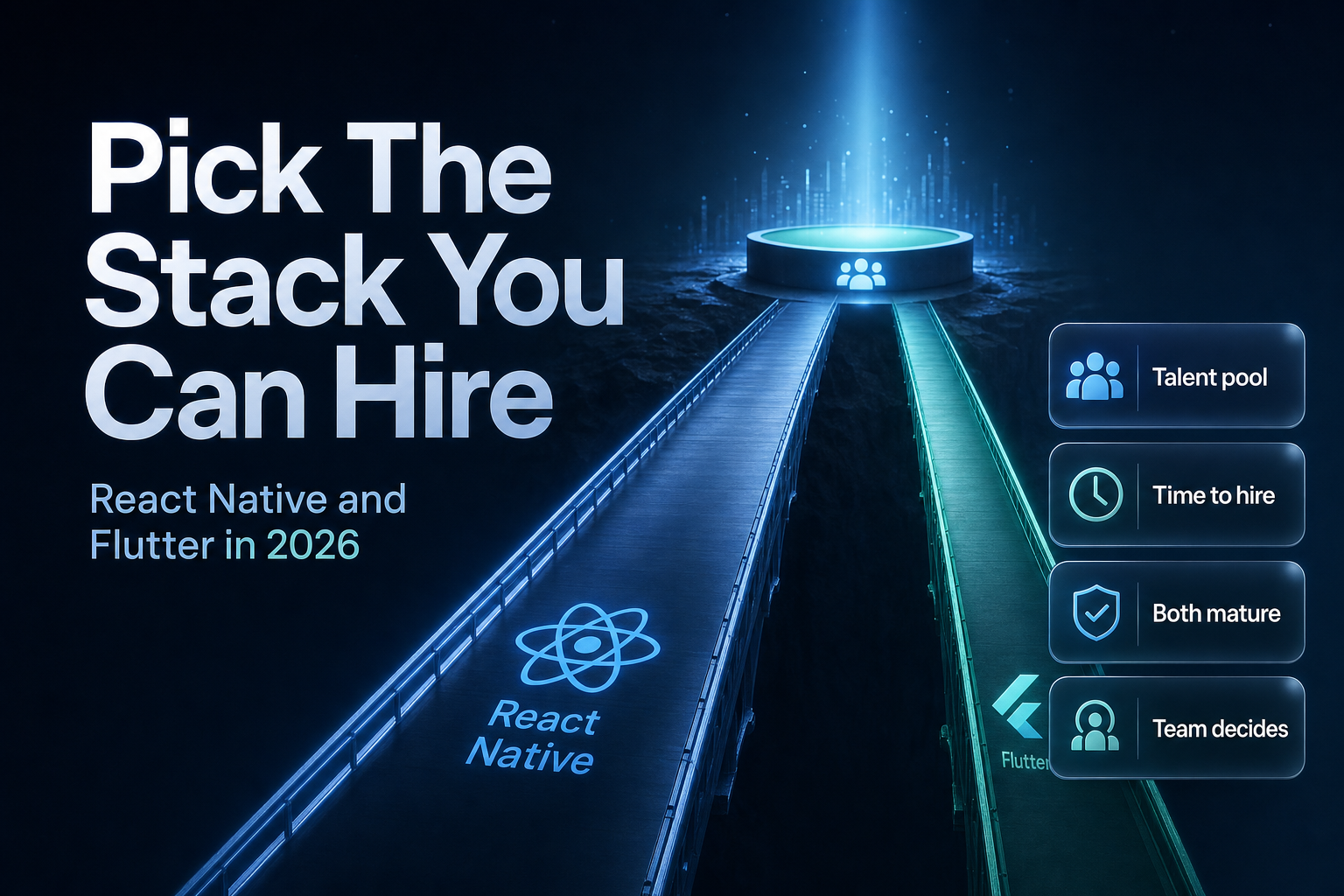
Summary. The talent pool for React Native developers runs roughly 10 to 15 times larger than the Flutter and Dart pool, and the job-posting gap is visible: about 6,413 US React Native postings on LinkedIn against 1,068 for Flutter, roughly 6x. A senior React Native hire in the US typically takes 4 to 8 weeks; the same Flutter hire runs 8 to 16 weeks and carries a 10% to 20% cost premium in most markets, with senior Flutter salaries at $135,000 to $180,000 against $125,000 to $160,000 for React Native. The performance argument that used to decide this is over. React Native's New Architecture has been the default since 0.76 in December 2024, and Flutter's Impeller has been default on iOS and Android since 3.27, using about 100MB less memory than Skia. For roughly 90% of mobile apps both frameworks perform well. When performance ties, hiring decides. And in India the hiring numbers point somewhere different than they do in San Francisco.
The performance argument is settled enough to stop using
Both frameworks got their long-promised architectural rewrites, and both landed.
React Native 0.76 shipped in December 2024 with the New Architecture enabled by default in all new projects. The JavaScript Interface lets JavaScript hold references to C++ objects directly, so data moves through memory references instead of JSON serialisation. Fabric handles rendering, TurboModules handle native calls. Recent releases ship with no way to switch back to the old setup, which tells you how settled the team considers it.
Flutter replaced Skia with Impeller, built for Flutter's specific needs, and it has been the default on both iOS and Android since 3.27. Impeller precompiles shaders at build time rather than runtime, which removed the frame drops on first-time animations that dogged Flutter for years. It uses roughly 100MB less memory than Skia did.
| Metric | React Native | Flutter |
|---|---|---|
| Architecture status | New Architecture default since 0.76, December 2024 | Impeller default on iOS and Android since 3.27 |
| Complex UI frame rate | About 51 FPS with Fabric | 58–60 FPS with Impeller; 120 FPS animations |
| Startup time | About 200ms faster | Slower on startup |
| Battery consumption | About 12% less drain | Higher drain |
| Memory | Higher than Flutter with Impeller | About 100MB less than the previous Skia engine |
| Verdict for most apps | Near-native for standard UIs | Excellent, particularly on animation |
Read that table honestly. Flutter wins on frames and memory. React Native wins on startup and battery. Neither margin decides a product. For roughly 90% of mobile apps both frameworks perform well, and the performance gap has narrowed to the point where it is a tiebreaker rather than a decision.
Which is why the interesting variable moved. If both build the app, the question is who builds it and how fast you can find them.
The hiring math
This is where the frameworks genuinely differ, and the gap is not close.
| Hiring metric | React Native | Flutter |
|---|---|---|
| Relative talent pool size | Roughly 10 to 15 times larger | The smaller pool |
| US job postings on LinkedIn | About 6,413 | About 1,068 |
| Time to hire, senior, US | 4 to 8 weeks | 8 to 16 weeks |
| Senior salary, US | $125,000–$160,000 | $135,000–$180,000, a 10–20% premium in most markets |
| Time to hire, mid-level | Four to five weeks for JS-layer hires | Longer |
| Nearshore alternative | Eastern Europe and Latin America at 40–60% of US rates, with time zone overlap | Thinner outside South Asia |
Doubling your time-to-hire is not a footnote. A Flutter senior taking 8 to 16 weeks instead of 4 to 8 means a role open for an extra quarter, and on a small team one unfilled senior role is the roadmap. Add a 10% to 20% salary premium and Flutter costs more per engineer and takes longer to find in most Western markets.
The reason is supply, not quality. Flutter developers command higher salaries because demand outpaces the talent supply, which is a scarcity signal rather than a skill signal. Paying more for a scarcer engineer is fine if the framework earns it. On a standard business app where both perform well, it does not.
The pool is also geographically lopsided in a way that matters. Roughly two thirds of GitHub's Flutter contributor activity comes from India, Brazil, Indonesia, Vietnam and Nigeria. Flutter talent is concentrated, and it is concentrated a long way from San Francisco.
Which sets up the part most comparisons miss.
In India the numbers point differently
If you are hiring in Bengaluru rather than San Jose, the global averages mislead you in both directions.
South Asia, and India specifically, has the single largest concentration of Flutter developers globally in 2026. The scarcity premium that makes Flutter expensive in the US is much weaker where two thirds of the contributor base lives. A Flutter role that takes 16 weeks in the US does not take 16 weeks in Bengaluru.
But React Native does not lose here either. React and React Native developers are still about 3x more numerous than Flutter developers in India in 2026. The pool ratio narrows sharply from the global 10-to-15x. It does not invert.
| Market | Mid-senior monthly cost | Note |
|---|---|---|
| India | ₹85,000–₹2,20,000 | Largest Flutter concentration globally; RN devs still about 3x more numerous |
| Eastern Europe | ₹1,40,000–₹3,50,000 | Strong React Native supply, useful time zone overlap with Europe |
| Latin America | ₹1,30,000–₹3,00,000 | React Native at 40–60% of US rates with US time zone overlap |
| United States | ₹5,00,000–₹12,00,000 | Deepest React Native pool, longest Flutter timelines |
| Indian tier-2 cities | 30–40% below Bengaluru | Lucknow, Indore, Coimbatore, Kochi and Bhubaneswar produce strong Flutter engineers |
Flutter developers in India run ₹40,000 to ₹2,50,000 per month across tiers, and Glassdoor listed 265 open React Native and Flutter roles in India in June 2026. The tier-2 line is the one most teams have not priced: strong Flutter engineers at 30% to 40% below Bengaluru rates, in Lucknow, Indore, Coimbatore, Kochi and Bhubaneswar. If your hiring plan only looks at Bengaluru and the NCR, you are paying a premium for a postcode.
The practical read: a US or European company should default to React Native on hiring grounds unless something specific argues otherwise. An Indian company, or one hiring an Indian team, can pick either on merit, because both pools are deep enough locally. That is the opposite of the advice most global comparisons give, and it follows from the same data.
When to override the hiring default
Four cases where the framework, not the pool, should decide.
Animation-heavy interfaces. Flutter's 58 to 60 FPS on complex UIs and 120 FPS animations against React Native's 51 FPS is a real gap, and on a product whose value is the interface, it is worth a longer hire.
Mid-range Android as the primary device. Impeller's roughly 100MB memory saving over Skia matters most on constrained hardware, which describes most of the Indian market. This one deserves weight in India specifically.
An existing React or TypeScript organisation. If your web team writes React, React Native shares the language, the idioms and often the people. Mid-level JS-layer hires land in four to five weeks partly because you already employ some of them.
Startup time and battery as product requirements. React Native's roughly 200ms faster startup and 12% lower battery drain are the kind of numbers that only matter when they matter, and then they matter a lot.
Notice what is not on that list: raw performance for a standard business app. Both clear that bar.
The maintenance cost nobody prices
One 2026 change belongs in this decision because it lands on Flutter teams this quarter.
Flutter froze Material and Cupertino contributions in flutter/flutter on April 7, 2026, and moved them to pub.dev as material_ui and cupertino_ui. The in-SDK copies are deprecated at the next stable release. The migration itself is mechanical, but it is real work across an app portfolio, and we walk through it in our material_ui and cupertino_ui migration guide. Flutter 3.44 also made Swift Package Manager the default for iOS and macOS builds, which is a larger job for projects with custom CocoaPods configuration.
React Native's equivalent already happened: the New Architecture became the default and recent releases removed the escape hatch, which we covered in React Native's New Architecture migration.
Both frameworks are asking teams to migrate in 2026. Neither is free. Price a migration quarter into whichever you choose, because the framework you pick is a maintenance commitment and not just a build decision.
FAQ
How eCorpIT can help
eCorpIT is a CMMI Level 5 certified technology organisation in Gurugram, and our senior engineering teams ship production apps in both React Native and Flutter. We pick the stack against your hiring market rather than a framework preference, and we run the 2026 migrations both frameworks are asking for. If you are choosing a cross-platform stack or inheriting one you did not choose, contact us and we will work through the trade-offs with your team's actual hiring constraints.
References
- Flutter vs. React Native in 2026: Why the New Architecture and Impeller 2.0 Changed Everything — Bolder Apps
- Flutter vs React Native in 2026 — Shorebird
- Flutter vs React Native: 46% vs 35% Market Share (2026) — Tech Insider
- Hire Flutter Developer India 2026: Real Pricing — Codingclave
- Flutter's Material and Cupertino code freeze — Flutter blog
- Flutter vs React Native in 2026: An Honest Comparison — Foresight Mobile
_Last updated: July 15, 2026._