On this page · 11 sections
- What macOS 27 Golden Gate is and when it shipped
- Siri AI on the Mac
- Apple Intelligence inside apps
- Design and performance refinements
- Child safety and parental controls
- Which Macs can run macOS 27 Golden Gate
- What IT teams should do before upgrading a fleet
- What developers should look at
- What India users get, and what they do not get yet
- How eCorpIT can help
- References
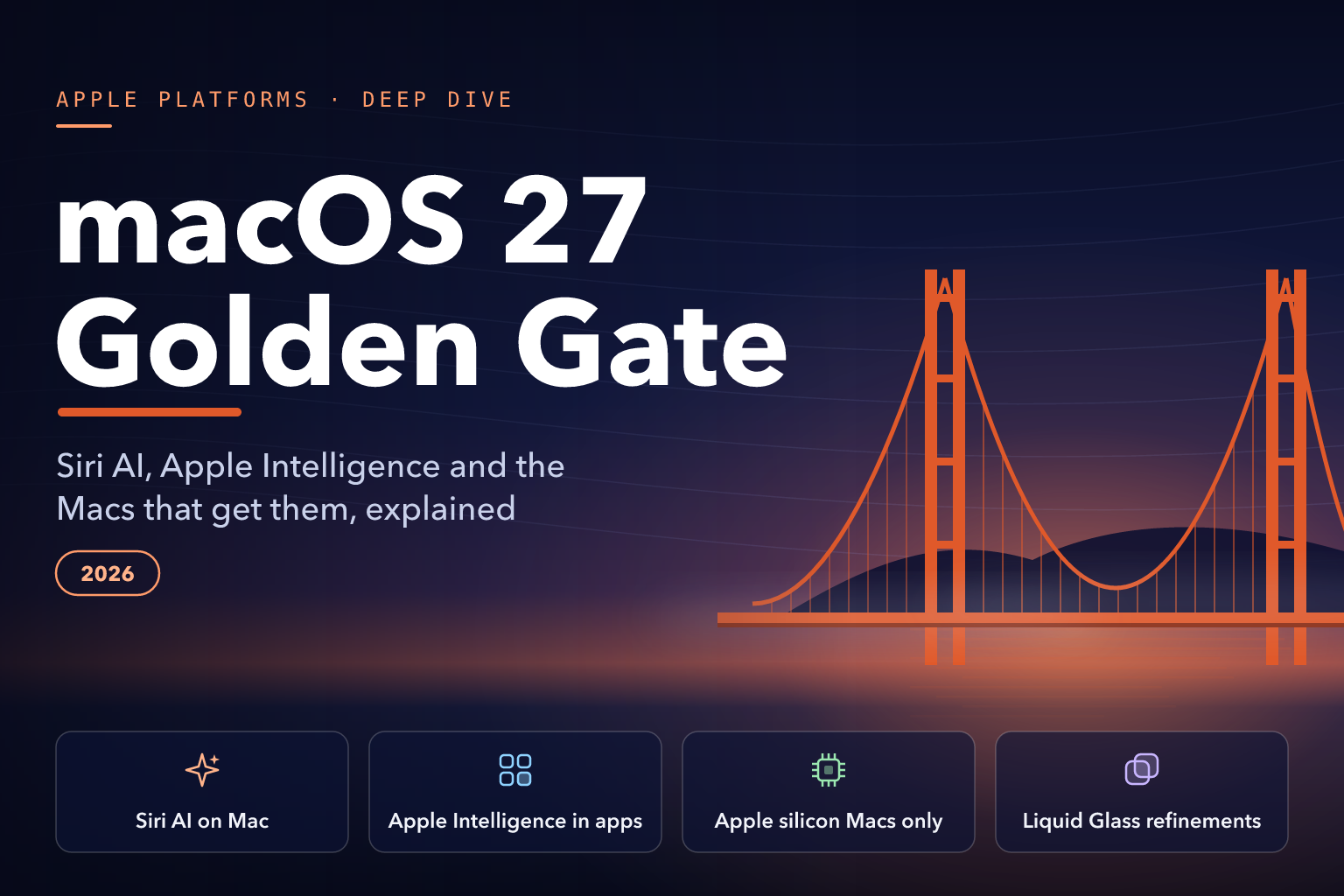
Summary. macOS 27 Golden Gate is Apple's new Mac operating system, version 27.0, and it brings the Siri AI beta and the next generation of Apple Intelligence to the Mac. Apple started rolling it out on 14 September 2026, the same day as iOS 27, iPadOS 27 and its other 27 releases, with Siri AI in English only at launch. It installs only on Macs with Apple silicon.
What macOS 27 Golden Gate is and when it shipped
Apple announced macOS 27 at WWDC26 on 8 June 2026, released developer betas that day, and promised the new features as a free software update in the autumn. On 14 September 2026, Apple Newsroom said Siri AI, new parental controls and other improvements were starting to roll out across iOS 27, iPadOS 27, macOS 27, watchOS 27, visionOS 27 and tvOS 27.
- The public release is macOS 27.0, build 26A428, according to Apple Developer's releases list. The first beta, 26A5353q, arrived on 8 June.
- Apple's security releases page lists "macOS Golden Gate 27" as released on 14 September 2026, alongside security updates macOS Tahoe 26.7 and macOS Sequoia 15.8.
- Apple uses two word orders: "macOS 27 Golden Gate" on consumer and upgrade pages, "macOS Golden Gate 27" on security and enterprise pages. Both mean the same release.
eCorpIT found no standalone macOS 27 press release. The Mac is covered inside cross-platform Newsroom posts, and apple.com/in/os/macos/ is the main consumer page for India. None of the Apple pages reviewed explains the Golden Gate name, though MacRumors reports new Golden Gate Sunset and Golden Gate Night wallpapers showing the San Francisco bridge.
Siri AI on the Mac
Apple's 14 September Siri AI announcement calls it an entirely new version of Siri, built on Apple Foundation Models "custom-built in collaboration with Google and its Gemini models".
What Siri AI does on a Mac
According to Apple's macOS page, Siri AI on the Mac:
- Appears in Spotlight, where you can choose "Ask Siri" as the top hit.
- Has a dedicated Siri app, so a conversation started on an iPhone can continue on a Mac.
- Uses personal context from photos, emails and notes, and takes actions in apps such as Messages, Music and Reminders.
- Drafts text wherever you type, and in Messages and Mail can match your writing style, punctuation and tone.
- Answers questions about a screenshot through Visual Intelligence with Siri. Apple's support page gives Visual Intelligence its own shortcut, Shift-Command-Space bar.
Beta, waitlist and English only
Siri AI ships as a beta, rolling out in English, with French, Japanese, Korean, Portuguese and Spanish due in October. Apple says it is not available to users under 13, and will not be offered in China while Apple works through regulatory requirements.
Access is gradual. After updating, open System Settings, click Siri, then Try Siri AI (Beta). Apple says this puts you on a waitlist with varying wait times, and Siri AI downloads automatically when your turn comes. Device language and Siri language must be the same supported language, and the Apple Account must be in an eligible region.
The EU is where Apple's pages disagree. The Newsroom post says Mac users in the EU can access Siri AI, with the initial EU exclusion covering iOS, iPadOS and watchOS. Apple's macOS feature-availability page lists Siri AI as not available in the European Union. Apple's Siri AI support page also allows it on macOS 27 for EU Apple Accounts with device and Siri language both set to English. eCorpIT treats the Newsroom and support wording as current, but EU teams should confirm on a test Mac.
Usage limits and a future fee
Apple says server-model features, including Siri AI, intelligent photo editing tools, Image Playground and AFM 3 Cloud models in Shortcuts, "are subject to daily usage limits". Apple's Usage Terms say a feature that hits its limit may become unavailable or limited until the limit resets. No limit numbers are published.
The paid side has shifted. In June, Apple said increased access came with most iCloud+ plans. In September, it said expanded access "will be available for a fee in the future", with no price or date. A 9 September Apple support page says limits will be implemented "in the future", so whether caps apply today is unclear. Our guide to iCloud+ tiers and Apple Intelligence limits tracks this.
Which Macs get which Siri AI features
Siri AI runs on MacBook Neo (A18 Pro) and any Mac with M1 or later. Apple's macOS page ties "Customise how Siri sounds" to Macs with M3 or later and at least 12GB of unified memory, and the Apple Intelligence page applies the same rule to improved Dictation. Apple's support documentation puts Apple Intelligence storage at up to 14 GB on those Macs and up to 8 GB on others. Apple's macOS feature-availability page also lists Siri AI's expressive voices only in English (United Kingdom) and English (United States).
| Mac | Siri AI | Voice customisation and improved Dictation | Storage needed |
|---|---|---|---|
| MacBook Neo (A18 Pro, 8GB) | Yes | No, on eCorpIT's reading | Up to 8 GB |
| Mac with M1 or M2 | Yes | No | Up to 8 GB |
| Mac with M3 or later, under 12GB | Yes | No | Up to 8 GB |
| Mac with M3 or later, 12GB or more | Yes | Yes | Up to 14 GB |
The MacBook Neo row is an inference: Apple's specs page lists 8GB of memory for both models, below the 12GB in Apple's footnote, but Apple does not spell out the consequence.
Apple Intelligence inside apps
Apple's macOS page also lists:
- Automatic tab grouping by topic in Safari, and Safari Notify Me, which watches pages for a price change or restock.
- Intelligent photo editing with Spatial Reframing, Extend and an enhanced Clean Up, marked "Usage limits may apply."
- Image Playground in more styles, including photorealistic, and Shortcuts built from a plain-language description, both with usage limits.
- Suggestions in Messages and Mail, Call Context during calls, event creation from a description in Calendar, and Enhanced Flyover in Maps.
Two items are not in 27.0. The Passwords app's "Fix passwords with a click", which updates weak or compromised passwords for you, is the only tile marked "Coming in a future software update", and a footnote says suggestions inside Messages conversations also come later. Apple gives no timing for either.
Design and performance refinements
Liquid Glass stays, refined. Apple lists uniform toolbars, edge-to-edge sidebars, updated window shapes and menu bar icons, and a slider that sets Liquid Glass from ultra clear to fully tinted. Apple claims quicker AirDrop transfers, faster network file browsing, faster Safari start page loading and a new relevance ranking for Mail search, without figures, so test before you repeat them.
Ultra wide displays can now run resolutions such as 5K at 120Hz, macOS remembers display arrangements, and Android or Windows users can join iCloud Shared Albums through iCloud.com.
Child safety and parental controls
With Ask to Browse, children must request access to new websites and parents review the request in Messages before approving; it works in Safari and other WebKit browsers after upgrading Screen Time. Communication Safety now intervenes before children see gore or violence in shared images and videos, and parental controls in System Settings are redesigned.
Which Macs can run macOS 27 Golden Gate
Apple's upgrade guide says macOS 27 "is compatible with any Mac with Apple silicon". The macOS page lists:
| Mac family | Models that can run macOS 27 |
|---|---|
| MacBook Neo | 2026 |
| MacBook Air | With Apple silicon, 2020 and later |
| MacBook Pro | With Apple silicon, 2020 and later |
| iMac | With Apple silicon, 2021 and later |
| Mac mini | With Apple silicon, 2020 and later |
| Mac Studio | 2022 and later |
| Mac Pro | With Apple silicon, 2023 |
| Intel-based Macs | Not listed |
What this means for Intel Macs
At WWDC26 Apple said "macOS Tahoe was the final release to support Intel Macs". Its deployment guide calls macOS 26 the last release with full support for Intel-based Macs and promises security updates for them for three years. Software Update offers only compatible updates, so Intel Macs will not be offered macOS 27. MacRumors names four Intel models that run Tahoe but not Golden Gate: the 13-inch MacBook Pro (2020, four Thunderbolt 3 ports), 16-inch MacBook Pro (2019), 27-inch iMac (2020) and Mac Pro (2019).
Rosetta still works, but check it after upgrading
Apple says Rosetta "will continue as a general-purpose compatibility tool through macOS 27". The release notes add that Intel-based software, except legacy games, will not be compatible with macOS 28.0. Two catches follow:
- A previously installed Rosetta is not restored after upgrading to macOS 27.0, and apps set to "Open using Rosetta" now launch natively. Apple's Rosetta support article gives
softwareupdate --install-rosettato reinstall it.
- Apple's messaging is inconsistent. A 9 September Apple Developer post said macOS 26 was "the final release supporting Intel Mac computers and Rosetta". eCorpIT follows the support documents and release notes, which agree Rosetta runs through macOS 27.
To list a Mac's Intel apps, open System Settings > General > About and click Details next to Intel-based Apps.
What IT teams should do before upgrading a fleet
Changes Apple documents for 27.0
- Split the fleet by chip. Intel Macs cannot upgrade. Record which Apple silicon Macs have M3 or later with 12GB or more.
- Move update control to declarative management. Legacy software update management "no longer functions in all 27.0 operating systems", including MDM commands and deferral restrictions. Old-style deferrals will not hold.
- Check TLS on management servers. MDM, declarative device management, enrolment, profile, app and software update traffic now needs TLS 1.2 or later with App Transport Security-compliant ciphers and certificates. Apple's TLS article exempts SCEP and content caching and suggests auditing from test devices on 26.4 or later but earlier than 27.
- Set a Siri AI policy first. Apple's support documentation says the next generation of Apple Intelligence is available automatically on eligible devices after updating. Device management can restrict Siri AI, Visual Intelligence and natural-language calendar editing. Apple's declarative device management documentation provides the
AllowSiriAIandAllowVisualIntelligencekeys for this, which Apple supports only on supervised Macs. The older restriction-payload keys for Apple Intelligence and Siri were deprecated in 26.4.
- Plan for Rosetta. Inventory Intel apps, reinstall Rosetta where needed, and use the
allowRosettaUsageAwarenessrestriction to hide Apple's deprecation notice.
- Rework privacy and app-control profiles. Granting Accessibility through a PPPC profile is removed, TCC profile keys give way to a Privacy key in com.apple.configuration.app.settings, and the com.apple.applicationaccess.new launch-control profile is deprecated in favour of Endpoint Security-based binary allow and deny lists on supervised Macs.
- Check agents and installers. Apps can no longer read the local TCC database directly, and
tccutil listreports privacy authorisations on managed Macs. Packages with no host architecture now default to arm64, and other teams' app containers are denied by default.
General good practice
These are eCorpIT's recommendations, not Apple requirements:
- Pilot with each Mac model and department first. Test VPN, endpoint security and printing, plus audio, Quick Look and Spotlight plug-ins, which Apple's release notes list among places to check for Intel code.
- Back up first, as Apple's upgrade guide recommends. Apple's Software Update advice also says not to let a Mac sleep or close its lid mid-install.
- Plan bandwidth. Each Mac downloads a multi-gigabyte update, so stagger the rollout or use content caching on the office network.
- Brief the helpdesk on the Siri AI waitlist, and hold the upgrade on managed Macs through declarative software update settings until the pilot passes.
Our iOS 27 enterprise rollout plan has a fuller template.
What developers should look at
Toolchain. Xcode 27 needs macOS Tahoe 26.6 or later, runs only on Apple silicon and includes Swift 6.4. The macOS 27 SDK can still back-deploy Universal apps to macOS 12, but with a deployment target of macOS 27.0, ARCHS_STANDARD drops x86_64. See our Xcode 27 and Swift 6.4 overview.
The Intel deadline. Intel-based software will not be compatible with macOS 28.0, apart from legacy games, so check plug-ins such as VSTs, HAL, ARA and PDEs now. Apple says Apple silicon-only binaries can now ship on the Mac App Store.
Design. Apple said at WWDC26 that apps recompiled with Xcode 27 lose the old-design opt-out and adopt Liquid Glass. Apps linked on the macOS 27 SDK hide menu item images automatically, and SwiftUI's FileDocument is deprecated in favour of ReadableDocument and Document. Our Liquid Glass migration guide covers the work.
Foundation Models. Apple says the on-device model changes with the 27 releases, so retest prompts. At WWDC26 it described a Private Cloud Compute model with a 32,000-token context window and reasoning, no token costs to developers and a daily limit per user. A footnote on Apple's macOS developer page says apps enrolled in the App Store Small Business Program with fewer than 2 million total first-time downloads can use that cloud model at no cloud API cost. Apple's usage-limits support page adds that developer apps using these cloud models will be subject to limits, with increased access for a fee. On-device features work offline "at no cost per request". See our Foundation Models utilities guide.
Siri AI. App Intents schemas connect Mac apps to Siri AI, and the View Annotations API lets Siri act on what is on screen. Entities using @AppEntity(schema: .photos.asset) might not compile with the 27 SDKs. Our Siri AI and App Intents prep guide goes deeper.
Mac apps can also adopt the ManagedApp framework and App Attest on macOS 27.
What India users get, and what they do not get yet
India is on the global schedule. Apple's India Newsroom ran the 14 September article with the same wording, and eCorpIT found no India-specific availability statement.
What India gets:
- macOS 27 on every compatible Apple silicon Mac, with Siri AI in English, subject to the waitlist and usage limits.
- English (India), as reported by MacRumors, which lists it among Siri AI's supported English variants. Apple's Siri AI pages say only "English" without listing variants, and its Visual Intelligence footnote asks for "a supported English variant", so set device and Siri language to the same variant.
What India does not get yet:
- Any Indian language. Apple Intelligence supports 16 languages, none of them Indian, and no Apple page gives a date for Hindi.
- Clarity on two features. The India macOS page marks Suggestions and Call Context "Coming in English." The US macOS page and India Apple Intelligence page call Suggestions "Available in English". Apple's macOS feature-availability page lists both Suggestions and Call Context in English (India). Test before promising either to users.
- Siri AI's expressive voices in English (India). Apple's feature-availability page lists them only in English (United Kingdom) and English (United States).
- A rupee price for expanded Apple Intelligence access.
For buyers, Apple's India store lists MacBook Neo from ₹79,900 (256GB) and ₹89,900 (512GB with Touch ID), MRP inclusive of taxes, against $699 to $799 in the US. It runs Siri AI, but its 8GB of memory is below the 12GB Apple requires for voice customisation and improved Dictation, so AI-heavy teams should weigh M3 or later Macs with 12GB or more.
How eCorpIT can help
eCorpIT is a Gurugram-based technology organisation, founded in 2021, assessed at CMMI Level 5 and MSME certified, with senior-led engineering teams working across AWS, Microsoft and Google platforms. For macOS 27, we test business-critical Mac apps, installers and plug-ins on Apple silicon with and without Rosetta, so you know what breaks before macOS 28 arrives. We add App Intents schemas and Foundation Models features so your Mac app works with Siri AI, and we plan fleet upgrades around declarative software update management, TLS checks on management servers and a clear Siri AI policy. Talk to us at /contact-us/.
Last updated: 15 September 2026.