On this page · 9 sections
Summary. Running an application on an end-of-life framework is now the most common way in. IBM's Cost of a Data Breach report puts the global average breach at $4.44 million, and $10.22 million in the United States, and finds that vulnerability exploitation triggers 31% of breaches, the top initial-access vector for the first time in the report's history. Meanwhile the ground keeps moving under production stacks: Node.js 18 has been end-of-life since April 2025 and Node.js 20 reached end-of-life on April 30, 2026; Next.js 15 drops out of support on October 21, 2026, while Next.js ships security patches monthly, with the July 2026 release alone fixing 4 high and 5 medium-severity issues. React Native, Flutter, and iOS each force a migration this year. If your team is a version or two behind on any of these, you are shipping unsupported, unpatched code. This playbook lays out what is actually going out of support, what the forced migrations are, and how eCorpIT modernizes a stack without stopping your roadmap.
Most teams do not fall behind through neglect. They fall behind because upgrades compete with feature work, and the upgrade always loses until something breaks or an audit flags it. By then the jump is two or three major versions, the migration is harder, and the security exposure has been live for months. Modernization is the work of closing that gap deliberately, before it closes itself the expensive way.
The real cost of a stale stack
An end-of-life framework does not just miss new features. It stops receiving security patches entirely, which is the part that turns a maintenance backlog into a breach risk. IBM's finding that vulnerability exploitation now starts 31% of breaches, ahead of stolen credentials at 13%, means unpatched software opens more than twice as many doors as leaked passwords. The same report notes that breaches taking longer than 200 days to contain cost $5.01 million on average, against $3.87 million for faster ones, and old dependencies are exactly the kind of weakness that sits undetected.
For a business, the exposure is concrete: a payment flow on an unsupported Node.js runtime, a customer portal on a Next.js version past its support window, a mobile app that will not build against the current SDK. None of these show up in a feature demo. All of them show up in a penetration test, a compliance review, or an incident. Modernization moves the cost from an unplanned incident to a planned engagement.
Is your stack still supported?
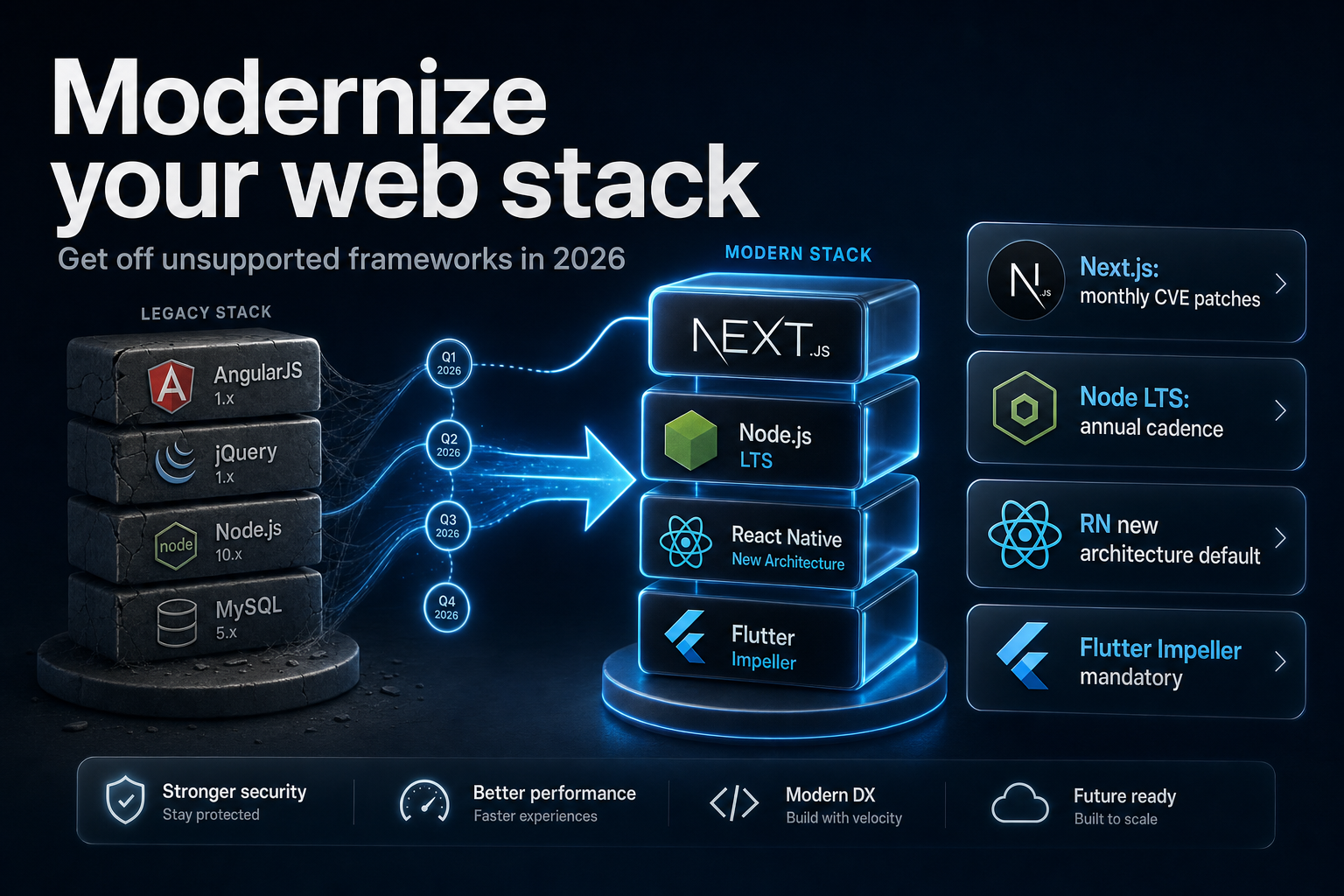
Support status is not a matter of opinion. Each framework publishes its dates, and the table below maps the current supported lines as of July 2026 against the versions that have already fallen out.
| Stack | Supported line (2026) | Out of support | Risk if you are behind |
|---|---|---|---|
| Node.js | 22 LTS, 24 LTS, 26 (July 2026) | 18 EOL April 2025; 20 EOL April 30, 2026 | No security patches at all |
| Next.js | 16.x Active LTS | 15 ends October 21, 2026; 14 and older EOL | Unpatched CVEs, monthly advisories missed |
| React Native | New Architecture is the default | Legacy architecture being removed | Upgrades break; libraries drop support |
| Flutter | Impeller renderer mandatory | Skia fallback removed | Rendering and performance regressions |
| iOS apps | Xcode 26 and the iOS 26 SDK | Older SDK uploads rejected since April 28, 2026 | Cannot ship to the App Store |
Vercel's support policy is explicit that a Next.js major stays in Maintenance LTS for two years after release, receiving only critical fixes and essential security updates, which is why Next.js 15 ends on October 21, 2026, two years after it shipped. Node.js is stricter still: even-numbered majors get 12 months of Active LTS and 18 months of maintenance before end-of-life. If you are reading this on Node.js 20, your runtime is already unsupported.
The forced migrations of 2026
Some upgrades are optional. This year's are not, because the frameworks are removing the old path, not just adding a new one. This is the list our engineering teams see most often, and each has a dedicated deep-dive.
Next.js 16 turned request APIs asynchronous and reworked caching, so an app moving off 15 has real code changes, not a version bump, as covered in our Next.js 16 migration guide. Next.js also moved to a monthly security-release cadence, which means a supported app now has a standing monthly patch task rather than an occasional one, detailed in the Next.js July 2026 security release writeup. React Native made its New Architecture the default and is retiring the legacy one, a migration that touches native modules and third-party libraries, which we break down in the React Native New Architecture migration guide. Flutter made the Impeller renderer mandatory and removed the older Skia fallback. On iOS, apps built with the iOS 27 SDK must adopt the UIScene lifecycle or they will not launch, and the App Store submission floor already sits at Xcode 26 and the iOS 26 SDK.
Node.js adds a scheduling change on top of the version treadmill: from October 2026 it moves to one major release per year with version numbers aligned to the calendar, and every release becoming long-term support. That simplifies planning going forward, but it does not rescue anyone still sitting on an already-EOL line today.
What modernization actually involves
Modernization done well is not a big-bang rewrite. It is a sequenced reduction of risk, and the sequence matters more than the speed.
The first step is an application portfolio analysis: inventory every service, its framework and version, its support status, and its exposure. The second is prioritisation by risk, not by age. An EOL runtime behind a public login page is a different urgency from an internal tool two minor versions behind. The third is phased migration, upgrading one bounded piece at a time behind tests, so the application keeps shipping while the stack moves underneath it. The fourth is verification: automated tests, a security review, and a dependency audit that confirms nothing regressed and nothing else is quietly out of date. Done this way, modernization is a series of small, reversible steps rather than one high-risk cutover.
This is also where technical-debt quantification earns its place. Putting a number on the cost of staying behind, in patching effort, incident risk, and slower delivery, is what turns "we should upgrade eventually" into a funded plan. We apply the same modernization patterns described in our application modernization patterns reference.
Build the catch-up in-house, or bring in a senior team?
Teams can absolutely do this work themselves. The question is whether the recurring cost of doing it between feature deadlines is lower than a scoped engagement that clears the backlog and hands the stack back current and documented.
| Factor | In-house, between features | eCorpIT modernization engagement |
|---|---|---|
| Time to market | Slow; upgrades lose to the roadmap | Dedicated senior team, phased delivery |
| Upfront cost | Hidden in a delayed roadmap | Scoped to the audit findings |
| Maintenance overhead | Recurs every release, often skipped | Brought current, with a patch cadence set |
| Data control | Full | Full; you retain code and ownership |
| Security posture | Ad hoc, EOL versions linger | Unsupported versions removed first |
eCorpIT is ISO 27001:2022 certified, which matters when the work is fundamentally a security and reliability exercise. We design applications aligned with DPDP Act 2023 requirements where the modernization touches personal data, and we hand back a stack that is current, tested, and documented, not a black box.
India-specific considerations
For Indian startups and SMBs, the modernization gap is often widest, because early product velocity left little room for maintenance and lean teams carry no dedicated platform function. The exposure is the same as anywhere, but the DPDP Act 2023 raises the stakes on the data-handling side: an unsupported runtime processing personal data is both a security risk and a compliance one. Budgeting in rupees, the choice is between a planned modernization engagement and the unplanned cost of an incident on an EOL stack, which, on IBM's global average of $4.44 million, is not a number most Indian SMBs can absorb. For teams weighing a rebuild against an upgrade, our React Native versus Flutter hiring decision framework and custom web application development work through the trade-offs.
FAQ
How eCorpIT can help
eCorpIT is a Gurugram-based, senior-led engineering organisation, founded in 2021, CMMI Level 5 and ISO 27001:2022 certified, and a partner of AWS, Microsoft, and Google. We modernize aging web and mobile stacks: we audit your application portfolio and its support status, prioritise by risk, migrate in tested phases off end-of-life Next.js, Node.js, React Native, and Flutter versions, and hand the stack back current, documented, and on a patch cadence. If your runtime is past its support window or a migration is blocking your roadmap, talk to our engineering team about a scoped modernization plan.
References
- Cost of a data breach 2026: IBM benchmarks — global average $4.44M, vulnerability exploitation 31% of breaches.
- Data breach cost 2026: $4.44M global, $10.22M US (IBM) — IBM Cost of a Data Breach figures.
- Next.js support policy — Vercel (Active LTS, Maintenance LTS, two-year window).
- Next.js EOL dates: version support timeline — HeroDevs.
- July 2026 security release — Next.js (4 high, 5 medium fixes).
- Node.js end-of-life — Node.js project (18 and 20 EOL dates).
- Node.js EOL, dates and risks — TuxCare.
- Evolving the Node.js release schedule — Node.js (one release per year from October 2026).
- Node.js — Monday, July 27, 2026 security releases — Node.js project.
- Apple upcoming SDK minimum requirements — Apple (Xcode 26 and iOS 26 SDK floor).
_Last updated: July 28, 2026._