On this page · 14 sections
- What actually changed
- Timeline — how the rollout actually happened
- What shader jank was, and why it happened
- Skia vs Impeller — the real architectural difference
- iOS: no engine, no opt-out
- Android: default now, opt-out deprecated
- The performance numbers, with sourcing
- The honest part — where Impeller still has rough edges
- A migration checklist before you upgrade
- Why this counts as a genuine engine shift, not just a version bump
- Frequently asked questions
- How eCorpIT can help
- Closing note
- References
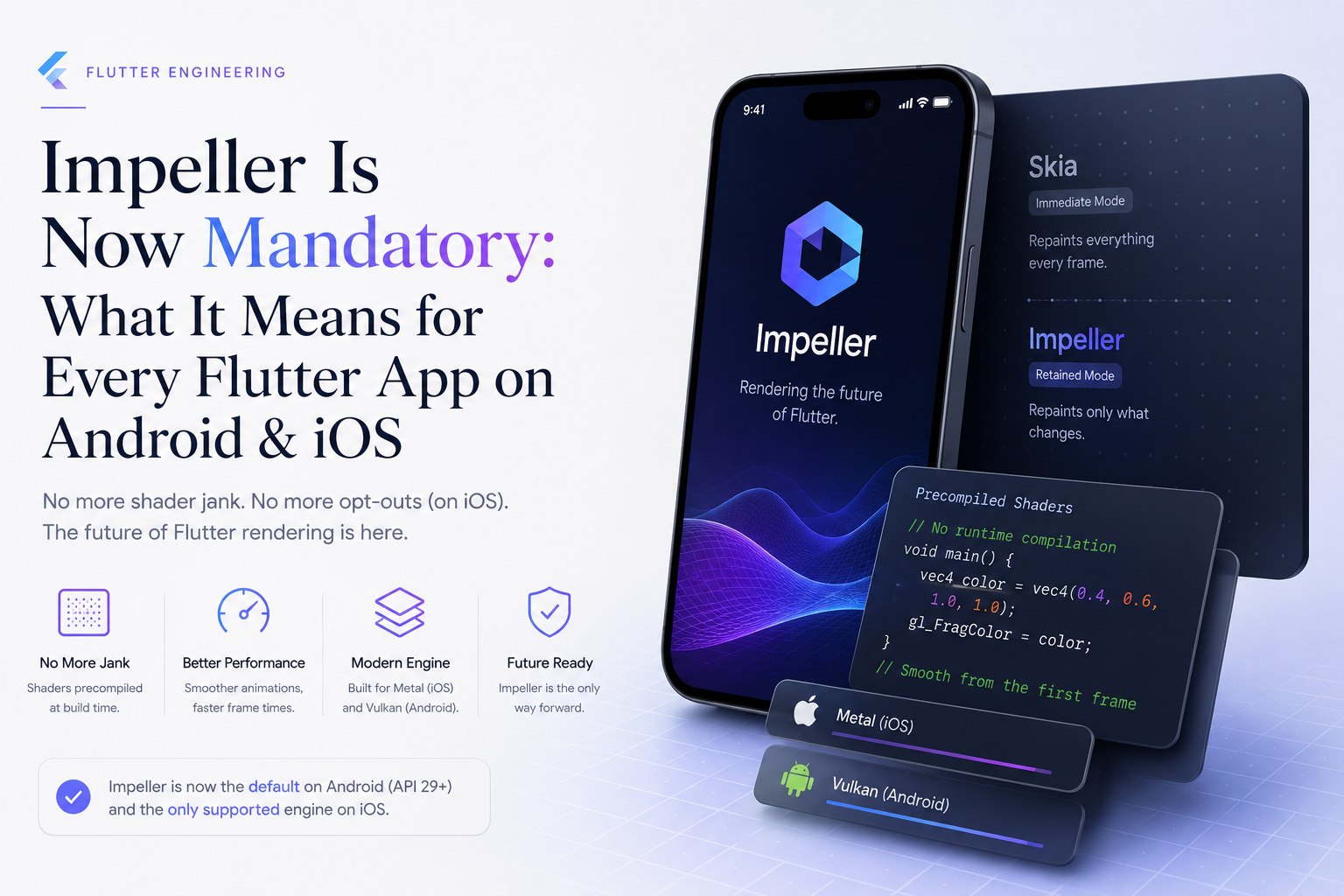
Summary. As of 2026, Flutter's Impeller renderer is no longer optional. On iOS, Skia was removed entirely in Flutter 3.29 — the --no-enable-impeller flag exists but does nothing. On Android, Impeller has been the default on API 29+ since Flutter 3.27, and Flutter 3.38 deprecated the manual opt-out in both the command-line flag and AndroidManifest.xml — using either now triggers a runtime warning that the option is being removed. Older Android devices (below API 29 or without Vulkan) fall back to the legacy OpenGL renderer automatically, so the rollout does not break device compatibility. The architectural change matters: Impeller compiles all shaders at build time instead of runtime, structurally eliminating the 20-100ms first-frame stutter (shader compilation jank) that Flutter apps have carried for years. Independent developer testing reports ~50% reduction in frame rasterization time and ~70% fewer dropped frames on animation-heavy workloads. The transition also targets Metal on iOS and Vulkan on Android rather than OpenGL. Two open issues remain: a performance regression with Platform Views and Textures, and a color-emoji rendering bug on the iOS simulator. This article covers what changed, what to test before your next release, and where the honest edge cases still are.
If you have built a Flutter app with any custom animation, you have seen it: the app runs perfectly smooth, and then the very first time a new gradient, blur or transition plays, the frame stutters — a tiny, visible hiccup that never happens again for that same animation. That is shader compilation jank, and for years it was accepted as "how Flutter apps behave on their first run." In 2026, it is no longer optional to fix, because the engine that eliminates it — Impeller — is no longer something you opt into.
What actually changed
Two separate but related things happened, on two separate platforms, and both are now locked in rather than experimental.
On iOS, Impeller is the only supported rendering engine, with no ability to switch back to Skia — the --no-enable-impeller flag that used to disable it is now a no-op, meaning the flag exists but does nothing. On Android, Impeller has been available and enabled by default on API 29+ since Flutter 3.27, and Flutter 3.38 went a step further by deprecating the manual opt-out entirely, signalling the final phase of a transition that had been running quietly in the background for years.
If you have not touched your rendering configuration and you are on a recent Flutter version, you are already running Impeller. The question is not whether to adopt it — that decision has effectively been made for you — it is whether your app has been tested against it properly.
Timeline — how the rollout actually happened
| Flutter version | iOS status | Android status |
|---|---|---|
| Pre-3.10 | Skia only | Skia only (Impeller in preview) |
| 3.10 – 3.26 | Impeller default; Skia available via flag | Impeller in preview / opt-in |
| 3.27 | Impeller default | Impeller default on API 29+; OpenGL fallback for older devices |
| 3.29 | Skia removed entirely; --no-enable-impeller becomes a no-op |
Impeller default; opt-out still functions |
| 3.38 → 3.44 (current, 2026) | Same as 3.29 — Skia absent | Opt-out deprecated in 3.38 (runtime warning); still deprecated through 3.44 (current); removal in a future release |
Two things read cleanly off this table. First, the iOS rollout is fully closed — no configuration change can bring Skia back. Second, the Android rollout is in its final phase — the opt-out still technically works, but it is on a public countdown.
What shader jank was, and why it happened
To understand why this change matters, it helps to understand the specific problem it solves. Flutter's old renderer, Skia, compiled GPU shaders at runtime — the first time your app needed to draw a particular gradient, blur or complex effect, the engine generated and compiled that shader on the spot. That compilation took real time, visible as a 20-100ms frame stutter the first time (and only the first time) that visual effect appeared on screen. It was especially noticeable on iOS, and especially frustrating because it was inconsistent by nature: the same animation that stuttered on first play would run perfectly smooth every time after.
Impeller's fix is architectural, not a patch. It precompiles the engine's shaders at build time instead of at runtime, so by the time your app's first frame renders, there is no compilation left to do. There is, structurally, nothing left to cause that specific kind of first-run stutter.
Skia vs Impeller — the real architectural difference
The deeper distinction is in when each engine does its GPU shader and pipeline work. Skia generates and compiles shaders at runtime — the first time a given gradient, blur or effect is drawn, the engine builds that shader on the spot. Impeller authors and compiles all of its shaders offline at build time, builds all of its pipeline state objects upfront, and controls its own caching explicitly — so by the time your first frame renders, there is no shader compilation left to do. It is a difference in when the GPU work happens, not a retained-versus-immediate-mode scene graph.
| Property | Skia (legacy) | Impeller (current) |
|---|---|---|
| Shader compilation | Runtime (first frame stutter) | Build time (no first-frame jank) |
| iOS backend | OpenGL / Metal (translated) | Metal (native) |
| Android backend | OpenGL | Vulkan (native, API 29+); OpenGL fallback older |
| First-frame jank on new animations | Common | Structurally eliminated |
| Text layout | SkParagraph | Still SkParagraph |
| Image decoding | Skia codecs | Still Skia-wrapped codecs |
| Frame rasterization time (heavy scenes) | Baseline | ~50% lower (independent testing) |
| Dropped frames on animation-heavy apps | Baseline | ~70% lower (independent testing) |
| Platform Views performance | Baseline | Regression on some Android devices (open issue) |
| iOS simulator emoji rendering | Works | Empty boxes with question marks (open issue) |
That architectural difference is why Impeller targets modern, lower-level graphics APIs directly — Metal on iOS and Vulkan on Android — instead of relying on OpenGL, which Apple has been deprecating on its own platforms for years. Building for Metal and Vulkan from the ground up is not a side benefit; it is a large part of why the performance gains are structural rather than incremental.
One nuance worth being precise about: Impeller is not a total clean break from Skia under the hood. Text layout and shaping still runs through SkParagraph, a Skia component, and image decoding still goes through Skia-wrapped codecs — so "Impeller has no dependency on Skia" is true for rendering itself, but not for every single piece of the pipeline. It is a meaningful distinction for anyone debugging a rendering issue and wondering why Skia still shows up in a stack trace.
iOS: no engine, no opt-out
For iOS specifically, this is as final as a platform decision gets in Flutter. Since Flutter 3.29, Skia is not merely deprecated on iOS — it is absent, and the flag that used to toggle it does nothing at all. If your app targets iOS and you are on a current Flutter version, Impeller is rendering every pixel, whether your team has explicitly tested against it or not.
For teams still running older Flutter versions specifically to avoid an Impeller-related rendering issue, that workaround has an expiration date attached to it — every future Flutter release moves further from Skia on iOS, not back toward it.
Android: default now, opt-out deprecated
Android's rollout has more nuance because of real hardware diversity. Impeller runs by default on API 29 and above; on devices running older Android versions, or that lack Vulkan support, Flutter automatically falls back to the legacy OpenGL renderer with no action required from the developer. That fallback logic is worth appreciating on its own — it means the default behaviour handles the hardware split for you, rather than forcing a manual device-tier decision in your own code.
What has changed as of Flutter 3.38 is the escape hatch. Both the command-line flag and the AndroidManifest.xml opt-out for disabling Impeller still technically function today, but the Flutter team has explicitly deprecated them, and developers who use them now see a runtime warning stating plainly that these options are going away in an upcoming release. Practically, that means any Android app still opting out should treat this as a countdown, not a stable long-term configuration.
The performance numbers, with sourcing
The headline performance claims circulating in 2026 are substantial: reports describe average frame rasterization time dropping by nearly 50% in complex scenes, and dropped-frame counts falling by more than 70% in real animation-heavy test apps using Hero transitions and gradients. Those specific figures come from independent developer testing rather than an official Google benchmark, so they are best read as directionally accurate and representative of real-world results rather than a guaranteed number for every app. Your own gains will depend heavily on how animation-heavy and shader-dependent your specific UI is.
What is consistently and independently confirmed, including in the engine's own FAQ, is the underlying mechanism producing those gains: all shaders and reflection data are compiled offline at build time, all pipeline state objects are built upfront, and the engine controls its own caching explicitly rather than relying on runtime compilation — which is precisely the mechanism that removes shader jank as a category of bug, not just as a symptom.
The honest part — where Impeller still has rough edges
No engine transition this size ships without edge cases. Two concrete, currently open issues are worth knowing about before you assume Impeller is a strict, unconditional upgrade for every app.
First, a reported performance regression with Platform Views or Textures — the kind of embedding used when a Flutter app hosts a native view (a map, a video player, a webview) inside itself. If your app leans heavily on platform views, this is worth testing explicitly rather than assuming parity. The issue is publicly tracked at flutter/flutter#180831.
Second, a rendering regression on the iOS simulator where colour emoji render as empty boxes with question marks — Impeller's text rendering path does not currently support them in that specific environment. This is a reminder that simulator behaviour and real-device behaviour are not guaranteed to match one-for-one during a transition like this. Tracked at flutter/flutter#183828.
Neither issue is a reason to avoid upgrading — both are specific, known, and tracked publicly — but a senior team's migration plan should include testing platform-view-heavy screens and simulator-only workflows specifically, rather than assuming a clean pass because the rest of the app looks fine. For deeper context on choosing between Flutter and React Native in 2026, see eCorpIT's Flutter vs React Native pillar.
A migration checklist before you upgrade
Before treating an Impeller-default Flutter upgrade as routine, work through this concrete list:
- Confirm your Flutter version. For most current apps on recent Flutter versions, Impeller is already active by default on your target platforms.
- Remove opt-out flags deliberately. If your Android build still carries the
EnableImpellermanifest opt-out or the--no-enable-impellerflag, plan its removal now rather than waiting for it to stop working.
- Test Platform Views and Textures. Every screen that uses them, given the known performance regression in that scenario.
- Test the iOS simulator separately. If your app displays emoji in custom-styled text, the simulator-only emoji-rendering gap is worth reproducing before your release build.
- Check your minimum Android API level. API 29 is the line where Impeller runs natively versus where automatic OpenGL fallback engages.
- Profile real animation-heavy screens before and after upgrade — the 50% / 70% figures are directional; measure yours.
- Update CI/CD test devices. Your golden-image or screenshot tests should include devices representing both the Vulkan and OpenGL-fallback Android tiers.
Why this counts as a genuine engine shift, not just a version bump
It is fair to be sceptical of framing this as more than a rendering-backend swap. What makes it different is scope and finality. This is not a performance tuning option sitting behind a flag for teams who want to opt in — it is the only path forward on iOS already, and the only path Android is visibly moving toward.
It also is not confined to mobile. The same engine transition is being extended toward desktop, with a Vulkan backend under way for Linux and Windows (macOS already runs Impeller on Metal behind a flag), aimed at a single, unified rendering engine across all six platforms Flutter targets (iOS, Android, macOS, Linux, Windows and Web).
Judged against that trajectory, this is not an optional performance upgrade for animation-heavy apps — it is the removal of an entire, long-standing category of Flutter's most commonly reported visual bug, platform by platform, on a timeline that is already mostly behind us on mobile.
Frequently asked questions
How eCorpIT can help
eCorpIT builds and maintains Flutter apps for clients across India, the US and the UK — including engine-migration audits, Impeller performance profiling, Platform View / Texture regression testing, iOS 27 App Intents integration, and end-to-end mobile app engineering with senior-only delivery. Our recent Flutter work includes projects in fintech, healthcare, sports & events, education and retail.
If your team is planning a Flutter upgrade that lands on Impeller, or you are seeing regressions after one, our engineering team can help. Reach us at ecorpit.com/contact-us/ or contact@ecorpit.com.
Closing note
Shader jank was never a Flutter bug you could fully fix in application code — it was a property of the rendering engine underneath your app, which meant every team was stuck waiting on Google to solve it at the source. That wait is now effectively over on the platforms most Flutter apps ship to first. The honest caveat is that "mandatory" does not mean "risk-free" — a small number of specific, tracked edge cases exist, and a senior team's job is to test for those deliberately rather than assume a flawless pass.
References
- Flutter documentation — Impeller rendering engine: docs.flutter.dev/perf/impeller
- Flutter engine — Impeller FAQ (GitHub): github.com/flutter/engine/impeller/docs/faq.md
- State of Flutter 2026 — Impeller transition locked in: devnewsletter.com/state-of-flutter-2026
- flutter/flutter Issue #180831 — Impeller performance vs Skia with Platform View / Texture: github.com/flutter/flutter/issues/180831
- flutter/flutter Issue #183828 — Color emoji rendering regression on iOS simulator: github.com/flutter/flutter/issues/183828
- DEV Community — How Impeller Is Transforming Flutter UI Rendering in 2026: dev.to
- Flutter's Architecture (Part IV) — Skia vs Impeller Engines: medium.com
- eCorpIT — Flutter vs React Native (2026): ecorpit.com/flutter-vs-react-native-2026/
- eCorpIT — Native vs Cross-Platform Mobile App Development: ecorpit.com/native-vs-cross-platform-mobile-app/
- eCorpIT — Hire Flutter Developers: ecorpit.com/hire-flutter-developers/
Last updated 6 July 2026 by the eCorpIT Editorial team. We will refresh this article when the Android opt-out is physically removed, when the Platform View regression is resolved, and when Impeller ships as default on desktop targets.