On this page · 11 sections
Summary. The question in the title is now partly settled. React Native's New Architecture has been the default since version 0.76, and the old bridge-based architecture was permanently removed in version 0.82, released October 2025, so any app on a current React Native is already on it. The payoff is real: production migrations report 43 percent faster cold starts, 39 percent faster rendering and 26 percent lower memory use, built on the Fabric renderer, TurboModules and JSI, with Hermes now required. The work is real too. Roughly 85 percent of popular packages are compatible, migrations take two to eight weeks, and at Indian rates that is on the order of ₹2 lakh to ₹8 lakh in engineering time. For mobile engineering leads, the decision is no longer whether but when, and how to do it without breaking production.
It is not "should you" anymore, it is "when"
The framing has changed. Because version 0.82 disabled the old architecture entirely, staying on the bridge means staying on an old React Native, which is its own accumulating risk. So the real choice is between migrating deliberately on your schedule or being forced into it the next time you need a new React Native version for a security fix or an OS update. Planned migration is cheaper than emergency migration. Our Expo versus React Native comparison covers the tooling context.
What the New Architecture actually is
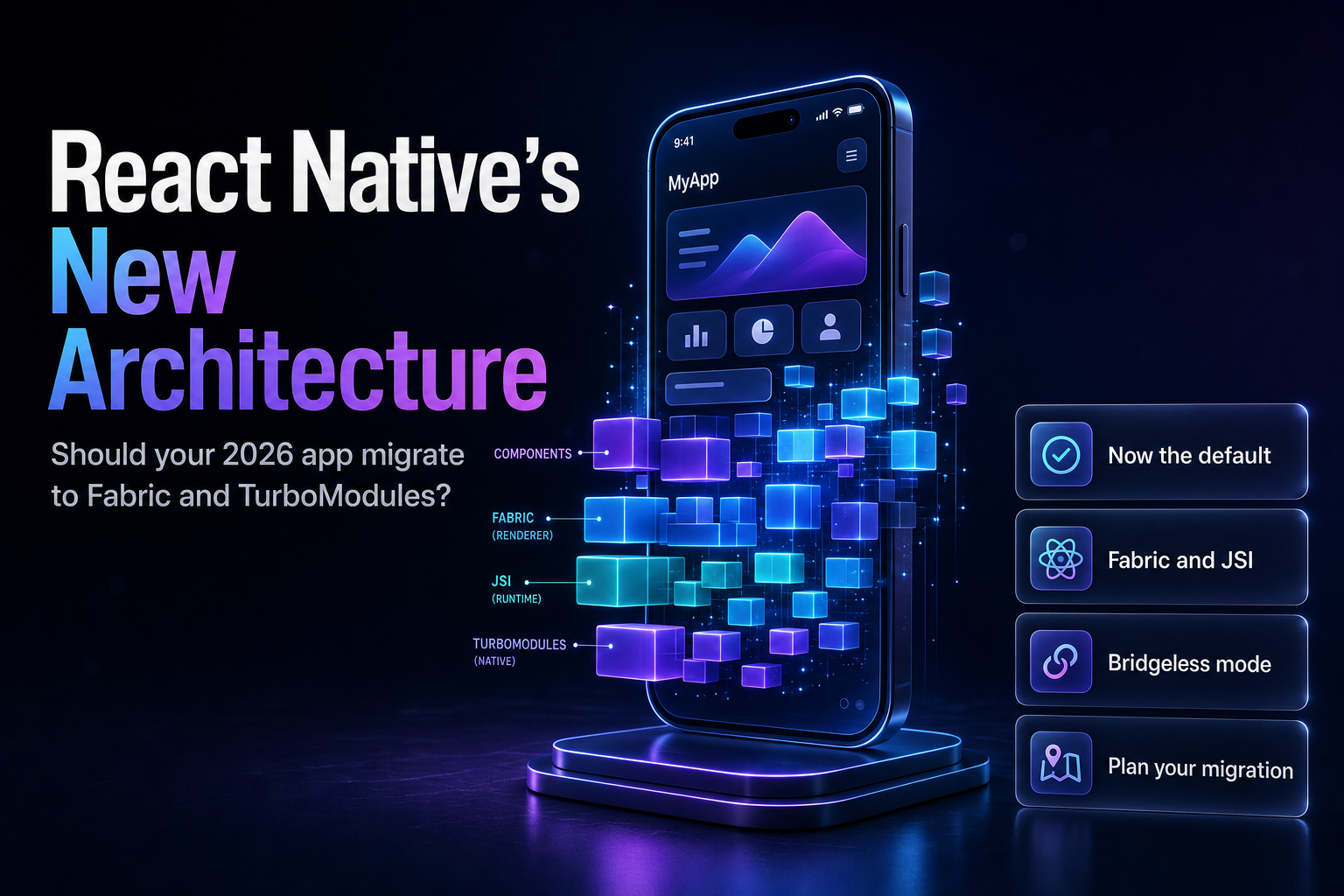
The New Architecture replaces the old asynchronous JavaScript bridge with three parts. Fabric is the new UI renderer. TurboModules are the successor to Native Modules, adding lazy initialisation so modules load on first use rather than at startup, synchronous access through JSI, and Codegen type safety. JSI, the JavaScript Interface, lets JavaScript and native code call each other directly and synchronously, without serialising messages across a bridge. Bridgeless mode, default since 0.78, removes the old bridge object completely, and Hermes is required because JSI depends on it.
| Aspect | Old bridge architecture | New architecture |
|---|---|---|
| JS-to-native communication | Asynchronous, serialised bridge | JSI, direct and synchronous |
| UI rendering | Paper renderer | Fabric renderer |
| Native modules | Native Modules, eager load | TurboModules, lazy load |
| JavaScript engine | JavaScriptCore or Hermes | Hermes required |
| Status in 0.82 and later | Removed | The only option |
The performance payoff
The gains are what justify the work. Real-world production migrations show 43 percent faster cold starts, 39 percent faster rendering and 26 percent lower memory use. Typical apps see a 10 to 30 percent improvement on the UI thread, and apps that lean on heavy native modules can see up to a 3x improvement in cross-thread call performance, because JSI removes the serialisation that the old bridge imposed on every call. The apps that gain most are the ones that were most constrained by the bridge.
The migration reality
The single biggest obstacle is third-party libraries, confirmed as the top pain point in the State of React Native survey. About 85 percent of popular packages are New Architecture compatible in 2026, with the other 15 percent bridge-only or partial, so a dependency audit comes first. React Native ships an interop layer that lets old Paper components and native modules run under the New Architecture unchanged, which is what makes incremental, component-by-component migration possible rather than a risky big-bang rewrite. Speed varies with custom native code: most migrations take two to eight weeks, though one team, Hipcamp, moved in two weeks against a two-to-three-month estimate by using an AI agent to audit over 100 dependencies and open upgrade pull requests in parallel.
| Step | What to do | Watch-out |
|---|---|---|
| Audit dependencies | Check every native package for New Architecture support | About 15 percent are still bridge-only |
| Enable Hermes | Switch from JavaScriptCore if you opted out | The New Architecture will not run on JSC |
| Use the interop layer | Migrate components one at a time | Keeps the app shippable during the move |
| Fix breaking APIs | Replace setNativeProps; review layout code | Some async layout now runs synchronously |
| Test on real devices | Verify rendering and gestures | Gesture timing can change subtly |
Breaking changes to watch
A few specific things break. setNativeProps no longer works and must be replaced with state-driven updates. Some asynchronous layout-measurement patterns now run synchronously, which can surface timing bugs. Gesture timing can differ in custom gesture logic, so custom interactions need retesting. And any app that opted out of Hermes will not run at all until it switches, because JSI depends on Hermes. None of these is large on its own, but together they are why testing on real devices is not optional.
The Expo path
If you use Expo, most of the native configuration is handled for you. All expo modules support the New Architecture, and as of January 2026 roughly 83 percent of Expo SDK 54 projects built with EAS Build already run on it, with SDK 55 and later running on it unconditionally. For many Expo apps, the migration is closer to an upgrade than a rewrite. Teams weighing native cross-platform options can also see our Swift 6.3 on Android guide and Jetpack Compose versus Flutter comparison.
India-specific considerations
For Indian teams and studios, the cost calculus is straightforward: a two-to-eight-week migration is a bounded, one-time investment against an app that then runs faster and stays on a supported React Native. Budget the developer time, prioritise the dependency audit, and use the interop layer to keep shipping while you migrate. The relative cost picture is in our India versus US app development cost analysis.
What to do this quarter
Run a dependency audit against the New Architecture first, because it tells you whether your migration is two weeks or eight. Enable Hermes if you have not, then migrate components incrementally behind the interop layer while the app stays shippable. Replace setNativeProps, retest gestures and layout on real devices, and measure cold start and memory before and after so the gain is documented. Plan it now rather than waiting for a forced upgrade.
FAQ
How eCorpIT can help
eCorpIT is a Gurugram-based, CMMI Level 5 consultancy with senior React Native, Flutter and native mobile engineers. We run New Architecture migrations the safe way: a dependency audit first, incremental conversion behind the interop layer, and before-and-after performance measurement, so your app keeps shipping throughout. To plan a React Native migration for 2026, talk to our team.
References
- React Native New Architecture migration guide (2026) - AgileSoftLabs.
- Migrating to React Native's New Architecture - Shopify Engineering.
- React Native's New Architecture - Expo Documentation.
- The ultimate 5-step guide to React Native Fabric migration in 2026 - MetaDesign Solutions.
- React Native's 2026 New Architecture: how JSI and Fabric killed the performance bridge - Bolder Apps.
- The React Native New Architecture migration process for 2026 - DEV Community.
_Last updated: July 10, 2026._