On this page · 9 sections
Summary. An AI-powered Android app uses AI inside its own screens, for features such as summarising, rewriting or describing an image. An agent-enabled app goes further and exposes selected capabilities that an authorised AI agent can call to complete a user's goal. Google's AppFunctions API is the structured route for that: it is experimental, runs on Android 16 or higher, and its integration with Gemini was in a private preview with trusted testers as of May 2026. The Jetpack library reached version 1.0.0-alpha13 on 7 October 2026. The two approaches work together; they are not competing architectures.
AI is changing how people use mobile apps. Instead of tapping through every screen, users increasingly expect apps to understand requests, summarise information and help complete tasks. For Android developers, two related approaches matter: adding AI features to an app, and making selected app capabilities available to compatible AI agents.
Google's AI on Android pages set out the toolkit: on-device features with Gemini Nano and the ML Kit GenAI APIs, cloud and hybrid features with Firebase AI Logic, AppFunctions for agent access, and UI automation on supported devices as a fallback. Each option has different capabilities, device requirements and maturity, so check the current documentation before you commit to a launch date.
About this article. This guide is based on Google's Android Developers documentation for AppFunctions, Android Computer Control, Gemini Nano, the ML Kit GenAI APIs and Firebase AI Logic, and on the AppFunctions release notes, as checked on 17 October 2026. AppFunctions and Computer Control are in preview and their APIs change between releases. Researched with AI assistance and reviewed by our editorial team.
What is an AI-powered Android app?
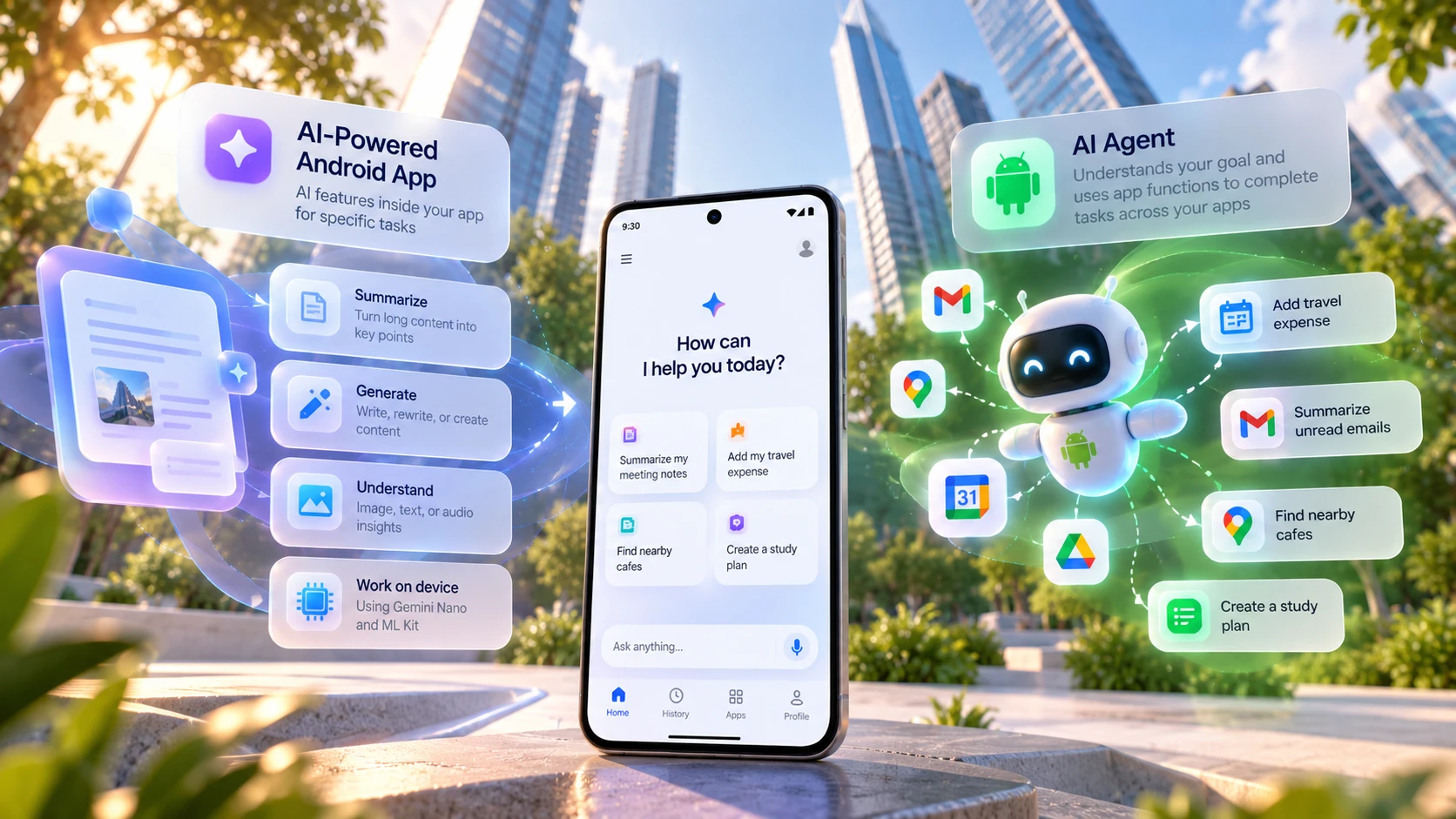
An AI-powered Android app adds AI to its existing user experience. Users reach the feature through the app's own interface: a button, a text field, an editor or a chat screen.
Examples include:
- Writing apps: rewrite text, proofread short messages or summarise content.
- Travel apps: summarise itineraries and organise trip information.
- Productivity apps: extract details from receipts or organise meeting notes.
- Education apps: explain concepts and generate practice questions.
- Media apps: describe images or transcribe audio for supported use cases.
The app stays responsible for the workflow. AI helps with a task, and the user chooses when and where to use it.
Android AI development technologies
Gemini Nano and the ML Kit GenAI APIs. Gemini Nano is Google's on-device foundation model, and it runs in Android's AICore system service. The ML Kit GenAI APIs put a high-level interface on top of it for summarisation, proofreading, rewriting, image description and speech recognition, plus a Prompt API for custom text or multimodal prompts. Google says input, inference and output stay on the device, the features keep working without a reliable connection, and there is no server cost per call. Device support is the catch. The task-specific APIs run on a published list of phones, including recent Pixel, Galaxy S and other flagship models. The speech recognition API is still in alpha, and its advanced GenAI mode runs only on Pixel 10 and Pixel 11 devices for now.
Firebase AI Logic. Firebase AI Logic connects an Android app to the cloud Gemini models, through either the Gemini Developer API or the Agent Platform Gemini API, formerly Vertex AI. Cloud inference suits tasks that need more model capability or context than an on-device option offers. It also brings network latency, a service dependency, usage-based costs and the need for authentication, abuse prevention and data protection. Firebase App Check and spending limits address part of that.
Traditional machine learning. Google's own guidance is that prediction, classification and detection are often better served by ML Kit, LiteRT and MediaPipe than by a generative model, with lower computing cost and a simpler build. Not every intelligent feature needs a generative model.
What is an AI agent in Android app development?
An AI agent interprets a user's goal and chooses from the tools or actions available to it. Depending on its permissions and integrations, it can retrieve information, call app functions or carry out several steps in a row.
Take a travel app that stores trips and expenses. In a conventional flow, a user opens a trip, goes to expenses, picks a category, enters an amount and saves the record. In an agent-enabled flow, the user might simply say: "Add my coffee expense to today's Paris trip."
If a compatible agent can reach the right function, it may identify the trip and call the expense-creation operation. The app must still validate the request, confirm the user is authorised and apply its normal business rules. Natural-language input should never bypass the app's safeguards.
Android gives agents two routes into an app.
Route 1: structured integration through AppFunctions
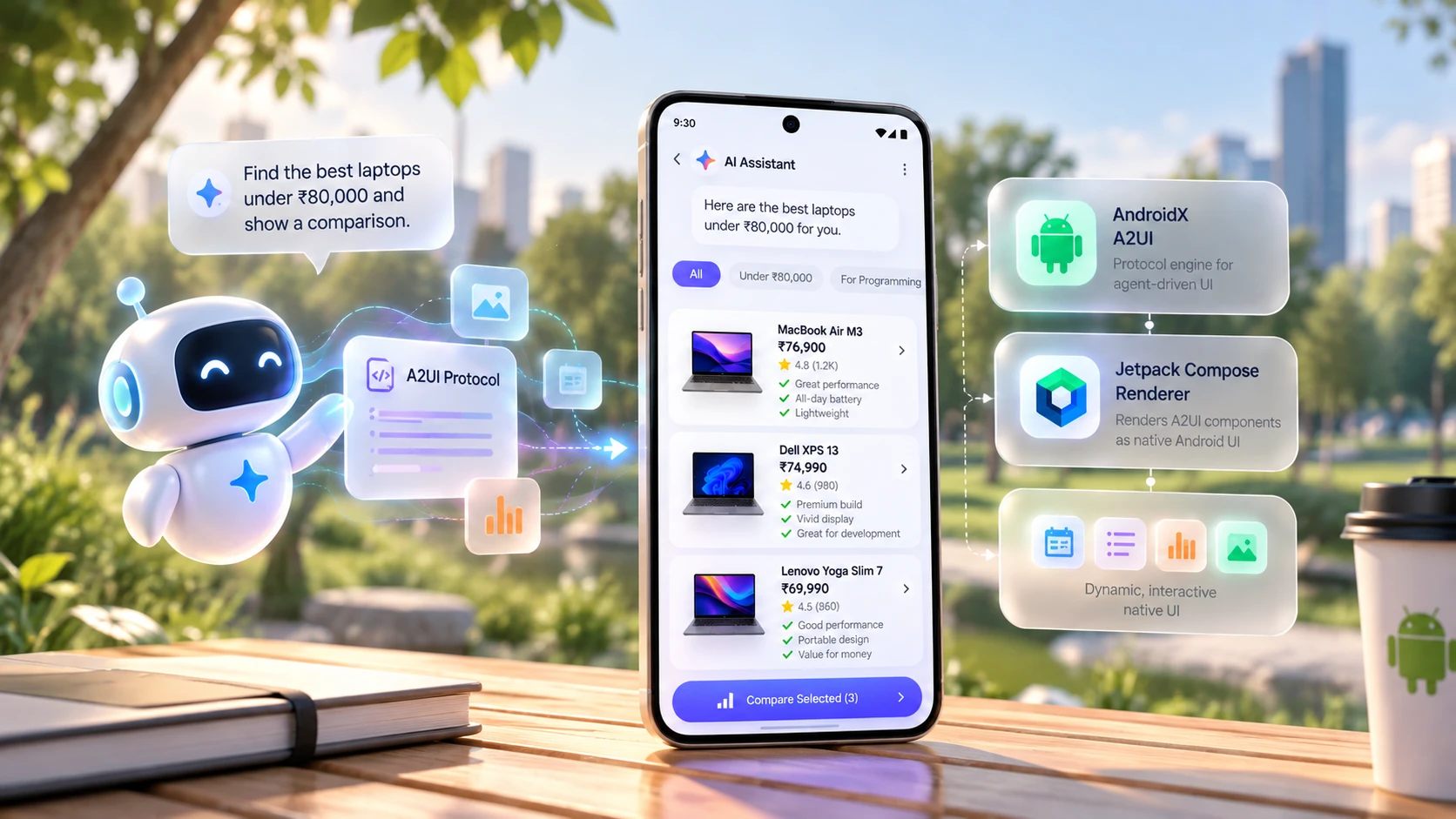
AppFunctions is an Android platform API with an accompanying Jetpack library. Google describes AppFunctions as the mobile equivalent of tools in the Model Context Protocol: the app behaves like an on-device MCP server whose functions an agent can call. The web has a parallel effort in WebMCP, and our comparison of MCP and A2A covers the protocol side.
The flow has four steps. The app declares its functions. The Jetpack library generates an XML schema that the Android OS indexes. An agent reads the function metadata, including the descriptions you write in KDoc. The agent then picks a function and calls it with parameters taken from the user's request. Callers need the EXECUTE_APP_FUNCTIONS permission to discover and run functions, and they can be agents, other apps or assistants such as Gemini.
For example, an expense app could expose narrowly scoped functions to list a trip's expenses or add an expense. Because the agent chooses functions from their names and descriptions, a clear name such as getTripExpenses with an accurate KDoc comment tells it far more than a vague name such as processData.
Availability matters. Google labels AppFunctions an experimental preview whose API is subject to change, and it runs only on devices with Android 16 or higher. During this phase only a limited number of apps and system agents can use the whole pipeline. You can implement and test your functions today, check that they are registered with adb shell cmd app_function list-app-functions, and register interest in Google's Early Access Program, which does not by itself grant access to the full integration.
The library is also moving quickly. Version 1.0.0-alpha13, released on 7 October 2026, renamed the @AppFunction annotation to @AppFunctionDeclaration and added an @AppFunctionAccessLevel annotation for restricting access. Code written against earlier alphas, including some published samples, will need updating.
Route 2: UI automation through Android Computer Control
Android Computer Control lets an assistant preloaded by the phone maker operate apps through their user interface, with no code changes in those apps. The assistant must hold the privileged ACCESS_COMPUTER_CONTROL permission, and the system asks the user's permission before automation starts. The target app then runs on a background virtual display while the assistant reads screenshots and simulates taps, swipes and text input. One session can cover up to six target apps, only one session runs at a time, and the assistant can hand control back to the user, for example to confirm a transaction.
Computer Control is also a preview, and for now it works with a limited set of target apps. Google advises target apps to follow its existing guidance on adaptive design and lifecycle handling.
The two routes are not interchangeable. AppFunctions exposes operations your app defines and validates; Computer Control drives the same screens a person would use. Neither should be assumed to work on every Android device or with every assistant.
AI-powered apps vs AI-agent-enabled apps
| Area | AI-powered Android app | AI-agent-enabled Android app |
|---|---|---|
| Main purpose | Add intelligent features to the app | Let supported agents use selected app capabilities |
| Typical interaction | App UI, such as a button, editor or chat | Natural-language request through a compatible assistant, where supported |
| Example | Summarise a travel itinerary | Retrieve the next itinerary event through an exposed function |
| Integration work | Integrate and evaluate a model or AI API | Define functions, descriptions, permissions and execution behaviour |
| Main engineering concerns | Quality, latency, privacy, cost and reliability | Authorisation, input validation, side effects, failure handling and agent reliability |
| Relationship | Can work on its own | Can coexist with AI features inside the app |
The practical takeaway is that an app can use AI internally while also exposing selected capabilities to compatible agents. The right design depends on the tasks users need to complete, not on whether a product carries an AI-first label.
On-device AI vs cloud AI vs hybrid AI
The choice of AI architecture affects privacy, responsiveness, model capability, network dependency and running costs.
On-device AI
On-device inference runs directly on a compatible phone or tablet.
Potential benefits
- Supported inputs are processed on the device.
- Suitable tasks keep working with little or no network.
- Latency can be lower for some workloads.
- There is no cloud inference bill for work handled locally.
Trade-offs
- Device and API support varies.
- Model capability and context may be too limited for some tasks.
- Memory, battery, heat and performance constraints matter.
- Unsupported devices need a clear fallback; our Android AI fallback plan covers the hardware floor.
On Gemini Nano, AICore isolates each request and does not keep a record of the input or output after processing, according to Google. On-device AI is worth evaluating for supported tasks where local processing adds value, such as summarisation or rewriting through an ML Kit GenAI API.
Cloud AI
Cloud inference sends requests to remote models over the network, and Firebase AI Logic is one way to reach the Gemini models from an Android app.
Potential benefits
- Access to the larger cloud models.
- Less reliance on the device's own computing power.
- More room for workloads that need broader context or complex reasoning.
Trade-offs
- Cloud inference needs a network connection.
- Network latency and service availability affect the experience.
- Usage-based costs apply; our guide to AI app development cost in India shows how that bill grows.
- Sensitive data needs careful handling, authentication and abuse prevention.
Cloud AI is not automatically unsafe, just as on-device AI is not automatically secure. Implementation and data handling decide that.
Hybrid AI
A hybrid approach uses on-device and cloud models for different tasks or devices. Google's guidance is that mobile apps commonly use local models for small text such as chat conversations or articles, and turn to a cloud model for larger sources such as PDFs or when more knowledge is needed. You can build the routing yourself or use the Firebase AI Logic hybrid API, which runs a request on the device when it can and falls back to the cloud when it cannot.
On Android that hybrid mode is experimental. It needs the Firebase AI Logic SDK v17.10.0 or later, it runs on specific devices only, and on the device it supports single-turn text generation from text or from text with one image, not chat. Check how your chosen API routes data, handles fallback and reports failures.
| Requirement | Approach to evaluate |
|---|---|
| Local processing and less network dependency | On-device AI |
| Cloud-model capabilities or broader context | Cloud AI |
| Different needs across task types or devices | Hybrid AI |
| Specialised vision or custom inference | Traditional ML or a custom model |
Practical example: making a travel app agent-enabled
Imagine a travel app that stores trips, expenses, itineraries and voice notes. Google's own Build intelligent Android apps series takes a demo travel app, Jetpacker, through the same journey in its posts on on-device inference, cloud and hybrid inference, and AppFunctions.
Stage 1: add an AI feature
Introduce itinerary summaries using a supported on-device or cloud option. Users still open the app and choose the feature from its interface.
Stage 2: expose selected functions
Identify repeated tasks that would be easier in natural language, such as retrieving the next itinerary event, adding an expense or saving a voice note. Where supported, expose narrowly scoped operations through AppFunctions and document their parameters and behaviour in KDoc. Google's walkthrough points out that a privileged agent can then use the app's features in the background, which helps when a user is driving, walking or otherwise busy.
Stage 3: add safeguards
- Validate every input, including values supplied by an agent.
- Check the current user's authorisation for the requested action and record.
- Enforce business rules in the app or a trusted backend.
- Handle retries and duplicate requests safely.
- Require confirmation for consequential actions, such as payments or deletions.
- Return a meaningful error when a request is ambiguous or unsupported. AppFunctions provides predefined exceptions, such as an invalid-argument exception, that tell the agent why a call failed.
- Treat text that reaches an agent from outside the app as untrusted, because it can carry prompt injection; our article on prompt injection controls for agents lists the defences.
The aim is to add another way to use the app without weakening its existing controls.
A decision framework for Android developers
Before you choose an approach, answer these questions:
- What user problem are you solving? If users need help generating or understanding content, an AI feature may be enough. If they need to complete multi-step actions, agent access may be worth exploring.
- Does the task need to run locally? Consider data sensitivity, offline behaviour, supported devices and model capability.
- Does the task change important data? Define authorisation, validation, confirmation, audit and retry behaviour before exposing it to an agent.
- Is the platform ready for your audience? AppFunctions needs Android 16 or higher, and agent access is still limited. Confirm API maturity, device coverage and assistant integration before you commit to a launch date.
- Can you measure whether it helps? Track completion rate, error rate, latency, user effort, cost and user trust, not just whether the model produces a plausible answer. Our guide to evaluating LLM tool use covers the testing side.
A conventional interface with deterministic business logic is still the best answer for some tasks. AI is worth adding only when it creates real value for users.
Conclusion
Android developers have two complementary opportunities: build AI into the app experience, and make selected app capabilities available to supported agents. Gemini Nano and the ML Kit GenAI APIs cover certain on-device tasks, Firebase AI Logic provides cloud and hybrid options, AppFunctions offers an experimental structured path for agents, and Computer Control lets preloaded assistants operate a limited set of apps through their screens.
The right approach starts with a real user problem. Choose the architecture that fits the task, confirm the current platform limits, and build around clear permissions, reliable execution and measurable value.
How eCorpIT can help
eCorpIT is a Gurugram-based technology organisation, founded in 2021, assessed at CMMI Level 5 and MSME certified, with senior-led engineering teams working across AWS, Microsoft and Google platforms. Our Android team adds on-device and cloud AI features to existing apps through our AI mobile app development services, and can prepare AppFunctions with the validation, authorisation and confirmation steps that agent calls need, so an app is ready when wider agent access opens. Talk to us at /contact-us/.
Last updated: 17 October 2026.