On this page · 9 sections
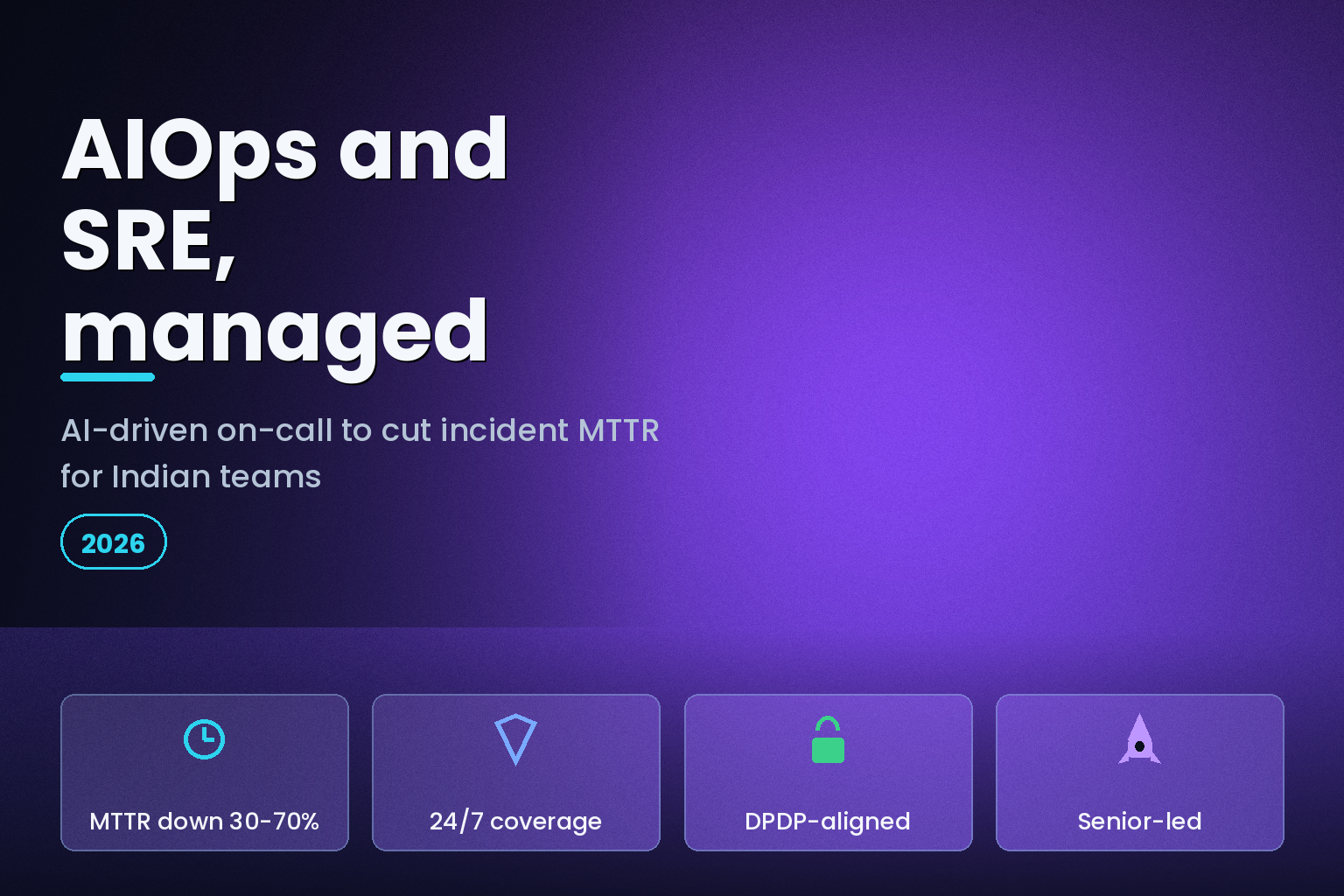
Summary. More than 90% of midsize and large enterprises say a single hour of downtime now costs over $300,000, and 41% put a bad hour between $1 million and $5 million, according to ITIC's 2024 survey. Yet a full 24/7 on-call rotation is expensive to staff: a site reliability engineer (SRE) in India averages about ₹13 lakh a year and a senior SRE runs ₹18-35 lakh, so a sustainable five-person rotation costs roughly ₹65 lakh to ₹1.75 crore in salary alone. AI-driven operations tooling changes the maths. AIOps platforms report mean-time-to-resolution (MTTR) reductions of 30-70%, and AWS DevOps Agent, generally available since 31 March 2026 at $0.0083 per agent-second, automates first-line incident investigation. eCorpIT's AIOps and SRE managed service pairs that automation with senior on-call engineers so an Indian team gets 24/7 reliability without hiring an entire follow-the-sun rotation. This article covers the real cost of downtime, what a rotation actually costs, what automation does and does not solve, and the build-versus-buy decision.
The reliability problem most Indian scale-ups hit
A product that runs around the clock needs someone ready to respond around the clock. The trouble starts when a team of eight engineers tries to cover nights and weekends on top of shipping features. Pages pile onto the same few senior people, response quality drops at 2 AM, and the best engineers start looking for calmer jobs. Meanwhile the cost of an outage keeps rising: the average hourly cost of downtime for a small or mid-sized business runs $5,000 to $50,000, and for larger enterprises it clears $300,000 an hour. Reliability is no longer a back-office concern; it is a direct revenue line.
What a 24/7 on-call rotation actually costs in India
To cover 24 hours a day, seven days a week, without burning people out, you need enough engineers that any one person is on call only about one week in five or six. That is a five- to six-person rotation at minimum for a single tier. Using published 2026 salary data, the arithmetic is sobering.
| Rotation model | People | Indicative annual salary cost | Notes |
|---|---|---|---|
| Mid-level SRE rotation | 5 | About ₹65 lakh (at ₹13 lakh average) | Salary only; excludes benefits and tooling |
| Senior SRE rotation | 5 | ₹90 lakh to ₹1.75 crore (₹18-35 lakh each) | The depth you actually want at 2 AM |
| Follow-the-sun, two regions | 8-10 | ₹1.3 crore and up | Removes night shifts, doubles headcount |
| Managed AIOps + senior on-call | Blended | Scales with coverage, not headcount | Automation handles first-line triage |
Salary is only part of the loaded cost; recruitment, attrition, tooling and management add more. The figures are illustrative and built from public salary ranges, not a quote, but the shape is consistent: a credible in-house 24/7 function is a multi-crore commitment before it prevents a single outage.
What AI-driven operations actually changes
AIOps does not replace judgement, but it removes the slowest part of an incident: the manual correlation of metrics, logs, traces and recent deploys before anyone can form a hypothesis. Across platforms, AIOps tools report MTTR reductions of 30-70%. The specific numbers from AWS DevOps Agent are useful because they are vendor-published with named customers: up to 75% lower MTTR and 3 to 5 times faster resolution in preview, and one university cut a live investigation from about two hours to 28 minutes. We analysed that product in depth in our guide to AWS DevOps Agent on-call cost and buy-versus-build.
The tooling landscape is real and priced. AWS DevOps Agent bills at $0.0083 per agent-second with no idle charge. PagerDuty sells its AIOps capability as an add-on from about $699 a month. Grafana, Datadog and others sit in the same space. The estimated size of the AIOps market for 2026 varies widely by analyst definition, from roughly $11 billion to $47 billion, which tells you the category is both large and loosely bounded. The point for a buyer is not the market number; it is that first-line triage can now be automated, so a smaller group of senior engineers can supervise rather than manually chase every alert.
Build vs buy an SRE function
For most Indian scale-ups the honest comparison is not "AIOps tool A vs tool B" but "hire and run an SRE team vs buy a managed capability."
| Decision vector | Build in-house | eCorpIT managed AIOps + SRE |
|---|---|---|
| Time to 24/7 coverage | Months to hire and train a rotation | Weeks to onboard onto your stack |
| Upfront cost | Multi-crore salary commitment | Engagement scales with coverage |
| Senior depth at 2 AM | Hard to retain in a small team | Pooled senior on-call plus automation |
| Tooling and integration | You build and maintain it | We wire and run AWS DevOps Agent, PagerDuty, Grafana |
| Data control | Full control, full burden | Runs in your accounts, scoped access |
Building makes sense when reliability is your core product and you can retain a deep bench. For everyone else, a managed capability reaches 24/7 coverage faster and keeps senior depth on the rotation without carrying the full headcount, which is exactly the cloud FinOps discipline of paying for outcomes rather than idle capacity.
What eCorpIT's AIOps and SRE managed service covers
We run reliability as a service on your infrastructure, not ours. The work is concrete: we instrument your stack with the observability you are missing, wire an AI incident-response agent such as AWS DevOps Agent into your alert sources, and put senior on-call engineers behind it so escalations reach people who can act. We tune alerting to cut noise, run blameless post-incident reviews, and feed the fixes back as prevention rather than repeat pages. Where you already run production observability on Grafana or Kubernetes, we build on it rather than replacing it, and we treat the agent with the same guardrails as any production system, drawing on our work across enterprise AI agents in production.
eCorpIT is a Gurugram-based, senior-led engineering organisation, founded in 2021 and certified for CMMI Level 5, MSME and ISO 27001:2022, with partnerships across AWS, Microsoft and Google. We do not sell a black box or a rate card off a web page; we scope the engagement to your coverage needs and your stack. Related managed offerings sit alongside this one, including our cloud FinOps managed service and our AI evaluation and observability service.
India-specific considerations
Incident telemetry is data, and much of it is personal data. Logs, traces and session records that identify users fall under India's Digital Personal Data Protection (DPDP) Act 2023, whose rules were notified on 13 November 2025 with substantive obligations due by 13 May 2027. An AIOps agent that reads production logs must therefore have scoped, auditable access, and any log retention should be documented in your data-handling records. We design the access model so the agent sees what it needs for triage and no more, and we keep the data flows aligned with DPDP requirements. For teams running regulated workloads, data residency also matters: choose Regions and log stores that meet your obligations, the same discipline we apply in our Kubernetes AI platform managed service.
How eCorpIT can help
If your team is covering nights and weekends on willpower, eCorpIT can stand up 24/7 reliability without you hiring a full rotation. We wire AI-driven incident response into your alert sources, put senior on-call engineers behind the automation, and align log access with the DPDP Act 2023. The engagement scales with the coverage you need rather than a fixed headcount. To scope it against your stack and your incident volume, contact us.
FAQ
References
_Last updated: 1 August 2026._