On this page · 8 sections
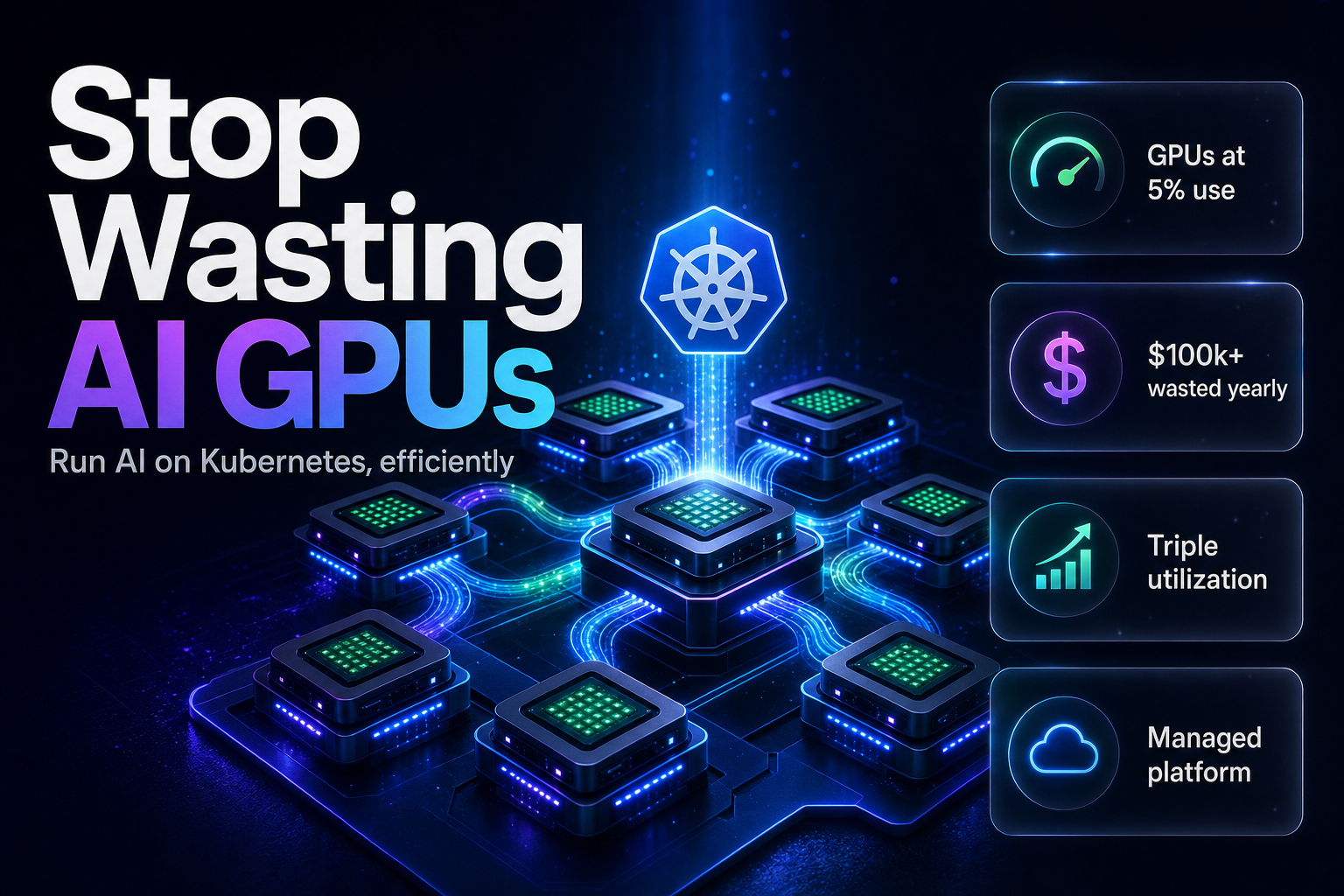
Summary. Kubernetes has become the default place to run AI workloads, but most teams are burning money on it. A Cast AI analysis of tens of thousands of clusters in 2026 found GPUs utilised at just 5%, while CPU sat at 8% and memory at 20%. The cost is real: an idle GPU costs dollars per hour where an idle CPU costs cents, and even at a conservative $3 per GPU-hour the waste tops $100,000 a year for a mid-size AI team and climbs into the millions for large enterprises. The good news is that this is fixable. Production case studies show advanced GPU scheduling lifting utilisation from 13% to 37%, and past 80% in some cases, using a now-mature stack of schedulers and operators. This piece explains why Kubernetes wins for AI, where the waste hides, and how eCorpIT runs a managed cloud-native platform so Indian enterprises get efficient AI infrastructure without building the expertise in-house.
Why Kubernetes for AI
By 2026 Kubernetes is the de facto orchestration layer for AI across most engineering organisations, and a key milestone made it cross-cloud: Dynamic Resource Allocation, or DRA, graduated to general availability in Kubernetes, replacing proprietary GPU scheduling with a standard mechanism for managing GPUs and specialised hardware across clusters. That means the same patterns work whether you run on Azure Kubernetes Service, Amazon EKS, or Google GKE, though each cloud still has quirks, such as different GPU taint formats.
The reason teams standardise on Kubernetes is that it handles training, batch, and real-time inference, including LLM APIs and vector search, under one control plane. The catch is that doing it efficiently takes real expertise, and without it the expensive part, the GPUs, sits mostly idle.
The GPU waste problem
The single most important number for any AI infrastructure decision is utilisation, because GPUs are where the money goes. When clusters average 5% GPU utilisation, you are paying for twenty times the hardware you actually use.
| Resource | Average utilisation | Idle cost |
|---|---|---|
| GPU | ~5% | Dollars per hour |
| CPU | ~8% | Cents per hour |
| Memory | ~20% | Lower |
The waste compounds in ways that are easy to miss. In a distributed training job, if seven of eight worker pods schedule while the eighth stays pending, the seven active workers hold GPU allocations at near-zero utilisation waiting for the missing peer. Training that spreads pods across network boundaries when it does not need to hits communication bottlenecks that waste GPU cycles. Each of these is a scheduling problem with a scheduling fix. Our note on why GPU spend is the top FinOps concern covers the budget angle.
The 2026 AI-on-Kubernetes stack
The ecosystem has matured into a fairly consensus stack. Knowing the pieces is the difference between a platform that runs GPUs hot and one that leaves them idle.
| Layer | Tools | Purpose |
|---|---|---|
| Inference | vLLM, KServe, KubeAI | Serve LLMs and models efficiently |
| Batch and quota | Kueue, Volcano | Admission control, gang scheduling, fairness |
| Distributed training | Ray and KubeRay | Coordinate multi-node training |
| GPU management | NVIDIA GPU Operator, DRA | Drivers, allocation, sharing |
| Observability | DCGM Exporter, MLflow | GPU metrics and experiment tracking |
| AKS accelerator | KAITO | Automates GPU node pools and model serving |
On Azure specifically, KAITO, the Kubernetes AI Toolchain Operator, automates GPU node pool provisioning, model deployment, and inference serving. The point of naming the stack is not to impress; it is that each layer closes a specific gap where GPUs would otherwise sit idle.
How to fix utilisation
Tripling GPU efficiency is not magic; it is disciplined scheduling and workload design. The techniques below are what move utilisation from single digits toward the 37% to 80% range seen in production case studies.
| Technique | What it does | Benefit |
|---|---|---|
| Workload segregation | Separate namespaces and node pools for training, batch, inference | Right-sized autoscaling and quotas per type |
| GPU sharing (MIG) | Partition a GPU for isolated tenants | Predictable performance in shared inference |
| GPU sharing (time slicing) | Share a GPU across lighter jobs | Cheaper dev, test, and bursty services |
| Gang scheduling (Volcano) | Schedule all pods of a job together | Stops partial-schedule GPU stalls |
| Topology-aware scheduling | Keep training pods close on the network | Cuts communication bottlenecks |
| Quotas and guardrails (Kueue) | Control admission and cap spend | Stops expensive jobs running unchecked |
The pattern is to match each workload to the right node pool, priority, and disruption budget, then put guardrails in place so expensive nodes and jobs never run unchecked. Our guide to controlling AI cloud cost across providers covers the FinOps discipline that pairs with this.
India-specific considerations
For Indian enterprises, three factors shape a Kubernetes AI platform. Data residency: where regulated data trains or serves models, keep clusters in India-region infrastructure and design under the Digital Personal Data Protection Act, 2023, with a documented compliance basis. Cost discipline: GPU capacity is the largest line in most AI budgets, so utilisation directly determines whether an AI initiative is affordable, and disciplined scheduling is the difference between a pilot that scales and one that stalls on cost. Skills: the operators, schedulers, and GPU-sharing techniques above are specialised, and hiring that depth is hard, which is exactly where a managed platform earns its keep. Our FinOps managed service covers the cost governance layer.
How eCorpIT can help
eCorpIT is a Gurugram technology consultancy, founded in 2021, that runs managed cloud-native platforms so enterprises get efficient AI infrastructure without building a platform team from scratch. As a partner across AWS, Microsoft, and Google, our senior engineers stand up Kubernetes clusters on AKS, EKS, or GKE, implement the 2026 AI stack of vLLM, KServe, Kueue, Ray, and the NVIDIA GPU Operator, and tune GPU scheduling, MIG or time slicing, and quotas to lift utilisation out of single digits. We design clusters for India-region data residency aligned with Digital Personal Data Protection Act, 2023 requirements and instrument GPU spend so it stays governed. Engagements usually start with a utilisation and readiness assessment, then platform build and ongoing managed operations. This suits enterprises running real AI workloads that want them fast, reliable, and cost-controlled. To run AI on Kubernetes efficiently, contact us.
FAQ
References
- The 2026 AI/ML on Kubernetes stack: vLLM, Kueue, KAITO, KServe, Ray — KubernetesGuru
- Kubernetes GPU node pools and autoscaling for AI (2026) — BuildMVPFast
_Last updated: July 14, 2026._