On this page · 8 sections
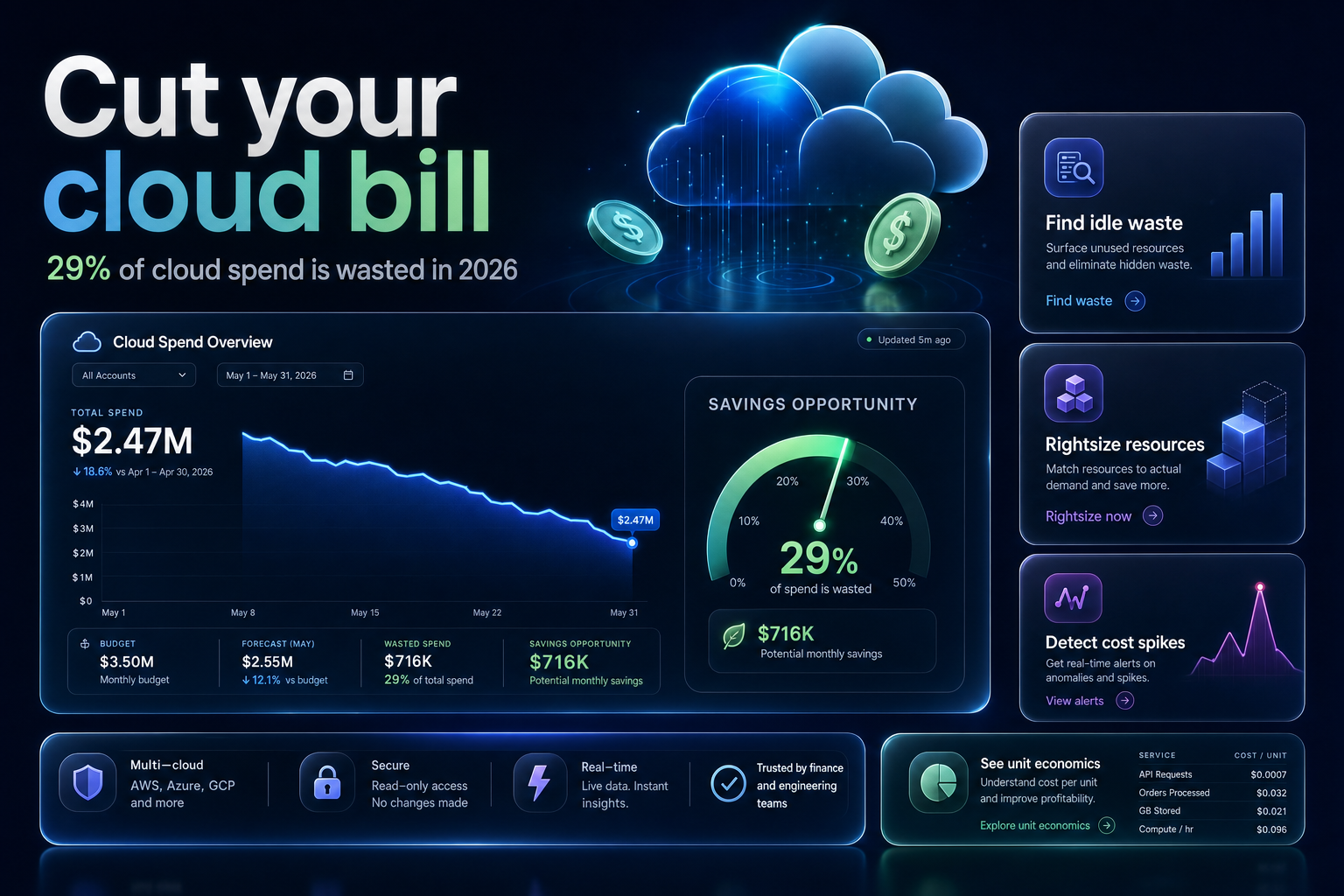
Summary. Cloud waste got worse in 2026, and AI is the reason. Flexera's State of the Cloud report puts wasted infrastructure spend at 29%, up from 27% in 2025 and the first increase in five years. Against a global public cloud market near $1.03 trillion, that is a vast amount of money burned on idle and overprovisioned resources. The absolute stakes scale fast: a 20% waste rate on $50 million of annual spend is $10 million. Structured cost-optimization programs typically recover 25% to 30% of monthly spend, which is why the FinOps platform market has grown to $15.77 billion and 98% of practitioners now name AI cost management their top priority. In India, where Gartner forecasts public cloud spending to rise 28% to $17.5 billion in 2026, the pressure is acute. eCorpIT's cloud FinOps managed service brings visibility, rightsizing, anomaly detection, and unit economics to AWS, Azure, and GCP, so you cut the bill without slowing delivery. This article explains where the money leaks, what the service does, and how to engage.
We run production cloud workloads ourselves, so the savings we find come from engineering trade-offs we have made, not just a billing dashboard.
Where cloud money actually leaks
Waste is not random; it clusters in a few predictable places. Understanding them is the first step to recovering the spend. The 2026 data from Flexera's State of the Cloud report and cloud-waste research shows a clear breakdown.
| Waste source | Typical share | How we fix it |
|---|---|---|
| Idle compute | ~35% | Schedule, decommission, or scale to zero |
| Overprovisioned instances | ~25% | Rightsize to real utilization |
| Untagged and unallocated spend | Significant | AI-assisted tagging to allocate 100% |
| Unused commitments | Varies | Match reservations to actual usage |
| Bursty AI inference | Growing | Governance for unpredictable workloads |
The reversal in the five-year downward trend is the important 2026 story. Flexera attributes it to AI workloads: unlike steady virtual machines, generative AI inference creates bursty, unpredictable spikes that reservation and spot-instance frameworks do not govern well. The old playbook does not fully cover the new bills. Our FinOps guide for AWS, Azure, and GCP goes deeper on the mechanics behind these categories.
What eCorpIT's FinOps managed service covers
FinOps is shared ownership between finance, engineering, and operations, and our service operationalizes that rather than handing you another dashboard to ignore. The engagement combines the standard FinOps capabilities: visibility, allocation, forecasting, rightsizing, and cloud financial management.
| Capability | What we do | Outcome |
|---|---|---|
| Visibility and allocation | Normalize AWS, Azure, GCP billing into one view | You see where every rupee goes |
| Rightsizing | Match instances and storage to real usage | Idle and oversized resources shrink |
| Commitment planning | Align reserved instances and savings plans | Lower rates on steady workloads |
| Anomaly detection | Machine-learning alerts on spend spikes | Surprises caught in hours, not months |
| Unit economics | Cost per customer, feature, or environment | Decisions tied to business value |
The multi-cloud piece matters because that is where the pain concentrates. The most common FinOps complaint is the inability to track costs across AWS, Azure, GCP, and third-party services in a single dashboard. We normalize billing across providers into unit economics, so leadership sees cost per customer or feature instead of five disconnected invoices. Where it helps, we wire in AI-assisted tagging to allocate untagged spend and automation to rightsize continuously. This pairs naturally with consolidating your operations plane, which we covered in our guide to managing multicloud fleets from one console.
What the savings look like, honestly
We do not promise a fixed percentage, because savings depend on your starting maturity and workload mix. What the data supports is a real range: enterprises that run structured cost-optimization programs report an average 25% to 30% reduction in monthly cloud spend. The absolute figure is what justifies the work. A 20% waste rate on $50 million of annual spend is $10 million recovered, and even smaller teams gain proportionally, since companies spending under $100,000 a year average 35% waste.
Engagements come in a few shapes so you can start where you are.
| Engagement | What is included | Best for |
|---|---|---|
| One-time cost audit | Full spend review and a ranked savings plan | Teams wanting a baseline |
| Optimization sprint | Rightsizing and commitment changes executed | Teams with a known overspend |
| Managed FinOps | Ongoing visibility, alerts, and re-optimization | Fast-changing or growing estates |
| Multi-cloud visibility setup | Unified reporting and unit economics | Teams on two or more clouds |
| AI-workload cost governance | Controls for bursty inference spend | Teams scaling generative AI |
Honest scope: what we do, and what we do not claim
We optimize what you actually run, and we are specific about it. We reduce waste, set up allocation and forecasting, and put governance around AI spend, working across AWS, Azure, and GCP. We do not move your money or make purchasing decisions for you; commitments and budgets stay under your control, with our recommendations and the numbers behind them. eCorpIT is a Gurugram-based technology organization, founded in 2021, assessed at CMMI Level 5, an MSME, and an AWS partner, with senior-led, multi-disciplinary teams. Because our engineers operate production workloads, our cost recommendations reflect the reliability and performance trade-offs that a spreadsheet-only exercise misses.
India-specific considerations
For Indian enterprises the timing is pointed. Gartner expects India's public cloud spending to grow 28% to $17.5 billion in 2026, up from $13.7 billion in 2025, with AI infrastructure the main driver, and Gartner explicitly lists FinOps maturity as a priority for Indian infrastructure and operations leaders. As bills climb with AI adoption, the rupee cost of a 29% waste rate climbs with them. Two practical notes for teams here: allocate spend to the AWS, Azure, or GCP India regions with data residency in mind under DPDP, and treat FinOps as a governance practice, not a one-time cleanup, because AI workloads reopen waste continuously. Our guide to cloud cost optimization for Indian companies covers the local context in more depth.
FAQ
How eCorpIT can help
If your cloud bill is growing faster than your business, eCorpIT can help. Our senior-led teams audit your AWS, Azure, and GCP spend, rightsize and re-commit to cut waste, set up anomaly detection and unit-economics reporting, and put governance around unpredictable AI workloads. We work from a one-time audit through fully managed FinOps, sized to your spend and aligned with DPDP data-residency needs. Talk to our cloud team to scope a FinOps engagement.
References
_Last updated: 12 July 2026._