On this page · 8 sections
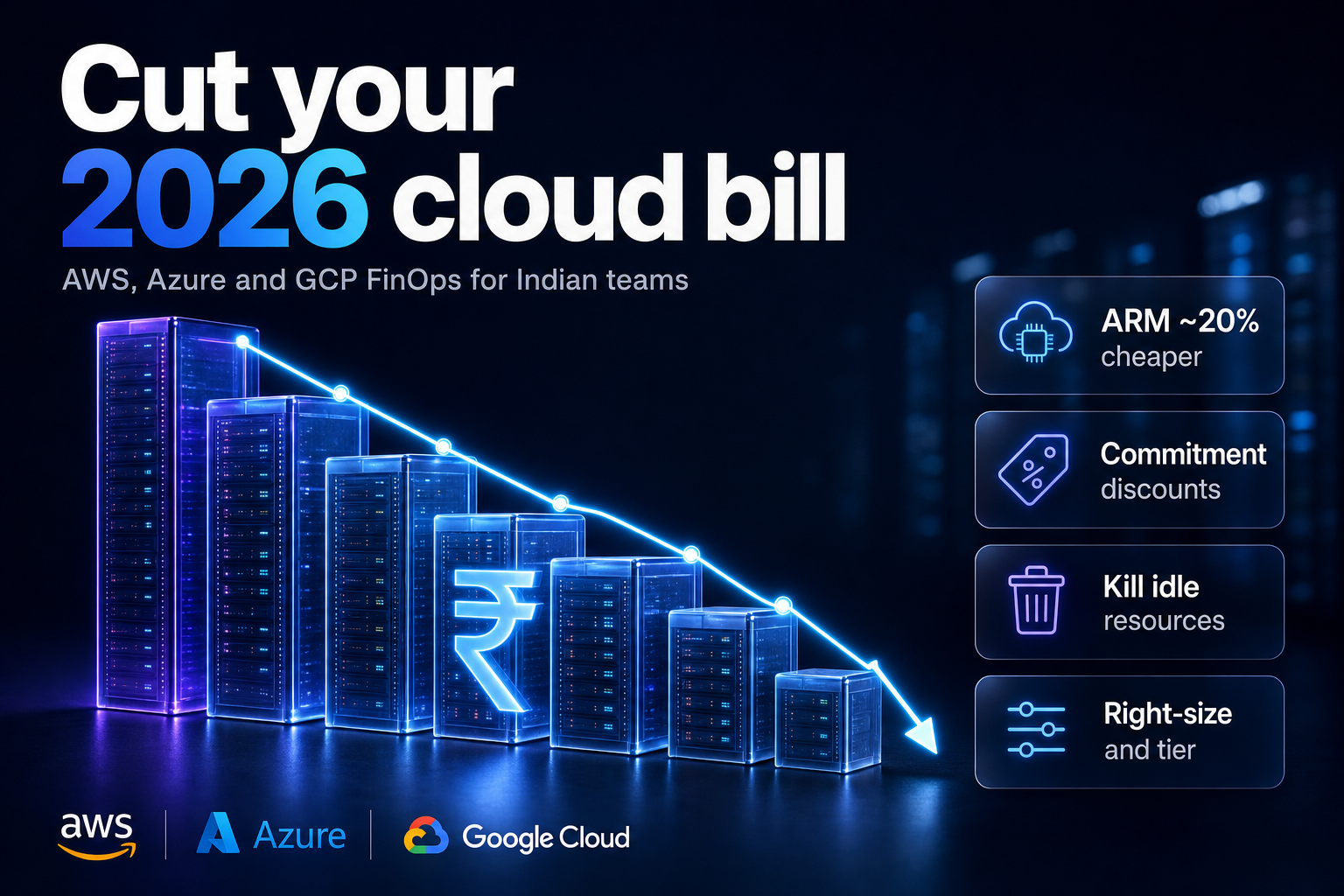
Summary. India's end-user public cloud spending is forecast to grow 28.1 percent to $17.5 billion in 2026, up from $13.7 billion in 2025, with infrastructure-as-a-service growing 40 percent, according to Gartner. At the same time, Flexera's 2026 State of the Cloud report says estimated wasted cloud spend rose to 29 percent, its first increase in five years, driven by AI workloads and new IaaS and PaaS complexity. The two numbers together are the whole FinOps case: bills are rising faster than budgets, and roughly a third of the money is wasted. This refreshed guide gives 9 levers with real 2026 discount figures. The largest are structural: AWS Spot instances run up to 90 percent below on-demand, AWS Savings Plans up to 72 percent, Azure Reserved VM Instances up to 72 percent, and Google Cloud committed use discounts around 55 percent for a 3-year commitment. Moving x86 workloads to AWS Graviton (ARM) lists up to 20 percent cheaper with up to 40 percent better price-performance. None of these need an engineering rewrite. For Indian teams the extra moves are region choice, egress discipline, and designing to the Digital Personal Data Protection Act, 2023 so a cost decision does not create a compliance problem. The order below is deliberate: commitment and instance choices first, because they cut the most for the least effort, then the operational hygiene that stops waste from creeping back.
The 2026 backdrop: spend is up, and so is waste
Gartner forecasts Indian organisations will spend $17.5 billion on public cloud in 2026, a 28.1 percent jump over 2025, with platform-as-a-service the single largest category at $6.4 billion as enterprises rebuild foundations for AI. That growth is not the problem. The problem is efficiency: Flexera's 2026 report found wasted cloud spend rose to 29 percent, reversing five straight years of decline, because AI training and inference, plus a wider mix of IaaS and PaaS services, made spend harder to track.
For an engineering leader in India, that combination means the same discipline that felt optional in 2023 is now the difference between a cloud bill that scales with revenue and one that scales with headcount. The good news is that the biggest savings come from decisions, not code. The nine levers below start with the highest-impact, lowest-effort moves.
The commitment layer: the biggest lever for the least work
The single largest structural discount is committing to a baseline of usage. Every major cloud rewards a 1-year or 3-year commitment with a steep discount over on-demand rates. The mechanics differ, but the ceilings are similar.
| Discount mechanism | AWS | Microsoft Azure | Google Cloud |
|---|---|---|---|
| Commitment discount | Savings Plans up to 72% | Reserved VM Instances up to 72%; Savings Plans up to 65% (3-yr) | Committed use discounts ~55% (3-yr) |
| Spot / preemptible | Spot up to 90% off on-demand | Spot VMs up to 90% | Spot VMs 60% to 91% |
| ARM option | Graviton, up to 20% cheaper | Cobalt (ARM) | Axion (ARM) |
| Best for | Steady baseline + interruptible batch | Steady baseline + dev/test | Steady baseline + batch |
| Commitment risk | Locked spend if usage drops | Locked spend if usage drops | Locked spend if usage drops |
The rule of thumb: commit to your steady-state floor, never your peak. A team that reserves 100 percent of a fluctuating workload trades an on-demand overspend for a commitment overspend. Measure the trailing 90-day minimum and commit to that, then let on-demand and spot absorb the variable top.
Lever 1: buy Savings Plans or reservations for your baseline
AWS Savings Plans discount steady compute up to 72 percent for a 3-year term, and Azure Reserved VM Instances reach the same up to 72 percent versus pay-as-you-go. Google Cloud committed use discounts sit around 55 percent for a 3-year commitment. If you run any workload continuously, the on-demand rate is the most expensive way to pay for it. Start here.
Lever 2: run interruptible work on spot
Spot and preemptible capacity is the deepest discount available: up to 90 percent off on-demand on AWS and Azure, and 60 to 91 percent on Google Cloud. The catch is interruption, so spot fits batch jobs, CI runners, stateless workers, and fault-tolerant data processing, not a stateful primary database. Pair spot with an on-demand or committed floor so an interruption degrades throughput rather than taking the service down.
Lever 3: move x86 workloads to ARM
AWS Graviton instances list up to 20 percent cheaper than comparable x86 EC2 instances and deliver up to 40 percent better price-performance, while using up to 60 percent less energy. Azure Cobalt and Google Axion are the equivalent ARM options. For most JVM, Go, Node.js, Python and container workloads, the migration is a rebuild and a test pass, not a rewrite. This lever stacks with commitments: buy a Savings Plan on Graviton capacity and the discounts compound.
The operational layer: stop paying for nothing
Structural discounts cut the price of what you use. The next levers cut how much you use, which is where Flexera's 29 percent waste actually lives.
Lever 4: kill idle and orphaned resources
The most common waste is capacity nobody is using: stopped instances still holding provisioned storage, unattached block volumes, idle load balancers, old snapshots, and unreleased static IP addresses. These are pure loss. A weekly sweep, or an automated policy, that flags and removes orphaned resources typically recovers a meaningful slice of the 29 percent Flexera measured.
Lever 5: right-size against real utilisation
Provisioning to a guessed peak is the second-biggest waste. Right-sizing means matching instance and database size to observed CPU, memory and I/O over a trailing window, then dropping a size, or two, where headroom is chronic. Cloud-native advisors (AWS Compute Optimizer, Azure Advisor, GCP Recommender) surface candidates; the discipline is acting on them on a schedule rather than once a year.
Lever 6: schedule non-production to business hours
Development, test and staging environments rarely need to run nights and weekends. Shutting them down outside working hours removes roughly two-thirds of their runtime, and therefore most of their cost, with a scheduler and a tag. For an Indian team serving a domestic user base, non-production can follow IST business hours with an even tighter window than a global follow-the-sun setup would allow.
Lever 7: tier and lifecycle your storage
Storage bills grow quietly. Moving infrequently accessed data to cheaper tiers, and lifecycling cold data to archival storage, cuts the per-gigabyte rate sharply. AWS S3 Intelligent-Tiering moves objects automatically based on access patterns, and lifecycle rules to archival tiers cut long-term retention cost further. The same tiering exists on Azure Blob and Google Cloud Storage. Our deep dive on cloud storage pricing across AWS S3, Azure and GCP breaks the tiers and break-even points down.
Lever 8: control data transfer and egress
Egress, data leaving a cloud or crossing regions, is a cost that does not show up until the bill arrives. Keep chatty services in the same region and availability zone, cache at the edge, and avoid unnecessary cross-region replication. Google Cloud has announced pricing changes for 2026, and egress remains one of the least-optimised lines on most bills, so it deserves a dedicated review rather than an assumption that it is small.
Lever 9: make cost visible with showback and a FinOps cadence
The levers above decay without ownership. Tagging every resource to a team or product, then showing each team its own spend (showback) or charging it back (chargeback), turns cost into a metric engineers can act on. Google Cloud made committed-use-discount sharing a default to simplify this; our note on GCP committed-use discount sharing and chargeback covers the mechanics. The FinOps practice is a monthly cadence, not a one-off audit: review the biggest movers, assign owners, and track the trend. The three metrics worth watching every month are commitment coverage (the share of eligible spend sitting on a discount), utilisation of what you committed to, and unit cost (spend per customer, per transaction, or per feature). A falling unit cost is the signal that growth is efficient rather than just large. For teams running AI workloads specifically, our guide to FinOps for AI cloud cost in India and the analysis of AWS EC2 Capacity Blocks and GPU pricing go deeper on the GPU lines that drove the 2026 waste increase, because idle reserved GPU capacity is now one of the largest single sources of the waste Flexera measured.
A worked example: stacking the levers
Take a hypothetical monthly cloud bill of $10,000 on pure on-demand compute, split as $6,000 of steady baseline and $4,000 of variable and batch load. Applying the sourced discounts in order shows why sequence matters. Move the $6,000 baseline to a 3-year Savings Plan at up to 72 percent and it costs about $1,680. Shift the batch half of the variable spend, say $2,000, to spot at up to 90 percent and it costs about $200, leaving $2,000 of genuinely bursty on-demand load. Rebuild the baseline on Graviton before you commit and the ARM list price is up to 20 percent lower again.
The stacked result turns a $10,000 on-demand bill into roughly $3,900, before a single line of application logic changes. The figures are illustrative, and your split of steady versus bursty load decides the real number, but the shape holds: commitments and instance choice do the heavy lifting, and the operational levers (killing idle, right-sizing, scheduling) protect that result from drifting back up. Chase the levers in this order, because running a right-sizing project on top of on-demand rates leaves the biggest discount, the commitment, on the table.
India-specific considerations
Three moves matter more for an India-based team. First, region choice: AWS, Azure and Google Cloud all run Indian regions (Mumbai among them), and keeping compute, storage and users in-region cuts both latency and cross-region egress. Second, data residency and DPDP: under the Digital Personal Data Protection Act, 2023, where you store and process personal data is a compliance decision, not only a cost one, so a "move it to the cheapest region" instinct has to respect residency requirements. Design applications aligned with DPDP obligations, and let residency constrain the region choice before cost does. Third, billing and currency: bills are set in US dollars and converted, so a weaker rupee raises the effective cost of a fixed-dollar commitment, which is one more argument for right-sizing the commitment to your true baseline rather than over-committing.
Given Gartner's forecast that Indian public cloud spend will grow 28.1 percent to $17.5 billion in 2026, the teams that treat FinOps as a standing engineering practice, rather than an annual cleanup, are the ones whose cloud bill will track their growth instead of outrunning it.
FAQ
How eCorpIT can help
eCorpIT is a Gurugram-based senior engineering organisation, certified for CMMI Level 5, MSME and ISO 27001:2022, that runs cloud cost optimisation and FinOps engagements for Indian and global teams across AWS, Azure and Google Cloud. We right-size workloads, model and buy the correct commitment mix, move eligible workloads to ARM, and set up tagging, showback and a monthly FinOps cadence, all while designing for Digital Personal Data Protection Act, 2023 residency requirements. If your cloud bill is growing faster than your usage, talk to our engineering team about a cost review.
References
Last updated: 27 July 2026.