On this page · 10 sections
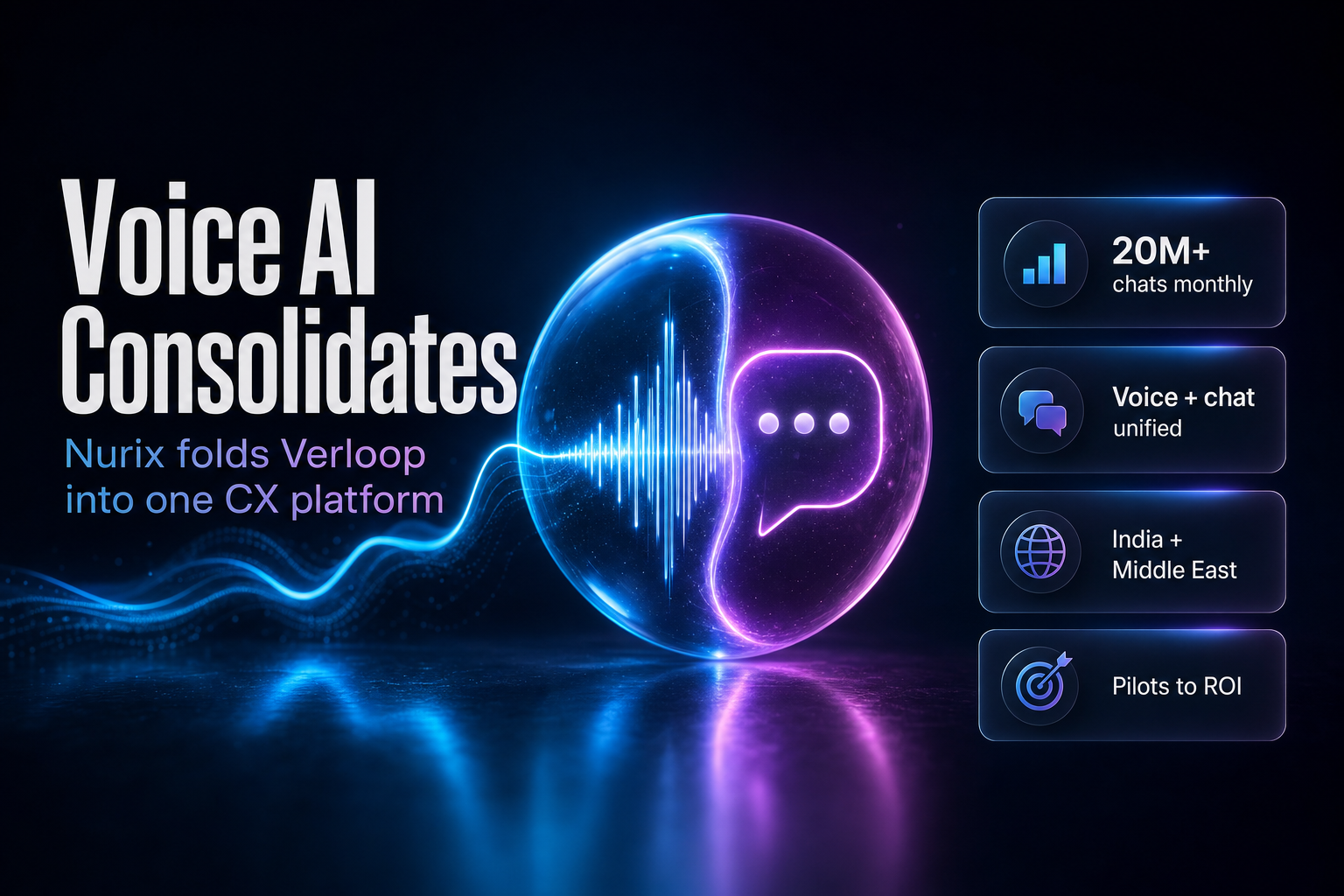
Summary. Nurix AI, the enterprise AI startup founded in 2024 by Mukesh Bansal of Myntra and Cult.fit, acquired conversational AI company Verloop.io in July 2026 to combine voice and chat agents under one platform across India and the Middle East. The deal folds Verloop.io, which powers more than 20 million customer interactions every month across banking, fintech, retail, and telecom, into Nurix's flagship voice AI product NuPlay, and brings Verloop founder Gaurav Singh onto the leadership team. Financial terms were not disclosed. It lands in a market moving fast: the global AI voice agent market was worth about $4.8 billion in the first quarter of 2026, up from $1.9 billion in 2024, and enterprises deploying voice AI report 30% to 50% cost reductions within three months. "AI is becoming a core operating layer for enterprises, but its value will be measured by real business outcomes, not pilots," said Bansal. This piece unpacks what the consolidation means for enterprise customer experience.
What the deal is
Nurix AI builds AI agents for enterprise customer service, sales, and operational workflows, with clients including super.money, Myntra, Cult.fit, and Aditya Birla Capital. Verloop.io, founded in 2015 by Gaurav Singh, automates customer conversations across banking, fintech, retail, and telecommunications, handling more than 20 million interactions a month. The acquisition adds Verloop.io's chat automation to Nurix's voice-first NuPlay platform, so a single system can carry a customer across voice and chat rather than stitching two vendors together.
Singh joins Nurix to oversee product strategy, enterprise go-to-market, and AI agent development. He framed the deployment problem in a way most CX leaders will recognise: "Over the last decade we've learned that enterprises don't struggle to understand the possibilities of AI, but they struggle to deploy it reliably at scale." That gap between demo and dependable production is the real product here.
Why voice and chat are merging
Customers do not think in channels. They start on chat, move to a call, and expect the second agent to know what the first one heard. Standalone chatbots and standalone voicebots break that continuity, and the market is consolidating to fix it. Buyers increasingly want one platform that spans voice, chat, and workflow automation instead of a stack of point tools.
| Approach | Standalone tools | Unified voice-plus-chat platform |
|---|---|---|
| Context across channels | Lost at handoff | Carried across voice and chat |
| Vendor management | Multiple contracts | One platform |
| Deployment consistency | Varies by tool | Shared agents and policies |
| Outcome measurement | Fragmented | Unified reporting |
| Best fit | Single-channel needs | End-to-end CX automation |
The Nurix move is a bet on that unified pattern, and it is not alone. Our guide to building an AI support agent for D2C covers how the same logic applies to consumer brands, and our note on AI shopping agents in agentic commerce covers the sales side of the same shift.
The market backdrop
Consolidation makes sense because the underlying market is growing fast and rewarding scale. The global AI voice agent market reached roughly $4.8 billion in the first quarter of 2026, up from $3.3 billion in 2025 and $1.9 billion in 2024, and Asia-Pacific is the fastest-growing region at about 31% year-over-year growth, led by India.
| Metric | Figure | Source context |
|---|---|---|
| AI voice agent market, Q1 2026 | ~$4.8 billion | Up from $1.9B in 2024 |
| APAC growth rate | ~31% year over year | Fastest region, led by India |
| Cost reduction after deployment | 30% to 50% | Within three months |
| CSAT increase | 25% to 40% | Within three months |
| CX interactions fully automated by 2026 | ~1 in 10 | Agentic voice AI |
Those operational numbers explain the urgency. When production voice AI can cut contact-centre cost by a third to a half and lift customer satisfaction inside a quarter, enterprises stop piloting and start standardising, and they prefer a vendor that can do voice and chat together. For India's banking, fintech, and telecom sectors, where Verloop.io already operates, that combination is directly relevant.
What it means for enterprise CX teams
The practical takeaways are concrete. First, expect fewer, broader vendors. If you run separate chat and voice tools, a unified platform can cut integration overhead and remove the handoff seams that frustrate customers, though it also concentrates risk in one supplier, so weigh lock-in against continuity. Second, judge on outcomes, not features, exactly as Bansal argues: measure resolution rate, cost per contact, and CSAT on your own traffic before and after, not the vendor's benchmark. Third, plan for voice specifically. Voice AI has harder requirements than chat around latency, accents, and languages, which matters acutely in India's multilingual market.
The honest caveats
Three cautions belong in any decision. Deal terms were undisclosed, so the strategic read matters more than the price, and integration of two products always takes longer than the announcement implies; give any newly merged platform time to prove stability. Market-size figures from research firms vary widely and should be treated as direction, not precision. And vendor-reported gains of 30% to 50% cost reduction are best cases from selected deployments, so validate on a scoped pilot against your current baseline before committing your whole contact centre.
India-specific considerations
For Indian enterprises the language dimension is decisive. Customer conversations span Hindi, English, and many regional languages, often code-mixed in a single call, so evaluate any voice platform on real vernacular accuracy rather than an English demo. Data protection is the other must: customer conversations are personal data under the Digital Personal Data Protection Act, 2023, and voice recordings in banking and fintech also sit under sector rules, so confirm data residency, consent capture, and retention before routing live calls through an AI platform. Our guide to DPDP consent and readiness covers that groundwork. Nurix and Verloop.io both already serve regulated Indian sectors, which is part of the deal's logic.
What to do now
Map your current CX channels and where context breaks between them, because those handoff seams are where a unified platform pays off first. Run a scoped pilot on one high-volume journey, measure resolution rate, cost per contact, CSAT, and vernacular accuracy against your baseline, and require clear data residency and consent terms before any live-call deployment. If the unified platform beats your point tools on outcomes, expand journey by journey rather than replacing everything at once. Keep an exit path so a single-vendor bet does not become a trap.
How eCorpIT can help
eCorpIT is a Gurugram technology consultancy, founded in 2021, that helps enterprises deploy conversational AI that holds up in production. Our senior-led teams evaluate voice and chat platforms on your own traffic, design the integration and measurement so decisions rest on resolution rate and cost per contact, and build data handling aligned with Digital Personal Data Protection Act, 2023 requirements for customer conversations. We test vernacular accuracy for India's multilingual reality before anything reaches a live line. To plan a CX automation pilot, contact us.
FAQ
References
- Nurix AI acquires Verloop.io, expanding AI agents across voice and chat — Analytics India Magazine
- Nurix AI buys Verloop.io to boost enterprise voice and chat AI — APAC News Network
- Nurix AI acquires Verloop to expand enterprise voice and conversational AI — CXO Digitalpulse
- Top enterprise AI voice agent vendors 2026 — Retell AI
- Best AI voice agent companies in India 2026 — SquadStack
- Voice AI trends 2026: enterprise adoption and ROI — NextLevel AI
_Last updated: July 14, 2026._