On this page · 12 sections
- The 2026 B2B reality in Delhi NCR
- Play 1: build content, SEO, and GEO as the foundation
- Play 2: win AI search, because your buyer is asking an LLM
- Play 3: use LinkedIn for precise demand, not vanity reach
- Play 4: run Google Ads to capture existing intent
- Play 5: build a signal-based ABM motion
- Play 6: measure acquisition cost and payback, not leads
- A 90-day rollout for a Gurugram team
- Common mistakes to avoid
- How eCorpIT can help
- FAQ
- References
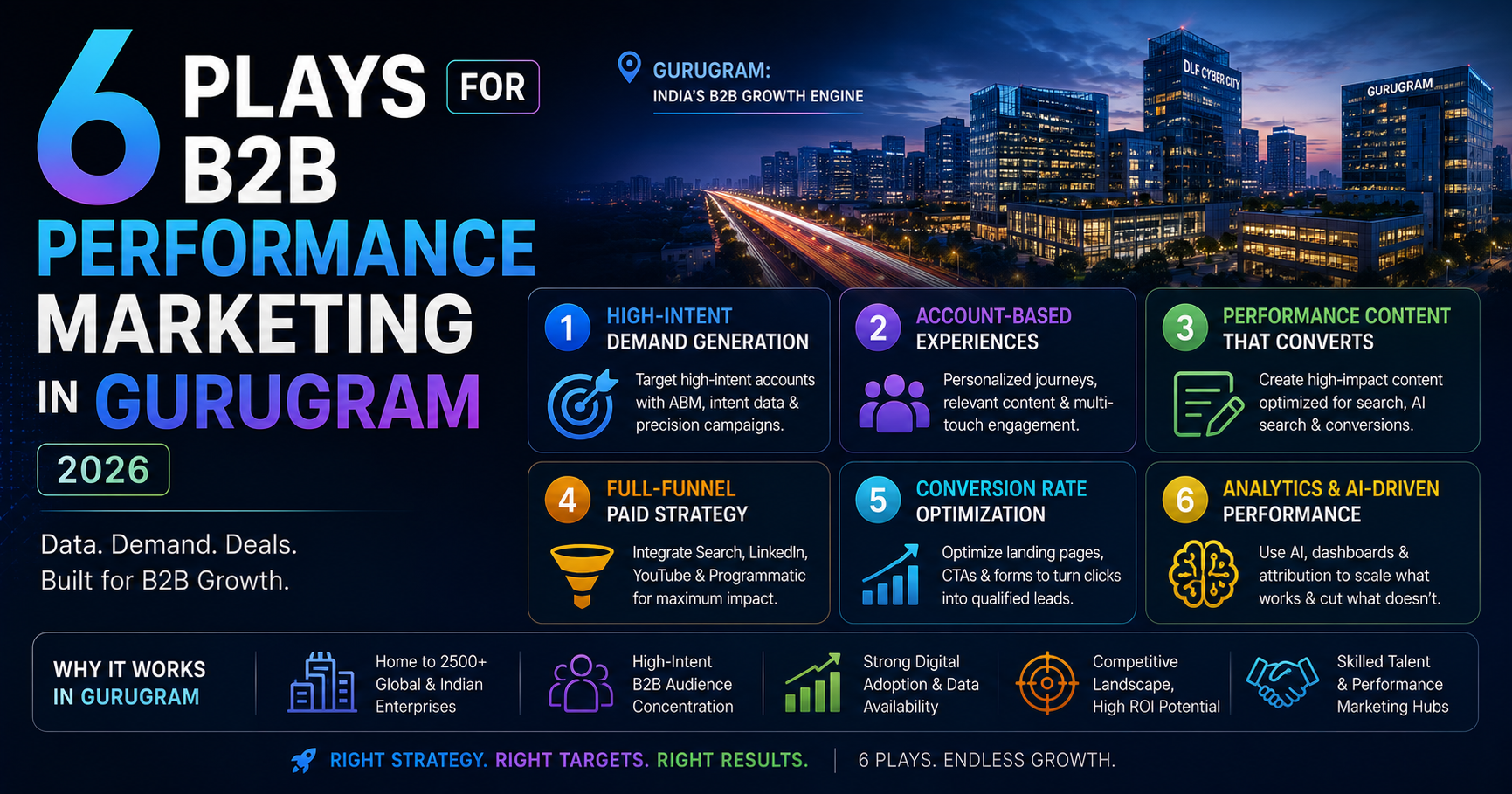
Summary. B2B performance marketing in Gurugram and Delhi NCR changed shape in 2026, and the old playbook of buying clicks and counting leads no longer pays back. The economics are unforgiving: outbound customer acquisition cost in India runs about Rs 2-4 lakh and only works when annual contract value clears roughly Rs 8 lakh. Buyers behave differently too. Roughly 70% of B2B buying research is done before anyone speaks to sales, 94% of buyers now use AI tools like ChatGPT in the decision process, and LinkedIn, with more than 110 million Indian professionals, drives about 80% of B2B social leads. Account-based programs return 2.6 times more pipeline per rupee than broad demand generation, with 41% higher win rates. Against that, a typical Google Ads lead costs around $70 and median payback sits near 6.8 months. This refreshed playbook gives NCR B2B teams six plays that fit those numbers: build content and AI-search visibility first, use paid channels for intent, run signal-based ABM, and measure acquisition cost and payback rather than raw lead volume.
The 2026 B2B reality in Delhi NCR
Two shifts matter most for a Gurugram B2B team. First, the buyer is self-educating. With around 70% of the buying journey complete before a sales conversation, the brands that show up in research, through content, search, and peer validation, are on the shortlist before a rep makes contact. B2B content consumption in India has grown more than 45% since 2022, and decision-makers actively seek thought leadership, detailed case studies, and proof.
Second, AI search is now part of that research. Indian B2B buyers ask large language models for vendor recommendations, and being absent from those answers means being absent from the shortlist. LinkedIn, for instance, generates close to 170,000 monthly citations across engines like Google's AI Overviews and ChatGPT, which is why visibility in AI answers, not just blue links, is now a performance channel. Ty Heath, global director of thought leadership GTM strategy at LinkedIn and co-founder of The B2B Institute, frames the modern challenge as buyability: making it easy for a buyer to choose and act, not just generating awareness.
The channels available to you have not changed much, but their roles have. The table sets the economics that drive the plays below.
| Channel | Relative acquisition cost | Lead time to results | Best for |
|---|---|---|---|
| Content, SEO, and GEO | Lowest per customer | 6 to 12 months | Compounding pipeline and AI-search visibility |
| LinkedIn ads | High CPM, high quality | Weeks | Precise targeting of NCR decision-makers |
| Google Ads | Around $70 per lead | Days | Capturing existing high-intent demand |
| Signal-based ABM | Efficient on target accounts | 1 to 3 months | Named-account pipeline and larger deals |
| Referral and partner | Lowest CAC overall | Ongoing | Trusted, fast-closing introductions |
Play 1: build content, SEO, and GEO as the foundation
Content, SEO, and what the industry now calls GEO, generative engine optimization, are the cheapest channels per customer in India, and they compound. The trade is patience: they take 6 to 12 months to produce real pipeline, which is exactly why teams under pressure skip them and then overpay for ads forever. Start here anyway, because every other play gets cheaper when buyers already know you from their own research.
The practical brief is to publish authoritative, specific content that answers the questions your buyers ask before they talk to sales: comparison pieces, dated benchmarks, implementation guides, and real case detail. This is the same work that earns search rankings and AI citations, so a single strong asset can serve Google, an AI Overview, and a sales rep at once. eCorpIT's approach to ranking and AI-citation visibility is laid out in the AEO, GEO, and SEO complete guide.
Play 2: win AI search, because your buyer is asking an LLM
GEO deserves its own play because the behavior is now mainstream: 94% of B2B buyers use large language models somewhere in the decision process. If a buyer asks an AI tool to shortlist vendors for a problem you solve and you are not named, you lost the deal before it started, silently. Traditional SEO gets you ranked; GEO gets you cited in the answer itself.
The work is concrete. Publish structured, factual, well-sourced content that models can lift, keep your entity consistent across the web, and earn mentions on the domains LLMs cite most, including LinkedIn. Track whether your brand appears in AI answers for your category the way you track keyword rankings. We cover the citation data behind this shift in ranking versus AI Overview citations. For a Gurugram firm selling to Indian and global buyers, AI-answer visibility is now as material as page-one rankings were a decade ago.
A simple way to start is to ask the major AI tools the questions your buyers ask, today, and record whether your brand appears and how it is described. That becomes your GEO baseline. From there, the levers are the same ones that build trust with people: accurate, structured, frequently updated content; consistent company information across the web so models resolve your entity correctly; third-party mentions and reviews on sources the models trust; and clear, factual answers to the comparison and how-to questions buyers ask. GEO is less a new discipline than SEO judged by whether an AI cites you, rather than whether a person clicks a link.
Play 3: use LinkedIn for precise demand, not vanity reach
LinkedIn is the primary B2B arena in India, with over 110 million professionals and roughly 80% of B2B social leads, but it punishes broad spending. CPMs to Indian decision-makers run higher than many expect, because the senior audience pool is smaller and crowded with advertisers. Treating LinkedIn as a reach channel burns budget; treating it as a precision channel earns pipeline.
Use tight targeting by title, company, and industry, pair paid promotion with consistent organic thought leadership from named people at your firm, and send traffic to specific, proof-heavy pages rather than a generic homepage. LinkedIn wins on quality metrics like targeting precision and return on ad spend, so judge it on pipeline and closed revenue, not impressions or cost per click. For an NCR team, the senior buyers you want are reachable here in a way no other channel matches, but only if you spend narrowly.
Play 4: run Google Ads to capture existing intent
Google Ads is the demand-capture counterpart to LinkedIn's demand-creation. When someone searches for the category you sell, they have intent now, and paid search puts you in front of it predictably. The cost is rising, with a typical B2B lead around $70 and climbing, so the discipline is to bid on high-intent, bottom-of-funnel terms and let content own the cheaper top-of-funnel queries.
Google wins on volume metrics, click-through rate, conversion rate, and cost per lead, while LinkedIn wins on quality. The combination is the point: Google captures the buyers already looking, LinkedIn and content create the demand that sends them looking. Send paid-search clicks to pages that match the query exactly, with a clear next step, because a high-intent click wasted on a vague landing page is the most expensive mistake in the channel.
Play 5: build a signal-based ABM motion
Account-based marketing is no longer an enterprise luxury in India. Tools like Clay, Apollo, and 6sense have brought it within reach of mid-market teams, and the returns justify the focus: ABM-led programs generate about 2.6 times more pipeline per marketing rupee than broad demand generation, with 41% higher win rates and 33% larger average deal sizes. For a Gurugram firm with a defined set of target accounts, this is usually the highest-return play.
The motion combines first-party signals, your CRM activity, website behavior, and email engagement, with third-party intent data such as job changes, funding announcements, and ad engagement, unified in one CRM with account scoring. Marketing and sales work the same prioritized account list, with content and ads tailored to each account's stage. The result is fewer, better-aimed touches on accounts that can actually close, which is what makes the per-rupee economics work.
For enterprise ABM campaigns, platforms like Folloze can help create highly personalized buyer experiences tailored to specific target accounts, industries, buying stages, and individual stakeholders within the buying committee. Rather than sending every prospect to the same generic landing page, marketers can create dynamic account-specific content experiences that bring together relevant case studies, industry reports, product demonstrations, customer success stories, videos, ROI calculators, whitepapers, webinars, and personalized calls to action based on each account's unique challenges and priorities. These experiences adapt to the visitor's profile and engagement history, ensuring that every interaction is relevant to where the buyer is in the decision-making process.
Beyond improving engagement, these personalized content journeys generate rich first-party intent data that strengthens both marketing and sales execution. Every interaction, including pages viewed, content downloaded, videos watched, assets shared internally, repeat visits, time spent, and return frequency, provides valuable buying signals that can be synchronized with CRM and marketing automation platforms. Combined with account scoring from tools such as Clay, Apollo, and 6sense, these insights help sales teams identify buying committee members, understand the topics attracting the most interest, prioritize high-intent accounts, personalize outreach, and engage prospects at the right moment. The outcome is shorter sales cycles, higher conversion rates, stronger sales and marketing alignment, and significantly improved ROI from enterprise ABM programs.
Play 6: measure acquisition cost and payback, not leads
The play that ties the rest together is measurement. Counting leads rewards volume and hides waste; measuring acquisition cost, payback, and lifetime-value-to-CAC ratio rewards pipeline that closes. In India the math is specific: outbound CAC of Rs 2-4 lakh only pencils out when ACV clears about Rs 8 lakh, so a channel that produces cheap leads on small deals can still lose money.
Hold every channel to the same three numbers: customer acquisition cost, payback period, and LTV to CAC. Median SaaS payback runs near 6.8 months and a healthy range is 6 to 12, while a sustainable LTV-to-CAC sits above 3 to 1. Indian B2B CAC is 40 to 60% lower than US peers in rupee terms, but ACVs are lower by a similar margin, so the ratios matter more than the absolute numbers. Report pipeline and revenue by channel, not lead counts, and move budget toward whatever pays back fastest.
A concrete example makes the discipline real. Suppose Google Ads produces leads at a low cost per lead, but those leads close small deals with a 14-month payback, while ABM produces fewer leads at a higher cost that close larger deals paying back in 5 months. A lead-counting dashboard would favor Google and starve ABM; a payback dashboard would do the opposite and grow faster. The numbers, not the channel's reputation, decide. Run this comparison every quarter, because channel economics drift as costs rise and your offer matures, and the channel that paid back fastest last year may not this year.
| Play | Primary metric | Owner |
|---|---|---|
| 1. Content, SEO, GEO | Organic pipeline and AI citations | Content and SEO |
| 2. Win AI search | Share of AI answers in category | SEO and GEO |
| 3. LinkedIn precision | Pipeline and ROAS, not impressions | Demand gen |
| 4. Google intent capture | Cost per qualified lead | Paid media |
| 5. Signal-based ABM | Pipeline per target account | Marketing and sales |
| 6. Measure CAC and payback | CAC, payback, LTV to CAC | Revenue leadership |
A 90-day rollout for a Gurugram team
You cannot run all six plays at once, so sequence them. In the first 30 days, fix measurement and foundations: set up customer acquisition cost, payback, and LTV-to-CAC tracking by channel, audit your site for search and AI-citation readiness, and define your target-account list. Without the numbers in place, you cannot tell which later play is working.
In days 30 to 60, turn on demand capture and start the compounding work. Launch Google Ads on a tight set of high-intent, bottom-of-funnel terms so you capture existing demand while the slower channels build, and begin publishing the content that feeds SEO, GEO, and sales at once. Stand up the ABM tooling and unify first-party and intent signals in your CRM.
In days 60 to 90, layer in LinkedIn precision targeting against your account list and named thought leadership, then review the channel economics you have started collecting. By day 90 you should be able to say which channel pays back fastest and shift budget toward it, which is the entire point of a performance approach.
Common mistakes to avoid
A few patterns waste budget repeatedly in NCR B2B. The first is treating LinkedIn as a reach channel and paying premium CPMs for impressions that never convert, when its value is precision. The second is judging content by traffic instead of pipeline, then cutting it after a quarter because it has not paid back in a window that always takes 6 to 12 months. The third is buying cheap leads on small deals where a Rs 2-4 lakh acquisition cost can never be recovered against a sub-Rs 8 lakh contract, which is a math problem no amount of optimization fixes. The fourth, increasingly costly, is ignoring AI search and assuming page-one rankings are enough while 94% of buyers consult an LLM that may never mention you. The common thread is measuring the wrong thing: activity instead of acquisition cost, leads instead of pipeline, clicks instead of closed revenue.
India and NCR-specific considerations
A few local realities shape how these plays run in Delhi NCR. India has more than 63 million MSMEs, so the addressable base is large but price-sensitive, and the ACV-to-CAC math above should gate which segments you pursue with paid channels versus content. Data rules also apply directly to performance marketing: the Digital Personal Data Protection Act, 2023 governs how you collect and use lead data, consent for marketing communications, and handling of personal information in your CRM, so build consent into forms and nurture flows from the start rather than retrofitting it. Our DPDP consent-manager readiness guide covers the compliance mechanics. For NCR firms selling globally, run the same plays but segment economics by region, since US and European ACVs and CACs differ sharply from Indian ones.
How eCorpIT can help
eCorpIT (eCorp Information Technologies Private Limited) is a senior-led technology consultancy in Gurugram, founded in 2021 and assessed at CMMI Level 5. As an NCR firm, we help B2B teams build the technical foundation these plays depend on: fast, search-and-AI-optimized websites, content and GEO infrastructure, CRM and ABM tooling, analytics that report CAC and payback, and DPDP-aligned consent and data handling. We design and instrument marketing systems aligned with privacy requirements rather than claiming certifications we do not hold. To refresh your B2B performance-marketing stack for 2026, contact our team.
FAQ
References
Last updated: June 29, 2026.