On this page · 11 sections
- The three constraints that shape startup mobile
- The startup MVP playbook
- The features to defer in your MVP
- What an $8K–$25K startup MVP actually delivers
- When startups should not pick the cheapest option
- Founder time math
- The right vendor profile for a startup MVP
- Frequently asked questions
- A short closing note
- Further reading
- References
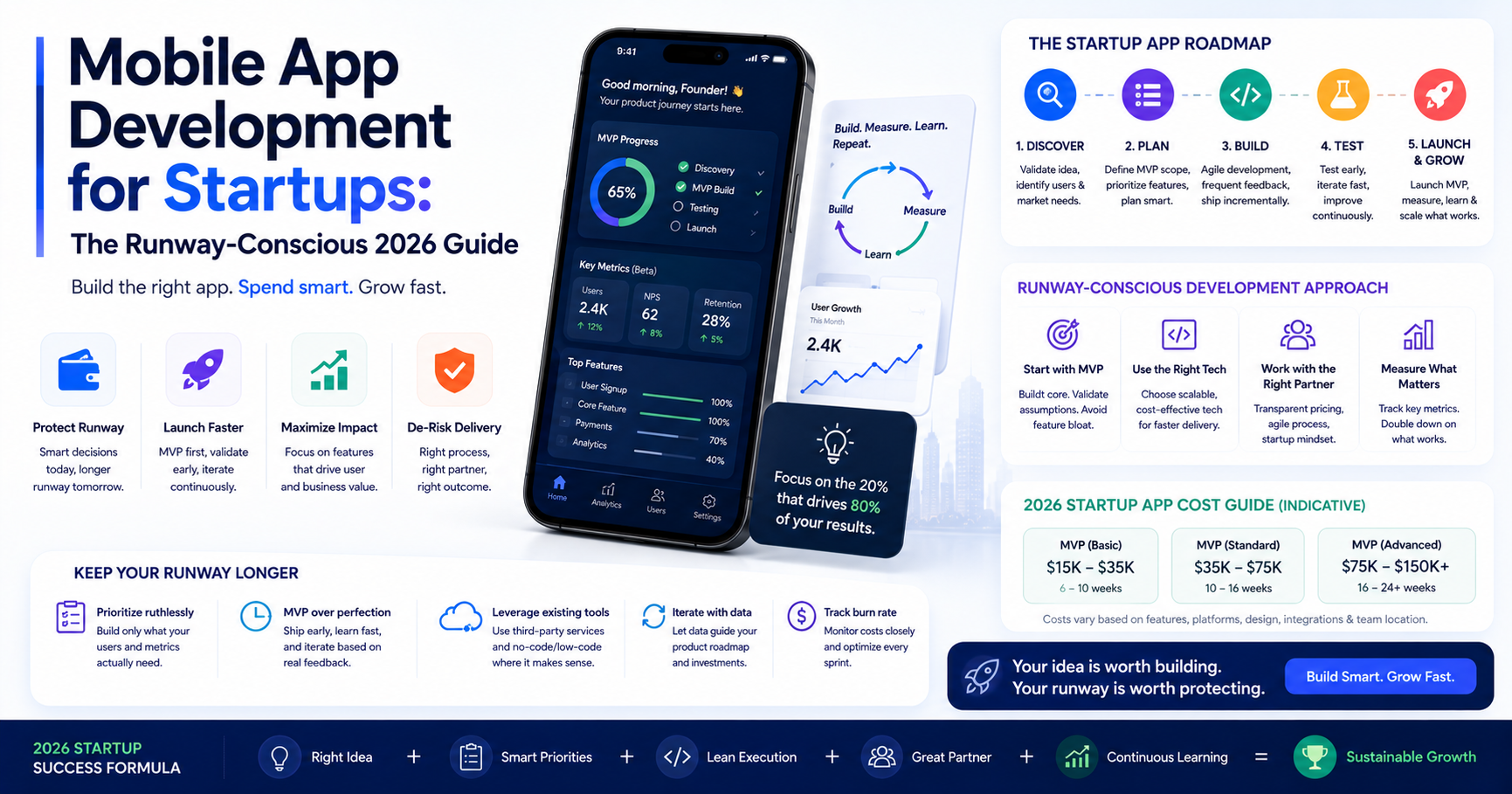
Summary. Startups have three constraints that shape mobile app development differently from enterprise builds: runway is finite, founder time is the binding constraint, and the product is not yet validated. The right startup mobile playbook is MVP-first ($8K–$25K), cross-platform default (Flutter or React Native), 6–10 week ship cycle, defer everything not core to validation, and choose a vendor with senior-only delivery and founder accountability. This guide gives you the runway-conscious decision framework.
Talk to eCorpIT about your startup build · Open the cost calculator
The three constraints that shape startup mobile
Every startup mobile decision should be evaluated against three constraints.
Runway is finite. Most pre-seed and seed-stage startups have 12–18 months of runway. Mobile development eats meaningful runway. A $25K MVP at seed stage may be 5–10% of total cash. The build has to be cheap enough to leave runway for marketing, customer acquisition, and the next pivot.
Founder time is the binding constraint. Founders cannot spend 20 hours/week managing the development team. Engagement models that need heavy founder management (Hourly with weekly scope reviews) cost the startup more in founder-time than they save in dollars.
The product is not yet validated. The mobile build is a hypothesis test, not a final product. Over-scoping is the standard mistake. The right MVP ships fast, learns fast, and rebuilds fast.
These three constraints push startups toward: small MVP scope, fast-shipping cross-platform stack, fixed-price engagement with limited founder-management overhead, and a vendor with senior-only delivery so the first build is production-quality.
The startup MVP playbook
A practical sequence for first-time mobile founders.
Step 1: Scope the smallest version that proves your hypothesis. What is the one user behavior that has to work for the startup to make sense? Build the smallest app that lets a real user complete that behavior. Everything else defers.
Step 2: Pick cross-platform unless you have a specific reason not to. Flutter or React Native for most startups. Single codebase, both stores, one engineering team. Native iOS or Android only if your audience is overwhelmingly one platform or you have a deep platform-feature dependency.
Step 3: Pick a fixed-price engagement. Predictable cost matters more than flexibility at MVP stage. The fixed-price model starting at $8K cross-platform locks scope, timeline, and budget at signature.
Step 4: Pick a senior-only vendor with founder accountability. Junior-backfill volume vendors produce MVPs that need to be rewritten. Senior-only delivery costs more per hour but produces production-quality code from day one.
Step 5: Ship in 6–10 weeks. Faster than 6 weeks is usually scope-cut, not engineering. Slower than 10 weeks is scope-creep, not difficulty. The 6–10 week window is the validation-cycle sweet spot.
Step 6: Validate before adding features. Most founders add features pre-validation. The right move is to ship the MVP, watch users use it, learn what they actually need, then add features that match the learnings.
The features to defer in your MVP
Six common features that startups over-include in MVPs.
Multi-language localisation. Ship in your primary language first. Add localisation after validation. Localisation is 15–25% of base build cost; defer until the market is proven.
Multiple auth methods. Ship with email-and-password or social-login-one-provider. Add Apple Sign-In, Google, phone OTP, magic links later. Each adds 3–8 hours of engineering plus QA time.
Admin dashboard or back-office. Ship the mobile app first. Use Firebase Console or a CRM for early user management. Build the admin only when manual operations become genuinely unsustainable.
Multi-region or multi-tenancy support. Single region, single tenant at MVP. Multi-region adds infrastructure complexity and 10–20% to base build cost. Defer until proven.
Heavy AI/LLM features. A simple ChatGPT API integration is fine. Custom AI models, RAG architectures, fine-tuned LLMs add 15–40% to base build cost. Defer until validation justifies the spend.
Comprehensive analytics dashboards. Ship Crashlytics for stability tracking, GA4 for basic usage. Defer Mixpanel, Amplitude, custom dashboards until you have enough users for data to matter.
The MVP's job is to test the hypothesis. Features added before validation usually get rebuilt or removed post-validation. Defer aggressively.
What an $8K–$25K startup MVP actually delivers
The honest range, by price point.
$8K–$12K cross-platform MVP. Single platform-pair (Flutter or React Native). 5–7 screens. Email auth. Simple backend on Firebase or Supabase. Standard design. Push notifications. App Store and Play Store submission. 6-week build.
$15K–$20K standard startup MVP. Cross-platform. 8–12 screens. Email plus social login. Custom Node/Python backend. Stripe or Razorpay payments. Push notifications. Custom design. App Store and Play Store submission. 8-week build.
$25K extended startup MVP. Cross-platform. 12–15 screens. Auth, payments, push, real-time updates or offline-first sync. Custom backend with simple admin dashboard. Custom design. Accessibility audit. App Store and Play Store submission. 10-week build.
Through eCorpIT, all three ranges include design, project management, QA, code review, store submission, weekly demos, and 30 days of post-launch support. Apple Developer Program ($99/year) and Google Play Console ($25 one-time) are separate.
When startups should not pick the cheapest option
Three situations where saving $5K–$10K on the MVP costs more downstream.
Junior-backfill vendor producing prototype-quality code. The MVP "works" but the architecture cannot support the next 10 features. The eventual rewrite costs 60–80% of the original budget.
No-code platforms when scale is coming. Adalo, Glide, Bubble work for the validation phase. They do not scale past about 10K MAU. The rewrite from no-code to custom is essentially a green-field build.
Skipping QA and accessibility. Apps that ship without basic QA discipline produce angry users, low App Store ratings, and high refund rates. The downstream support cost exceeds the QA cost.
The startup math favours spending $15K–$25K on a senior-only build over spending $8K on a build that needs a $20K rewrite within six months.
Founder time math
The hidden cost most founders underestimate.
A typical MVP build with heavy founder involvement consumes 4–8 hours of founder time per week over 8 weeks: review meetings, design feedback, scope decisions, demo attendance. That is 32–64 hours of founder time per MVP.
Founder time during the build is time not spent on customer development, fundraising, or product validation — the activities that determine whether the startup survives.
The right engagement model minimises founder-management overhead.
Fixed-price engagement with senior-only delivery. Founder attends the discovery call (60 minutes), reviews the strategy doc (1 hour), interviews engineers (90 minutes), attends kick-off (60 minutes), attends weekly demos (30 minutes × 8 weeks = 240 minutes), reviews final delivery (90 minutes). Total: about 9 hours over 8 weeks. Comfortable.
Time-and-Materials engagement with junior team. Founder attends weekly scope reviews (90 minutes), reviews design every sprint (60 minutes), responds to clarifying questions async (60 minutes/week), attends demos (30 minutes). Total: about 28 hours over 8 weeks. Heavy.
The founder-time difference (19 hours over 8 weeks) is itself worth more than the typical $5K–$8K price difference between models.
The right vendor profile for a startup MVP
Six criteria specifically tuned for startup builds.
1. Senior-only delivery. No junior backfill. The CV you interview is the engineer who ships.
2. Founder access. The vendor's founder or senior leader joins your discovery call and reviews the work. For startups, founder-to-founder communication matters.
3. Fixed-price engagement option. Scope, timeline, budget locked at signature. Predictability matters more than flexibility for MVPs.
4. Cross-platform default. Flutter or React Native unless you have a specific native requirement.
5. Fast onboarding. 14 days from NDA to first demo. Startups cannot wait 6 weeks for procurement-style onboarding.
6. 30 days post-launch support included. Bug fixes and minor adjustments for the first month after launch are bundled, not billed separately.
eCorpIT covers all six. Most volume India-export vendors do not (no founder access, junior backfill common). Most US agencies do not (no fixed-price MVPs, no 30-day support included). The intersection of these six criteria is what makes a vendor the right fit for a startup.
Frequently asked questions
A short closing note
Startup mobile in 2026 is a runway-conscious discipline. The MVP-first economics, cross-platform default, fixed-price engagement, and senior-only delivery are the playbook that has worked across hundreds of startup builds. The $8K–$25K range hits the sweet spot for validation; deferring features pre-validation preserves runway for the actual product.
If you want a senior read on the right MVP for your specific startup, that is what we do on the discovery call. Manu joins every startup discovery call personally.
Further reading
References
Page last reviewed by Manu Shukla, Founder, eCorpIT, on 30 May 2026. Next review: August 2026.